International Journal of Trend in Scientific Research and Development (IJTSRD)
Volume 3 Issue 5, August 2019 Available Online: www.ijtsrd.com e-ISSN: 2456 – 6470
@ IJTSRD | Unique Paper ID – IJTSRD27821 | Volume – 3 | Issue – 5 | July - August 2019 Page 2058
Design and Performance Analysis of Power Factor Controller
Soe Winn, Lwin Lwin Mar, Hnin Thiri Soe
Department of Electrical Power Engineering, Pyay Technological University, Pyay, Myanmar
How to cite this paper: Soe Winn | Lwin
Lwin Mar | Hnin Thiri Soe "Design and
Performance Analysis of Power Factor
Controller" Published in International
Journal of Trend in
Scientific Research
and Development
(ijtsrd), ISSN: 2456-
6470, Volume-3 |
Issue-5, August
2019, pp.2058-
2061,
https://doi.org/10.31142/ijtsrd27821
Copyright © 2019 by author(s) and
International Journal ofTrend inScientific
Research and Development Journal. This
is an Open Access article distributed
under the terms of
the Creative
Commons Attribution
License (CC BY 4.0)
(http://creativecommons.org/licenses/by
/4.0)
ABSTRACT
Demand of electrical energy is increasing day by day and power quality is one
of the buzzword nowadaysinMyanmar.Customerawareness ofpowerquality,
elecctronics load sensitivity and automation of industrialsarepushinghardto
improve power quality as never before. Power factor improvement is one of
the common ways to improve the quality of power in effective way.
Researching power factor controller enhance the deployment of voltage
sensing technique with potential transformer, current sensingtechnique with
current transformer, zero crossing detection of voltage and current signals,
zener voltage regulation, PIC microcontroller based control system and relay
driver system. Voltage and current were sensed by potential and current
transformers to evaluate the deviation ofvoltageandcurrentsingals withzero
crossing detection circuits respectively. Microcontroller is fed voltage and
current singals to determine the quality of power system and implement the
relays to keep the power factor as high as possible by switching capacitors to
improve power factor of the system.
KEYWORDS: potential transformer, current transformer, zero crossing detector,
power factor controller
I. INTRODUCTION
Power factor of an AC electrical power system is expressed as the ratio of the
real power, P flowing to the load to the apparent power, S in the cirucit. On the
other hand, power factor is the relationship of current and voltage of AC
distribution system.
Theorectically, unity power factor voltage and current are
inphase, low power factor called lagging, is caused by
inductive load and high power factor calledleadingis caused
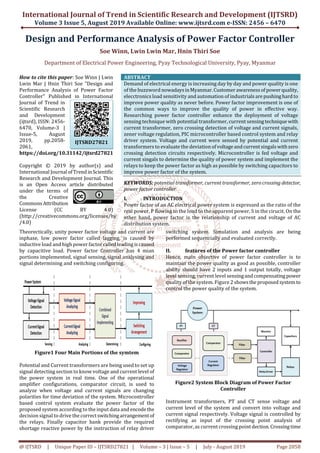
by capacitive load. Power factor Controller has 4 mian
portions implemented, signal sensing, signal analysing and
signal determining and switching configuring.
Figure1 Four Main Portions of the symtem
Potential and Current transformers are being used to set up
signal detecting section to know voltage and current level of
the power system in real time. One of the operational
amplifier configurations, comparator circuit, is used to
analyze when voltage and current signals are changing
polarities for time deviation of the system. Microcontroller
based control system evaluate the power factor of the
proposed system according to the input data and encodethe
decision signal to drive the correctswitchingarrangementof
the relays. Finally capacitor bank provide the required
shortage reactive power by the instruction of relay driver
switching system. Simulation and analysis are being
performed sequencially and evaluated correctly.
II. features of the Power factor controller
Hence, main objective of power factor controller is to
maintain the power quality as good as possible, controller
ability should have 2 inputs and 1 output totally, voltage
level sensing, current level sensingandcompensating power
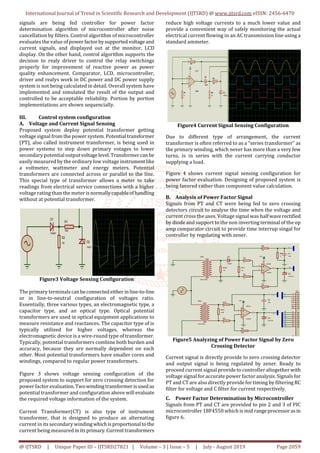
quality of the system. Figure 2 showstheproposedsystemto
control the power quality of the system.
Figure2 System Block Diagram of Power Factor
Controller
Instrument transformers, PT and CT sense voltage and
current level of the system and convert into voltage and
current signal respectively. Voltage signal is controlled by
rectifying as input of the crossing point analysis of
comparator, as current crossing point dection.Crossingtime
IJTSRD27821
International Journal of Trend in Scientific Research and Development (IJTSRD) @ www.ijtsrd.com eISSN: 2456-6470
@ IJTSRD | Unique Paper ID – IJTSRD27821 | Volume – 3 | Issue – 5 | July - August 2019 Page 2059
signals are being fed controller for power factor
determination algorithm of microcontroller after noise
cancellation by filters. Control algorithm of microcontroller
evaluates the value of power factorbysupportedvoltageand
current signals, and displayed out at the monitor, LCD
display. On the other hand, control algorithm supports the
decision to realy driver to control the relay switchings
properly for improvement of reactive power as power
quality enhancement. Comparator, LCD, microcontroller,
driver and realys work in DC power and DC power supply
system is not being calculated in detail. Overall system have
implemented and simulated the result of the output and
controlled to be acceptable reliability. Portion by portion
implementations are shown sequencially.
III. Control system configuration
A. Voltage and Current Signal Sensing
Proposed system deploy potential transformer getting
voltage signal from the power system. Potential transformer
(PT), also called instrument transformer, is being used in
power systems to step down primary votages to lower
secondary potentialoutputvoltagelevel.Transformercanbe
easily measured by the ordinary low voltage instrumentlike
a voltmeter, wattmeter and energy meters. Potential
transformers are connected across or parallel to the line.
This special type of transformer allows a meter to take
readings from electrical service connections with a higher
voltage rating than the meter is normally capableofhandling
without at potential transformer.
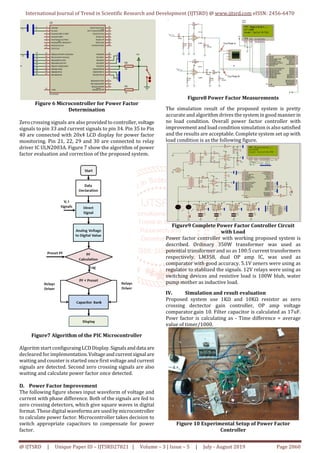
Figure3 Voltage Sensing Configuration
The primary terminals canbeconnected eitherinline-to-line
or in line-to-neutral configuration of voltages ratio.
Essentially, three various types, an electromagnetic type, a
capacitor type, and an optical type. Optical potential
transformers are used in optical equipment applications to
measure resistance and reactances. The capacitor type of is
typically utilized for higher voltages, whereas the
electromagnetic device is a wire-round type of transformer.
Typically, potential transformers combine both burden and
accuracy, because they are normally dependent on each
other. Most potential transformers have smaller cores and
windings, compared to regular power transformers.
Figure 3 shows voltage sensing configuration of the
proposed system to support for zero crossing detection for
power factor evaluation.Twowinding transformerisusedas
potential transformer and configuration above will evaluate
the required voltage information of the system.
Current Transformer(CT) is also type of instrument
transformer, that is designed to produce an alternating
current in its secondary windingwhichis proportionaltothe
current being measured inits primary.Currenttransformers
reduce high voltage currents to a much lower value and
provide a convenient way of safely monitoring the actual
electrical current flowing in an AC transmission line using a
standard ammeter.
Figure4 Current Signal Sensing Configuration
Due to different type of arrangement, the current
transformer is often referred to as a “series transformer” as
the primary winding, which never has more than a very few
turns, is in series with the current carrying conductor
supplying a load.
Figure 4 shows current signal sensing configuration for
power factor evaluation. Designing of proposed system is
being favored rather than component value calculation.
B. Analysis of Power Factor Signal
Signals from PT and CT were being fed to zero crossing
detectors circuit to analyse the time when the voltage and
current cross the axes. Voltage signal was halfwaverectified
by diode and support to the non inverting terminal of the op
amp comparator circuit to provide time interrup singal for
controller by regulating with zener.
Figure5 Analyzing of Power Factor Signal by Zero
Crossing Detector
Current signal is directly provide to zero crossing detector
and output signal is being regulated by zener. Ready to
proceed current signal provide to controller altogetherwith
voltage signal for accurate power factor analysis. Signals for
PT and CT are also directly provide for timing by filtering RC
filter for voltage and C filter for current respectively.
C. Power Factor Determination by Microcontroller
Signals from PT and CT are provided to pin 2 and 3 of PIC
microcontroller 18F4550 which is mid rangeprocessoras in
figure 6.
International Journal of Trend in Scientific Research and Development (IJTSRD) @ www.ijtsrd.com eISSN: 2456-6470
@ IJTSRD | Unique Paper ID – IJTSRD27821 | Volume – 3 | Issue – 5 | July - August 2019 Page 2060
Figure 6 Microcontroller for Power Factor
Determination
Zero crossing signals are also provided to controller,voltage
signals to pin 33 and current signals to pin 34. Pin 35 to Pin
40 are connected with 20x4 LCD display for power factor
monitoring. Pin 21, 22, 29 and 30 are connected to relay
driver IC ULN2003A. Figure 7 show the algorithm of power
factor evaluation and correction of the proposed system.
Figure7 Algorithm of the PIC Microcontroller
Algoritm start configuraingLCDDisplay.Signals anddata are
decleared for implementation.Voltageandcurrentsignal are
waiting and counter is started once first voltage and current
signals are detected. Second zero crossing signals are also
waiting and calculate power factor once detected.
D. Power Factor Improvement
The following figure shows input waveform of voltage and
current with phase difference. Both of the signals are fed to
zero crossing detectors, which give square waves in digital
format. These digital waveforms areusedbymicrocontroller
to calculate power factor. Microcontroller takes decision to
switch appropriate capacitors to compensate for power
factor.
Figure8 Power Factor Measurements
The simulation result of the proposed system is pretty
accurate and algorithm drives the system in good manner in
no load condition. Overall power factor controller with
improvement and load condition simulation is also satisfied
and the results are acceptable. Complete system set up with
load condition is as the following figure.
Figure9 Complete Power Factor Controller Circuit
with Load
Power factor controller with working proposed system is
described. Ordinary 350W transformer was used as
potential transformer and so as 100:5 current transformers
respectively. LM358, dual OP amp IC, was used as
comparator with good accuracy. 5.1V zeners were using as
regulator to stablized the signals. 12V relays were using as
switching devices and resistive load is 100W blub, water
pump mother as inductive load.
IV. Simulation and result evaluation
Proposed system use 1KΩ and 10KΩ resistor as zero
crossing dectector gain controller, OP amp voltage
comparator.gain 10. Filter capacitor is calculated as 17uF.
Powr factor is calculating as - Time difference = average
value of timer/1000.
Figure 10 Experimental Setup of Power Factor
Controller
International Journal of Trend in Scientific Research and Development (IJTSRD) @ www.ijtsrd.com eISSN: 2456-6470
@ IJTSRD | Unique Paper ID – IJTSRD27821 | Volume – 3 | Issue – 5 | July - August 2019 Page 2061
V. Discussion and evaluation
Efficiency of DC power supply is acceptable enough to drive
the controller and to supply zero crossing detectors. Zener
regualtion and capacitor filter circuits are also working in
goog manner. PIC microcontroller input output and timing
are all seamlessly set up. In the system relay drivers work
well but no security and safety for relay driver and
capacitors switching.
VI. CONCLUSION
Power factor controller is good for using witch capacitor
bank where several inductive load utilizing places, as
inducstrial and enterprise.
Acknowledgment
Author would like to acknowledge, Minister of Education,
Rector of Pyay Technological University, faculties of
DepartmentofElectrical PowerEngineering,colleagues from
Power Electronics and Device Control Engineering Division,
Parents, especially dedicated to my wife and son.
References
[1] Zin Mar Soe, Mar.2017. Design and Implementation of
Static Frequency Converter for Aircraft Power System,
ME Thesis, Mandalay Technological University.
[2] [18Ara] Ararso,“DesignandSimulationofAutomatic
Power Factor Correction for Industry Application”
International Journal of Engineering Technology and
Management Research (IJETMR), Volume 5, Issue 2 ,
February 2018.
[3] [17Sai] SAIRAJ GHARAT1, DARSHANA
PATILKHEDE2, SANKET PATIL3,ABHISHEK YADAV4,
“Automatic Power Factor Correction Using
Microcontroller” International Journal of Engineering
Technology Science and Research (IJETSR), Volume 4,
Issue 4,April 2017.
[4] [16Bho] Prof. J. C Bhola, Prof. Pragti Jyotishi,
“Reactive Power Compensation in 132kV&33kV Grid of
Narsinghpur Area”, International Journal of
Computation Engineering Research (IJCER), Volume6,
Issue 6, June 2016.
[5] [15Ano] Anonymous, Datasheet and Guide Book of
PIC 18F4550 Microcontroller,
www.alldatasheet.com/PIC, 2015.
[6] [14Ana] Mr.Anant Kumar Tiwari, Mrs. Durga
Sharma, Mr.Vijay Kumar Sharma “Power Factor
Correction Using Capacitive Bank ”,Int. Journal of
Engineering Research and Applications ISSN : 2248-
9622, Vol. 4, Issue 2(Version 1), pp.393-395, February
2014.
[7] [13Akw] Akwukwaegbu I. O, Okwe Gerald Ibe,
“Concepts of Reactive power Control and Voltage
Stability Methods in Power System Network”, Journal of
Computer Engineering (IOSR-JCE) Volume 11, Issue
2,(May-Jun 2013).

Design and Performance Analysis of Power Factor Controller

  • 1.
    International Journal ofTrend in Scientific Research and Development (IJTSRD) Volume 3 Issue 5, August 2019 Available Online: www.ijtsrd.com e-ISSN: 2456 – 6470 @ IJTSRD | Unique Paper ID – IJTSRD27821 | Volume – 3 | Issue – 5 | July - August 2019 Page 2058 Design and Performance Analysis of Power Factor Controller Soe Winn, Lwin Lwin Mar, Hnin Thiri Soe Department of Electrical Power Engineering, Pyay Technological University, Pyay, Myanmar How to cite this paper: Soe Winn | Lwin Lwin Mar | Hnin Thiri Soe "Design and Performance Analysis of Power Factor Controller" Published in International Journal of Trend in Scientific Research and Development (ijtsrd), ISSN: 2456- 6470, Volume-3 | Issue-5, August 2019, pp.2058- 2061, https://doi.org/10.31142/ijtsrd27821 Copyright © 2019 by author(s) and International Journal ofTrend inScientific Research and Development Journal. This is an Open Access article distributed under the terms of the Creative Commons Attribution License (CC BY 4.0) (http://creativecommons.org/licenses/by /4.0) ABSTRACT Demand of electrical energy is increasing day by day and power quality is one of the buzzword nowadaysinMyanmar.Customerawareness ofpowerquality, elecctronics load sensitivity and automation of industrialsarepushinghardto improve power quality as never before. Power factor improvement is one of the common ways to improve the quality of power in effective way. Researching power factor controller enhance the deployment of voltage sensing technique with potential transformer, current sensingtechnique with current transformer, zero crossing detection of voltage and current signals, zener voltage regulation, PIC microcontroller based control system and relay driver system. Voltage and current were sensed by potential and current transformers to evaluate the deviation ofvoltageandcurrentsingals withzero crossing detection circuits respectively. Microcontroller is fed voltage and current singals to determine the quality of power system and implement the relays to keep the power factor as high as possible by switching capacitors to improve power factor of the system. KEYWORDS: potential transformer, current transformer, zero crossing detector, power factor controller I. INTRODUCTION Power factor of an AC electrical power system is expressed as the ratio of the real power, P flowing to the load to the apparent power, S in the cirucit. On the other hand, power factor is the relationship of current and voltage of AC distribution system. Theorectically, unity power factor voltage and current are inphase, low power factor called lagging, is caused by inductive load and high power factor calledleadingis caused by capacitive load. Power factor Controller has 4 mian portions implemented, signal sensing, signal analysing and signal determining and switching configuring. Figure1 Four Main Portions of the symtem Potential and Current transformers are being used to set up signal detecting section to know voltage and current level of the power system in real time. One of the operational amplifier configurations, comparator circuit, is used to analyze when voltage and current signals are changing polarities for time deviation of the system. Microcontroller based control system evaluate the power factor of the proposed system according to the input data and encodethe decision signal to drive the correctswitchingarrangementof the relays. Finally capacitor bank provide the required shortage reactive power by the instruction of relay driver switching system. Simulation and analysis are being performed sequencially and evaluated correctly. II. features of the Power factor controller Hence, main objective of power factor controller is to maintain the power quality as good as possible, controller ability should have 2 inputs and 1 output totally, voltage level sensing, current level sensingandcompensating power quality of the system. Figure 2 showstheproposedsystemto control the power quality of the system. Figure2 System Block Diagram of Power Factor Controller Instrument transformers, PT and CT sense voltage and current level of the system and convert into voltage and current signal respectively. Voltage signal is controlled by rectifying as input of the crossing point analysis of comparator, as current crossing point dection.Crossingtime IJTSRD27821
  • 2.
    International Journal ofTrend in Scientific Research and Development (IJTSRD) @ www.ijtsrd.com eISSN: 2456-6470 @ IJTSRD | Unique Paper ID – IJTSRD27821 | Volume – 3 | Issue – 5 | July - August 2019 Page 2059 signals are being fed controller for power factor determination algorithm of microcontroller after noise cancellation by filters. Control algorithm of microcontroller evaluates the value of power factorbysupportedvoltageand current signals, and displayed out at the monitor, LCD display. On the other hand, control algorithm supports the decision to realy driver to control the relay switchings properly for improvement of reactive power as power quality enhancement. Comparator, LCD, microcontroller, driver and realys work in DC power and DC power supply system is not being calculated in detail. Overall system have implemented and simulated the result of the output and controlled to be acceptable reliability. Portion by portion implementations are shown sequencially. III. Control system configuration A. Voltage and Current Signal Sensing Proposed system deploy potential transformer getting voltage signal from the power system. Potential transformer (PT), also called instrument transformer, is being used in power systems to step down primary votages to lower secondary potentialoutputvoltagelevel.Transformercanbe easily measured by the ordinary low voltage instrumentlike a voltmeter, wattmeter and energy meters. Potential transformers are connected across or parallel to the line. This special type of transformer allows a meter to take readings from electrical service connections with a higher voltage rating than the meter is normally capableofhandling without at potential transformer. Figure3 Voltage Sensing Configuration The primary terminals canbeconnected eitherinline-to-line or in line-to-neutral configuration of voltages ratio. Essentially, three various types, an electromagnetic type, a capacitor type, and an optical type. Optical potential transformers are used in optical equipment applications to measure resistance and reactances. The capacitor type of is typically utilized for higher voltages, whereas the electromagnetic device is a wire-round type of transformer. Typically, potential transformers combine both burden and accuracy, because they are normally dependent on each other. Most potential transformers have smaller cores and windings, compared to regular power transformers. Figure 3 shows voltage sensing configuration of the proposed system to support for zero crossing detection for power factor evaluation.Twowinding transformerisusedas potential transformer and configuration above will evaluate the required voltage information of the system. Current Transformer(CT) is also type of instrument transformer, that is designed to produce an alternating current in its secondary windingwhichis proportionaltothe current being measured inits primary.Currenttransformers reduce high voltage currents to a much lower value and provide a convenient way of safely monitoring the actual electrical current flowing in an AC transmission line using a standard ammeter. Figure4 Current Signal Sensing Configuration Due to different type of arrangement, the current transformer is often referred to as a “series transformer” as the primary winding, which never has more than a very few turns, is in series with the current carrying conductor supplying a load. Figure 4 shows current signal sensing configuration for power factor evaluation. Designing of proposed system is being favored rather than component value calculation. B. Analysis of Power Factor Signal Signals from PT and CT were being fed to zero crossing detectors circuit to analyse the time when the voltage and current cross the axes. Voltage signal was halfwaverectified by diode and support to the non inverting terminal of the op amp comparator circuit to provide time interrup singal for controller by regulating with zener. Figure5 Analyzing of Power Factor Signal by Zero Crossing Detector Current signal is directly provide to zero crossing detector and output signal is being regulated by zener. Ready to proceed current signal provide to controller altogetherwith voltage signal for accurate power factor analysis. Signals for PT and CT are also directly provide for timing by filtering RC filter for voltage and C filter for current respectively. C. Power Factor Determination by Microcontroller Signals from PT and CT are provided to pin 2 and 3 of PIC microcontroller 18F4550 which is mid rangeprocessoras in figure 6.
  • 3.
    International Journal ofTrend in Scientific Research and Development (IJTSRD) @ www.ijtsrd.com eISSN: 2456-6470 @ IJTSRD | Unique Paper ID – IJTSRD27821 | Volume – 3 | Issue – 5 | July - August 2019 Page 2060 Figure 6 Microcontroller for Power Factor Determination Zero crossing signals are also provided to controller,voltage signals to pin 33 and current signals to pin 34. Pin 35 to Pin 40 are connected with 20x4 LCD display for power factor monitoring. Pin 21, 22, 29 and 30 are connected to relay driver IC ULN2003A. Figure 7 show the algorithm of power factor evaluation and correction of the proposed system. Figure7 Algorithm of the PIC Microcontroller Algoritm start configuraingLCDDisplay.Signals anddata are decleared for implementation.Voltageandcurrentsignal are waiting and counter is started once first voltage and current signals are detected. Second zero crossing signals are also waiting and calculate power factor once detected. D. Power Factor Improvement The following figure shows input waveform of voltage and current with phase difference. Both of the signals are fed to zero crossing detectors, which give square waves in digital format. These digital waveforms areusedbymicrocontroller to calculate power factor. Microcontroller takes decision to switch appropriate capacitors to compensate for power factor. Figure8 Power Factor Measurements The simulation result of the proposed system is pretty accurate and algorithm drives the system in good manner in no load condition. Overall power factor controller with improvement and load condition simulation is also satisfied and the results are acceptable. Complete system set up with load condition is as the following figure. Figure9 Complete Power Factor Controller Circuit with Load Power factor controller with working proposed system is described. Ordinary 350W transformer was used as potential transformer and so as 100:5 current transformers respectively. LM358, dual OP amp IC, was used as comparator with good accuracy. 5.1V zeners were using as regulator to stablized the signals. 12V relays were using as switching devices and resistive load is 100W blub, water pump mother as inductive load. IV. Simulation and result evaluation Proposed system use 1KΩ and 10KΩ resistor as zero crossing dectector gain controller, OP amp voltage comparator.gain 10. Filter capacitor is calculated as 17uF. Powr factor is calculating as - Time difference = average value of timer/1000. Figure 10 Experimental Setup of Power Factor Controller
  • 4.
    International Journal ofTrend in Scientific Research and Development (IJTSRD) @ www.ijtsrd.com eISSN: 2456-6470 @ IJTSRD | Unique Paper ID – IJTSRD27821 | Volume – 3 | Issue – 5 | July - August 2019 Page 2061 V. Discussion and evaluation Efficiency of DC power supply is acceptable enough to drive the controller and to supply zero crossing detectors. Zener regualtion and capacitor filter circuits are also working in goog manner. PIC microcontroller input output and timing are all seamlessly set up. In the system relay drivers work well but no security and safety for relay driver and capacitors switching. VI. CONCLUSION Power factor controller is good for using witch capacitor bank where several inductive load utilizing places, as inducstrial and enterprise. Acknowledgment Author would like to acknowledge, Minister of Education, Rector of Pyay Technological University, faculties of DepartmentofElectrical PowerEngineering,colleagues from Power Electronics and Device Control Engineering Division, Parents, especially dedicated to my wife and son. References [1] Zin Mar Soe, Mar.2017. Design and Implementation of Static Frequency Converter for Aircraft Power System, ME Thesis, Mandalay Technological University. [2] [18Ara] Ararso,“DesignandSimulationofAutomatic Power Factor Correction for Industry Application” International Journal of Engineering Technology and Management Research (IJETMR), Volume 5, Issue 2 , February 2018. [3] [17Sai] SAIRAJ GHARAT1, DARSHANA PATILKHEDE2, SANKET PATIL3,ABHISHEK YADAV4, “Automatic Power Factor Correction Using Microcontroller” International Journal of Engineering Technology Science and Research (IJETSR), Volume 4, Issue 4,April 2017. [4] [16Bho] Prof. J. C Bhola, Prof. Pragti Jyotishi, “Reactive Power Compensation in 132kV&33kV Grid of Narsinghpur Area”, International Journal of Computation Engineering Research (IJCER), Volume6, Issue 6, June 2016. [5] [15Ano] Anonymous, Datasheet and Guide Book of PIC 18F4550 Microcontroller, www.alldatasheet.com/PIC, 2015. [6] [14Ana] Mr.Anant Kumar Tiwari, Mrs. Durga Sharma, Mr.Vijay Kumar Sharma “Power Factor Correction Using Capacitive Bank ”,Int. Journal of Engineering Research and Applications ISSN : 2248- 9622, Vol. 4, Issue 2(Version 1), pp.393-395, February 2014. [7] [13Akw] Akwukwaegbu I. O, Okwe Gerald Ibe, “Concepts of Reactive power Control and Voltage Stability Methods in Power System Network”, Journal of Computer Engineering (IOSR-JCE) Volume 11, Issue 2,(May-Jun 2013).