International Research Journal of Engineering and Technology (IRJET) e-ISSN: 2395-0056
Volume: 09 Issue: 09 | Sep 2022 www.irjet.net p-ISSN: 2395-0072
DESIGN AND IMPLEMENTATION OF QUADRATIC BOOST CONVERTER
FOR APPLICATION OF BLDC MOTOR
Mr. Manoj kumar J A1, Mrs. Harini Vaikund2
1Department of Electrical and Electronics Engineering, Dr. Ambedkar Institute Of Technology, Bengaluru 560056
2Assistant Proffesor in Electrical and Electronics Engineering, Dr. Ambedkar Institue Of Technology
Bengaluru 560056
---------------------------------------------------------------------***----------------------------------------------------------------------
Abstract - The purpose of this paper is to design a quadratic boost converter (QBC) with the help of MATLAB-SIMULINK. The
BLDC motor is made run using the quadratic boost converter. Numerous industries, including aviation, automation, industrial
process control, precise machine tools, automotive electronics, and residential applications are using these motors extensively.
The pulse width modulation (PWM) current controller technology is used in the paper to effectively control the speed of a
BLDC motor. It is noted how the BLDC motor behaves in terms of speed and torque as well as the current and voltage
components of the inverter. An elaborate explanation about quadratic boost converter for application of BLDC motor is
shown. Here quadratic boost converter used for the application of BLDC motor simulation is done in MATLAB - SIMULINK
software and in hardware also it is implemented.
Key Words: Quadratic boost converter (QBC), Three phase inverter, MOSFET, Aurdino UNO, Brushless dc motor
(BLDC) etc…
1. INTRODUCTION
In the majority of applications with low power demands, the demand for distributing dc-dc electricity, high-frequency
power conversion is continuously rising day by day. The development of converters for point-of-load applications is given
more consideration by designers, with a focus on achieving objectives including greater power density, improved
conversion efficiency at full load, and less electromagnetic interference (EMI). The design challenges for the application
engineer are: (i) formulation of non-isolated topologies free of transformers; (ii) minimum ripples together with minimal
requirement in L, C components; and (iii) reduction in the size of the filtering components together reduced
severity/impact of electromagnetic interference. Multiple point-of-load converters are increasingly used in low power
distribution systems (EMI). High-frequency switching is commonly used to create point-of-load converters, which are
more compact, lighter, and have higher power densities thanks to the development of low loss magnetic materials. Many
power electronic converters, or dc-dc conversion systems, that can generate stable voltages to drive dc loads have been
reported in the literature. They can be broadly categorised as: (i) bucking-based circuits, (ii) boosting circuits, and (iii)
buck-boost and other relatively high converter circuits. These converter circuits have a broad range of uses, including: (i)
specialised low-power integrated circuits; (ii) powering small automotive devices or loads; (iii) complex loads like
biomedical equipment; and (iii) internet, wide area network, and local area network services, and (iv) equipment for
defence, spacecraft power systems, and communications power supply systems. Commonly used in front-end power
processing and power factor applications are boosting dc-dc converters. To generate greater load voltages from low
voltage dc batteries, point of load converters are used in back-end applications. To achieve high voltage gain, the standard
boost dc-dc converter must be powered at a high duty ratio, but the related operation may not be practical from an
efficiency standpoint.
2. QUADRATIC BOOST CONVERTER
An ordinary Boost Converter (BC) has several switching properties that increase I2R losses make them unsuitable for
use in high-power sectors where great efficiency is the key to success. As a result, the Quadratic Boost Converter (QBC), a
cascaded version of two standard boost converters with one switch acting as a MOSFET to lower losses and boost
efficiency, is presented. Low saturation levels and unsteady voltage control are drawbacks.
3. THREE PHASE VOLTAGE SOURCE INVERTER
An inverter, transforms a DC amount into an AC amount. By adjusting the duty cycle frequency of the voltage source
inverter, we may alter the frequency of a output voltages, which may have a constant or variable frequency. The ac voltage
output to dc input voltage ratio is known as the inverter gain. An efficient inverter will have sinusoidal output voltages. An
© 2022, IRJET | Impact Factor value: 7.529 | ISO 9001:2008 Certified Journal | Page 478
International Research Journal of Engineering and Technology (IRJET) e-ISSN: 2395-0056
Volume: 09 Issue: 09 | Sep 2022 www.irjet.net p-ISSN: 2395-0072
ordinary Boost Converter (BC) has several switching properties that increase I2R losses make them unsuitable for use in
high-power sectors where great efficiency is the key to success. As a result, the Quadratic Boost Converter (QBC), a
cascaded version of two standard boost converters with one switch acting as a MOSFET to lower losses and boost
efficiency, is presented. Low saturation levels and unsteady voltage control are drawbacks.
4. BRUSHLESS DC MOTOR
An electronically commutated DC motor without brushes is referred to as a BLDC motor. The synchronous motor's
speed and torque are controlled by the controller by sending short bursts of current to the motor windings. BLDC motors
are very effective at generating a lot of torque across speed range. In brushless motors, the problem of attaching electricity
to the armature is resolved by moving permanent magnets with a fixed armature. Transportation based on electronics
gives a wide range of options and adaptability. They are renowned for their ability to retain torque at rest and for their
silent operation.
5. BLOCK DIAGRAM
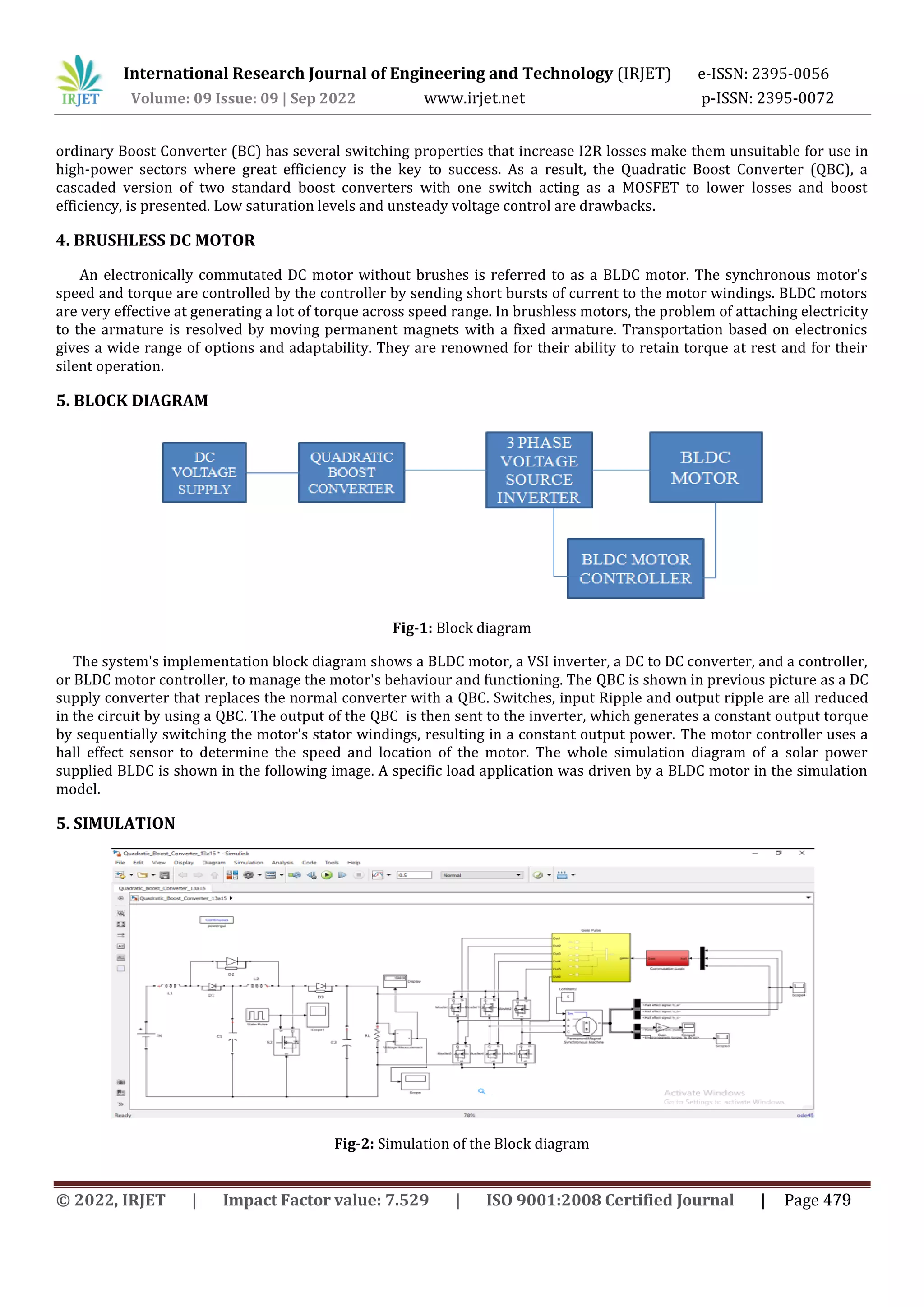
Fig-1: Block diagram
The system's implementation block diagram shows a BLDC motor, a VSI inverter, a DC to DC converter, and a controller,
or BLDC motor controller, to manage the motor's behaviour and functioning. The QBC is shown in previous picture as a DC
supply converter that replaces the normal converter with a QBC. Switches, input Ripple and output ripple are all reduced
in the circuit by using a QBC. The output of the QBC is then sent to the inverter, which generates a constant output torque
by sequentially switching the motor's stator windings, resulting in a constant output power. The motor controller uses a
hall effect sensor to determine the speed and location of the motor. The whole simulation diagram of a solar power
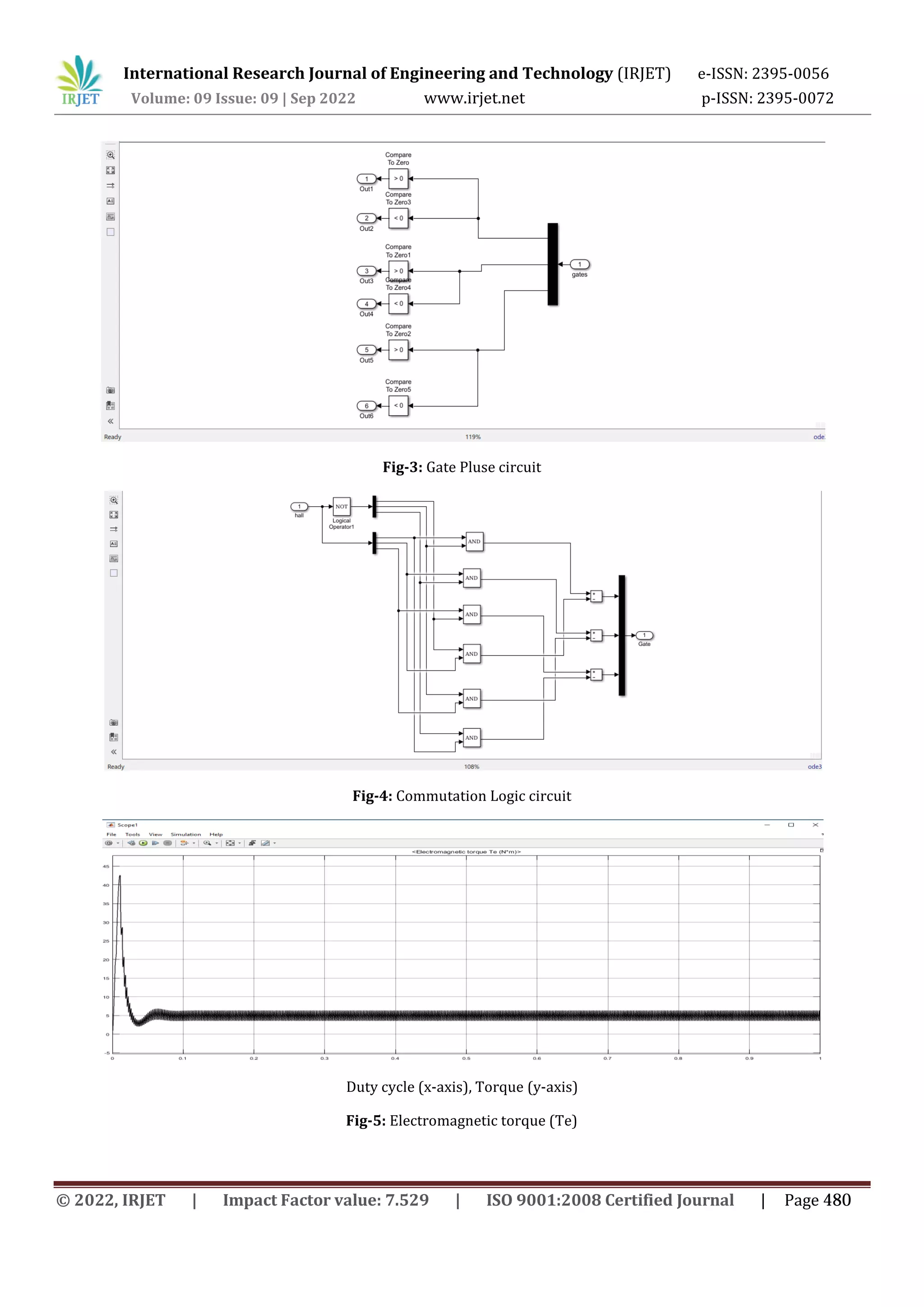
supplied BLDC is shown in the following image. A specific load application was driven by a BLDC motor in the simulation
model.
5. SIMULATION
Fig-2: Simulation of the Block diagram
© 2022, IRJET | Impact Factor value: 7.529 | ISO 9001:2008 Certified Journal | Page 479
International Research Journal of Engineering and Technology (IRJET) e-ISSN: 2395-0056
Volume: 09 Issue: 09 | Sep 2022 www.irjet.net p-ISSN: 2395-0072
Fig-3: Gate Pluse circuit
Fig-4: Commutation Logic circuit
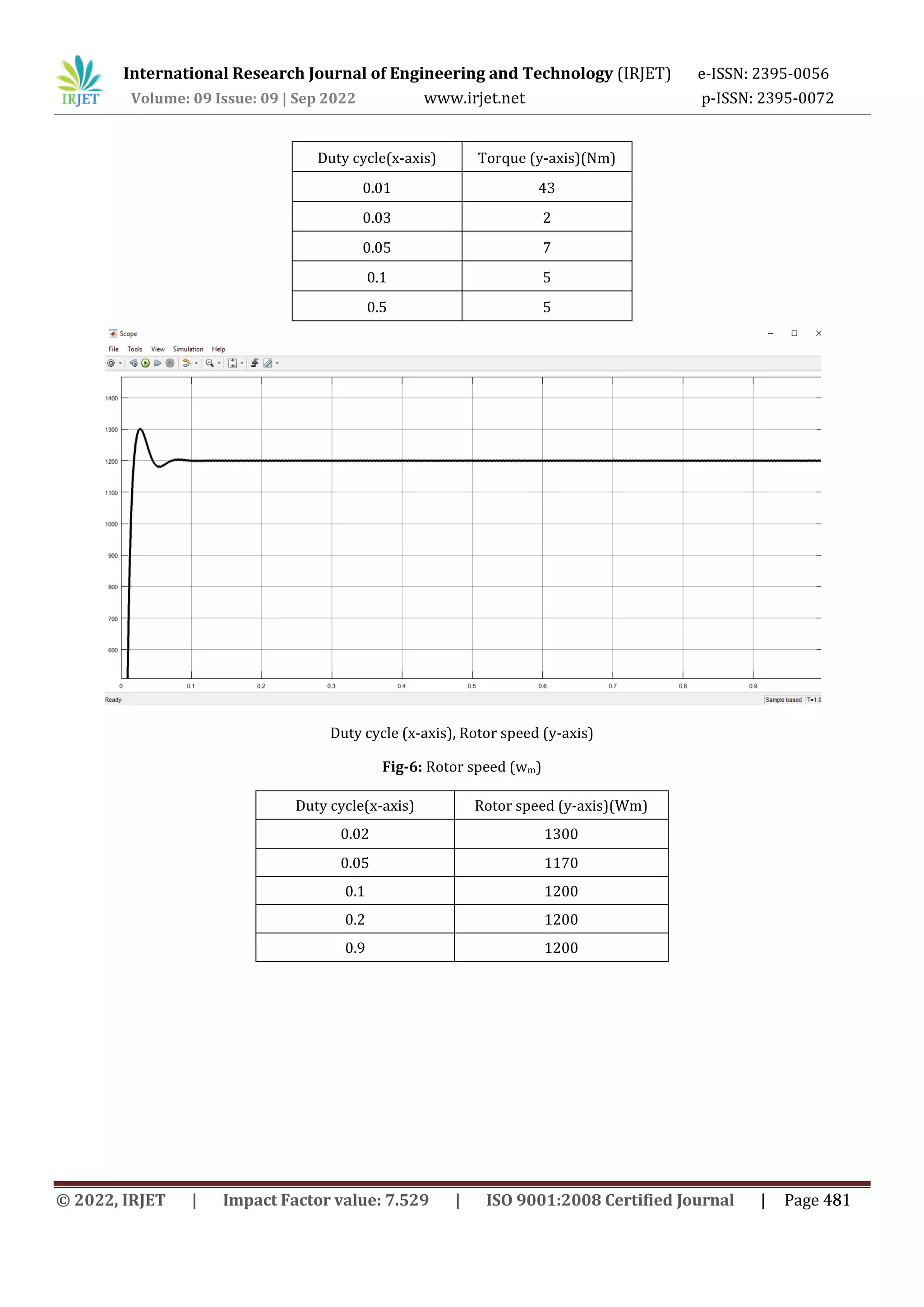
Duty cycle (x-axis), Torque (y-axis)
Fig-5: Electromagnetic torque (Te)
© 2022, IRJET | Impact Factor value: 7.529 | ISO 9001:2008 Certified Journal | Page 480
International Research Journal of Engineering and Technology (IRJET) e-ISSN: 2395-0056
Volume: 09 Issue: 09 | Sep 2022 www.irjet.net p-ISSN: 2395-0072
Duty cycle(x-axis) Torque (y-axis)(Nm)
0.01 43
0.03 2
0.05 7
0.1 5
0.5 5
Duty cycle (x-axis), Rotor speed (y-axis)
Fig-6: Rotor speed (wm)
Duty cycle(x-axis) Rotor speed (y-axis)(Wm)
0.02 1300
0.05 1170
0.1 1200
0.2 1200
0.9 1200
© 2022, IRJET | Impact Factor value: 7.529 | ISO 9001:2008 Certified Journal | Page 481
International Research Journal of Engineering and Technology (IRJET) e-ISSN: 2395-0056
Volume: 09 Issue: 09 | Sep 2022 www.irjet.net p-ISSN: 2395-0072
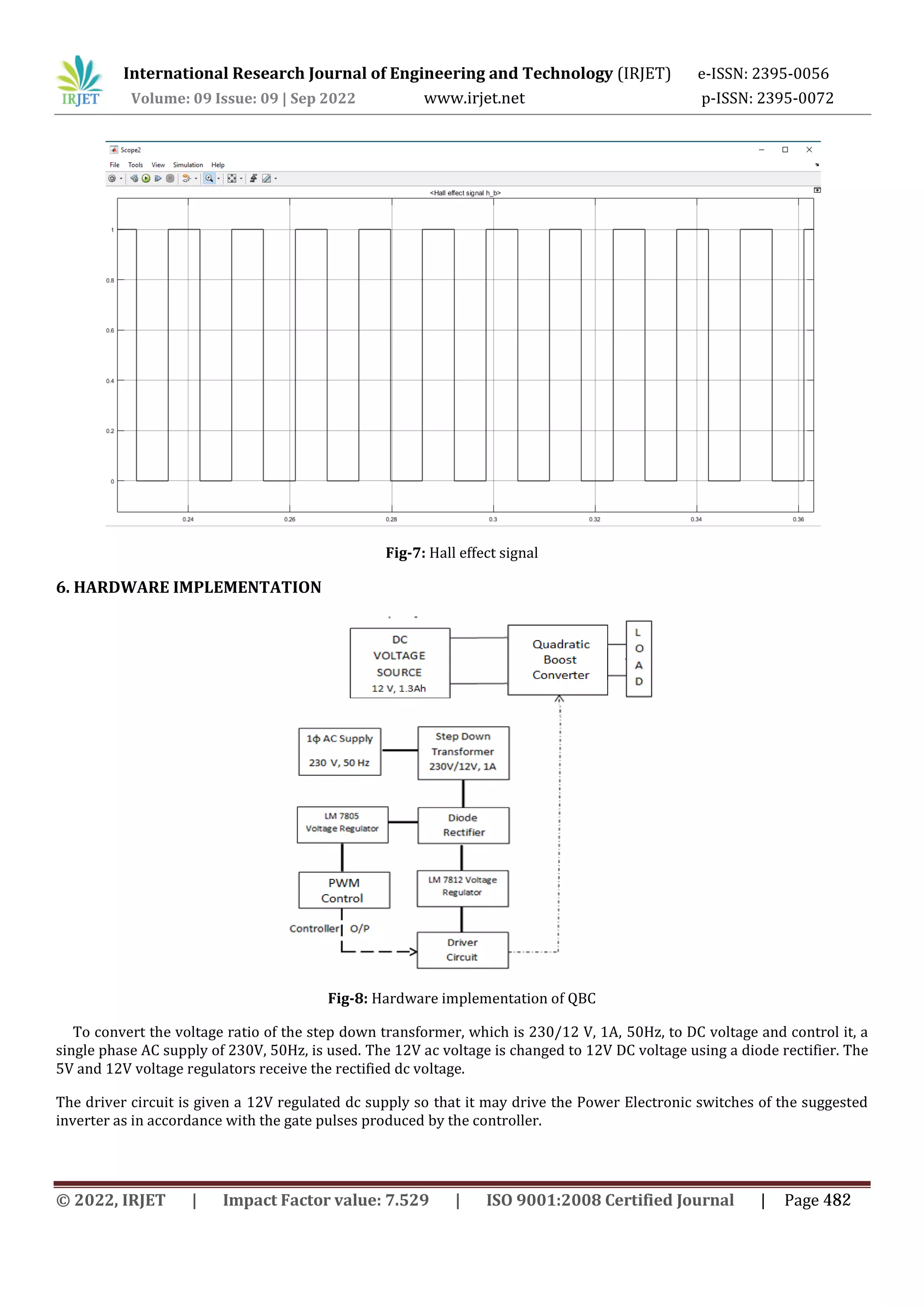
Fig-7: Hall effect signal
6. HARDWARE IMPLEMENTATION
Fig-8: Hardware implementation of QBC
To convert the voltage ratio of the step down transformer, which is 230/12 V, 1A, 50Hz, to DC voltage and control it, a
single phase AC supply of 230V, 50Hz, is used. The 12V ac voltage is changed to 12V DC voltage using a diode rectifier. The
5V and 12V voltage regulators receive the rectified dc voltage.
The driver circuit is given a 12V regulated dc supply so that it may drive the Power Electronic switches of the suggested
inverter as in accordance with the gate pulses produced by the controller.
© 2022, IRJET | Impact Factor value: 7.529 | ISO 9001:2008 Certified Journal | Page 482
International Research Journal of Engineering and Technology (IRJET) e-ISSN: 2395-0056
Volume: 09 Issue: 09 | Sep 2022 www.irjet.net p-ISSN: 2395-0072
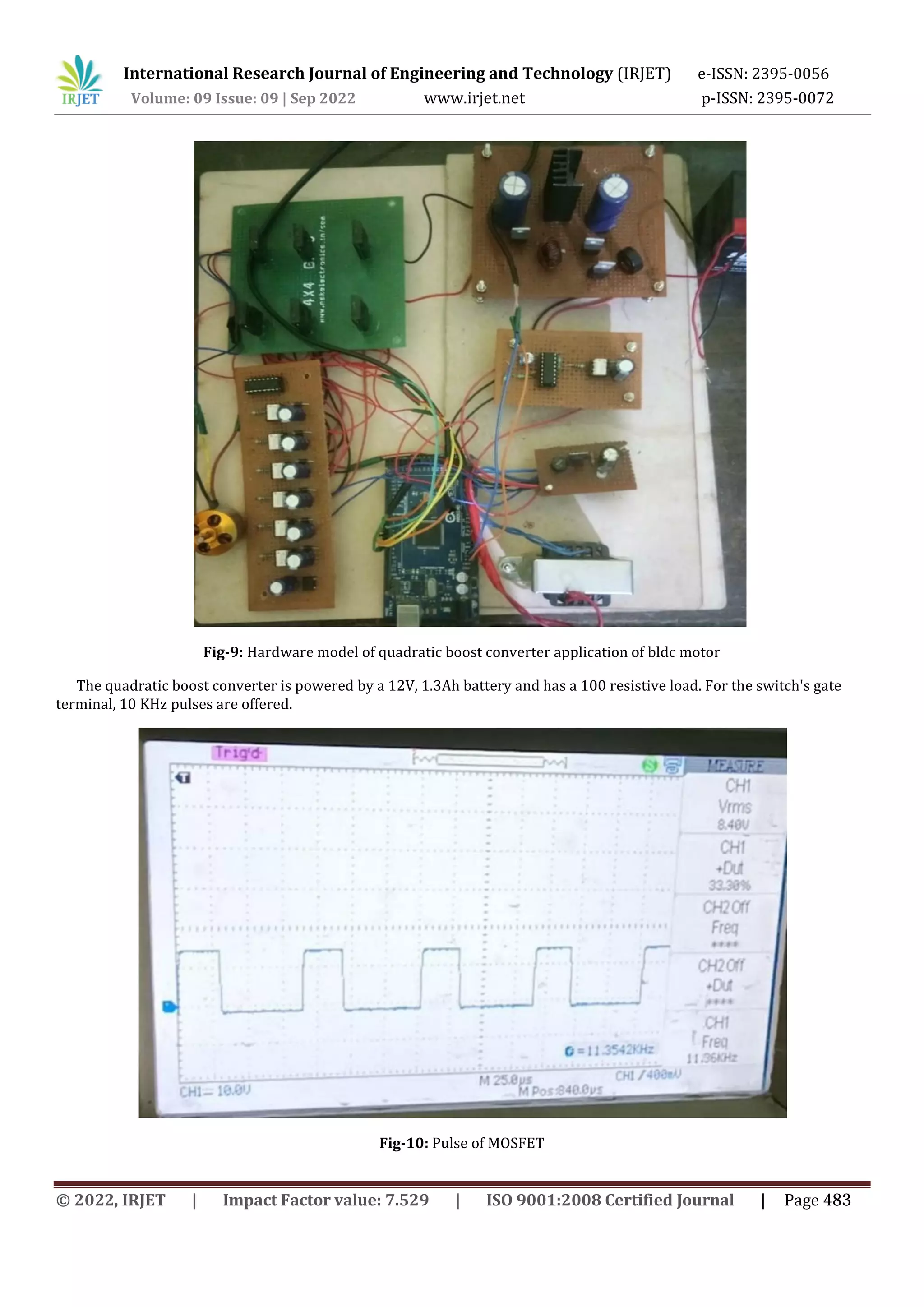
Fig-9: Hardware model of quadratic boost converter application of bldc motor
The quadratic boost converter is powered by a 12V, 1.3Ah battery and has a 100 resistive load. For the switch's gate
terminal, 10 KHz pulses are offered.
Fig-10: Pulse of MOSFET
© 2022, IRJET | Impact Factor value: 7.529 | ISO 9001:2008 Certified Journal | Page 483
International Research Journal of Engineering and Technology (IRJET) e-ISSN: 2395-0056
Volume: 09 Issue: 09 | Sep 2022 www.irjet.net p-ISSN: 2395-0072
Fig-11: Output of quadratic boost onverter
The load voltage is around 44V which is 3.67 times higher than that of input battery voltage for the duty ratio 0f 33%.
7. CONCLUSION
It has been noted that the input voltage given in both the hardware and software situations is around 12 V. Originally
rated at 50 W, the device's power consumption has decreased to about 32W as a result of loss in the hardware
implementation. In both the hardware implementation and simulation, the output voltage increased by a factor of four to
48 V, which is exactly twice the 24 V target value for a traditional boost converter. In both instances, the switching
frequency was set at 50 kHz, which is recommended for QBC’s with efficiency and high gain. The BLDC motor made to run
by quadratic boost converter using the three phase inverter for the power of 32W.
8. REFERENCES
[1]. B.Chandra Krishna, M.Nageswara Rao “Speed Control of BLDC Motor using Modified Buck Boost Converter” IEEE
Transactions on Power Electronics, vol. 24, no. 5, pp. 1198–1208, May 2019.
[2]. Ashirvad M and Rupesh K C “Quadratic Boost Converter for Grid-Connected MicroInverter” IEEE Trans. Power
Electronics, vol. 30, no. 3, pp. 1488-1498, March. 2019.
[3]. M. Veerachary “Design and Analysis of a Boost Converter” IEEE Transactions on Industrial Electronics, vol. 56, issue 6,
pp. 2203 - 2212, June 2018.
[4]. Kemal Kaya and Yakup Hames “A Quadratic Cascade DC/DC Boost Converter Design” IEEE
Trans. Power Electronic. vol. 18, no. 1, pp.164–172, Jan. 2016.
[5]. Selva Kumar. R, Vignesh.C. J, Gayathri Deivanayaki. V. P. “Design and Comparison of Quadratic Boost Converter with
Boost Converter” IEEE Trans.Ind. Appl., vol. 32, no. 3, pp. 518–525, 2017.
[6]. Mustafa İnci “Design and Analysis of Quadratic Boost Converter with Inductor-Capacitor-Diode Voltage Multiplier
Circuit” IEEE Trans. Ind. Elect.,vol.50, no.5,pp.962– 981,Oct. 2018.
[7]. Angalaeswari S, Deepa.T, Subbulekshmi.D, Krithiga S, Pramit Ghosh, Aniket Kumar, Mutthi Karunanidhi, “Design and
execution of Quadratic Boost Converter (QBC) in Renewabe Energy Synergies” Applied Power Electronics Conference and
Exposition, 2018. APEC 2018. Twenty-Third Annual IEEE, May 2018, pp. 973 - 979.
© 2022, IRJET | Impact Factor value: 7.529 | ISO 9001:2008 Certified Journal | Page 484
International Research Journal of Engineering and Technology (IRJET) e-ISSN: 2395-0056
Volume: 09 Issue: 09 | Sep 2022 www.irjet.net p-ISSN: 2395-0072
Based on Coupled inductor with Single Switch and Continuous Input Current” IEEE Transactions on Power Electronics, vol.
29, no. 9, pp.4684-4692, 2019.
[9]. M.S. Aspalli, Farhat Mubeen Munshi, Savitri.L.Medegar “Speed control of BLDC Motor
with Four Switch Three Phase Inverter using Digital Signal Controller” IEEE Trans. Power Electron., vol. 18, no. 1, pp.164–
172, Jan. 2016.
[10] K. I. Hwu, W. C. Tu, "Voltage-boosting converters with hybrid energy pumping," IET Power Electron., vol. 5, no. 2, pp.
185-195,Feb.2017.
[11] Shiyu Zhang, Jianping Xu, Ping Yang, “A single-switch high-gain quadratic boost converter based on voltage-lift-
technique”, Proc. of IEEE IPEC, 2012, pp. 71-75.
[12] K. I. Hwu, Y. T. Yau, “ A KY boost converter,” IEEE Trans. on Power Electron., vol. 25, no. 11, pp. 2699-2703, Nov. 2019.
[8]. S.Alireza Modaberi, Babak Allahverdinejad, Mohamad Reza Banaei, “A Quadratic High Step-up DC-DC Boost Converter
© 2022, IRJET | Impact Factor value: 7.529 | ISO 9001:2008 Certified Journal | Page 485

DESIGN AND IMPLEMENTATION OF QUADRATIC BOOST CONVERTER FOR APPLICATION OF BLDC MOTOR

  • 1.
    International Research Journalof Engineering and Technology (IRJET) e-ISSN: 2395-0056 Volume: 09 Issue: 09 | Sep 2022 www.irjet.net p-ISSN: 2395-0072 DESIGN AND IMPLEMENTATION OF QUADRATIC BOOST CONVERTER FOR APPLICATION OF BLDC MOTOR Mr. Manoj kumar J A1, Mrs. Harini Vaikund2 1Department of Electrical and Electronics Engineering, Dr. Ambedkar Institute Of Technology, Bengaluru 560056 2Assistant Proffesor in Electrical and Electronics Engineering, Dr. Ambedkar Institue Of Technology Bengaluru 560056 ---------------------------------------------------------------------***---------------------------------------------------------------------- Abstract - The purpose of this paper is to design a quadratic boost converter (QBC) with the help of MATLAB-SIMULINK. The BLDC motor is made run using the quadratic boost converter. Numerous industries, including aviation, automation, industrial process control, precise machine tools, automotive electronics, and residential applications are using these motors extensively. The pulse width modulation (PWM) current controller technology is used in the paper to effectively control the speed of a BLDC motor. It is noted how the BLDC motor behaves in terms of speed and torque as well as the current and voltage components of the inverter. An elaborate explanation about quadratic boost converter for application of BLDC motor is shown. Here quadratic boost converter used for the application of BLDC motor simulation is done in MATLAB - SIMULINK software and in hardware also it is implemented. Key Words: Quadratic boost converter (QBC), Three phase inverter, MOSFET, Aurdino UNO, Brushless dc motor (BLDC) etc… 1. INTRODUCTION In the majority of applications with low power demands, the demand for distributing dc-dc electricity, high-frequency power conversion is continuously rising day by day. The development of converters for point-of-load applications is given more consideration by designers, with a focus on achieving objectives including greater power density, improved conversion efficiency at full load, and less electromagnetic interference (EMI). The design challenges for the application engineer are: (i) formulation of non-isolated topologies free of transformers; (ii) minimum ripples together with minimal requirement in L, C components; and (iii) reduction in the size of the filtering components together reduced severity/impact of electromagnetic interference. Multiple point-of-load converters are increasingly used in low power distribution systems (EMI). High-frequency switching is commonly used to create point-of-load converters, which are more compact, lighter, and have higher power densities thanks to the development of low loss magnetic materials. Many power electronic converters, or dc-dc conversion systems, that can generate stable voltages to drive dc loads have been reported in the literature. They can be broadly categorised as: (i) bucking-based circuits, (ii) boosting circuits, and (iii) buck-boost and other relatively high converter circuits. These converter circuits have a broad range of uses, including: (i) specialised low-power integrated circuits; (ii) powering small automotive devices or loads; (iii) complex loads like biomedical equipment; and (iii) internet, wide area network, and local area network services, and (iv) equipment for defence, spacecraft power systems, and communications power supply systems. Commonly used in front-end power processing and power factor applications are boosting dc-dc converters. To generate greater load voltages from low voltage dc batteries, point of load converters are used in back-end applications. To achieve high voltage gain, the standard boost dc-dc converter must be powered at a high duty ratio, but the related operation may not be practical from an efficiency standpoint. 2. QUADRATIC BOOST CONVERTER An ordinary Boost Converter (BC) has several switching properties that increase I2R losses make them unsuitable for use in high-power sectors where great efficiency is the key to success. As a result, the Quadratic Boost Converter (QBC), a cascaded version of two standard boost converters with one switch acting as a MOSFET to lower losses and boost efficiency, is presented. Low saturation levels and unsteady voltage control are drawbacks. 3. THREE PHASE VOLTAGE SOURCE INVERTER An inverter, transforms a DC amount into an AC amount. By adjusting the duty cycle frequency of the voltage source inverter, we may alter the frequency of a output voltages, which may have a constant or variable frequency. The ac voltage output to dc input voltage ratio is known as the inverter gain. An efficient inverter will have sinusoidal output voltages. An © 2022, IRJET | Impact Factor value: 7.529 | ISO 9001:2008 Certified Journal | Page 478
  • 2.
    International Research Journalof Engineering and Technology (IRJET) e-ISSN: 2395-0056 Volume: 09 Issue: 09 | Sep 2022 www.irjet.net p-ISSN: 2395-0072 ordinary Boost Converter (BC) has several switching properties that increase I2R losses make them unsuitable for use in high-power sectors where great efficiency is the key to success. As a result, the Quadratic Boost Converter (QBC), a cascaded version of two standard boost converters with one switch acting as a MOSFET to lower losses and boost efficiency, is presented. Low saturation levels and unsteady voltage control are drawbacks. 4. BRUSHLESS DC MOTOR An electronically commutated DC motor without brushes is referred to as a BLDC motor. The synchronous motor's speed and torque are controlled by the controller by sending short bursts of current to the motor windings. BLDC motors are very effective at generating a lot of torque across speed range. In brushless motors, the problem of attaching electricity to the armature is resolved by moving permanent magnets with a fixed armature. Transportation based on electronics gives a wide range of options and adaptability. They are renowned for their ability to retain torque at rest and for their silent operation. 5. BLOCK DIAGRAM Fig-1: Block diagram The system's implementation block diagram shows a BLDC motor, a VSI inverter, a DC to DC converter, and a controller, or BLDC motor controller, to manage the motor's behaviour and functioning. The QBC is shown in previous picture as a DC supply converter that replaces the normal converter with a QBC. Switches, input Ripple and output ripple are all reduced in the circuit by using a QBC. The output of the QBC is then sent to the inverter, which generates a constant output torque by sequentially switching the motor's stator windings, resulting in a constant output power. The motor controller uses a hall effect sensor to determine the speed and location of the motor. The whole simulation diagram of a solar power supplied BLDC is shown in the following image. A specific load application was driven by a BLDC motor in the simulation model. 5. SIMULATION Fig-2: Simulation of the Block diagram © 2022, IRJET | Impact Factor value: 7.529 | ISO 9001:2008 Certified Journal | Page 479
  • 3.
    International Research Journalof Engineering and Technology (IRJET) e-ISSN: 2395-0056 Volume: 09 Issue: 09 | Sep 2022 www.irjet.net p-ISSN: 2395-0072 Fig-3: Gate Pluse circuit Fig-4: Commutation Logic circuit Duty cycle (x-axis), Torque (y-axis) Fig-5: Electromagnetic torque (Te) © 2022, IRJET | Impact Factor value: 7.529 | ISO 9001:2008 Certified Journal | Page 480
  • 4.
    International Research Journalof Engineering and Technology (IRJET) e-ISSN: 2395-0056 Volume: 09 Issue: 09 | Sep 2022 www.irjet.net p-ISSN: 2395-0072 Duty cycle(x-axis) Torque (y-axis)(Nm) 0.01 43 0.03 2 0.05 7 0.1 5 0.5 5 Duty cycle (x-axis), Rotor speed (y-axis) Fig-6: Rotor speed (wm) Duty cycle(x-axis) Rotor speed (y-axis)(Wm) 0.02 1300 0.05 1170 0.1 1200 0.2 1200 0.9 1200 © 2022, IRJET | Impact Factor value: 7.529 | ISO 9001:2008 Certified Journal | Page 481
  • 5.
    International Research Journalof Engineering and Technology (IRJET) e-ISSN: 2395-0056 Volume: 09 Issue: 09 | Sep 2022 www.irjet.net p-ISSN: 2395-0072 Fig-7: Hall effect signal 6. HARDWARE IMPLEMENTATION Fig-8: Hardware implementation of QBC To convert the voltage ratio of the step down transformer, which is 230/12 V, 1A, 50Hz, to DC voltage and control it, a single phase AC supply of 230V, 50Hz, is used. The 12V ac voltage is changed to 12V DC voltage using a diode rectifier. The 5V and 12V voltage regulators receive the rectified dc voltage. The driver circuit is given a 12V regulated dc supply so that it may drive the Power Electronic switches of the suggested inverter as in accordance with the gate pulses produced by the controller. © 2022, IRJET | Impact Factor value: 7.529 | ISO 9001:2008 Certified Journal | Page 482
  • 6.
    International Research Journalof Engineering and Technology (IRJET) e-ISSN: 2395-0056 Volume: 09 Issue: 09 | Sep 2022 www.irjet.net p-ISSN: 2395-0072 Fig-9: Hardware model of quadratic boost converter application of bldc motor The quadratic boost converter is powered by a 12V, 1.3Ah battery and has a 100 resistive load. For the switch's gate terminal, 10 KHz pulses are offered. Fig-10: Pulse of MOSFET © 2022, IRJET | Impact Factor value: 7.529 | ISO 9001:2008 Certified Journal | Page 483
  • 7.
    International Research Journalof Engineering and Technology (IRJET) e-ISSN: 2395-0056 Volume: 09 Issue: 09 | Sep 2022 www.irjet.net p-ISSN: 2395-0072 Fig-11: Output of quadratic boost onverter The load voltage is around 44V which is 3.67 times higher than that of input battery voltage for the duty ratio 0f 33%. 7. CONCLUSION It has been noted that the input voltage given in both the hardware and software situations is around 12 V. Originally rated at 50 W, the device's power consumption has decreased to about 32W as a result of loss in the hardware implementation. In both the hardware implementation and simulation, the output voltage increased by a factor of four to 48 V, which is exactly twice the 24 V target value for a traditional boost converter. In both instances, the switching frequency was set at 50 kHz, which is recommended for QBC’s with efficiency and high gain. The BLDC motor made to run by quadratic boost converter using the three phase inverter for the power of 32W. 8. REFERENCES [1]. B.Chandra Krishna, M.Nageswara Rao “Speed Control of BLDC Motor using Modified Buck Boost Converter” IEEE Transactions on Power Electronics, vol. 24, no. 5, pp. 1198–1208, May 2019. [2]. Ashirvad M and Rupesh K C “Quadratic Boost Converter for Grid-Connected MicroInverter” IEEE Trans. Power Electronics, vol. 30, no. 3, pp. 1488-1498, March. 2019. [3]. M. Veerachary “Design and Analysis of a Boost Converter” IEEE Transactions on Industrial Electronics, vol. 56, issue 6, pp. 2203 - 2212, June 2018. [4]. Kemal Kaya and Yakup Hames “A Quadratic Cascade DC/DC Boost Converter Design” IEEE Trans. Power Electronic. vol. 18, no. 1, pp.164–172, Jan. 2016. [5]. Selva Kumar. R, Vignesh.C. J, Gayathri Deivanayaki. V. P. “Design and Comparison of Quadratic Boost Converter with Boost Converter” IEEE Trans.Ind. Appl., vol. 32, no. 3, pp. 518–525, 2017. [6]. Mustafa İnci “Design and Analysis of Quadratic Boost Converter with Inductor-Capacitor-Diode Voltage Multiplier Circuit” IEEE Trans. Ind. Elect.,vol.50, no.5,pp.962– 981,Oct. 2018. [7]. Angalaeswari S, Deepa.T, Subbulekshmi.D, Krithiga S, Pramit Ghosh, Aniket Kumar, Mutthi Karunanidhi, “Design and execution of Quadratic Boost Converter (QBC) in Renewabe Energy Synergies” Applied Power Electronics Conference and Exposition, 2018. APEC 2018. Twenty-Third Annual IEEE, May 2018, pp. 973 - 979. © 2022, IRJET | Impact Factor value: 7.529 | ISO 9001:2008 Certified Journal | Page 484
  • 8.
    International Research Journalof Engineering and Technology (IRJET) e-ISSN: 2395-0056 Volume: 09 Issue: 09 | Sep 2022 www.irjet.net p-ISSN: 2395-0072 Based on Coupled inductor with Single Switch and Continuous Input Current” IEEE Transactions on Power Electronics, vol. 29, no. 9, pp.4684-4692, 2019. [9]. M.S. Aspalli, Farhat Mubeen Munshi, Savitri.L.Medegar “Speed control of BLDC Motor with Four Switch Three Phase Inverter using Digital Signal Controller” IEEE Trans. Power Electron., vol. 18, no. 1, pp.164– 172, Jan. 2016. [10] K. I. Hwu, W. C. Tu, "Voltage-boosting converters with hybrid energy pumping," IET Power Electron., vol. 5, no. 2, pp. 185-195,Feb.2017. [11] Shiyu Zhang, Jianping Xu, Ping Yang, “A single-switch high-gain quadratic boost converter based on voltage-lift- technique”, Proc. of IEEE IPEC, 2012, pp. 71-75. [12] K. I. Hwu, Y. T. Yau, “ A KY boost converter,” IEEE Trans. on Power Electron., vol. 25, no. 11, pp. 2699-2703, Nov. 2019. [8]. S.Alireza Modaberi, Babak Allahverdinejad, Mohamad Reza Banaei, “A Quadratic High Step-up DC-DC Boost Converter © 2022, IRJET | Impact Factor value: 7.529 | ISO 9001:2008 Certified Journal | Page 485