Download to read offline
![International Research Journal of Engineering and Technology (IRJET) e-ISSN: 2395 -0056
Volume: 03 Issue: 02 | Feb-2016 www.irjet.net p-ISSN: 2395-0072
© 2016, IRJET | Impact Factor value: 4.45 | ISO 9001:2008 Certified Journal | Page 918
Design and Implementation of Brain Computer Interface for
Wheelchair control
Rajeshree Mahendra Patil1, Prof. D.M. Kate 2, Prof. A.P. Thakare 3
1Mtech student Department of Electronic and communication Engineering, PBCOE College, Maharashtra, India
2Assistance professor Department of Electronic and communication Engineering, PBCOE College, Maharashtra,
India
3Assistance professor Department of Electronic and communication Engineering, PBCOE College, Maharashtra,
India
---------------------------------------------------------------------***---------------------------------------------------------------------
Abstract - This paper presents a design and
implementation of Brain computer Interface (BCI) for
wheelchair control. In this paper, the
Electroencephalogram signals (EEG) have been used to
provide new ways for communication and control. Brain
Computer Interface (BCI) technology is a powerful
communication and control option in the interaction
between user and system.Thistechnology enablessignals
from brain to directly some externalactivity.BCIsystemis
also known as “Brain- Machine Interface (BMI)”. In BCI
system signals are acquire from the human scalp by the
electrode. The experimental results confirmed that EEG
signals acquire from the dataset and after acquiring that
signals we process that signalandcontrolthewheelchair.
Key Words: EEG Signals, BCI system, Wheelchair,
1. INTRODUCTION
The paralyzed patient or patients who are suffering from
severe physical disabilities have their limited motion in
environment. BCI system allows the communication
between the brain and controlling device using the
brainwave. Brain - Computer Interface (BCI) can assist the
patient who has their limited motor imagery movement or
damages to their organ. BCI also allows the users to
communicate with the multimedia devices through
brainwave signals. To acquire Electroencephalograph(EEG)
signals have some basic process, the small electrode which
are placed on the scalp. The signals generated in the brain
are sense by the electrode and map it on the output device.
The wireless BCI system, analyzed signals and recognizes
that signals and pass for further preprocess and translate
into specified command and that commands control the
wheelchair movement and decide where to move the
wheelchair similarly the other controls like multimedia or
other useful control can be operated by using thistechnique.
These feasibility of using a Brain- computer interface (BCI)
for the control of the Wheelchair as been under recent
Investigation at UTS. Initial work using a simpleof2Channel
EEG recorder, attempting to classify 3 different classes of
mental commands in order to allow the control of the
wheelchair. The main advantages of this method is that it
requires no motor skills whatever in order to achieve
wheelchair control. However it also has some rather main
disadvantages when used as the sole method of wheelchair
control, for instance of a 2 second classification window
makes the eventual control quite slows.
2. SYSTEM OVERVIEW
To achieve the goal, the following additional technical
arrangements are implemented in the BCI system. Multiple
devices are controlled and processed by BCI. BCI is a novel
communication system which enables users to translate
brain activity, measured by Electroencephalography (EEG),
into control signal and sending to computers. BCI have been
exposed as a promising tool for paralyzed people in several
computer applicationssuchasa promisingtool forparalyzed
people and healthy people in several computer applications
such as medical assistant devices[8] and video game[9].
Fig.1 shows schematics of a BCIsystem.Thissysteminvolves
EEG acquisition, signal processing, and an application
interface together with the applications. The block of signal
processing includes preprocessing, feature extraction, and
classification.](https://image.slidesharecdn.com/irjet-v3i2161-171027090815/85/Design-and-Implementation-of-Brain-Computer-Interface-for-Wheelchair-control-1-320.jpg)
![International Research Journal of Engineering and Technology (IRJET) e-ISSN: 2395 -0056
Volume: 03 Issue: 02 | Feb-2016 www.irjet.net p-ISSN: 2395-0072
© 2016, IRJET | Impact Factor value: 4.45 | ISO 9001:2008 Certified Journal | Page 918
Design and Implementation of Brain Computer Interface for
Wheelchair control
Rajeshree Mahendra Patil1, Prof. D.M. Kate 2, Prof. A.P. Thakare 3
1Mtech student Department of Electronic and communication Engineering, PBCOE College, Maharashtra, India
2Assistance professor Department of Electronic and communication Engineering, PBCOE College, Maharashtra,
India
3Assistance professor Department of Electronic and communication Engineering, PBCOE College, Maharashtra,
India
---------------------------------------------------------------------***---------------------------------------------------------------------
Abstract - This paper presents a design and
implementation of Brain computer Interface (BCI) for
wheelchair control. In this paper, the
Electroencephalogram signals (EEG) have been used to
provide new ways for communication and control. Brain
Computer Interface (BCI) technology is a powerful
communication and control option in the interaction
between user and system.Thistechnology enablessignals
from brain to directly some externalactivity.BCIsystemis
also known as “Brain- Machine Interface (BMI)”. In BCI
system signals are acquire from the human scalp by the
electrode. The experimental results confirmed that EEG
signals acquire from the dataset and after acquiring that
signals we process that signalandcontrolthewheelchair.
Key Words: EEG Signals, BCI system, Wheelchair,
1. INTRODUCTION
The paralyzed patient or patients who are suffering from
severe physical disabilities have their limited motion in
environment. BCI system allows the communication
between the brain and controlling device using the
brainwave. Brain - Computer Interface (BCI) can assist the
patient who has their limited motor imagery movement or
damages to their organ. BCI also allows the users to
communicate with the multimedia devices through
brainwave signals. To acquire Electroencephalograph(EEG)
signals have some basic process, the small electrode which
are placed on the scalp. The signals generated in the brain
are sense by the electrode and map it on the output device.
The wireless BCI system, analyzed signals and recognizes
that signals and pass for further preprocess and translate
into specified command and that commands control the
wheelchair movement and decide where to move the
wheelchair similarly the other controls like multimedia or
other useful control can be operated by using thistechnique.
These feasibility of using a Brain- computer interface (BCI)
for the control of the Wheelchair as been under recent
Investigation at UTS. Initial work using a simpleof2Channel
EEG recorder, attempting to classify 3 different classes of
mental commands in order to allow the control of the
wheelchair. The main advantages of this method is that it
requires no motor skills whatever in order to achieve
wheelchair control. However it also has some rather main
disadvantages when used as the sole method of wheelchair
control, for instance of a 2 second classification window
makes the eventual control quite slows.
2. SYSTEM OVERVIEW
To achieve the goal, the following additional technical
arrangements are implemented in the BCI system. Multiple
devices are controlled and processed by BCI. BCI is a novel
communication system which enables users to translate
brain activity, measured by Electroencephalography (EEG),
into control signal and sending to computers. BCI have been
exposed as a promising tool for paralyzed people in several
computer applicationssuchasa promisingtool forparalyzed
people and healthy people in several computer applications
such as medical assistant devices[8] and video game[9].
Fig.1 shows schematics of a BCIsystem.Thissysteminvolves
EEG acquisition, signal processing, and an application
interface together with the applications. The block of signal
processing includes preprocessing, feature extraction, and
classification.](https://image.slidesharecdn.com/irjet-v3i2161-171027090815/75/Design-and-Implementation-of-Brain-Computer-Interface-for-Wheelchair-control-1-2048.jpg)
![International Research Journal of Engineering and Technology (IRJET) e-ISSN: 2395 -0056
Volume: 03 Issue: 02 | Feb-2016 www.irjet.net p-ISSN: 2395-0072
© 2016, IRJET | Impact Factor value: 4.45 | ISO 9001:2008 Certified Journal | Page 920
Figure 5. Generated recognition pattern (subject D)
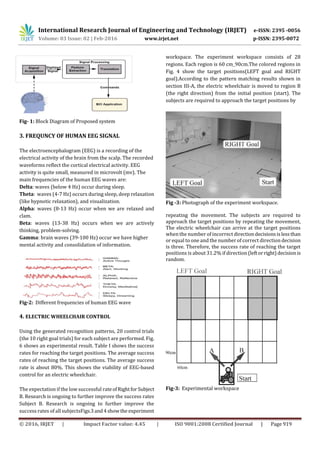
In the experiment, the wheelchair is stopped during theEEG
detection and the patternmatchingsincetheprocessingtime
is several seconds. According to the pattern matchingresult,
the electrical wheelchair is moved to the next region. The
procedure is repeated until the wheelchair reaches at the
target position or until the number of incorrect directions is
more than one.
Fig. 4 and 5 show the recognition patterns for the left
and right thinking of the subjects C and D, respectively. In
the figures, the horizontal and vertical axis denote the
element number m and the elements (V lm(E)andVrm(E)),
respectively. These patterns are generated through the
recursive training described in section III. The patterns of
subjects C and D are quite different. This fact shows that it is
quite reasonable to generate an individual recognized
pattern for each subject.
Table -1: Success rates
Fig -1: Experiment results
4. CONCLUSION
This paper investigates control of an electric wheelchair by
EEG signals. This represents an attempt to control machines
via brain signals. In this research, the goal is to control the
direction (left or right) of the electric wheelchair by EEG
signals. This paper investigates control of an electric
wheelchair by EEG signals. In situations without obstacles
both measures are not impeded by assistance module.
Hence, in normal situations the advantage of collision-free
driving remains, while the drawbacks nearly disappear.
REFERENCES
[1] Kazuo Tanaka, kazuyuki Matsuyama and Hua O.
“Electroencephalogram-Based control of an Electric
Wheelchair,” IEEE TRANSACTIONS ROBOTICS,
VOL.21, NO. 4. AUGUST .2005.
[2] Jzau-sheng Lin; Kuok-chichen;Win-chinYang,,”EEG
and eye-blinking signals through a Brain-computer
Subject
Success rate %
Left Right
A 80 90
B 90 20
C 100 100
D 80 100
E 80 80
F 70 90
Avg. 83(%) 80(%)](https://image.slidesharecdn.com/irjet-v3i2161-171027090815/85/Design-and-Implementation-of-Brain-Computer-Interface-for-Wheelchair-control-3-320.jpg)
![International Research Journal of Engineering and Technology (IRJET) e-ISSN: 2395 -0056
Volume: 03 Issue: 02 | Feb-2016 www.irjet.net p-ISSN: 2395-0072
© 2016, IRJET | Impact Factor value: 4.45 | ISO 9001:2008 Certified Journal | Page 921
Interface based control for electric wheelchairs
with wireless scheme”, May 2010 ,IEEE conference
,4th International Conference on New Trends in
Information Science and service
science(NISS),2010.
[3] Yeaning Li; Jiamusi Pan; Fey Wang; Zhejiang Yu,”A
Hybrid BCI System Combining P300 and SSVEP and
Its Application to Wheelchair Control”, IEEE
Transactions on Biomedical Engineering, (Volume:
60, Issue: 11), pp. 3156-3166,2010.
[4] M. Jawed Khan, Melissa Joyous Hong, and Keum-
Shik Hong, “Decoding of four movement directions
using hybrid NIRS-EEG brain computer Interface”,
Frontiers in Human Neuroscience, April
2014|Volume8| article 244.
[5] Yin, E. ;E. Yin ZHOU, z. ; Jiang, J.; Yu, Y. , “A
dynamically optimized SSVEP brain-computer
interface (BCI) speller”, April 2014, Biomedical
Engineering, IEEE Transactions on (Volume: PP
,Issue:99).
[6] ALLISON, Blush, T.; Balbuena, D.; Teymourian,
A.,”BCI Demographics: How Many (and What Kinds
of) People Can Use an SSVEP BCI?” April 2010,
Neural Systems and Rehabilitation Engineering,
IEEE Transactions on (Volume: 18, Issue:2).
[7] Cheng, M.; Ago, s.; CSU, d.,”Multiple color stimulus
induce steady state visual evoked potentials”,2001,
Engineering in Medicine and Biology Society, 2001.
Processing’s of the 23rd Annual International
Conference of the IEEE (Volume: 2).
[8] A. Lecuyer, F. Lottie, R. B. Reilly, R. Leeb, M.
Hirose, and M. Slater, Brain-Computer Interface,
Virtual Reality and Videogames: Current
Applications and Future Trends, IEEE computes.
Vol. 41, no. 10, PP.66-72, 2008.
[9] A. Cabrera and K. Dremstrup, "Auditory and
spatial navigation imagery in brain computer
interface using optimized wavelets," Journal of
Neuroscience Methods, vol. 174, no. 1, pp. 135-
146, 2006.
[10] Robert Leeb, Doron Friedman, Gernot R.Muller-
putz, Reinhold Scherer, Mel Slater and Gert
Pfurtscheller, “self-paced (Asynchronous)BCI
Control of a Wheelchair in Virtual Environments:”
,Hindawi Publishing Corporation Computational
Intelligence and NeuroscienceVolume2007,Article
ID 79642, 8 page.
[11] Fan, X; Bi, L.; Tang, T.; Ding, H.,”A Brain-Computer
Interface-Based Vehicle Destination Selection
System Using P300 and SSVEP Signals”, July 2014,
Intelligent Transportation Systems, IEEE
Transportation Systems, and IEEE Transactions on
(Volume: PP, Issue: 99).
[12] Xzenge Bi; Key Joe; Xing-an Fan; Yen Lima DSSVEP
brain –computer interface with the hybrid
Stimuli of SSVEP and P300”, Complex Medical
Engineering (CME), 2013 ICME International
Conference on CME May 2014.
[13] Kuo-kai shyu; Yen-Jen Chiu; Po-Lie Lee; Jiao-Ming
Liang, ”Adaptive SSVEP-Based BCI System With
Frequency and Pulse Duty- cycle Stimuli Tuning
Design”, Sep 2013,Neural Systems and
Rehabilitation Engineering, IEEE Transactions on
(Volume: 21, Issue: 5).](https://image.slidesharecdn.com/irjet-v3i2161-171027090815/85/Design-and-Implementation-of-Brain-Computer-Interface-for-Wheelchair-control-4-320.jpg)

This document describes the design and implementation of a brain-computer interface (BCI) system to control a wheelchair using electroencephalography (EEG) signals. Specifically, it presents a BCI system that acquires EEG signals from electrodes on a user's scalp, processes the signals to classify intended movement commands (left, right), and uses these commands to control the direction of a wheelchair. The system achieves an average success rate of 83% for left commands and 80% for right commands across 6 test subjects. It provides a potential communication method for people with severe physical disabilities.


