

INTERNATIONAL JOURNAL OF COMPUTER ENGINEERING &
  International Journal of Computer Engineering and Technology (IJCET), ISSN 0976 –
  6367(Print), ISSN 0976 – 6375(Online) Volume 3, Issue 3, October-December (2012), © IAEME
                              TECHNOLOGY (IJCET)
ISSN 0976 – 6367(Print)
ISSN 0976 – 6375(Online)
Volume 3, Issue 3, October - December (2012), pp. 104-111
                                                                                 IJCET
© IAEME: www.iaeme.com/ijcet.asp
Journal Impact Factor (2012): 3.9580 (Calculated by GISI)                    ©IAEME
www.jifactor.com


                     BRAIN CONTROLLED ARTIFICIAL LEGS
                                            K.Vikram
                           Associate prof, Medak College of Engineering
                                       Siddipet, Medak (D)

                                       Dr. Niraj Upapadyaya
                                        Dean of CSE & IT
                                        JBIET, Hyderabad

                                             Mr. Srinivas
                                Asst.Prof. of Computer Science Dept.
                                               JBREC

                                             Mr.R.Raju
                                Asst.Prof of Computer Science Dept.
                                              JBREC

  ABSTRACT

  This paper describes a brain controlled robotic leg which is designed to perform the normal
  operations of a human leg. After implanting this leg in a human, the leg can be controlled
  with the help of user’s brain signals alone. This leg behaves similar to a normal human leg
  and it can perform operation like walking, running, climbing stairs etc. The entire systemis
  controlled with the help of advanced microcontrollers and digital signal processors. The
  signals are taken out from the human brain with the help of electroencephalography
  technique. The person can perform operations like walking, running etc just by their thought.
  This system will be very much suitable for those who lost their legs in accidents and the
  proposed system is hundred percent feasible in the real time environment with the currently
  available technology. The Brain Controlled Artificial Legs are very much cost effective when
  compared to the normal Artificial legs which is available in the market. The reduction in cost
  of the proposed system is found to be above 80% when compared to the existing system.
  Moreover, the user can have full control over the artificial legs which is not possible in the
  existing system.

  INTRODUCTION

  A brain-computer interface (BCI), sometimes called a direct neural interface or a brain-machine
  interface, is a direct communication pathway between a human or animal brain and an external
  device. In this definition, the word brain means the brain or nervous system of an organic life form


                                                  104
International Journal of Computer Engineering and Technology (IJCET), ISSN 0976 –
6367(Print), ISSN 0976 – 6375(Online) Volume 3, Issue 3, October-December (2012), © IAEME

rather than the mind. Computer means any processing or computational device, from simple circuits
to the complex microprocessors and microcontrollers.


An interesting question for the development of a BCI is how to handle two learning systems: The
machine should learn to discriminate between different patterns of brain activity as accurate as
possible and the user of the BCI should learn to perform different mental tasks in order to produce
distinct brain signals. BCI research makes high demands on the system and software used. Parameter
extraction, pattern recognition and classification are the main tasks to be performed in a brain signals.
In this paper it is assumed that the user of this system has one leg which is functioning fully and the
system is designed accordingly. This system can be extended for both the legs and it is not limited to
the basic operation of human legs such as walking, running, climbing stairs etc. It can also perform
operations like cycling, hopping etc

BRAINWAVES

Electrical activity emanating from the brain is displayed in the form of brainwaves. There are four
categories of these brainwaves ranging from the most activity to the least activity. When the brain is
aroused and actively engaged in mental activities, it generates beta waves. These beta waves are of
relatively low amplitude, and are the fastest of the four different brainwaves. The frequency of beta
waves ranges from 15 to 40 cycles a second.


                                                  105
International Journal of Computer Engineering and Technology (IJCET), ISSN 0976 –
6367(Print), ISSN 0976 – 6375(Online) Volume 3, Issue 3, October-December (2012), © IAEME


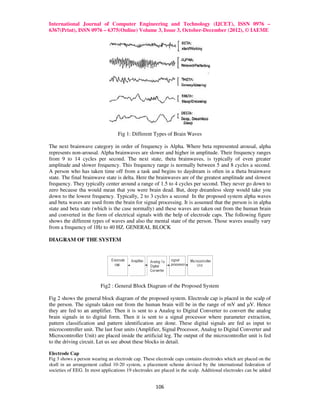
                                  Fig 1: Different Types of Brain Waves

The next brainwave category in order of frequency is Alpha. Where beta represented arousal, alpha
represents non-arousal. Alpha brainwaves are slower and higher in amplitude. Their frequency ranges
from 9 to 14 cycles per second. The next state, theta brainwaves, is typically of even greater
amplitude and slower frequency. This frequency range is normally between 5 and 8 cycles a second.
A person who has taken time off from a task and begins to daydream is often in a theta brainwave
state. The final brainwave state is delta. Here the brainwaves are of the greatest amplitude and slowest
frequency. They typically center around a range of 1.5 to 4 cycles per second. They never go down to
zero because tha would mean that you were brain dead. But, deep dreamless sleep would take you
down to the lowest frequency. Typically, 2 to 3 cycles a second In the proposed system alpha waves
and beta waves are used from the brain for signal processing. It is assumed that the person is in alpha
state and beta state (which is the case normally) and these waves are taken out from the human brain
and converted in the form of electrical signals with the help of electrode caps. The following figure
shows the different types of waves and also the mental state of the person. Those waves usually vary
from a frequency of 1Hz to 40 HZ. GENERAL BLOCK

DIAGRAM OF THE SYSTEM


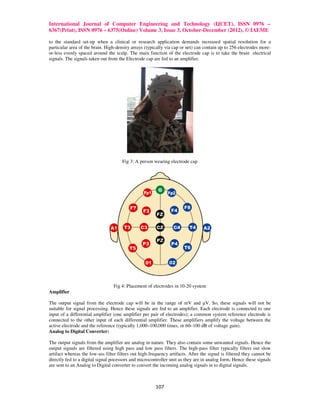
                          Fig2 : General Block Diagram of the Proposed System

Fig 2 shows the general block diagram of the proposed system. Electrode cap is placed in the scalp of
the person. The signals taken out from the human brain will be in the range of mV and µV. Hence
they are fed to an amplifier. Then it is sent to a Analog to Digital Converter to convert the analog
brain signals in to digital form. Then it is sent to a signal processor where parameter extraction,
pattern classification and pattern identification are done. These digital signals are fed as input to
microcontroller unit. The last four units (Amplifier, Signal Processor, Analog to Digital Converter and
Microcontroller Unit) are placed inside the artificial leg. The output of the microcontroller unit is fed
to the driving circuit. Let us see about these blocks in detail.

Electrode Cap
Fig 3 shows a person wearing an electrode cap. These electrode caps contains electrodes which are placed on the
skull in an arrangement called 10-20 system, a placement scheme devised by the international federation of
societies of EEG. In most applications 19 electrodes are placed in the scalp. Additional electrodes can be added


                                                     106
International Journal of Computer Engineering and Technology (IJCET), ISSN 0976 –
6367(Print), ISSN 0976 – 6375(Online) Volume 3, Issue 3, October-December (2012), © IAEME

to the standard set-up when a clinical or research application demands increased spatial resolution for a
particular area of the brain. High-density arrays (typically via cap or net) can contain up to 256 electrodes more-
or-less evenly spaced around the scalp. The main function of the electrode cap is to take the brain electrical
signals. The signals taken out from the Electrode cap are fed to an amplifier.


                                      Fig 3: A person wearing electrode cap


                                  Fig 4: Placement of electrodes in 10-20 system
Amplifier

The output signal from the electrode cap will be in the range of mV and µV. So, these signals will not be
suitable for signal processing. Hence these signals are fed to an amplifier. Each electrode is connected to one
input of a differential amplifier (one amplifier per pair of electrodes); a common system reference electrode is
connected to the other input of each differential amplifier. These amplifiers amplify the voltage between the
active electrode and the reference (typically 1,000–100,000 times, or 60–100 dB of voltage gain).
Analog to Digital Converter:

The output signals from the amplifier are analog in nature. They also contain some unwanted signals. Hence the
output signals are filtered using high pass and low pass filters. The high-pass filter typically filters out slow
artifact whereas the low-ass filter filters out high-frequency artifacts. After the signal is filtered they cannot be
directly fed to a digital signal pocessors and microcontroller unit as they are in analog form. Hence these signals
are sent to an Analog to Digital converter to convert the incoming analog signals in to digital signals.


                                                        107
International Journal of Computer Engineering and Technology (IJCET), ISSN 0976 –
6367(Print), ISSN 0976 – 6375(Online) Volume 3, Issue 3, October-December (2012), © IAEME

Signal Processor:

Using the output signal from the A/D converter, parameter extraction, pattern classification and pattern
identification are done. Then the signals are fed to a Fast Fourier Transform Unit. This is done to simplify the
calculations. An FFT algorithm computes the result in O (N log N) operations instead of O (N2) operations. The
output signals from the signal processor are fed to a Microcontroller unit.

Microcontroller unit:

The output signals from the signal processor are fed to a microcontroller unit. This microcontroller unit
performs the robotic operation with the help of a stepper motor. It will control the operations such as walking,
running, etc depending upon the input signal. For different patterns of input signals it will be preprogrammed to
do a specific operation. The reference signal will be already stored in the microcontroller memory in digital
form. Usually an 8 bit or a 16 bit microcontroller is preferred depending upon the number of operations to be
performed. The complexity of the microcontroller programming increases with the number of operations which
has to be performed.

Working of the Proposed System:
For every human activity the brain waves changes its pattern. For example, if a person moves his/her hands then
a specific pattern of brain wave is obtained and if the same person moves his/her legs then a different pattern of
brain wave is obtained. Even if a person thinks of moving his/her legs a brain wave of specific pattern is
produced and it is sent to the legs and then the operation of moving the legs is performed. The same brain waves
are produced even for a person who is not having his/her legs. But the operation of moving the legs will not be
performed due to the absence of legs. So, just by thinking of moving the legs, a brain wave which is capable of
performing a specific operation is generated in the brain. Due to the lack of the appropriate system, the activity
will not be performed successfully. In the proposed system, the brain waves are pre-recorded for each operation
to be performed and these waves are used as reference signals. These signals are stored in the microcontroller
memory. For each reference signal in the microcontroller memory, the robotic leg is pre-programmed to do a
specific peration. When the reference signal matches with the actual signal from the user’s brain, the robotic leg
will do the pre-programmed operation with the help of the microcontroller. For example, let us say that the user
is thinking of walking. So a brain wave will be produced. These waves are processed and then it is converted in
to digital signals. These signals are compared with the pre-recorded reference signals and a match in the signal
pattern will be found in the microcontroller. The operation for this particular pre-recorded signal will be pre-
programmed in the microcontroller circuit i.e. walking and thus the microcontroller will send the control signal
to the artificial robotic leg and the robotic leg will perform the required operation. Usually a stepper motor
controlled robotic leg is used for this purpose. Similarly to walking, other operations can also be performed
using the artificial leg. This system is very user friendly and the system can be designed according to the user’s
requirements i.e. the number of operations required for the user can be fixed by him and the system can be
designed accordingly. So the number of operations that has to be performed by the leg can be increased or
decreased and the complexity of the design varies accordingly. This idea can be extended for both the legs and
both the legs can be made to do operations like walk, run etc simultaneously. Thus the system is versatile. This
system is hundred percent feasible in the real time environment and it can be implanted to any human
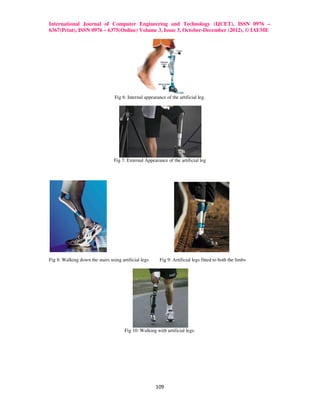
irrespective of their age. Figure 5, 6, 7, 8, 9 and 10 shows some of the pictures of artificial legs.


                                   Fig 5: Proposed Model of the artificial legs


                                                      108
International Journal of Computer Engineering and Technology (IJCET), ISSN 0976 –
6367(Print), ISSN 0976 – 6375(Online) Volume 3, Issue 3, October-December (2012), © IAEME


                                  Fig 6: Internal appearance of the artificial leg.


                                 Fig 7: External Appearance of the artificial leg


Fig 8: Walking down the stairs using artificial legs      Fig 9: Artificial legs fitted to both the limbs


                                       Fig 10: Walking with artificial legs.


                                                        109
International Journal of Computer Engineering and Technology (IJCET), ISSN 0976 –
6367(Print), ISSN 0976 – 6375(Online) Volume 3, Issue 3, October-December (2012), © IAEME

Difference between the Brain Controlled Artificial legs and the Normal Artificial Legs


        Brain              Controlled   Normal Artificial Legs
        Artificial
        Legs

        1. Ease of Construction         Complex in construction

        Cost is not more                Cost is about $80,000-
        than Rs.5,00,000                $90,000(Rs.35,00,000 to
                                        Rs.40,00,000)

        User can have full              User cannot have full control
        control over the artificial     over the artificial leg.
        leg.

        Semi-Automatic                  Fully automatic
        Requires simple                 Requires complex control
        control unit.                   unit.

        Sensors are absent              Sensors are present

Normal Artificial legs

Normal Artificial Legs, available in the market, is very costly. They use a group of sensors and a
complex algorithm for their operation which makes the existing system very costly. This disadvantage
has been overcome in the Brain Controlled Artificial Legs as they don’t use any sensors for their
operation. Moreover the normal artificial legs are 100% dynamic in operation. Hence the chance of
occurrence of an error is more in those systems. External appearance and output of both the legs are
same. But the method of operation is different. Hence the Brain Controlled Artificial Legs are cost
effective.


CONCLUSION

Forty years ago, the technology was so basic. Newton said. “Leg sockets were made out of wood,
offering the equivalent of a door hinge at the knee” But with the recent advancement in the
technology, Brain Controlled Artificial leg can be made as a reality. The performance of the proposed
system will be better than the existing artificial legs as the user has full control over the Brain
Controlled Artificial Legs. Hence it behaves like a normal human leg. The builtin battery lasts
anywhere from 25 to 40 hours so it can support a full day’s activity. The recharge can be performed
overnight or while traveling in a car via a cigarette lighter adapter. The cost of the proposed system is
found to be very less when compared to the existing ones. So, even the middle class people who
cannot purchase the existing artificial legs can make use of this proposed system. With this system life
can be made easier for the handicapped persons and they can also do their day-to-day activities
normally without any difficulties.

REFERENCES

1. “Digital Signal Processing Principles, Algorithms and Applications” by J.G.Proakis and
D.G.Manolakis.
2. “Digital Signal Processing: Principles, Devices and Applications” by Norman Barrie jones and
J.D.Mack Watson.
3. “A guide to Methods in the Bio-Medical Sciences” by Ronald B.Corley.
4. “Handbook of Bio-Medical Instrumentation” by R.S.Khandpur.


                                                          110
International Journal of Computer Engineering and Technology (IJCET), ISSN 0976 –
6367(Print), ISSN 0976 – 6375(Online) Volume 3, Issue 3, October-December (2012), © IAEME

5. “Integrated Electronics: Analog and Digital Circuits and System” by Jacob Millman and Christos
C.Halkias.
6. http://www.wikipedia.org
7. http://www.ece.ubc.ca
8. http://www.electrodesales.com


AUTHORS

                 K.Vikram is working as a Vice-Principal at Medak College of Engineering and
                 Technology (MCET), Hyderabad, India. He has received MCA and ME.(Computer
                 Science and Engineering) from Anna University. Presently, he is a Research
                 Scholar. He has published and presented good number of technical papers in
                 National and International Conferences. His main research interests are Software
                 Engineering, Data Mining, and Network Security.


                 Neeraj Upadyay is working as a Dean of CSE Dept. at JBIET. He has received
                B.Tech and MS.(Computer Science and Engineering) from BITS and Ph.D. . He
                has published and presented good number of technical papers in National and
                International Conferences. His main research interests are Software Engineering,
                Data Mining, and Network Security.


                 Mr. Raju is working as a Asst. Professor in CSE Dept. at JBREC. His interest
                 research areas are Datamining , Image processing . He guided B.tech Level &
                 M.Tech Level Projects


                 Mr. Srinivas is working as a Asst. Professor in CSE Dept. at JBREC. His interest
                 research areas are Datamining , Image processing . He guided B.tech Level &
                 M.Tech Level Projects


                                              111

Brain controlled artificial legs

  • 1.
    INTERNATIONAL JOURNAL OFCOMPUTER ENGINEERING & International Journal of Computer Engineering and Technology (IJCET), ISSN 0976 – 6367(Print), ISSN 0976 – 6375(Online) Volume 3, Issue 3, October-December (2012), © IAEME TECHNOLOGY (IJCET) ISSN 0976 – 6367(Print) ISSN 0976 – 6375(Online) Volume 3, Issue 3, October - December (2012), pp. 104-111 IJCET © IAEME: www.iaeme.com/ijcet.asp Journal Impact Factor (2012): 3.9580 (Calculated by GISI) ©IAEME www.jifactor.com BRAIN CONTROLLED ARTIFICIAL LEGS K.Vikram Associate prof, Medak College of Engineering Siddipet, Medak (D) Dr. Niraj Upapadyaya Dean of CSE & IT JBIET, Hyderabad Mr. Srinivas Asst.Prof. of Computer Science Dept. JBREC Mr.R.Raju Asst.Prof of Computer Science Dept. JBREC ABSTRACT This paper describes a brain controlled robotic leg which is designed to perform the normal operations of a human leg. After implanting this leg in a human, the leg can be controlled with the help of user’s brain signals alone. This leg behaves similar to a normal human leg and it can perform operation like walking, running, climbing stairs etc. The entire systemis controlled with the help of advanced microcontrollers and digital signal processors. The signals are taken out from the human brain with the help of electroencephalography technique. The person can perform operations like walking, running etc just by their thought. This system will be very much suitable for those who lost their legs in accidents and the proposed system is hundred percent feasible in the real time environment with the currently available technology. The Brain Controlled Artificial Legs are very much cost effective when compared to the normal Artificial legs which is available in the market. The reduction in cost of the proposed system is found to be above 80% when compared to the existing system. Moreover, the user can have full control over the artificial legs which is not possible in the existing system. INTRODUCTION A brain-computer interface (BCI), sometimes called a direct neural interface or a brain-machine interface, is a direct communication pathway between a human or animal brain and an external device. In this definition, the word brain means the brain or nervous system of an organic life form 104
  • 2.
    International Journal ofComputer Engineering and Technology (IJCET), ISSN 0976 – 6367(Print), ISSN 0976 – 6375(Online) Volume 3, Issue 3, October-December (2012), © IAEME rather than the mind. Computer means any processing or computational device, from simple circuits to the complex microprocessors and microcontrollers. An interesting question for the development of a BCI is how to handle two learning systems: The machine should learn to discriminate between different patterns of brain activity as accurate as possible and the user of the BCI should learn to perform different mental tasks in order to produce distinct brain signals. BCI research makes high demands on the system and software used. Parameter extraction, pattern recognition and classification are the main tasks to be performed in a brain signals. In this paper it is assumed that the user of this system has one leg which is functioning fully and the system is designed accordingly. This system can be extended for both the legs and it is not limited to the basic operation of human legs such as walking, running, climbing stairs etc. It can also perform operations like cycling, hopping etc BRAINWAVES Electrical activity emanating from the brain is displayed in the form of brainwaves. There are four categories of these brainwaves ranging from the most activity to the least activity. When the brain is aroused and actively engaged in mental activities, it generates beta waves. These beta waves are of relatively low amplitude, and are the fastest of the four different brainwaves. The frequency of beta waves ranges from 15 to 40 cycles a second. 105
  • 3.
    International Journal ofComputer Engineering and Technology (IJCET), ISSN 0976 – 6367(Print), ISSN 0976 – 6375(Online) Volume 3, Issue 3, October-December (2012), © IAEME Fig 1: Different Types of Brain Waves The next brainwave category in order of frequency is Alpha. Where beta represented arousal, alpha represents non-arousal. Alpha brainwaves are slower and higher in amplitude. Their frequency ranges from 9 to 14 cycles per second. The next state, theta brainwaves, is typically of even greater amplitude and slower frequency. This frequency range is normally between 5 and 8 cycles a second. A person who has taken time off from a task and begins to daydream is often in a theta brainwave state. The final brainwave state is delta. Here the brainwaves are of the greatest amplitude and slowest frequency. They typically center around a range of 1.5 to 4 cycles per second. They never go down to zero because tha would mean that you were brain dead. But, deep dreamless sleep would take you down to the lowest frequency. Typically, 2 to 3 cycles a second In the proposed system alpha waves and beta waves are used from the brain for signal processing. It is assumed that the person is in alpha state and beta state (which is the case normally) and these waves are taken out from the human brain and converted in the form of electrical signals with the help of electrode caps. The following figure shows the different types of waves and also the mental state of the person. Those waves usually vary from a frequency of 1Hz to 40 HZ. GENERAL BLOCK DIAGRAM OF THE SYSTEM Fig2 : General Block Diagram of the Proposed System Fig 2 shows the general block diagram of the proposed system. Electrode cap is placed in the scalp of the person. The signals taken out from the human brain will be in the range of mV and µV. Hence they are fed to an amplifier. Then it is sent to a Analog to Digital Converter to convert the analog brain signals in to digital form. Then it is sent to a signal processor where parameter extraction, pattern classification and pattern identification are done. These digital signals are fed as input to microcontroller unit. The last four units (Amplifier, Signal Processor, Analog to Digital Converter and Microcontroller Unit) are placed inside the artificial leg. The output of the microcontroller unit is fed to the driving circuit. Let us see about these blocks in detail. Electrode Cap Fig 3 shows a person wearing an electrode cap. These electrode caps contains electrodes which are placed on the skull in an arrangement called 10-20 system, a placement scheme devised by the international federation of societies of EEG. In most applications 19 electrodes are placed in the scalp. Additional electrodes can be added 106
  • 4.
    International Journal ofComputer Engineering and Technology (IJCET), ISSN 0976 – 6367(Print), ISSN 0976 – 6375(Online) Volume 3, Issue 3, October-December (2012), © IAEME to the standard set-up when a clinical or research application demands increased spatial resolution for a particular area of the brain. High-density arrays (typically via cap or net) can contain up to 256 electrodes more- or-less evenly spaced around the scalp. The main function of the electrode cap is to take the brain electrical signals. The signals taken out from the Electrode cap are fed to an amplifier. Fig 3: A person wearing electrode cap Fig 4: Placement of electrodes in 10-20 system Amplifier The output signal from the electrode cap will be in the range of mV and µV. So, these signals will not be suitable for signal processing. Hence these signals are fed to an amplifier. Each electrode is connected to one input of a differential amplifier (one amplifier per pair of electrodes); a common system reference electrode is connected to the other input of each differential amplifier. These amplifiers amplify the voltage between the active electrode and the reference (typically 1,000–100,000 times, or 60–100 dB of voltage gain). Analog to Digital Converter: The output signals from the amplifier are analog in nature. They also contain some unwanted signals. Hence the output signals are filtered using high pass and low pass filters. The high-pass filter typically filters out slow artifact whereas the low-ass filter filters out high-frequency artifacts. After the signal is filtered they cannot be directly fed to a digital signal pocessors and microcontroller unit as they are in analog form. Hence these signals are sent to an Analog to Digital converter to convert the incoming analog signals in to digital signals. 107
  • 5.
    International Journal ofComputer Engineering and Technology (IJCET), ISSN 0976 – 6367(Print), ISSN 0976 – 6375(Online) Volume 3, Issue 3, October-December (2012), © IAEME Signal Processor: Using the output signal from the A/D converter, parameter extraction, pattern classification and pattern identification are done. Then the signals are fed to a Fast Fourier Transform Unit. This is done to simplify the calculations. An FFT algorithm computes the result in O (N log N) operations instead of O (N2) operations. The output signals from the signal processor are fed to a Microcontroller unit. Microcontroller unit: The output signals from the signal processor are fed to a microcontroller unit. This microcontroller unit performs the robotic operation with the help of a stepper motor. It will control the operations such as walking, running, etc depending upon the input signal. For different patterns of input signals it will be preprogrammed to do a specific operation. The reference signal will be already stored in the microcontroller memory in digital form. Usually an 8 bit or a 16 bit microcontroller is preferred depending upon the number of operations to be performed. The complexity of the microcontroller programming increases with the number of operations which has to be performed. Working of the Proposed System: For every human activity the brain waves changes its pattern. For example, if a person moves his/her hands then a specific pattern of brain wave is obtained and if the same person moves his/her legs then a different pattern of brain wave is obtained. Even if a person thinks of moving his/her legs a brain wave of specific pattern is produced and it is sent to the legs and then the operation of moving the legs is performed. The same brain waves are produced even for a person who is not having his/her legs. But the operation of moving the legs will not be performed due to the absence of legs. So, just by thinking of moving the legs, a brain wave which is capable of performing a specific operation is generated in the brain. Due to the lack of the appropriate system, the activity will not be performed successfully. In the proposed system, the brain waves are pre-recorded for each operation to be performed and these waves are used as reference signals. These signals are stored in the microcontroller memory. For each reference signal in the microcontroller memory, the robotic leg is pre-programmed to do a specific peration. When the reference signal matches with the actual signal from the user’s brain, the robotic leg will do the pre-programmed operation with the help of the microcontroller. For example, let us say that the user is thinking of walking. So a brain wave will be produced. These waves are processed and then it is converted in to digital signals. These signals are compared with the pre-recorded reference signals and a match in the signal pattern will be found in the microcontroller. The operation for this particular pre-recorded signal will be pre- programmed in the microcontroller circuit i.e. walking and thus the microcontroller will send the control signal to the artificial robotic leg and the robotic leg will perform the required operation. Usually a stepper motor controlled robotic leg is used for this purpose. Similarly to walking, other operations can also be performed using the artificial leg. This system is very user friendly and the system can be designed according to the user’s requirements i.e. the number of operations required for the user can be fixed by him and the system can be designed accordingly. So the number of operations that has to be performed by the leg can be increased or decreased and the complexity of the design varies accordingly. This idea can be extended for both the legs and both the legs can be made to do operations like walk, run etc simultaneously. Thus the system is versatile. This system is hundred percent feasible in the real time environment and it can be implanted to any human irrespective of their age. Figure 5, 6, 7, 8, 9 and 10 shows some of the pictures of artificial legs. Fig 5: Proposed Model of the artificial legs 108
  • 6.
    International Journal ofComputer Engineering and Technology (IJCET), ISSN 0976 – 6367(Print), ISSN 0976 – 6375(Online) Volume 3, Issue 3, October-December (2012), © IAEME Fig 6: Internal appearance of the artificial leg. Fig 7: External Appearance of the artificial leg Fig 8: Walking down the stairs using artificial legs Fig 9: Artificial legs fitted to both the limbs Fig 10: Walking with artificial legs. 109
  • 7.
    International Journal ofComputer Engineering and Technology (IJCET), ISSN 0976 – 6367(Print), ISSN 0976 – 6375(Online) Volume 3, Issue 3, October-December (2012), © IAEME Difference between the Brain Controlled Artificial legs and the Normal Artificial Legs Brain Controlled Normal Artificial Legs Artificial Legs 1. Ease of Construction Complex in construction Cost is not more Cost is about $80,000- than Rs.5,00,000 $90,000(Rs.35,00,000 to Rs.40,00,000) User can have full User cannot have full control control over the artificial over the artificial leg. leg. Semi-Automatic Fully automatic Requires simple Requires complex control control unit. unit. Sensors are absent Sensors are present Normal Artificial legs Normal Artificial Legs, available in the market, is very costly. They use a group of sensors and a complex algorithm for their operation which makes the existing system very costly. This disadvantage has been overcome in the Brain Controlled Artificial Legs as they don’t use any sensors for their operation. Moreover the normal artificial legs are 100% dynamic in operation. Hence the chance of occurrence of an error is more in those systems. External appearance and output of both the legs are same. But the method of operation is different. Hence the Brain Controlled Artificial Legs are cost effective. CONCLUSION Forty years ago, the technology was so basic. Newton said. “Leg sockets were made out of wood, offering the equivalent of a door hinge at the knee” But with the recent advancement in the technology, Brain Controlled Artificial leg can be made as a reality. The performance of the proposed system will be better than the existing artificial legs as the user has full control over the Brain Controlled Artificial Legs. Hence it behaves like a normal human leg. The builtin battery lasts anywhere from 25 to 40 hours so it can support a full day’s activity. The recharge can be performed overnight or while traveling in a car via a cigarette lighter adapter. The cost of the proposed system is found to be very less when compared to the existing ones. So, even the middle class people who cannot purchase the existing artificial legs can make use of this proposed system. With this system life can be made easier for the handicapped persons and they can also do their day-to-day activities normally without any difficulties. REFERENCES 1. “Digital Signal Processing Principles, Algorithms and Applications” by J.G.Proakis and D.G.Manolakis. 2. “Digital Signal Processing: Principles, Devices and Applications” by Norman Barrie jones and J.D.Mack Watson. 3. “A guide to Methods in the Bio-Medical Sciences” by Ronald B.Corley. 4. “Handbook of Bio-Medical Instrumentation” by R.S.Khandpur. 110
  • 8.
    International Journal ofComputer Engineering and Technology (IJCET), ISSN 0976 – 6367(Print), ISSN 0976 – 6375(Online) Volume 3, Issue 3, October-December (2012), © IAEME 5. “Integrated Electronics: Analog and Digital Circuits and System” by Jacob Millman and Christos C.Halkias. 6. http://www.wikipedia.org 7. http://www.ece.ubc.ca 8. http://www.electrodesales.com AUTHORS K.Vikram is working as a Vice-Principal at Medak College of Engineering and Technology (MCET), Hyderabad, India. He has received MCA and ME.(Computer Science and Engineering) from Anna University. Presently, he is a Research Scholar. He has published and presented good number of technical papers in National and International Conferences. His main research interests are Software Engineering, Data Mining, and Network Security. Neeraj Upadyay is working as a Dean of CSE Dept. at JBIET. He has received B.Tech and MS.(Computer Science and Engineering) from BITS and Ph.D. . He has published and presented good number of technical papers in National and International Conferences. His main research interests are Software Engineering, Data Mining, and Network Security. Mr. Raju is working as a Asst. Professor in CSE Dept. at JBREC. His interest research areas are Datamining , Image processing . He guided B.tech Level & M.Tech Level Projects Mr. Srinivas is working as a Asst. Professor in CSE Dept. at JBREC. His interest research areas are Datamining , Image processing . He guided B.tech Level & M.Tech Level Projects 111