Designing a CLIL Unit © Isabel Pérez Torres
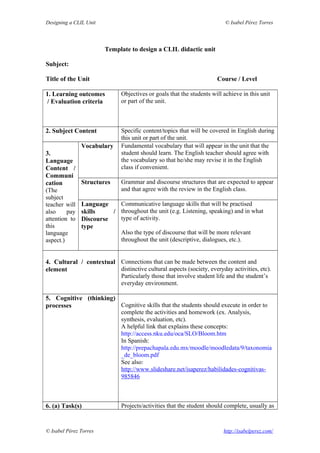
Template to design a CLIL didactic unit
Subject:
Title of the Unit Course / Level
1. Learning outcomes
/ Evaluation criteria
Objectives or goals that the students will achieve in this unit
or part of the unit.
2. Subject Content Specific content/topics that will be covered in English during
this unit or part of the unit.
3.
Language
Content /
Communi
cation
(The
subject
teacher will
also pay
attention to
this
language
aspect.)
Vocabulary Fundamental vocabulary that will appear in the unit that the
student should learn. The English teacher should agree with
the vocabulary so that he/she may revise it in the English
class if convenient.
Structures Grammar and discourse structures that are expected to appear
and that agree with the review in the English class.
Language
skills /
Discourse
type
Communicative language skills that will be practised
throughout the unit (e.g. Listening, speaking) and in what
type of activity.
Also the type of discourse that will be more relevant
throughout the unit (descriptive, dialogues, etc.).
4. Cultural / contextual
element
Connections that can be made between the content and
distinctive cultural aspects (society, everyday activities, etc).
Particularly those that involve student life and the student’s
everyday environment.
5. Cognitive (thinking)
processes Cognitive skills that the students should execute in order to
complete the activities and homework (ex. Analysis,
synthesis, evaluation, etc).
A helpful link that explains these concepts:
http://access.nku.edu/oca/SLO/Bloom.htm
In Spanish:
http://prepachapala.edu.mx/moodle/moodledata/9/taxonomia
_de_bloom.pdf
See also:
http://www.slideshare.net/isaperez/habilidades-cognitivas-
985846
6. (a) Task(s) Projects/activities that the student should complete, usually as
© Isabel Pérez Torres http://isabelperez.com/
Designing a CLIL Unit © Isabel Pérez Torres
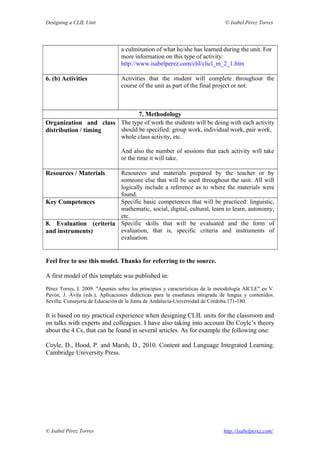
a culmination of what he/she has learned during the unit. For
more information on this type of activity:
http://www.isabelperez.com/clil/clicl_m_2_1.htm
6. (b) Activities Activities that the student will complete throughout the
course of the unit as part of the final project or not.
7. Methodology
Organization and class
distribution / timing
The type of work the students will be doing with each activity
should be specified: group work, individual work, pair work,
whole class activity, etc.
And also the number of sessions that each activity will take
or the time it will take.
Resources / Materials Resources and materials prepared by the teacher or by
someone else that will be used throughout the unit. All will
logically include a reference as to where the materials were
found.
Key Competences Specific basic competences that will be practiced: linguistic,
mathematic, social, digital, cultural, learn to learn, autonomy,
etc.
8. Evaluation (criteria
and instruments)
Specific skills that will be evaluated and the form of
evaluation, that is, specific criteria and instruments of
evaluation.
Feel free to use this model. Thanks for referring to the source.
A first model of this template was published in:
Pérez Torres, I. 2009. "Apuntes sobre los principios y características de la metodología AICLE" en V.
Pavón, J. Ávila (eds.), Aplicaciones didácticas para la enseñanza integrada de lengua y contenidos.
Sevilla: Consejería de Educación de la Junta de Andalucía-Universidad de Córdoba.171-180.
It is based on my practical experience when designing CLIL units for the classroom and
on talks with experts and colleagues. I have also taking into account Do Coyle’s theory
about the 4 Cs, that can be found in several articles. As for example the following one:
Coyle, D., Hood, P. and Marsh, D., 2010. Content and Language Integrated Learning.
Cambridge University Press.
© Isabel Pérez Torres http://isabelperez.com/

Design a clill unit

  • 1.
    Designing a CLILUnit © Isabel Pérez Torres Template to design a CLIL didactic unit Subject: Title of the Unit Course / Level 1. Learning outcomes / Evaluation criteria Objectives or goals that the students will achieve in this unit or part of the unit. 2. Subject Content Specific content/topics that will be covered in English during this unit or part of the unit. 3. Language Content / Communi cation (The subject teacher will also pay attention to this language aspect.) Vocabulary Fundamental vocabulary that will appear in the unit that the student should learn. The English teacher should agree with the vocabulary so that he/she may revise it in the English class if convenient. Structures Grammar and discourse structures that are expected to appear and that agree with the review in the English class. Language skills / Discourse type Communicative language skills that will be practised throughout the unit (e.g. Listening, speaking) and in what type of activity. Also the type of discourse that will be more relevant throughout the unit (descriptive, dialogues, etc.). 4. Cultural / contextual element Connections that can be made between the content and distinctive cultural aspects (society, everyday activities, etc). Particularly those that involve student life and the student’s everyday environment. 5. Cognitive (thinking) processes Cognitive skills that the students should execute in order to complete the activities and homework (ex. Analysis, synthesis, evaluation, etc). A helpful link that explains these concepts: http://access.nku.edu/oca/SLO/Bloom.htm In Spanish: http://prepachapala.edu.mx/moodle/moodledata/9/taxonomia _de_bloom.pdf See also: http://www.slideshare.net/isaperez/habilidades-cognitivas- 985846 6. (a) Task(s) Projects/activities that the student should complete, usually as © Isabel Pérez Torres http://isabelperez.com/
  • 2.
    Designing a CLILUnit © Isabel Pérez Torres a culmination of what he/she has learned during the unit. For more information on this type of activity: http://www.isabelperez.com/clil/clicl_m_2_1.htm 6. (b) Activities Activities that the student will complete throughout the course of the unit as part of the final project or not. 7. Methodology Organization and class distribution / timing The type of work the students will be doing with each activity should be specified: group work, individual work, pair work, whole class activity, etc. And also the number of sessions that each activity will take or the time it will take. Resources / Materials Resources and materials prepared by the teacher or by someone else that will be used throughout the unit. All will logically include a reference as to where the materials were found. Key Competences Specific basic competences that will be practiced: linguistic, mathematic, social, digital, cultural, learn to learn, autonomy, etc. 8. Evaluation (criteria and instruments) Specific skills that will be evaluated and the form of evaluation, that is, specific criteria and instruments of evaluation. Feel free to use this model. Thanks for referring to the source. A first model of this template was published in: Pérez Torres, I. 2009. "Apuntes sobre los principios y características de la metodología AICLE" en V. Pavón, J. Ávila (eds.), Aplicaciones didácticas para la enseñanza integrada de lengua y contenidos. Sevilla: Consejería de Educación de la Junta de Andalucía-Universidad de Córdoba.171-180. It is based on my practical experience when designing CLIL units for the classroom and on talks with experts and colleagues. I have also taking into account Do Coyle’s theory about the 4 Cs, that can be found in several articles. As for example the following one: Coyle, D., Hood, P. and Marsh, D., 2010. Content and Language Integrated Learning. Cambridge University Press. © Isabel Pérez Torres http://isabelperez.com/