UNIT 6:              CYCLE: 1st          LEVEL: 2sr          NUMBER OF PUPILS: 18             TERM: second      TIMING: five sessions
invents              Cycle               Course                                               term              a week of 45 minutes
                                                                                                                each)
                                                          TEACHER: DNL teacher
                                               OBJECTIVES                                            ASSESSMENT CRITERIA
CYCLE OBJECTIVES                                      DIDACTIC OBJECTIVES
                                                CONTENT OBJECTIVES:
2. Identificar los principales elementos del entorno                                           CONTENT
natural, social y cultural y comprender sus     • To recognise common types of                 • Understands that our senses tell us
características desde el análisis de su organización e
                                                  materials and their properties.                about the world around us.
interacciones y progresando en el dominio de ámbitos
espaciales cada vez más complejos.
                                                  To differenciate between discoveries         • Identifies the senses and sense
                                                  and inventions.
3. Analizar algunas manifestaciones de la intervención                                           organs.
humana en el medio, valorándola críticamente y    To identify materials for making             • Learns we perceive shapes and
                                                  clothes and their properties.
adoptando un comportamiento en la vida cotidiana de                                              colours with our sense of sight.
                                                • To make predictions about the results
defensa y recuperación del equilibrio ecológico y de
                                                                                               • Learns we perceive hardness and
conservación del patrimonio natural.              of an experiment.
5.1. Participar en actividades grupales adoptando un                                             texture with our sense of touch.
                                                • To find out about certain inventions         • Learns we perceive flavours with our
comportamiento responsable solidario, de diálogo y
                                                  and discoveries which have changed             sense of taste.
de respeto hacia las normas establecidas.
                                                  our lives considerably.
6.1. Elaborar proyectos sencillos de manera individual                                         • Learns we perceive odours with our
                                                • To appreciate the usefulness of
y grupal a partir de un interrogante surgido. Buscar                                             sense of smell.
información utilizando distintas estrategias de   inventions in our daily lives.
                                                • To identify the function and use of
búsqueda y tratamiento de la información ( esquema,                                            • Learns we perceive sounds with our
subrayado, resumen… ) y presentar las conclusionescertain inventions.                            sense of hearing.
obtenidas con distintos códigos ( orales, escritos y de
                                                • To recognise that technological              • Recognises the importance of all the
imágenes ).                                       advances improve the quality of                senses for perceiving the external
7.1. Utilizar las tecnologías de la información, los                                             environment.
                                                  human life.
recursos de la biblioteca de aula y del centro y la
                                                • To recognise the usefulness of               • Shows interest in protecting the health
comunicación      para    la    búsqueda,       selección,
organización e interpretación de informaciones    electricity and plastic in our daily           of our sense organs.
                                                  lives.
sencillas sobre el medio físico, social y cultural.                                            • Understands and respect people who
7.2. Leer comprensiva, expresiva y críticamente • To understand that people invent               are blind or deaf.
diferentes tipos de textos con diferentes códigos,many different materials to improve          • Respects and Tolerances towards the
relacionados con los contenidos de la asignatura para
                                                  our lives.                                     disabled.
la búsqueda de información y el disfrute.
                                                • To appreciate the work of scientists.        •
                                                • To appreciate and value scientific           LANGUAGE
9. Utilizar la lengua extranjera para conocer y
comunicar los contenidos de otras áreas
                                                  discoveries and their role in human             • Uses It is to identify and describe:
                                                  life.                                              It is smooth.
                                                • To recognise the usefulness of                  • Describes what objects are made
                                                  medicines     and     other    scientific          of: The boat is made of wood.
                                                  discoveries.                                    • Uses because to give reasons:
•   To     develop       reading     with               Why can glass be dangerous?
                                                         understanding through an informative                Because it can break easily.
                                                         text.                                            • Uses the present tense: The ball
                                                     •   To apply and use some of the                        floats. I wear cotton in summer.
                                                         concepts acquired through the unit.              • Predicts outcomes of investigation:
                                                                                                             I think the stone will sink.
                                                                                                          • Uses the past tense: invented
                                                     LANGUAGE OBJECTIVES:
                                                                                                          • Uses before and after
                                                        • To use It is to identify and describe: It
                                                                                                          • Answers questions started with
                                                          is smooth.
                                                                                                             who, where, what.
                                                        • To describe what objects are made
                                                                                                      •   Uses: What is this? This is….
                                                          of: The boat is made of wood.
                                                        • To use because to give reasons:
                                                          Why can glass be dangerous?
                                                          Because it can break easily.
                                                        • To use the present tense: The ball
                                                          floats. I wear cotton in summer.
                                                        • To predict outcomes of investigation:
                                                          I think the stone will sink.
                                                        • To use the past tense: invented
                                                        • To use before and after
                                                        • To answer question started with who,
                                                          where, what.
                                                        • To use: What is this? This is….
                                                            KEY COMPETENCES
                          Learning to learn                                                        Digital ICT competence
                  Autonomy and personal initiative                                           Interpersonal and civic competence
                       Linguistic competence                                                   Cultural and artistic expression
               Knowledge and interaction with our world
                                                         CONTENTS
SCIENCE CONTENTS                                              LANGUAGE CONTENTS
  - Materials: metal, wood, paper, glass, cotton, wool, silk, • Using It is to identify and describe: It is smooth.
       plastic.                                                        •   Responding to questions beginning with can: Can you bend wood?
   -   Properties of materials: hard, smooth, transparent, soft.           No, I can’t.
   -   Able to float / sink.                                           •   Describing what objects are made of: The boat is made of wood.
   -   Record observations in simple form.                             •   To use because to give reasons: Why can glass be dangerous?
   -   Make predictions about the results of experiments.                  Because it can break easily.
   -   Show interest in carrying out experiments.
-   Inventions: electric light bulb, mop, diaper, television.   •   Using the present tense: The ball floats. I wear cotton in summer.
  -   Electricity, fire.                                          •   Predicting outcomes of investigation: I think the stone will sink.
                                                                  •   Using: what is this? This is….
                                                                  •   The use of before and after
                                                                  •   Answering question started with who, where, what.
SOCIO-CULTURAL CONCEPT:

Didactic Unit 6.Inventions.Science

  • 1.
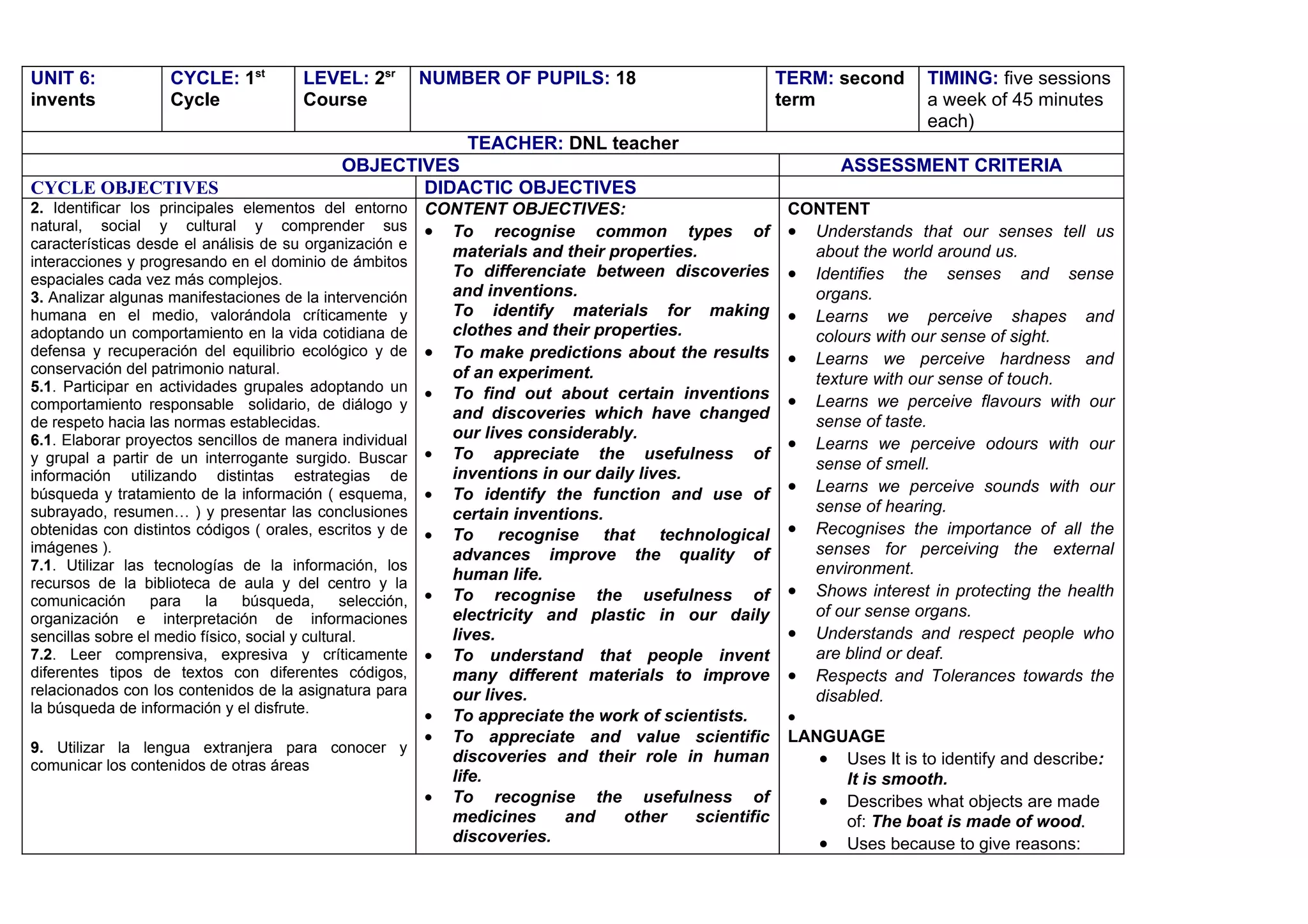
    UNIT 6: CYCLE: 1st LEVEL: 2sr NUMBER OF PUPILS: 18 TERM: second TIMING: five sessions invents Cycle Course term a week of 45 minutes each) TEACHER: DNL teacher OBJECTIVES ASSESSMENT CRITERIA CYCLE OBJECTIVES DIDACTIC OBJECTIVES CONTENT OBJECTIVES: 2. Identificar los principales elementos del entorno CONTENT natural, social y cultural y comprender sus • To recognise common types of • Understands that our senses tell us características desde el análisis de su organización e materials and their properties. about the world around us. interacciones y progresando en el dominio de ámbitos espaciales cada vez más complejos. To differenciate between discoveries • Identifies the senses and sense and inventions. 3. Analizar algunas manifestaciones de la intervención organs. humana en el medio, valorándola críticamente y To identify materials for making • Learns we perceive shapes and clothes and their properties. adoptando un comportamiento en la vida cotidiana de colours with our sense of sight. • To make predictions about the results defensa y recuperación del equilibrio ecológico y de • Learns we perceive hardness and conservación del patrimonio natural. of an experiment. 5.1. Participar en actividades grupales adoptando un texture with our sense of touch. • To find out about certain inventions • Learns we perceive flavours with our comportamiento responsable solidario, de diálogo y and discoveries which have changed sense of taste. de respeto hacia las normas establecidas. our lives considerably. 6.1. Elaborar proyectos sencillos de manera individual • Learns we perceive odours with our • To appreciate the usefulness of y grupal a partir de un interrogante surgido. Buscar sense of smell. información utilizando distintas estrategias de inventions in our daily lives. • To identify the function and use of búsqueda y tratamiento de la información ( esquema, • Learns we perceive sounds with our subrayado, resumen… ) y presentar las conclusionescertain inventions. sense of hearing. obtenidas con distintos códigos ( orales, escritos y de • To recognise that technological • Recognises the importance of all the imágenes ). advances improve the quality of senses for perceiving the external 7.1. Utilizar las tecnologías de la información, los environment. human life. recursos de la biblioteca de aula y del centro y la • To recognise the usefulness of • Shows interest in protecting the health comunicación para la búsqueda, selección, organización e interpretación de informaciones electricity and plastic in our daily of our sense organs. lives. sencillas sobre el medio físico, social y cultural. • Understands and respect people who 7.2. Leer comprensiva, expresiva y críticamente • To understand that people invent are blind or deaf. diferentes tipos de textos con diferentes códigos,many different materials to improve • Respects and Tolerances towards the relacionados con los contenidos de la asignatura para our lives. disabled. la búsqueda de información y el disfrute. • To appreciate the work of scientists. • • To appreciate and value scientific LANGUAGE 9. Utilizar la lengua extranjera para conocer y comunicar los contenidos de otras áreas discoveries and their role in human • Uses It is to identify and describe: life. It is smooth. • To recognise the usefulness of • Describes what objects are made medicines and other scientific of: The boat is made of wood. discoveries. • Uses because to give reasons:
  • 2.
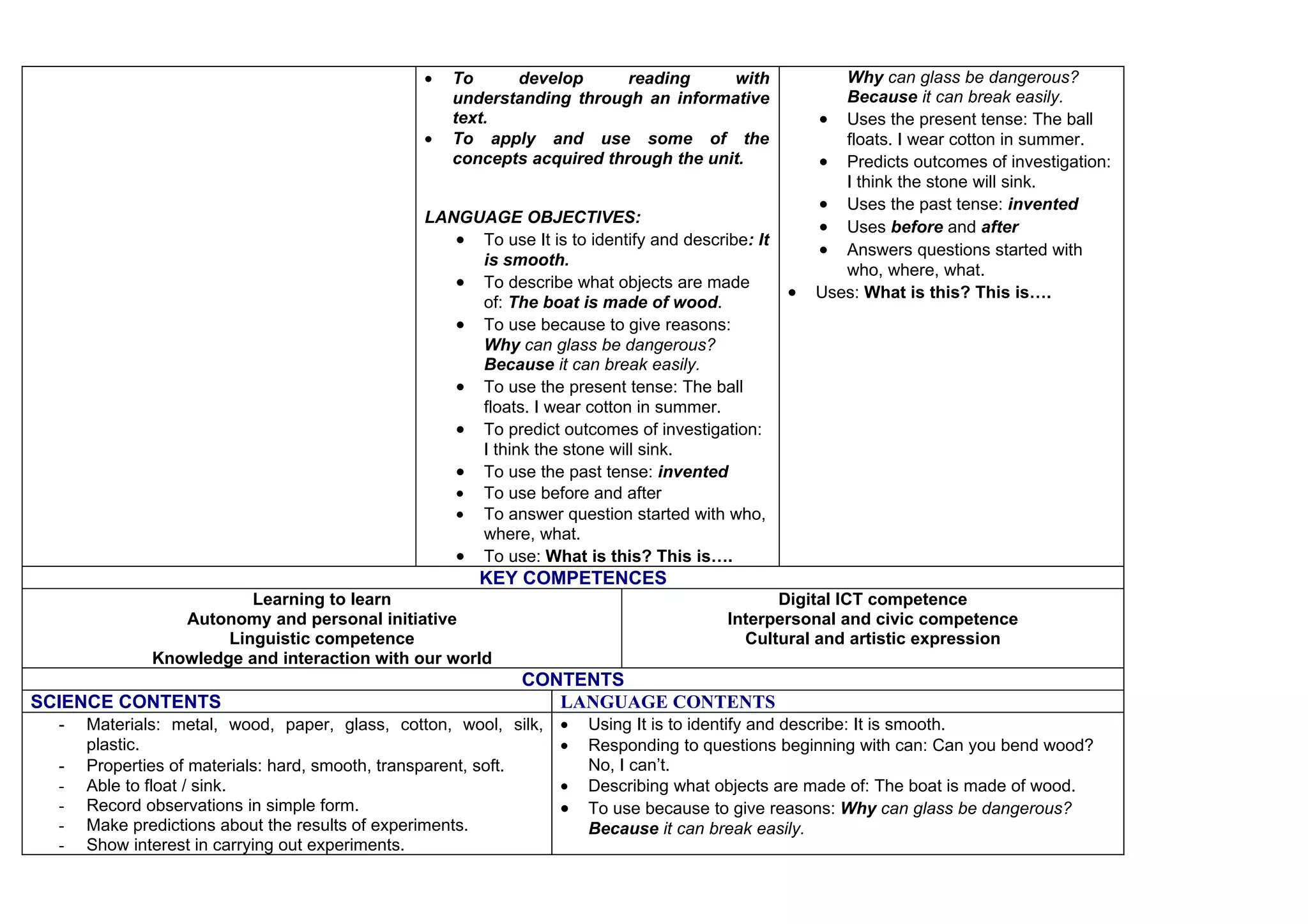
    To develop reading with Why can glass be dangerous? understanding through an informative Because it can break easily. text. • Uses the present tense: The ball • To apply and use some of the floats. I wear cotton in summer. concepts acquired through the unit. • Predicts outcomes of investigation: I think the stone will sink. • Uses the past tense: invented LANGUAGE OBJECTIVES: • Uses before and after • To use It is to identify and describe: It • Answers questions started with is smooth. who, where, what. • To describe what objects are made • Uses: What is this? This is…. of: The boat is made of wood. • To use because to give reasons: Why can glass be dangerous? Because it can break easily. • To use the present tense: The ball floats. I wear cotton in summer. • To predict outcomes of investigation: I think the stone will sink. • To use the past tense: invented • To use before and after • To answer question started with who, where, what. • To use: What is this? This is…. KEY COMPETENCES Learning to learn Digital ICT competence Autonomy and personal initiative Interpersonal and civic competence Linguistic competence Cultural and artistic expression Knowledge and interaction with our world CONTENTS SCIENCE CONTENTS LANGUAGE CONTENTS - Materials: metal, wood, paper, glass, cotton, wool, silk, • Using It is to identify and describe: It is smooth. plastic. • Responding to questions beginning with can: Can you bend wood? - Properties of materials: hard, smooth, transparent, soft. No, I can’t. - Able to float / sink. • Describing what objects are made of: The boat is made of wood. - Record observations in simple form. • To use because to give reasons: Why can glass be dangerous? - Make predictions about the results of experiments. Because it can break easily. - Show interest in carrying out experiments.
  • 3.
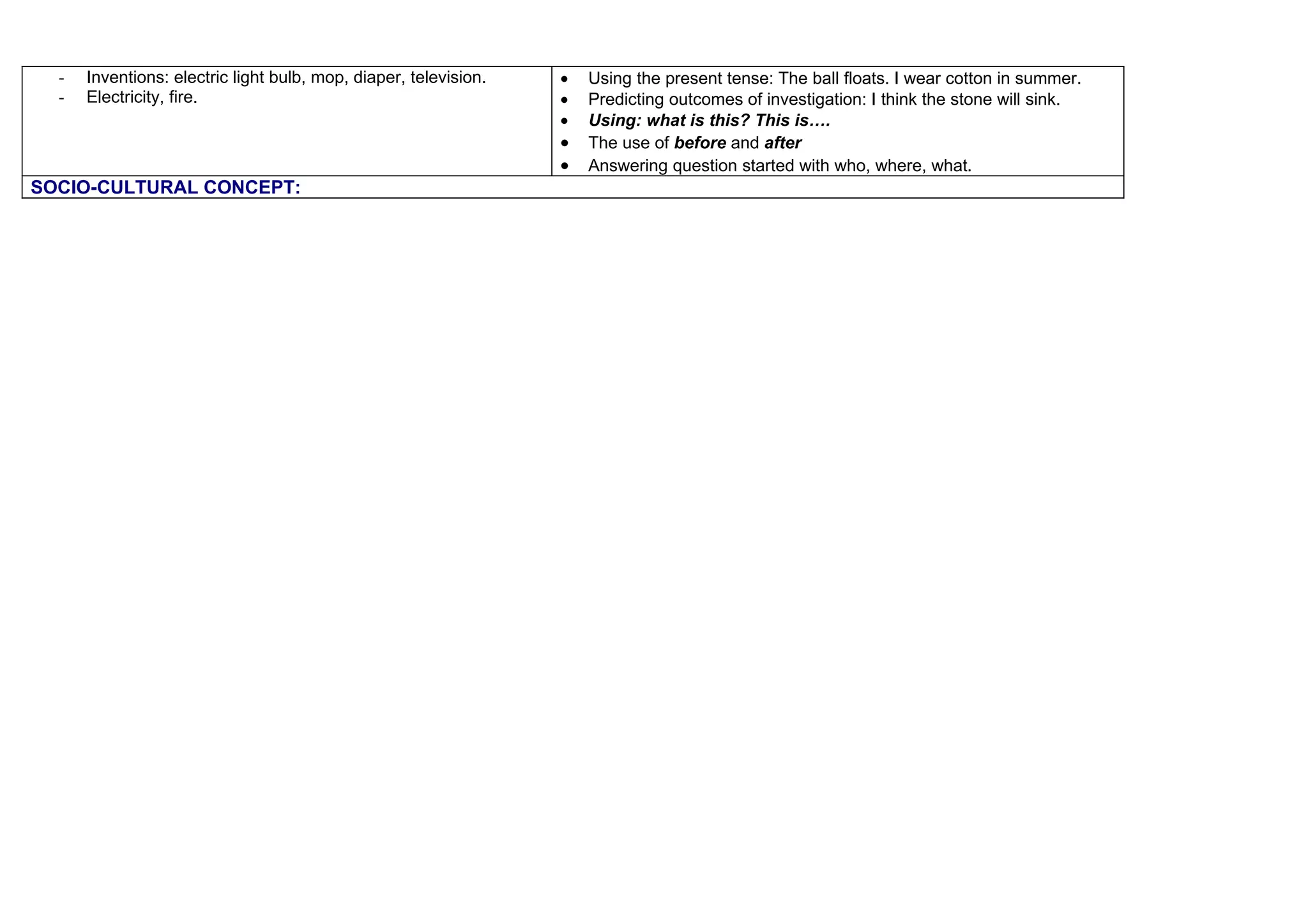
    - Inventions: electric light bulb, mop, diaper, television. • Using the present tense: The ball floats. I wear cotton in summer. - Electricity, fire. • Predicting outcomes of investigation: I think the stone will sink. • Using: what is this? This is…. • The use of before and after • Answering question started with who, where, what. SOCIO-CULTURAL CONCEPT: