Curso REA para AICLE (INTEF – 2013)

José Antonio Gutiérrez Flores

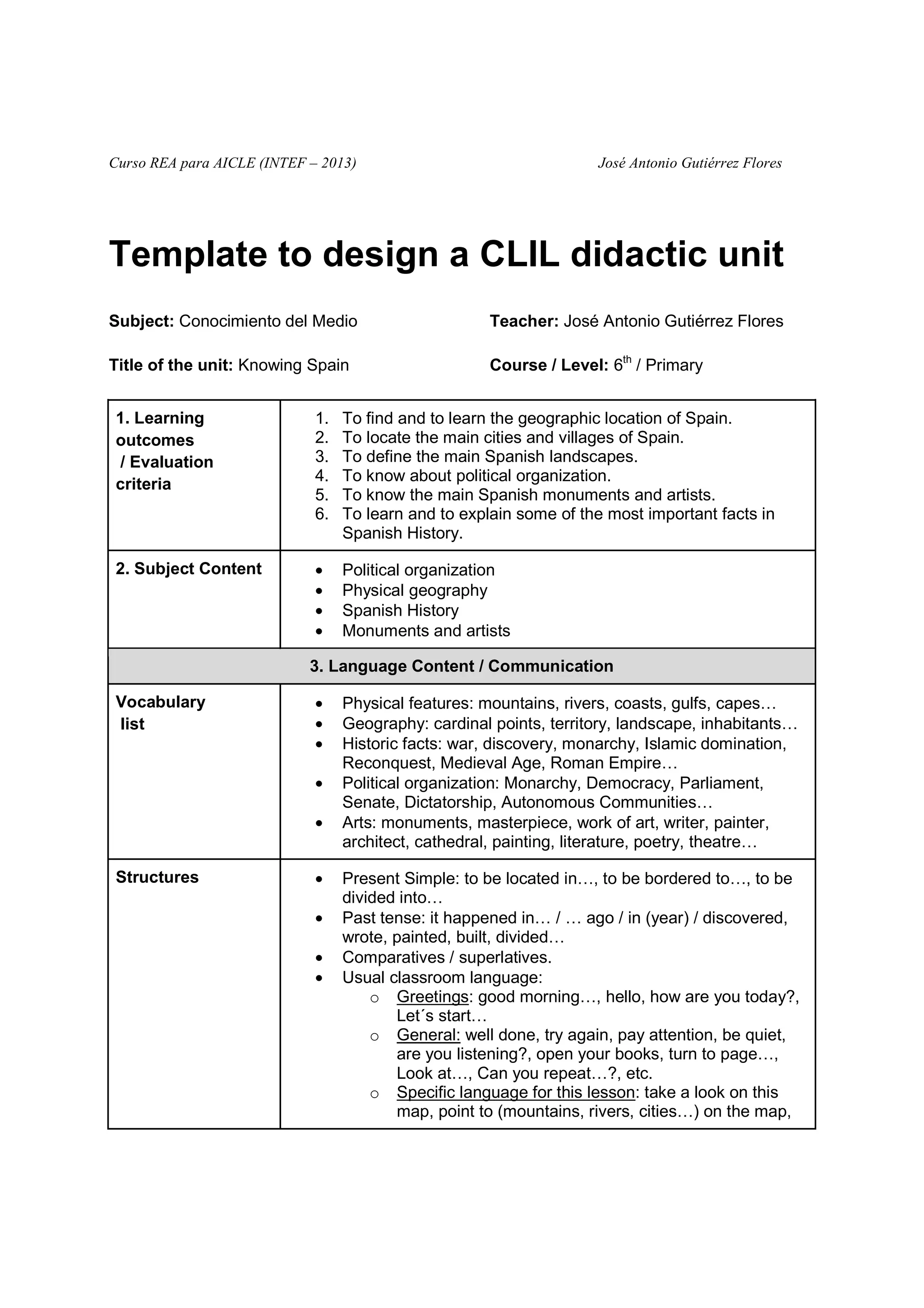
Template to design a CLIL didactic unit
Subject: Conocimiento del Medio

Teacher: José Antonio Gutiérrez Flores

Title of the unit: Knowing Spain

Course / Level: 6th / Primary

1. Learning
outcomes
/ Evaluation
criteria

1.
2.
3.
4.
5.
6.

To find and to learn the geographic location of Spain.
To locate the main cities and villages of Spain.
To define the main Spanish landscapes.
To know about political organization.
To know the main Spanish monuments and artists.
To learn and to explain some of the most important facts in
Spanish History.

2. Subject Content

•
•
•
•

Political organization
Physical geography
Spanish History
Monuments and artists

3. Language Content / Communication
Vocabulary
list

•
•
•
•
•

Structures

•
•
•
•

Physical features: mountains, rivers, coasts, gulfs, capes…
Geography: cardinal points, territory, landscape, inhabitants…
Historic facts: war, discovery, monarchy, Islamic domination,
Reconquest, Medieval Age, Roman Empire…
Political organization: Monarchy, Democracy, Parliament,
Senate, Dictatorship, Autonomous Communities…
Arts: monuments, masterpiece, work of art, writer, painter,
architect, cathedral, painting, literature, poetry, theatre…
Present Simple: to be located in…, to be bordered to…, to be
divided into…
Past tense: it happened in… / … ago / in (year) / discovered,
wrote, painted, built, divided…
Comparatives / superlatives.
Usual classroom language:
o Greetings: good morning…, hello, how are you today?,
Let´s start…
o General: well done, try again, pay attention, be quiet,
are you listening?, open your books, turn to page…,
Look at…, Can you repeat…?, etc.
o Specific language for this lesson: take a look on this
map, point to (mountains, rivers, cities…) on the map,
Curso REA para AICLE (INTEF – 2013)

José Antonio Gutiérrez Flores

o

o

Discourse type

•
•
•
•
•
•
•

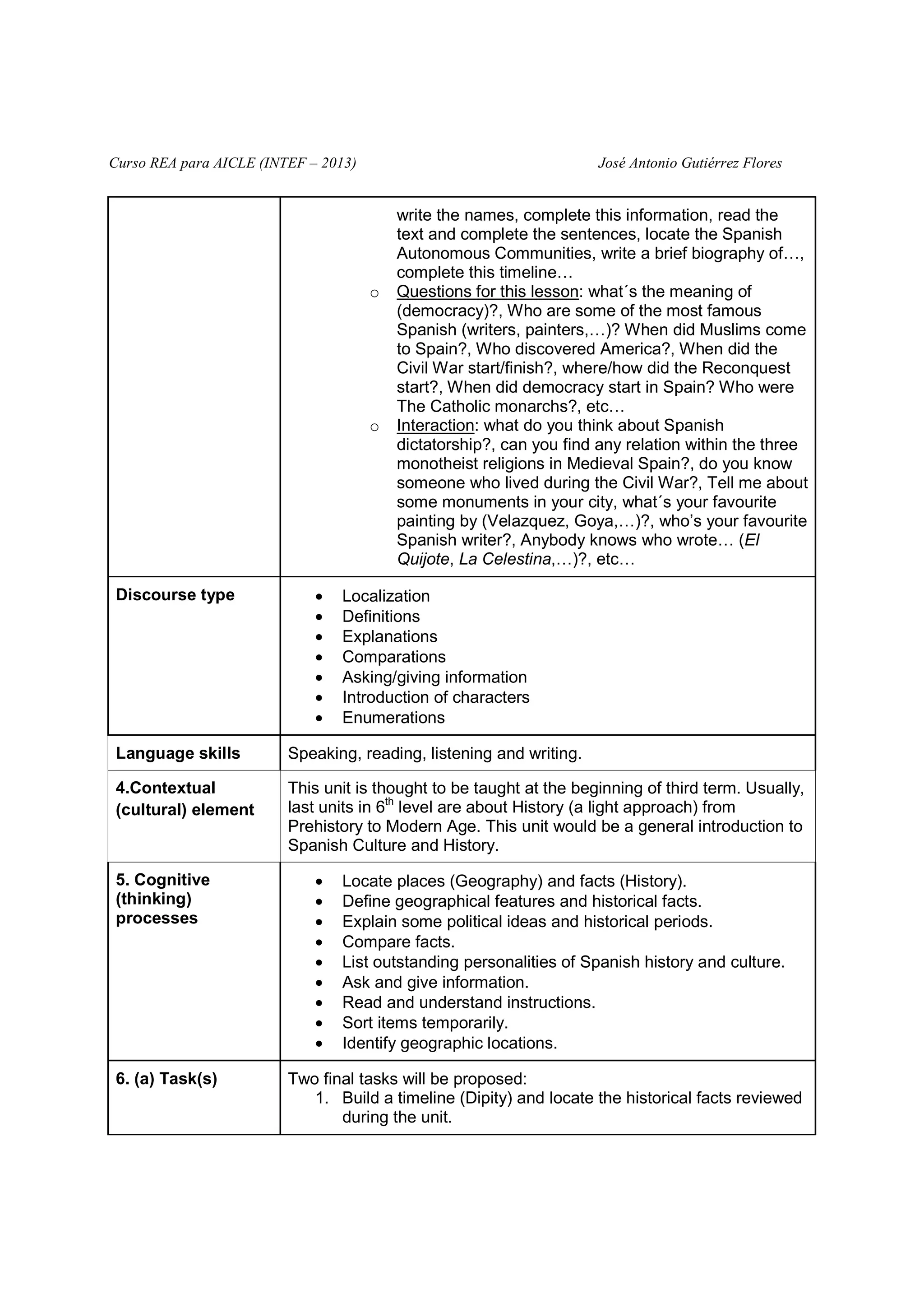
write the names, complete this information, read the
text and complete the sentences, locate the Spanish
Autonomous Communities, write a brief biography of…,
complete this timeline…
Questions for this lesson: what´s the meaning of
(democracy)?, Who are some of the most famous
Spanish (writers, painters,…)? When did Muslims come
to Spain?, Who discovered America?, When did the
Civil War start/finish?, where/how did the Reconquest
start?, When did democracy start in Spain? Who were
The Catholic monarchs?, etc…
Interaction: what do you think about Spanish
dictatorship?, can you find any relation within the three
monotheist religions in Medieval Spain?, do you know
someone who lived during the Civil War?, Tell me about
some monuments in your city, what´s your favourite
painting by (Velazquez, Goya,…)?, who’s your favourite
Spanish writer?, Anybody knows who wrote… (El
Quijote, La Celestina,…)?, etc…

Localization
Definitions
Explanations
Comparations
Asking/giving information
Introduction of characters
Enumerations

Language skills

Speaking, reading, listening and writing.

4.Contextual
(cultural) element

This unit is thought to be taught at the beginning of third term. Usually,
last units in 6th level are about History (a light approach) from
Prehistory to Modern Age. This unit would be a general introduction to
Spanish Culture and History.

5. Cognitive
(thinking)
processes

6. (a) Task(s)

•
•
•
•
•
•
•
•
•

Locate places (Geography) and facts (History).
Define geographical features and historical facts.
Explain some political ideas and historical periods.
Compare facts.
List outstanding personalities of Spanish history and culture.
Ask and give information.
Read and understand instructions.
Sort items temporarily.
Identify geographic locations.

Two final tasks will be proposed:
1. Build a timeline (Dipity) and locate the historical facts reviewed
during the unit.
Curso REA para AICLE (INTEF – 2013)

José Antonio Gutiérrez Flores

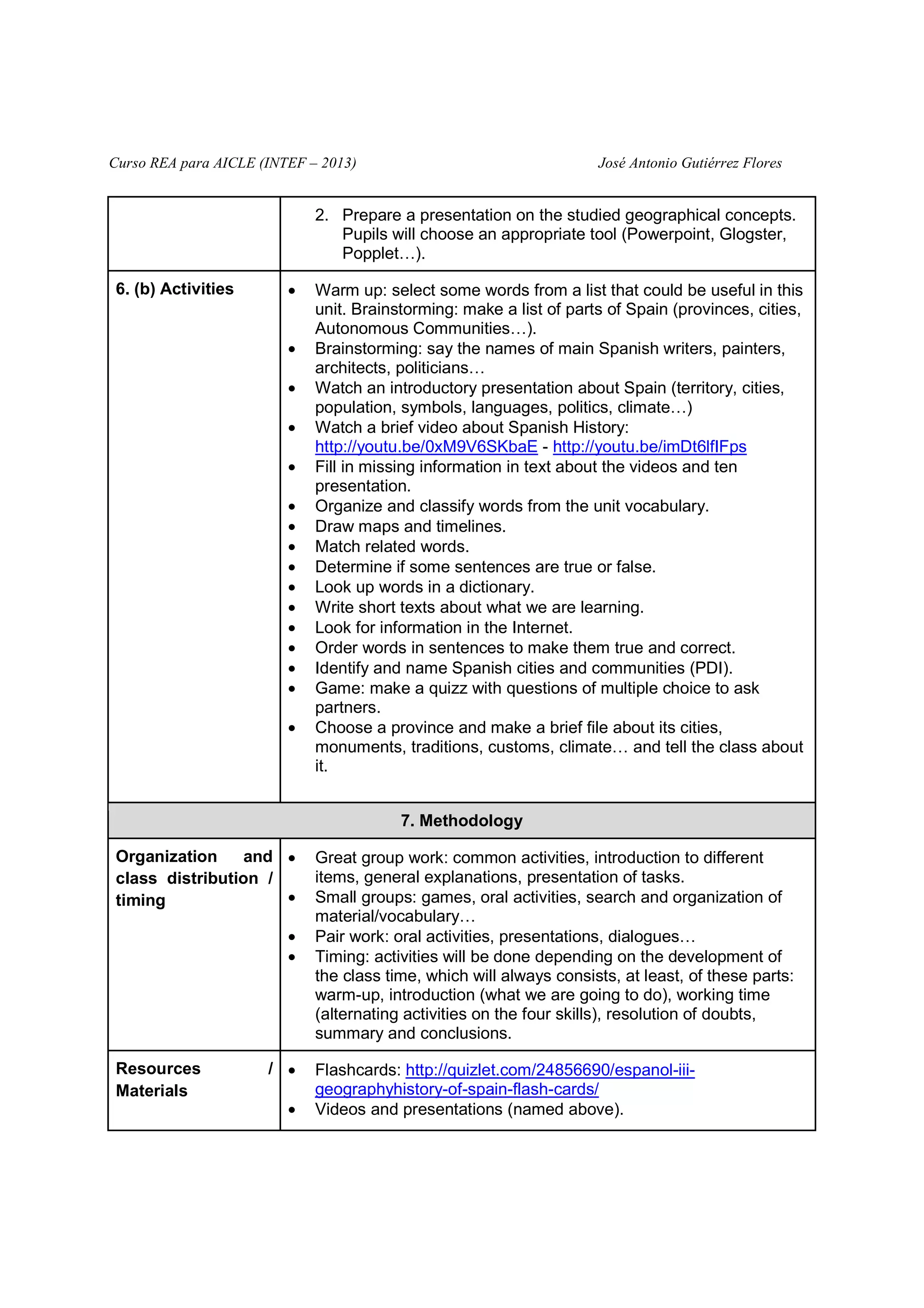
2. Prepare a presentation on the studied geographical concepts.
Pupils will choose an appropriate tool (Powerpoint, Glogster,
Popplet…).
6. (b) Activities

•
•
•
•
•
•
•
•
•
•
•
•
•
•
•
•

Warm up: select some words from a list that could be useful in this
unit. Brainstorming: make a list of parts of Spain (provinces, cities,
Autonomous Communities…).
Brainstorming: say the names of main Spanish writers, painters,
architects, politicians…
Watch an introductory presentation about Spain (territory, cities,
population, symbols, languages, politics, climate…)
Watch a brief video about Spanish History:
http://youtu.be/0xM9V6SKbaE - http://youtu.be/imDt6lfIFps
Fill in missing information in text about the videos and ten
presentation.
Organize and classify words from the unit vocabulary.
Draw maps and timelines.
Match related words.
Determine if some sentences are true or false.
Look up words in a dictionary.
Write short texts about what we are learning.
Look for information in the Internet.
Order words in sentences to make them true and correct.
Identify and name Spanish cities and communities (PDI).
Game: make a quizz with questions of multiple choice to ask
partners.
Choose a province and make a brief file about its cities,
monuments, traditions, customs, climate… and tell the class about
it.
7. Methodology

Organization
and •
class distribution /
•
timing
•
•

Resources
Materials

/ •
•

Great group work: common activities, introduction to different
items, general explanations, presentation of tasks.
Small groups: games, oral activities, search and organization of
material/vocabulary…
Pair work: oral activities, presentations, dialogues…
Timing: activities will be done depending on the development of
the class time, which will always consists, at least, of these parts:
warm-up, introduction (what we are going to do), working time
(alternating activities on the four skills), resolution of doubts,
summary and conclusions.
Flashcards: http://quizlet.com/24856690/espanol-iiigeographyhistory-of-spain-flash-cards/
Videos and presentations (named above).
Curso REA para AICLE (INTEF – 2013)

•
•
•

•
Key Competences

•
•
•
•

•

José Antonio Gutiérrez Flores

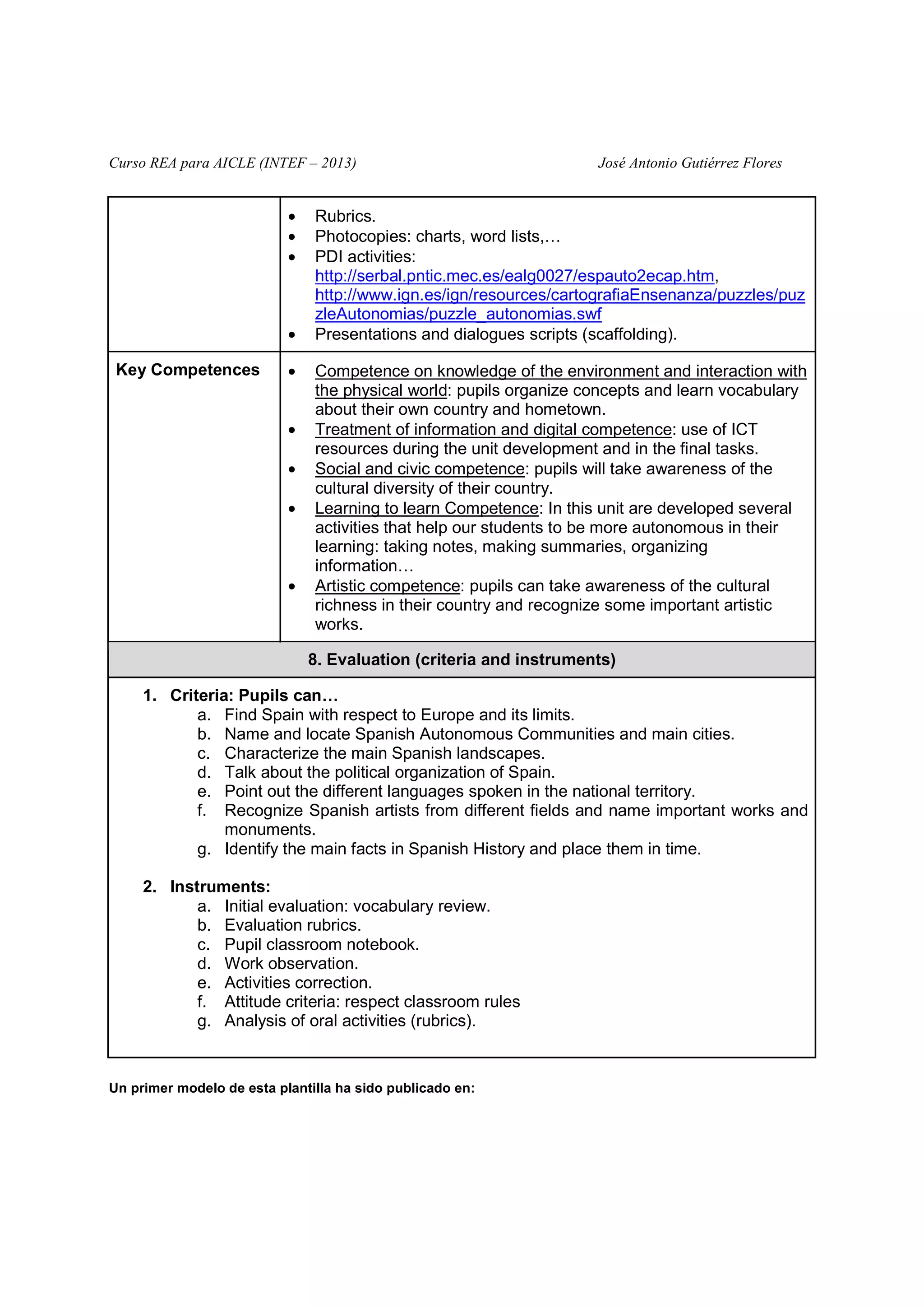
Rubrics.
Photocopies: charts, word lists,…
PDI activities:
http://serbal.pntic.mec.es/ealg0027/espauto2ecap.htm,
http://www.ign.es/ign/resources/cartografiaEnsenanza/puzzles/puz
zleAutonomias/puzzle_autonomias.swf
Presentations and dialogues scripts (scaffolding).
Competence on knowledge of the environment and interaction with
the physical world: pupils organize concepts and learn vocabulary
about their own country and hometown.
Treatment of information and digital competence: use of ICT
resources during the unit development and in the final tasks.
Social and civic competence: pupils will take awareness of the
cultural diversity of their country.
Learning to learn Competence: In this unit are developed several
activities that help our students to be more autonomous in their
learning: taking notes, making summaries, organizing
information…
Artistic competence: pupils can take awareness of the cultural
richness in their country and recognize some important artistic
works.
8. Evaluation (criteria and instruments)

1. Criteria: Pupils can…
a. Find Spain with respect to Europe and its limits.
b. Name and locate Spanish Autonomous Communities and main cities.
c. Characterize the main Spanish landscapes.
d. Talk about the political organization of Spain.
e. Point out the different languages spoken in the national territory.
f. Recognize Spanish artists from different fields and name important works and
monuments.
g. Identify the main facts in Spanish History and place them in time.
2. Instruments:
a. Initial evaluation: vocabulary review.
b. Evaluation rubrics.
c. Pupil classroom notebook.
d. Work observation.
e. Activities correction.
f. Attitude criteria: respect classroom rules
g. Analysis of oral activities (rubrics).

Un primer modelo de esta plantilla ha sido publicado en:
Curso REA para AICLE (INTEF – 2013)

José Antonio Gutiérrez Flores

Pérez Torres, I. 2009. “Apuntes sobre los principios y características de la metodología AICLE” en V. Pavón, J. Ávila
(eds.), Aplicaciones didácticas para la enseñanza integrada de lengua y contenidos. Sevilla: Consejería de
Educación de la Junta de Andalucía-Universidad de Córdoba.171-180.
Está basada sobre todo en la experiencia práctica a la hora de diseñar unidades y conversaciones con expertos y
compañeros. También he tenido en cuenta la teoría de las 4 Cs de Do Coyle, expuesto en numerosas publicaciones
como por ejemplo: Coyle, D., Hood, P. and Marsh, D., 2010. Content and Language Integrated Learning. Cambridge
University Press.

Plantilla ud aicle

  • 1.
    Curso REA paraAICLE (INTEF – 2013) José Antonio Gutiérrez Flores Template to design a CLIL didactic unit Subject: Conocimiento del Medio Teacher: José Antonio Gutiérrez Flores Title of the unit: Knowing Spain Course / Level: 6th / Primary 1. Learning outcomes / Evaluation criteria 1. 2. 3. 4. 5. 6. To find and to learn the geographic location of Spain. To locate the main cities and villages of Spain. To define the main Spanish landscapes. To know about political organization. To know the main Spanish monuments and artists. To learn and to explain some of the most important facts in Spanish History. 2. Subject Content • • • • Political organization Physical geography Spanish History Monuments and artists 3. Language Content / Communication Vocabulary list • • • • • Structures • • • • Physical features: mountains, rivers, coasts, gulfs, capes… Geography: cardinal points, territory, landscape, inhabitants… Historic facts: war, discovery, monarchy, Islamic domination, Reconquest, Medieval Age, Roman Empire… Political organization: Monarchy, Democracy, Parliament, Senate, Dictatorship, Autonomous Communities… Arts: monuments, masterpiece, work of art, writer, painter, architect, cathedral, painting, literature, poetry, theatre… Present Simple: to be located in…, to be bordered to…, to be divided into… Past tense: it happened in… / … ago / in (year) / discovered, wrote, painted, built, divided… Comparatives / superlatives. Usual classroom language: o Greetings: good morning…, hello, how are you today?, Let´s start… o General: well done, try again, pay attention, be quiet, are you listening?, open your books, turn to page…, Look at…, Can you repeat…?, etc. o Specific language for this lesson: take a look on this map, point to (mountains, rivers, cities…) on the map,
  • 2.
    Curso REA paraAICLE (INTEF – 2013) José Antonio Gutiérrez Flores o o Discourse type • • • • • • • write the names, complete this information, read the text and complete the sentences, locate the Spanish Autonomous Communities, write a brief biography of…, complete this timeline… Questions for this lesson: what´s the meaning of (democracy)?, Who are some of the most famous Spanish (writers, painters,…)? When did Muslims come to Spain?, Who discovered America?, When did the Civil War start/finish?, where/how did the Reconquest start?, When did democracy start in Spain? Who were The Catholic monarchs?, etc… Interaction: what do you think about Spanish dictatorship?, can you find any relation within the three monotheist religions in Medieval Spain?, do you know someone who lived during the Civil War?, Tell me about some monuments in your city, what´s your favourite painting by (Velazquez, Goya,…)?, who’s your favourite Spanish writer?, Anybody knows who wrote… (El Quijote, La Celestina,…)?, etc… Localization Definitions Explanations Comparations Asking/giving information Introduction of characters Enumerations Language skills Speaking, reading, listening and writing. 4.Contextual (cultural) element This unit is thought to be taught at the beginning of third term. Usually, last units in 6th level are about History (a light approach) from Prehistory to Modern Age. This unit would be a general introduction to Spanish Culture and History. 5. Cognitive (thinking) processes 6. (a) Task(s) • • • • • • • • • Locate places (Geography) and facts (History). Define geographical features and historical facts. Explain some political ideas and historical periods. Compare facts. List outstanding personalities of Spanish history and culture. Ask and give information. Read and understand instructions. Sort items temporarily. Identify geographic locations. Two final tasks will be proposed: 1. Build a timeline (Dipity) and locate the historical facts reviewed during the unit.
  • 3.
    Curso REA paraAICLE (INTEF – 2013) José Antonio Gutiérrez Flores 2. Prepare a presentation on the studied geographical concepts. Pupils will choose an appropriate tool (Powerpoint, Glogster, Popplet…). 6. (b) Activities • • • • • • • • • • • • • • • • Warm up: select some words from a list that could be useful in this unit. Brainstorming: make a list of parts of Spain (provinces, cities, Autonomous Communities…). Brainstorming: say the names of main Spanish writers, painters, architects, politicians… Watch an introductory presentation about Spain (territory, cities, population, symbols, languages, politics, climate…) Watch a brief video about Spanish History: http://youtu.be/0xM9V6SKbaE - http://youtu.be/imDt6lfIFps Fill in missing information in text about the videos and ten presentation. Organize and classify words from the unit vocabulary. Draw maps and timelines. Match related words. Determine if some sentences are true or false. Look up words in a dictionary. Write short texts about what we are learning. Look for information in the Internet. Order words in sentences to make them true and correct. Identify and name Spanish cities and communities (PDI). Game: make a quizz with questions of multiple choice to ask partners. Choose a province and make a brief file about its cities, monuments, traditions, customs, climate… and tell the class about it. 7. Methodology Organization and • class distribution / • timing • • Resources Materials / • • Great group work: common activities, introduction to different items, general explanations, presentation of tasks. Small groups: games, oral activities, search and organization of material/vocabulary… Pair work: oral activities, presentations, dialogues… Timing: activities will be done depending on the development of the class time, which will always consists, at least, of these parts: warm-up, introduction (what we are going to do), working time (alternating activities on the four skills), resolution of doubts, summary and conclusions. Flashcards: http://quizlet.com/24856690/espanol-iiigeographyhistory-of-spain-flash-cards/ Videos and presentations (named above).
  • 4.
    Curso REA paraAICLE (INTEF – 2013) • • • • Key Competences • • • • • José Antonio Gutiérrez Flores Rubrics. Photocopies: charts, word lists,… PDI activities: http://serbal.pntic.mec.es/ealg0027/espauto2ecap.htm, http://www.ign.es/ign/resources/cartografiaEnsenanza/puzzles/puz zleAutonomias/puzzle_autonomias.swf Presentations and dialogues scripts (scaffolding). Competence on knowledge of the environment and interaction with the physical world: pupils organize concepts and learn vocabulary about their own country and hometown. Treatment of information and digital competence: use of ICT resources during the unit development and in the final tasks. Social and civic competence: pupils will take awareness of the cultural diversity of their country. Learning to learn Competence: In this unit are developed several activities that help our students to be more autonomous in their learning: taking notes, making summaries, organizing information… Artistic competence: pupils can take awareness of the cultural richness in their country and recognize some important artistic works. 8. Evaluation (criteria and instruments) 1. Criteria: Pupils can… a. Find Spain with respect to Europe and its limits. b. Name and locate Spanish Autonomous Communities and main cities. c. Characterize the main Spanish landscapes. d. Talk about the political organization of Spain. e. Point out the different languages spoken in the national territory. f. Recognize Spanish artists from different fields and name important works and monuments. g. Identify the main facts in Spanish History and place them in time. 2. Instruments: a. Initial evaluation: vocabulary review. b. Evaluation rubrics. c. Pupil classroom notebook. d. Work observation. e. Activities correction. f. Attitude criteria: respect classroom rules g. Analysis of oral activities (rubrics). Un primer modelo de esta plantilla ha sido publicado en:
  • 5.
    Curso REA paraAICLE (INTEF – 2013) José Antonio Gutiérrez Flores Pérez Torres, I. 2009. “Apuntes sobre los principios y características de la metodología AICLE” en V. Pavón, J. Ávila (eds.), Aplicaciones didácticas para la enseñanza integrada de lengua y contenidos. Sevilla: Consejería de Educación de la Junta de Andalucía-Universidad de Córdoba.171-180. Está basada sobre todo en la experiencia práctica a la hora de diseñar unidades y conversaciones con expertos y compañeros. También he tenido en cuenta la teoría de las 4 Cs de Do Coyle, expuesto en numerosas publicaciones como por ejemplo: Coyle, D., Hood, P. and Marsh, D., 2010. Content and Language Integrated Learning. Cambridge University Press.