MANUAL “How to develop a dossier”

Everybody knows that today English is very important around the world. The
importance is because all scientific articles, books and technological information
are writhed in English. For this reason we are offering this language in this manual.

   1. Aims

         Teach to English teachers how to develop a handbook about the 6
          different areas of language learning.
             Language Awareness
             Language and Culture
             Language Learning Processes
             Language Teaching
             Planning and Evaluation
             Self-Assessment and Development

         Facilitate a way to organize and planning an English class and course.

   2. Requirements

   To develop an English handbook you need to have internet access, a
   computer, office package, grammar books about your topics and to read the
   “Info content areas” document.

   3. Requirements of the trainee.

To join the course "Teachers’ training” trainees must demonstrate the following
competencies:
Basic:
1. Properly use Spanish, both oral and written expression.
2. Use properly English, both oral and written expression in a minimum level B1.
3. Use logical and systematic reasoning.
4. Organizes and uses a proprietary method of study: learning to learn, autonomy
and personal initiative.
5. Interacts and communicates with one or more people in their social group.
6. Competently handles word processing and basic computer tools

      Specific

Master the four skills of English at an intermediate to advanced intermediate
minimum. (Level B2 of the ALTE; Breakthrough of Cambridge; 500-550 pts. Pen
and paper TOEFL exam, Level B2 of the Common European Framework of
Reference for Languages.
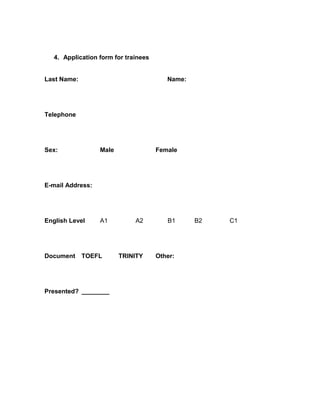
4. Application form for trainees


Last Name:                               Name:


Telephone


Sex:              Male                Female


E-mail Address:


English Level     A1          A2         B1      B2   C1


Document     TOEFL       TRINITY      Other:


Presented? ________
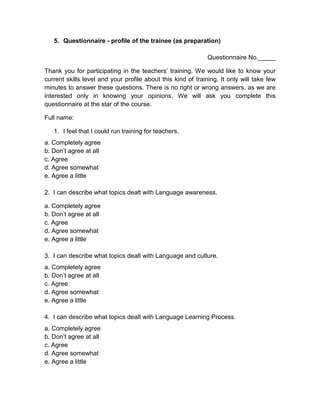
5. Questionnaire - profile of the trainee (as preparation)

                                                              Questionnaire No._____

Thank you for participating in the teachers’ training. We would like to know your
current skills level and your profile about this kind of training. It only will take few
minutes to answer these questions. There is no right or wrong answers, as we are
interested only in knowing your opinions. We will ask you complete this
questionnaire at the star of the course.

Full name:

   1. I feel that I could run training for teachers.
a. Completely agree
b. Don’t agree at all
c. Agree
d. Agree somewhat
e. Agree a little

2. I can describe what topics dealt with Language awareness.

a. Completely agree
b. Don’t agree at all
c. Agree
d. Agree somewhat
e. Agree a little

3. I can describe what topics dealt with Language and culture.
a. Completely agree
b. Don’t agree at all
c. Agree
d. Agree somewhat
e. Agree a little

4. I can describe what topics dealt with Language Learning Process.
a. Completely agree
b. Don’t agree at all
c. Agree
d. Agree somewhat
e. Agree a little
5. I can describe what topics dealt with Language Teaching.
a. Completely agree
b. Don’t agree at all
c. Agree
d. Agree somewhat
e. Agree a little

6. I can describe what topics dealt with Planning and evaluation.
a. Completely agree
b. Don’t agree at all
c. Agree
d. Agree somewhat
e. Agree a little

7. I can describe what topics dealt with self- assessment and development.
a. Completely agree
b. Don’t agree at all
c. Agree
d. Agree somewhat
e. Agree a little

   6. Course Rules

      The participant must maintain an 80% attendance otherwise cause global
       low    course.
      To be considered as approved participant that obtains total at least 80
       points after the course.
      No absences will be excused under any circumstances.


   7. Structure and timing

You must to make a plan and consider how long takes you the explanation of every
topic and activity you teach. And need to know how to ask for the delivery including
times and the way of it between face to face or online way.
8. How to obtain the certificate

This is the evaluation parameters and criteria to accredit the course.
BENCHMARKS:
                                        Language awareness
                                        Language and culture
                                        Language learning process
   - Know                  20%          Language teaching
                                        Planning and evaluation
                                        Self-Assessment and development

                                          Rubrics to assess
   -   Know doing           60%           Participant´s demo classes
                                          Trainee dossiers

   -   Being                20%           Class participation and checklist to review
                                          The evidence folder
                            100%
CRITERIA:
  - The participant must get an 80% attendance otherwise he/she causes
     global low course.
  - The participant deemed approved if he/she obtains the total at least 80
     points at the end of the course.

       APPLICATION FORM FOR TEACHERS’ TRAINING CERTIFICATION
       Trainee name: ___________________________________________
       Address: ________________________________________________
       E-mail address: ___________________________________________
       Phone number: ___________________________________________

       I would like to apply for the Teachers’ certification course, and I agree all the
       information above is true.

                  Signature:
       ___________________________
9. Description of the topics

These content areas are included in the teachers’ training:

I. Language Awareness
II. Language and Culture
III. Language Learning Processes IV. Language Teaching
V. Planning and Evaluation
VI. Self-Assessment and Development

I. LANGUAGE AWARENESS

Trainees are able to do at the end of the course:
    Describe the language I am teaching and use the appropriate terminology
    Understand the principles of language learning and teaching
    Select the appropriate teaching points from teaching materials to suit
      different levels
    Provide my students with clear and effective explanations in a way that is
      helpful to them
    Select and apply the appropriate methodological tools to highlight
      differences in language systems
    Use reference materials (i.e. grammar books) effectively to provide my
      students with clear answers with regards to language-related questions

II. LANGUAGE AND CULTURE

Trainees are able to do at the end of the course:

      Take into account and incorporate into my teaching the educational
       experiences my students have had previously
      Provide for individual learner styles and strategies in my teaching
      Design my lessons with my students' needs and interests in mind in order to
       make it interesting, lively and motivating
      Give my students feedback on their language competence in a way that is
       appropriate and helpful (i.e. error correction) taking into account the stage of
       language development they are at
      Encourage and motivate my students to improve.
III. LANGUAGE LEARNING PROCESSES

Trainees are able to do at the end of the course:
    Take into account and incorporate into my teaching the educational
      experiences my students have had previously.
    Provide for individual learner styles and strategies in my teaching
    Design my lessons with my students' needs and interests in mind in order to
      make it interesting, lively and motivating
    Give my students feedback on their language competence in a way that is
      appropriate and helpful (i.e. error correction) taking into account the stage of
      language development they are as well as the stage aim we are trying to
      achieve in a particular stage of a lesson.
    Encourage and motivate my students to improve, being aware of different
      types of motivation and capable to relate those to my students.

IV. LANGUAGE TEACHING

Trainees are able to do at the end of the course:
    Define the aims of my lesson and understand how to achieve them by the
      end of the lesson as well as make my students aware of what my aims are
    Be confident in selecting, adapting and designing materials to suits those
      aims
    Use a variety of exercise types
    Use various media forms appropriately (Moodle, whiteboard, Smartboard...)
    Evaluate learning tasks and activities
    Incorporate learning tasks and activities which encourage and facilitate
      learner autonomy and take into account learners' learning styles and cultural
      expectations
    Give clear instructions and make sure they are understood
    Manage a class effectively in a wide variety of contexts taking into
      consideration the learners' needs and levels of language competence as
      well as mixed abilities
    Clarify the meaning of new vocabulary through the use of different means
      and I am able to check that the students have understood.
V. PLANNING AND EVALUATION

Trainees are able to do at the end of the course:

      State the general aims of a course with reference to the CEFR (European
       Framework).
      Define the aims of my lesson so that they fit within the context of the whole
       course.
      Plan lessons and teaching programs and include appropriate tasks to suit
       the learning outcomes.
      Use various ways of conducting a course evaluation
      Do a needs analysis and assess my students' language competence
       according to the CEFR
      Inform my students on language examinations available to them and advice
       them on the appropriate options for them
      Help my students to plan further learning to suit their needs
      Use a variety of inductive and deductive approaches to present a grammar
       structure and select an effective approach taking into account the grammar
       point in question and the group I'm teaching.

VI. SELF-ASSESSMENT AND DEVELOPMENT

Trainees are able to do at the end of the course:
    Reflect and draw conclusions from observations and self-observation in
      order to gain a better understanding of the teaching situation and validate,
      bring changes to and improve my own teaching
    Receive and make use of feedback on my teaching performance
    give constructive feedback to colleagues.
    Incorporate the systematic sharing of ideas with colleagues to promote best
      practice.
    Access the relevant support systems that will enable me to develop further
      and find solutions to my teaching problems.
    Put forward ideas on how to ensure continuous professional development.
10. Training contents and contents areas

I.         LANGUAGE AWARENESS
          Pronunciation training
          Learning vocabulary
          Listening comprehension, understanding different accents
          Learning spoken and written language

II.        LANGUAGE AND CULTURE
          Awareness of socio-cultural and intercultural aspects of language
          Dealing sensitively with classroom situations relating to intercultural
           differences
          Understanding different backgrounds of students
          Cross-cultural communication

III.       LANGUAGE LEARNING PROCESSES
          How to correct mistakes and the use of social forms
          The different learner types
          Learning strategies and learner autonomy
          Progress tests
          Application of theoretical knowledge in real situations

IV.        LANGUAGE TEACHING
          How do I teach vocabulary
          Speaking activities
          Difficult classroom situations
          The use of b-learning and e-learning

V.         PLANNING AND EVALUATION
          Aims and objectives of language teaching in the context of the institution
           and of the course
          Structure and sequence of course content
          Evaluation of learner's progress

VI.        SELF-ASSESSMENT AND DEVELOPMENT
          Dealing with feedback
          Awareness of one’s own strengths and weaknesses
          Awareness of possibilities for further professional development
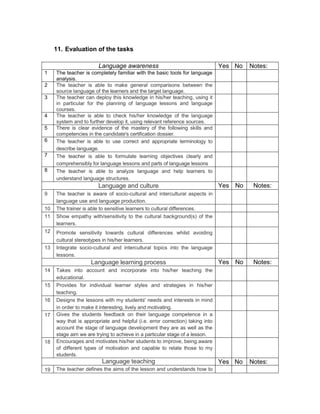
11. Evaluation of the tasks

                        Language awareness                                     Yes No   Notes:
1    The teacher is completely familiar with the basic tools for language
     analysis.
2    The teacher is able to make general comparisons between the
     source language of the learners and the target language.
3    The teacher can deploy this knowledge in his/her teaching, using it
     in particular for the planning of language lessons and language
     courses.
4    The teacher is able to check his/her knowledge of the language
     system and to further develop it, using relevant reference sources.
5    There is clear evidence of the mastery of the following skills and
     competencies in the candidate's certification dossier.
6    The teacher is able to use correct and appropriate terminology to
     describe language.
7    The teacher is able to formulate learning objectives clearly and
     comprehensibly for language lessons and parts of language lessons
8    The teacher is able to analyze language and help learners to
     understand language structures.
                        Language and culture                                   Yes No    Notes:
9    The teacher is aware of socio-cultural and intercultural aspects in
     language use and language production.
10   The trainer is able to sensitive learners to cultural differences.
11   Show empathy with/sensitivity to the cultural background(s) of the
     learners.
12   Promote sensitivity towards cultural differences whilst avoiding
     cultural stereotypes in his/her learners.
13   Integrate socio-cultural and intercultural topics into the language
     lessons.
                    Language learning process                                  Yes No    Notes:
14   Takes into account and incorporate into his/her teaching the
     educational.
15   Provides for individual learner styles and strategies in his/her
     teaching.
16   Designs the lessons with my students' needs and interests in mind
     in order to make it interesting, lively and motivating.
17   Gives the students feedback on their language competence in a
     way that is appropriate and helpful (i.e. error correction) taking into
     account the stage of language development they are as well as the
     stage aim we are trying to achieve in a particular stage of a lesson.
18   Encourages and motivates his/her students to improve, being aware
     of different types of motivation and capable to relate those to my
     students.
                         Language teaching                                     Yes No   Notes:
19   The teacher defines the aims of the lesson and understands how to
achieve them by the end of the lesson as well as makes his/her
     students aware what their aims are.
20   The teacher is confident in selecting, adapting and designing
     materials to suits those aims.
21   The teacher uses a variety of exercise types.
22   The teacher uses various media forms appropriately (Moodle,
     whiteboard, Smart board...)
23   The teacher evaluates learning tasks and activities.
24   The teacher gives clear instructions and make sure they have
     understood
25   The teacher manages a class effectively in a wide variety of
     contexts taking into consideration the learners' needs and levels of
     language competence as well as mixed abilities
                      Planning and evaluation                                  Yes No   Notes:
26   The teacher is able to plan and evaluate language lessons within
     the context of a given curriculum/course of studies.
27   The teacher understands the institutional context of his/her teaching
     activities and is familiar with the overall training programs offered
     within his/her institution.
28   The teacher Understands the levels of competence defined in the
     European Framework of Reference, is familiar with the main
     language         examinations      offered       in     the     target
     language and is able to prepare learners to take such examinations.
               Self-assessment and development                                 Yes No   Notes:
29   The teacher Is able to Combine theoretical knowledge with practical
     language teaching.
30   The teacher Acquire basic methodological-didactic competence and
     skills and know when and how to apply them.
31   The teacher Understand the different aspects and problems related
     to modern language teaching.


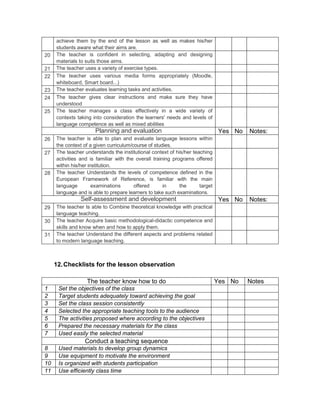
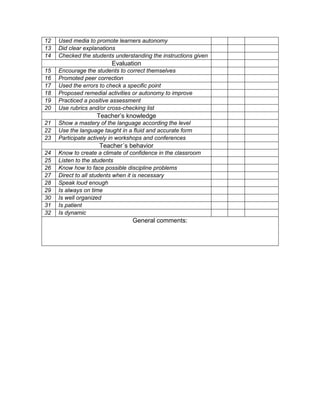
     12. Checklists for the lesson observation

                  The teacher know how to do                                  Yes No    Notes
1     Set the objectives of the class
2     Target students adequately toward achieving the goal
3     Set the class session consistently
4     Selected the appropriate teaching tools to the audience
5     The activities proposed where according to the objectives
6     Prepared the necessary materials for the class
7     Used easily the selected material
                 Conduct a teaching sequence
8     Used materials to develop group dynamics
9     Use equipment to motivate the environment
10    Is organized with students participation
11    Use efficiently class time
12   Used media to promote learners autonomy
13   Did clear explanations
14   Checked the students understanding the instructions given
                         Evaluation
15   Encourage the students to correct themselves
16   Promoted peer correction
17   Used the errors to check a specific point
18   Proposed remedial activities or autonomy to improve
19   Practiced a positive assessment
20   Use rubrics and/or cross-checking list
                   Teacher’s knowledge
21   Show a mastery of the language according the level
22   Use the language taught in a fluid and accurate form
23   Participate actively in workshops and conferences
                    Teacher´s behavior
24   Know to create a climate of confidence in the classroom
25   Listen to the students
26   Know how to face possible discipline problems
27   Direct to all students when it is necessary
28   Speak loud enough
29   Is always on time
30   Is well organized
31   Is patient
32   Is dynamic
                                 General comments:

Manual

  • 1.
    MANUAL “How todevelop a dossier” Everybody knows that today English is very important around the world. The importance is because all scientific articles, books and technological information are writhed in English. For this reason we are offering this language in this manual. 1. Aims  Teach to English teachers how to develop a handbook about the 6 different areas of language learning.  Language Awareness  Language and Culture  Language Learning Processes  Language Teaching  Planning and Evaluation  Self-Assessment and Development  Facilitate a way to organize and planning an English class and course. 2. Requirements To develop an English handbook you need to have internet access, a computer, office package, grammar books about your topics and to read the “Info content areas” document. 3. Requirements of the trainee. To join the course "Teachers’ training” trainees must demonstrate the following competencies: Basic: 1. Properly use Spanish, both oral and written expression. 2. Use properly English, both oral and written expression in a minimum level B1. 3. Use logical and systematic reasoning. 4. Organizes and uses a proprietary method of study: learning to learn, autonomy and personal initiative. 5. Interacts and communicates with one or more people in their social group. 6. Competently handles word processing and basic computer tools Specific Master the four skills of English at an intermediate to advanced intermediate minimum. (Level B2 of the ALTE; Breakthrough of Cambridge; 500-550 pts. Pen and paper TOEFL exam, Level B2 of the Common European Framework of Reference for Languages.
  • 2.
    4. Application formfor trainees Last Name: Name: Telephone Sex: Male Female E-mail Address: English Level A1 A2 B1 B2 C1 Document TOEFL TRINITY Other: Presented? ________
  • 3.
    5. Questionnaire -profile of the trainee (as preparation) Questionnaire No._____ Thank you for participating in the teachers’ training. We would like to know your current skills level and your profile about this kind of training. It only will take few minutes to answer these questions. There is no right or wrong answers, as we are interested only in knowing your opinions. We will ask you complete this questionnaire at the star of the course. Full name: 1. I feel that I could run training for teachers. a. Completely agree b. Don’t agree at all c. Agree d. Agree somewhat e. Agree a little 2. I can describe what topics dealt with Language awareness. a. Completely agree b. Don’t agree at all c. Agree d. Agree somewhat e. Agree a little 3. I can describe what topics dealt with Language and culture. a. Completely agree b. Don’t agree at all c. Agree d. Agree somewhat e. Agree a little 4. I can describe what topics dealt with Language Learning Process. a. Completely agree b. Don’t agree at all c. Agree d. Agree somewhat e. Agree a little
  • 4.
    5. I candescribe what topics dealt with Language Teaching. a. Completely agree b. Don’t agree at all c. Agree d. Agree somewhat e. Agree a little 6. I can describe what topics dealt with Planning and evaluation. a. Completely agree b. Don’t agree at all c. Agree d. Agree somewhat e. Agree a little 7. I can describe what topics dealt with self- assessment and development. a. Completely agree b. Don’t agree at all c. Agree d. Agree somewhat e. Agree a little 6. Course Rules  The participant must maintain an 80% attendance otherwise cause global low course.  To be considered as approved participant that obtains total at least 80 points after the course.  No absences will be excused under any circumstances. 7. Structure and timing You must to make a plan and consider how long takes you the explanation of every topic and activity you teach. And need to know how to ask for the delivery including times and the way of it between face to face or online way.
  • 5.
    8. How toobtain the certificate This is the evaluation parameters and criteria to accredit the course. BENCHMARKS: Language awareness Language and culture Language learning process - Know 20% Language teaching Planning and evaluation Self-Assessment and development Rubrics to assess - Know doing 60% Participant´s demo classes Trainee dossiers - Being 20% Class participation and checklist to review The evidence folder 100% CRITERIA: - The participant must get an 80% attendance otherwise he/she causes global low course. - The participant deemed approved if he/she obtains the total at least 80 points at the end of the course. APPLICATION FORM FOR TEACHERS’ TRAINING CERTIFICATION Trainee name: ___________________________________________ Address: ________________________________________________ E-mail address: ___________________________________________ Phone number: ___________________________________________ I would like to apply for the Teachers’ certification course, and I agree all the information above is true. Signature: ___________________________
  • 6.
    9. Description ofthe topics These content areas are included in the teachers’ training: I. Language Awareness II. Language and Culture III. Language Learning Processes IV. Language Teaching V. Planning and Evaluation VI. Self-Assessment and Development I. LANGUAGE AWARENESS Trainees are able to do at the end of the course:  Describe the language I am teaching and use the appropriate terminology  Understand the principles of language learning and teaching  Select the appropriate teaching points from teaching materials to suit different levels  Provide my students with clear and effective explanations in a way that is helpful to them  Select and apply the appropriate methodological tools to highlight differences in language systems  Use reference materials (i.e. grammar books) effectively to provide my students with clear answers with regards to language-related questions II. LANGUAGE AND CULTURE Trainees are able to do at the end of the course:  Take into account and incorporate into my teaching the educational experiences my students have had previously  Provide for individual learner styles and strategies in my teaching  Design my lessons with my students' needs and interests in mind in order to make it interesting, lively and motivating  Give my students feedback on their language competence in a way that is appropriate and helpful (i.e. error correction) taking into account the stage of language development they are at  Encourage and motivate my students to improve.
  • 7.
    III. LANGUAGE LEARNINGPROCESSES Trainees are able to do at the end of the course:  Take into account and incorporate into my teaching the educational experiences my students have had previously.  Provide for individual learner styles and strategies in my teaching  Design my lessons with my students' needs and interests in mind in order to make it interesting, lively and motivating  Give my students feedback on their language competence in a way that is appropriate and helpful (i.e. error correction) taking into account the stage of language development they are as well as the stage aim we are trying to achieve in a particular stage of a lesson.  Encourage and motivate my students to improve, being aware of different types of motivation and capable to relate those to my students. IV. LANGUAGE TEACHING Trainees are able to do at the end of the course:  Define the aims of my lesson and understand how to achieve them by the end of the lesson as well as make my students aware of what my aims are  Be confident in selecting, adapting and designing materials to suits those aims  Use a variety of exercise types  Use various media forms appropriately (Moodle, whiteboard, Smartboard...)  Evaluate learning tasks and activities  Incorporate learning tasks and activities which encourage and facilitate learner autonomy and take into account learners' learning styles and cultural expectations  Give clear instructions and make sure they are understood  Manage a class effectively in a wide variety of contexts taking into consideration the learners' needs and levels of language competence as well as mixed abilities  Clarify the meaning of new vocabulary through the use of different means and I am able to check that the students have understood.
  • 8.
    V. PLANNING ANDEVALUATION Trainees are able to do at the end of the course:  State the general aims of a course with reference to the CEFR (European Framework).  Define the aims of my lesson so that they fit within the context of the whole course.  Plan lessons and teaching programs and include appropriate tasks to suit the learning outcomes.  Use various ways of conducting a course evaluation  Do a needs analysis and assess my students' language competence according to the CEFR  Inform my students on language examinations available to them and advice them on the appropriate options for them  Help my students to plan further learning to suit their needs  Use a variety of inductive and deductive approaches to present a grammar structure and select an effective approach taking into account the grammar point in question and the group I'm teaching. VI. SELF-ASSESSMENT AND DEVELOPMENT Trainees are able to do at the end of the course:  Reflect and draw conclusions from observations and self-observation in order to gain a better understanding of the teaching situation and validate, bring changes to and improve my own teaching  Receive and make use of feedback on my teaching performance  give constructive feedback to colleagues.  Incorporate the systematic sharing of ideas with colleagues to promote best practice.  Access the relevant support systems that will enable me to develop further and find solutions to my teaching problems.  Put forward ideas on how to ensure continuous professional development.
  • 9.
    10. Training contentsand contents areas I. LANGUAGE AWARENESS  Pronunciation training  Learning vocabulary  Listening comprehension, understanding different accents  Learning spoken and written language II. LANGUAGE AND CULTURE  Awareness of socio-cultural and intercultural aspects of language  Dealing sensitively with classroom situations relating to intercultural differences  Understanding different backgrounds of students  Cross-cultural communication III. LANGUAGE LEARNING PROCESSES  How to correct mistakes and the use of social forms  The different learner types  Learning strategies and learner autonomy  Progress tests  Application of theoretical knowledge in real situations IV. LANGUAGE TEACHING  How do I teach vocabulary  Speaking activities  Difficult classroom situations  The use of b-learning and e-learning V. PLANNING AND EVALUATION  Aims and objectives of language teaching in the context of the institution and of the course  Structure and sequence of course content  Evaluation of learner's progress VI. SELF-ASSESSMENT AND DEVELOPMENT  Dealing with feedback  Awareness of one’s own strengths and weaknesses  Awareness of possibilities for further professional development
  • 10.
    11. Evaluation ofthe tasks Language awareness Yes No Notes: 1 The teacher is completely familiar with the basic tools for language analysis. 2 The teacher is able to make general comparisons between the source language of the learners and the target language. 3 The teacher can deploy this knowledge in his/her teaching, using it in particular for the planning of language lessons and language courses. 4 The teacher is able to check his/her knowledge of the language system and to further develop it, using relevant reference sources. 5 There is clear evidence of the mastery of the following skills and competencies in the candidate's certification dossier. 6 The teacher is able to use correct and appropriate terminology to describe language. 7 The teacher is able to formulate learning objectives clearly and comprehensibly for language lessons and parts of language lessons 8 The teacher is able to analyze language and help learners to understand language structures. Language and culture Yes No Notes: 9 The teacher is aware of socio-cultural and intercultural aspects in language use and language production. 10 The trainer is able to sensitive learners to cultural differences. 11 Show empathy with/sensitivity to the cultural background(s) of the learners. 12 Promote sensitivity towards cultural differences whilst avoiding cultural stereotypes in his/her learners. 13 Integrate socio-cultural and intercultural topics into the language lessons. Language learning process Yes No Notes: 14 Takes into account and incorporate into his/her teaching the educational. 15 Provides for individual learner styles and strategies in his/her teaching. 16 Designs the lessons with my students' needs and interests in mind in order to make it interesting, lively and motivating. 17 Gives the students feedback on their language competence in a way that is appropriate and helpful (i.e. error correction) taking into account the stage of language development they are as well as the stage aim we are trying to achieve in a particular stage of a lesson. 18 Encourages and motivates his/her students to improve, being aware of different types of motivation and capable to relate those to my students. Language teaching Yes No Notes: 19 The teacher defines the aims of the lesson and understands how to
  • 11.
    achieve them bythe end of the lesson as well as makes his/her students aware what their aims are. 20 The teacher is confident in selecting, adapting and designing materials to suits those aims. 21 The teacher uses a variety of exercise types. 22 The teacher uses various media forms appropriately (Moodle, whiteboard, Smart board...) 23 The teacher evaluates learning tasks and activities. 24 The teacher gives clear instructions and make sure they have understood 25 The teacher manages a class effectively in a wide variety of contexts taking into consideration the learners' needs and levels of language competence as well as mixed abilities Planning and evaluation Yes No Notes: 26 The teacher is able to plan and evaluate language lessons within the context of a given curriculum/course of studies. 27 The teacher understands the institutional context of his/her teaching activities and is familiar with the overall training programs offered within his/her institution. 28 The teacher Understands the levels of competence defined in the European Framework of Reference, is familiar with the main language examinations offered in the target language and is able to prepare learners to take such examinations. Self-assessment and development Yes No Notes: 29 The teacher Is able to Combine theoretical knowledge with practical language teaching. 30 The teacher Acquire basic methodological-didactic competence and skills and know when and how to apply them. 31 The teacher Understand the different aspects and problems related to modern language teaching. 12. Checklists for the lesson observation The teacher know how to do Yes No Notes 1 Set the objectives of the class 2 Target students adequately toward achieving the goal 3 Set the class session consistently 4 Selected the appropriate teaching tools to the audience 5 The activities proposed where according to the objectives 6 Prepared the necessary materials for the class 7 Used easily the selected material Conduct a teaching sequence 8 Used materials to develop group dynamics 9 Use equipment to motivate the environment 10 Is organized with students participation 11 Use efficiently class time
  • 12.
    12 Used media to promote learners autonomy 13 Did clear explanations 14 Checked the students understanding the instructions given Evaluation 15 Encourage the students to correct themselves 16 Promoted peer correction 17 Used the errors to check a specific point 18 Proposed remedial activities or autonomy to improve 19 Practiced a positive assessment 20 Use rubrics and/or cross-checking list Teacher’s knowledge 21 Show a mastery of the language according the level 22 Use the language taught in a fluid and accurate form 23 Participate actively in workshops and conferences Teacher´s behavior 24 Know to create a climate of confidence in the classroom 25 Listen to the students 26 Know how to face possible discipline problems 27 Direct to all students when it is necessary 28 Speak loud enough 29 Is always on time 30 Is well organized 31 Is patient 32 Is dynamic General comments: