Coordinación bilingüe Isabel Pérez Tor 
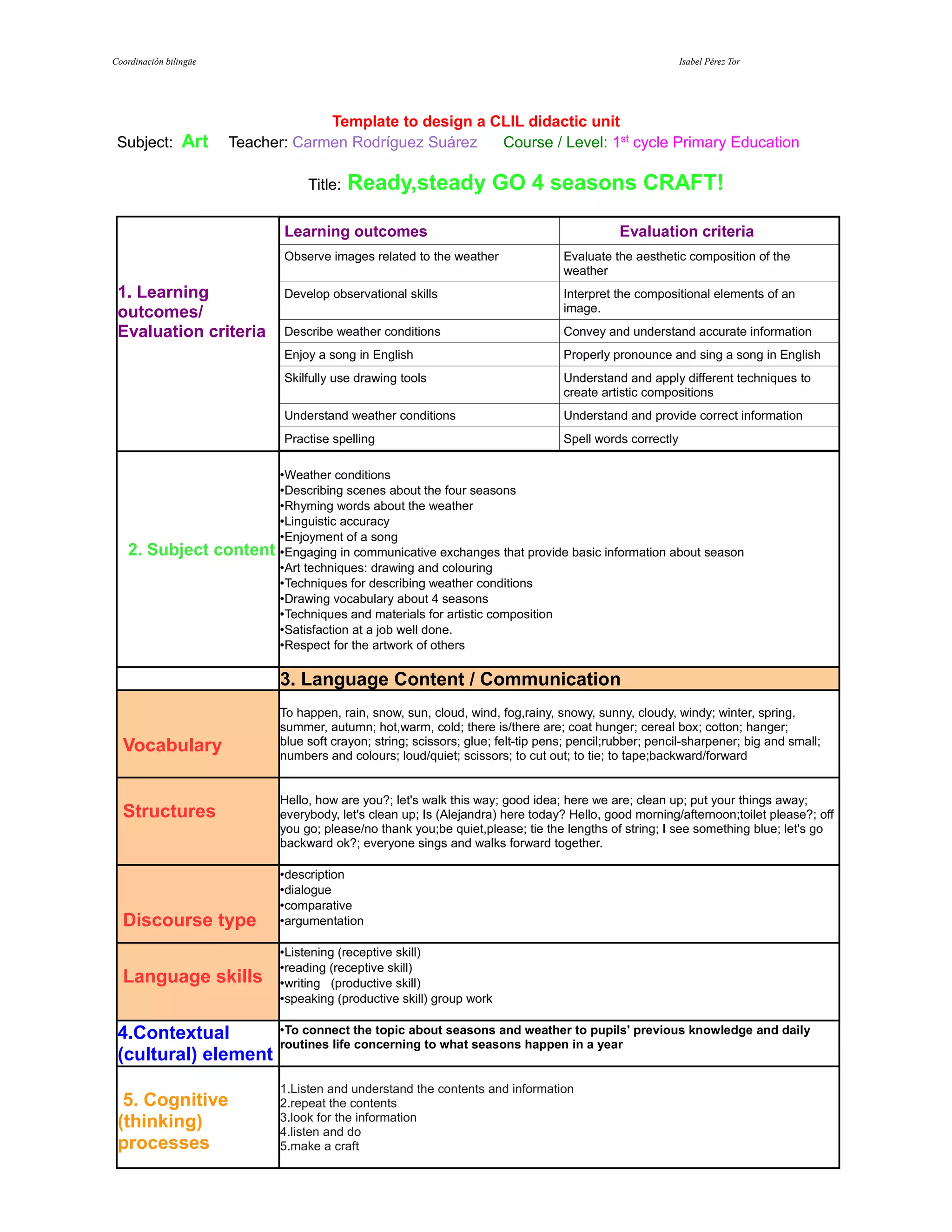
Template to design a CLIL didactic unit 
Subject: Art Teacher: Carmen Rodríguez Suárez Course / Level: 1st cycle Primary Education 
Title: Ready,steady GO 4 seasons CRAFT! 
1. Learning 
outcomes/ 
Evaluation criteria 
Learning outcomes Evaluation criteria 
Observe images related to the weather Evaluate the aesthetic composition of the 
weather 
Develop observational skills Interpret the compositional elements of an 
image. 
Describe weather conditions Convey and understand accurate information 
Enjoy a song in English Properly pronounce and sing a song in English 
Skilfully use drawing tools Understand and apply different techniques to 
create artistic compositions 
Understand weather conditions Understand and provide correct information 
Practise spelling Spell words correctly 
2. Subject content 
•Weather conditions 
•Describing scenes about the four seasons 
•Rhyming words about the weather 
•Linguistic accuracy 
•Enjoyment of a song 
•Engaging in communicative exchanges that provide basic information about season 
•Art techniques: drawing and colouring 
•Techniques for describing weather conditions 
•Drawing vocabulary about 4 seasons 
•Techniques and materials for artistic composition 
•Satisfaction at a job well done. 
•Respect for the artwork of others 
3. Language Content / Communication 
Vocabulary 
To happen, rain, snow, sun, cloud, wind, fog,rainy, snowy, sunny, cloudy, windy; winter, spring, 
summer, autumn; hot,warm, cold; there is/there are; coat hunger; cereal box; cotton; hanger; 
blue soft crayon; string; scissors; glue; felt-tip pens; pencil;rubber; pencil-sharpener; big and small; 
numbers and colours; loud/quiet; scissors; to cut out; to tie; to tape;backward/forward 
Structures 
Hello, how are you?; let's walk this way; good idea; here we are; clean up; put your things away; 
everybody, let's clean up; Is (Alejandra) here today? Hello, good morning/afternoon;toilet please?; off 
you go; please/no thank you;be quiet,please; tie the lengths of string; I see something blue; let's go 
backward ok?; everyone sings and walks forward together. 
Discourse type 
•description 
•dialogue 
•comparative 
•argumentation 
Language skills 
•Listening (receptive skill) 
•reading (receptive skill) 
•writing (productive skill) 
•speaking (productive skill) group work 
4.Contextual 
(cultural) element 
•To connect the topic about seasons and weather to pupils' previous knowledge and daily 
routines life concerning to what seasons happen in a year 
5. Cognitive 
(thinking) 
processes 
1.Listen and understand the contents and information 
2.repeat the contents 
3.look for the information 
4.listen and do 
5.make a craft
Coordinación bilingüe Isabel Pérez Tor 
6.Final task •To create a visual tour museum for the Art classroom ( a blog for Art classroom) 
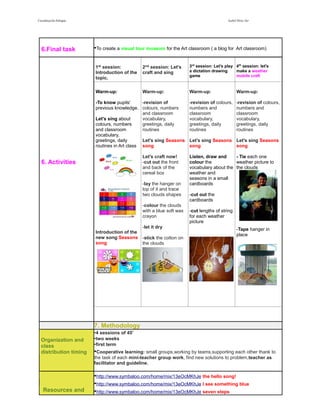
6. Activities 
1st session: 
Introduction of the 
topic. 
2nd session: Let's 
craft and sing 
3rd session: Let's play 
a dictation drawing 
game 
4th session: let's 
make a weather 
mobile craft 
Warm-up: 
-To know pupils' 
previous knowledge. 
Let's sing about 
colours, numbers 
and classroom 
vocabulary, 
greetings, daily 
routines in Art class 
Introduction of the 
new song:Seasons 
song 
Warm-up: 
-revision of 
colours, numbers 
and classroom 
vocabulary, 
greetings, daily 
routines 
Let's sing Seasons 
song 
Let's craft now! 
-cut out the front 
and back of the 
cereal box 
-lay the hanger on 
top of it and trace 
two clouds shapes 
-colour the clouds 
with a blue soft wax 
crayon 
-let it dry 
-stick the cotton on 
the clouds 
Warm-up: 
-revision of colours, 
numbers and 
classroom 
vocabulary, 
greetings, daily 
routines 
Let's sing Seasons 
song 
Listen, draw and 
colour the 
vocabulary about the 
weather and 
seasons in a small 
cardboards 
-cut out the 
cardboards 
-cut lengths of string 
for each weather 
picture 
Warm-up: 
-revision of colours, 
numbers and 
classroom 
vocabulary, 
greetings, daily 
routines 
Let's sing Seasons 
song 
- Tie each one 
weather picture to 
the clouds 
-Tape hanger in 
place 
7. Methodology 
Organization and 
class 
distribution timing 
•4 sessions of 45' 
•two weeks 
•first term 
•Cooperative learning: small groups,working by teams,supporting each other thank to 
the task of each mini-teacher group work, find new solutions to problem,teacher as 
facilitator and guideline. 
Resources and 
• http://www.symbaloo.com/home/mix/13eOcMKhJe the hello song! 
• http://www.symbaloo.com/home/mix/13eOcMKhJe I see something blue 
• http://www.symbaloo.com/home/mix/13eOcMKhJe seven steps
Coordinación bilingüe Isabel Pérez Tor 
Materials • http://www.symbaloo.com/home/mix/13eOcMKhJe open shut them! 
• http://www.symbaloo.com/home/mix/13eOcMKhJe clean up song 
• https://www.youtube.com/watch?v=ksGiLaIx39c seasons song 
• https://www.classdojo.com / self-evaluation and co-evauation 
Key 
Competences 
•Knowledge and interaction with the physical world 
•Competence in linguistic communication 
•Establish organised dialogue and communication among all members of the class. 
•Show curiosity about natural environments,producing questions and answers 
•Use linguistic skills to pursue oral accuracy 
•Cultural and artistic competence 
•Competence for learning to learn 
•Develop self-confidence and the desire for excellence while creating art 
•Autonomy and personal initiative 
8. Evaluation 
(criteria and 
instruments) 
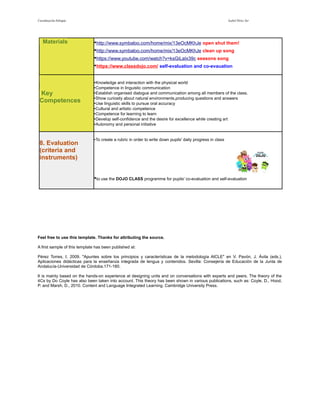
•To create a rubric in order to write down pupils' daily progress in class 
•to use the DOJO CLASS programme for pupils' co-evaluation and self-evaluation 
Feel free to use this template. Thanks for attributing the source. 
A first sample of this template has been published at: 
Pérez Torres, I. 2009. "Apuntes sobre los principios y características de la metodología AICLE" en V. Pavón, J. Ávila (eds.), 
Aplicaciones didácticas para la enseñanza integrada de lengua y contenidos. Sevilla: Consejería de Educación de la Junta de 
Andalucía-Universidad de Córdoba.171-180. 
It is mainly based on the hands-on experience at designing units and on conversations with experts and peers. The theory of the 
4Cs by Do Coyle has also been taken into account. This theory has been shown in various publications, such as: Coyle, D., Hood, 
P. and Marsh, D., 2010. Content and Language Integrated Learning. Cambridge University Press.

Aicle unit topic3

  • 1.
    Coordinación bilingüe IsabelPérez Tor Template to design a CLIL didactic unit Subject: Art Teacher: Carmen Rodríguez Suárez Course / Level: 1st cycle Primary Education Title: Ready,steady GO 4 seasons CRAFT! 1. Learning outcomes/ Evaluation criteria Learning outcomes Evaluation criteria Observe images related to the weather Evaluate the aesthetic composition of the weather Develop observational skills Interpret the compositional elements of an image. Describe weather conditions Convey and understand accurate information Enjoy a song in English Properly pronounce and sing a song in English Skilfully use drawing tools Understand and apply different techniques to create artistic compositions Understand weather conditions Understand and provide correct information Practise spelling Spell words correctly 2. Subject content •Weather conditions •Describing scenes about the four seasons •Rhyming words about the weather •Linguistic accuracy •Enjoyment of a song •Engaging in communicative exchanges that provide basic information about season •Art techniques: drawing and colouring •Techniques for describing weather conditions •Drawing vocabulary about 4 seasons •Techniques and materials for artistic composition •Satisfaction at a job well done. •Respect for the artwork of others 3. Language Content / Communication Vocabulary To happen, rain, snow, sun, cloud, wind, fog,rainy, snowy, sunny, cloudy, windy; winter, spring, summer, autumn; hot,warm, cold; there is/there are; coat hunger; cereal box; cotton; hanger; blue soft crayon; string; scissors; glue; felt-tip pens; pencil;rubber; pencil-sharpener; big and small; numbers and colours; loud/quiet; scissors; to cut out; to tie; to tape;backward/forward Structures Hello, how are you?; let's walk this way; good idea; here we are; clean up; put your things away; everybody, let's clean up; Is (Alejandra) here today? Hello, good morning/afternoon;toilet please?; off you go; please/no thank you;be quiet,please; tie the lengths of string; I see something blue; let's go backward ok?; everyone sings and walks forward together. Discourse type •description •dialogue •comparative •argumentation Language skills •Listening (receptive skill) •reading (receptive skill) •writing (productive skill) •speaking (productive skill) group work 4.Contextual (cultural) element •To connect the topic about seasons and weather to pupils' previous knowledge and daily routines life concerning to what seasons happen in a year 5. Cognitive (thinking) processes 1.Listen and understand the contents and information 2.repeat the contents 3.look for the information 4.listen and do 5.make a craft
  • 2.
    Coordinación bilingüe IsabelPérez Tor 6.Final task •To create a visual tour museum for the Art classroom ( a blog for Art classroom) 6. Activities 1st session: Introduction of the topic. 2nd session: Let's craft and sing 3rd session: Let's play a dictation drawing game 4th session: let's make a weather mobile craft Warm-up: -To know pupils' previous knowledge. Let's sing about colours, numbers and classroom vocabulary, greetings, daily routines in Art class Introduction of the new song:Seasons song Warm-up: -revision of colours, numbers and classroom vocabulary, greetings, daily routines Let's sing Seasons song Let's craft now! -cut out the front and back of the cereal box -lay the hanger on top of it and trace two clouds shapes -colour the clouds with a blue soft wax crayon -let it dry -stick the cotton on the clouds Warm-up: -revision of colours, numbers and classroom vocabulary, greetings, daily routines Let's sing Seasons song Listen, draw and colour the vocabulary about the weather and seasons in a small cardboards -cut out the cardboards -cut lengths of string for each weather picture Warm-up: -revision of colours, numbers and classroom vocabulary, greetings, daily routines Let's sing Seasons song - Tie each one weather picture to the clouds -Tape hanger in place 7. Methodology Organization and class distribution timing •4 sessions of 45' •two weeks •first term •Cooperative learning: small groups,working by teams,supporting each other thank to the task of each mini-teacher group work, find new solutions to problem,teacher as facilitator and guideline. Resources and • http://www.symbaloo.com/home/mix/13eOcMKhJe the hello song! • http://www.symbaloo.com/home/mix/13eOcMKhJe I see something blue • http://www.symbaloo.com/home/mix/13eOcMKhJe seven steps
  • 3.
    Coordinación bilingüe IsabelPérez Tor Materials • http://www.symbaloo.com/home/mix/13eOcMKhJe open shut them! • http://www.symbaloo.com/home/mix/13eOcMKhJe clean up song • https://www.youtube.com/watch?v=ksGiLaIx39c seasons song • https://www.classdojo.com / self-evaluation and co-evauation Key Competences •Knowledge and interaction with the physical world •Competence in linguistic communication •Establish organised dialogue and communication among all members of the class. •Show curiosity about natural environments,producing questions and answers •Use linguistic skills to pursue oral accuracy •Cultural and artistic competence •Competence for learning to learn •Develop self-confidence and the desire for excellence while creating art •Autonomy and personal initiative 8. Evaluation (criteria and instruments) •To create a rubric in order to write down pupils' daily progress in class •to use the DOJO CLASS programme for pupils' co-evaluation and self-evaluation Feel free to use this template. Thanks for attributing the source. A first sample of this template has been published at: Pérez Torres, I. 2009. "Apuntes sobre los principios y características de la metodología AICLE" en V. Pavón, J. Ávila (eds.), Aplicaciones didácticas para la enseñanza integrada de lengua y contenidos. Sevilla: Consejería de Educación de la Junta de Andalucía-Universidad de Córdoba.171-180. It is mainly based on the hands-on experience at designing units and on conversations with experts and peers. The theory of the 4Cs by Do Coyle has also been taken into account. This theory has been shown in various publications, such as: Coyle, D., Hood, P. and Marsh, D., 2010. Content and Language Integrated Learning. Cambridge University Press.