Conditionals in grammar use.
A verb-based technique used to show the time, and
sometimes the persistence or completeness, of an act
or state in relation to the time of verbal
communication.
The model of tense in English is a system that we
use to refer to time - past, present and future.
Many languages exercise tense to talk about time.
Other languages have no perception of tense at all,
but of course they can still talk about time, using
diverse methods.
 Verbs come in three tenses: past, present, future.
 The past is used to describe things that have already
happened. The present tense is used to describe things that
are happening right now, or things that are continuous.
The future tense describes things that have yet to happen.
 We cannot talk of tenses without bearing in mind two
components of many English tenses: time and aspect. In
simple terms
Time expresses:
 Past - before now
 Present - now, or any time that includes now
 Future - after now
Aspect can be:
 Progressive - uncompleted action
 Perfective - completed action or state
 Conditional tenses are used to contemplate about
what might happen, what might have happened,
and what we wish would occur. In English, most
sentences using the conditional contain the
word “if”.
 Many conditional forms in English are used in
sentences that include verbs in one of the past
tenses.
 This is referred to as "the unreal past" because
we use past tense but we are not referring to
something that happened in the past.
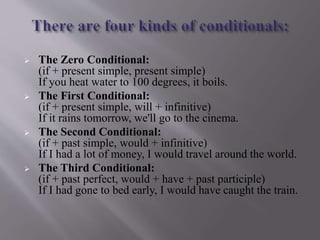
 The Zero Conditional:
(if + present simple, present simple)
If you heat water to 100 degrees, it boils.
 The First Conditional:
(if + present simple, will + infinitive)
If it rains tomorrow, we'll go to the cinema.
 The Second Conditional:
(if + past simple, would + infinitive)
If I had a lot of money, I would travel around the world.
 The Third Conditional:
(if + past perfect, would + have + past participle)
If I had gone to bed early, I would have caught the train.

Describe tenses in grammar use

  • 1.
  • 2.
    A verb-based techniqueused to show the time, and sometimes the persistence or completeness, of an act or state in relation to the time of verbal communication. The model of tense in English is a system that we use to refer to time - past, present and future. Many languages exercise tense to talk about time. Other languages have no perception of tense at all, but of course they can still talk about time, using diverse methods.
  • 3.
     Verbs comein three tenses: past, present, future.  The past is used to describe things that have already happened. The present tense is used to describe things that are happening right now, or things that are continuous. The future tense describes things that have yet to happen.  We cannot talk of tenses without bearing in mind two components of many English tenses: time and aspect. In simple terms Time expresses:  Past - before now  Present - now, or any time that includes now  Future - after now Aspect can be:  Progressive - uncompleted action  Perfective - completed action or state
  • 4.
     Conditional tensesare used to contemplate about what might happen, what might have happened, and what we wish would occur. In English, most sentences using the conditional contain the word “if”.  Many conditional forms in English are used in sentences that include verbs in one of the past tenses.  This is referred to as "the unreal past" because we use past tense but we are not referring to something that happened in the past.
  • 5.
     The ZeroConditional: (if + present simple, present simple) If you heat water to 100 degrees, it boils.  The First Conditional: (if + present simple, will + infinitive) If it rains tomorrow, we'll go to the cinema.  The Second Conditional: (if + past simple, would + infinitive) If I had a lot of money, I would travel around the world.  The Third Conditional: (if + past perfect, would + have + past participle) If I had gone to bed early, I would have caught the train.