ENGLISH GRAMMAR
PRESENT TENSE OF ENGLISH VERB
Prepared by Khabibulin Vladimir
GRAND 2014
CONTENTS
Introduction
Diagram of English Verb Tenses
Formulas of using Present Tense
Examples
Any questions?
INTRODUCTION
History of origin of the word «TENSE»
The word «Tense» is derived from Latin
word «tempus» which means time.
A verb indicates the time of an action,
event or condition by changing its form.
DIAGRAM OF ENGLISH VERB TENSES
Based on Aspect.
Aspect refers to the
nature of the action
described by the verb.
Based on Time
Frame
Verb
Tenses
Future
Simple
Continuous
Perfect
Perfect Continuous
Present
Simple
Continuous
Perfect
Perfect Continuous
Past
Simple
Continuous
Perfect
Perfect Continuous
FORMULAS OF USING PRESENT TENSE
PRESENT
Simple Continuous Perfect Perfect Continuous
Used to describe an action,
an event, or condition that
is occurring in the present,
at the moment of speaking
or writing.
Is emphasizes the continuing
nature of an action, event, or
condition.
Used to describe action that
began in the past and
continues into the present or
has just been completed.
Is used to describe an action, event, or
condition that has begun in the past
and continues into the present.
+ S + V/Vs + S + am/is/are + Ving + S + have/has + Ved/3 + S + have/has been + Ving
- S + don’t/doesn’t + V - S + am/is/are not + Ving - S + have/has not+ V3 - S + have/has not been + Ving
? Do/Does + S + V? ? Am/is/are + S + Ving? ? [?] + Have + S + Ved/3? ? Have/Has + S + been + Ving
every day, usually,
never, at first, then,
after, in the morning,
evening, often
now, at the moment twice, several times,
lately, recently, yet,
already, never, just, ever
since 2 o’clock, for 3 hours
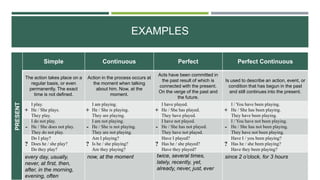
EXAMPLES
PRESENT
Simple Continuous Perfect Perfect Continuous
The action takes place on a
regular basis, or even
permanently. The exact
time is not defined.
Action in the process occurs at
the moment when talking
about him. Now, at the
moment.
Acts have been committed in
the past result of which is
connected with the present.
On the verge of the past and
the future.
Is used to describe an action, event, or
condition that has begun in the past
and still continues into the present.
+
I play.
He / She plays.
They play.
+
I am playing.
He / She is playing.
They are playing.
+
I have played.
He / She has played.
They have played.
+
I / You have been playing.
He / She has been playing.
They have been playing.
-
I do not play.
He / She does not play.
They do not play.
-
I am not playing.
He / She is not playing.
They are not playing.
-
I have not played.
He / She has not played.
They have not played.
-
I / You have not been playing.
He / She has not been playing.
They have not been playing.
?
Do I play?
Does he / she play?
Do they play?
?
Am I playing?
Is he / she playing?
Are they playing?
?
Have I played?
Has he / she played?
Have they played?
?
Have I / you been playing?
Has he / she been playing?
Have they been playing?
every day, usually,
never, at first, then,
after, in the morning,
evening, often
now, at the moment twice, several times,
lately, recently, yet,
already, never, just, ever
since 2 o’clock, for 3 hours
ANY QUESTIONS?
…?

The english present tense

  • 1.
    ENGLISH GRAMMAR PRESENT TENSEOF ENGLISH VERB Prepared by Khabibulin Vladimir GRAND 2014
  • 2.
    CONTENTS Introduction Diagram of EnglishVerb Tenses Formulas of using Present Tense Examples Any questions?
  • 3.
    INTRODUCTION History of originof the word «TENSE» The word «Tense» is derived from Latin word «tempus» which means time. A verb indicates the time of an action, event or condition by changing its form.
  • 4.
    DIAGRAM OF ENGLISHVERB TENSES Based on Aspect. Aspect refers to the nature of the action described by the verb. Based on Time Frame Verb Tenses Future Simple Continuous Perfect Perfect Continuous Present Simple Continuous Perfect Perfect Continuous Past Simple Continuous Perfect Perfect Continuous
  • 5.
    FORMULAS OF USINGPRESENT TENSE PRESENT Simple Continuous Perfect Perfect Continuous Used to describe an action, an event, or condition that is occurring in the present, at the moment of speaking or writing. Is emphasizes the continuing nature of an action, event, or condition. Used to describe action that began in the past and continues into the present or has just been completed. Is used to describe an action, event, or condition that has begun in the past and continues into the present. + S + V/Vs + S + am/is/are + Ving + S + have/has + Ved/3 + S + have/has been + Ving - S + don’t/doesn’t + V - S + am/is/are not + Ving - S + have/has not+ V3 - S + have/has not been + Ving ? Do/Does + S + V? ? Am/is/are + S + Ving? ? [?] + Have + S + Ved/3? ? Have/Has + S + been + Ving every day, usually, never, at first, then, after, in the morning, evening, often now, at the moment twice, several times, lately, recently, yet, already, never, just, ever since 2 o’clock, for 3 hours
  • 6.
    EXAMPLES PRESENT Simple Continuous PerfectPerfect Continuous The action takes place on a regular basis, or even permanently. The exact time is not defined. Action in the process occurs at the moment when talking about him. Now, at the moment. Acts have been committed in the past result of which is connected with the present. On the verge of the past and the future. Is used to describe an action, event, or condition that has begun in the past and still continues into the present. + I play. He / She plays. They play. + I am playing. He / She is playing. They are playing. + I have played. He / She has played. They have played. + I / You have been playing. He / She has been playing. They have been playing. - I do not play. He / She does not play. They do not play. - I am not playing. He / She is not playing. They are not playing. - I have not played. He / She has not played. They have not played. - I / You have not been playing. He / She has not been playing. They have not been playing. ? Do I play? Does he / she play? Do they play? ? Am I playing? Is he / she playing? Are they playing? ? Have I played? Has he / she played? Have they played? ? Have I / you been playing? Has he / she been playing? Have they been playing? every day, usually, never, at first, then, after, in the morning, evening, often now, at the moment twice, several times, lately, recently, yet, already, never, just, ever since 2 o’clock, for 3 hours
  • 7.