Guided By,
K .A Ouseph
(Professor in charge)
Presented By,
Sahla P.I
S7 CE
Roll No:51
Why not the “Natural Water”?
2
“Our Globe possess more Water than
land!!”
(Source: http//www.animatedgif.net/earthglobe/earthglobe8.shtml)
3
•INTRODUCTION
•USE & COST OF DESALINATION
•DESALINATION PROCESS
•MAJOR DESALINATION METHODS
• REVERSE OSMOSIS
• SEAWATER GREENHOUSE
CONTENTS
4
CONTENTS
• CASE STUDY: HBT RO PLANT: QATAR
• GLOBAL CONTEXT
• OASIS GENERATION PROGRAMME
• SEAWATER TO FRESHWATER BY RO:
(VIDEO CLIP)
• CONCLUSION
• REFERENCE 5
INTRODUCTION
•DESALINATION : Saline water to fresh water
•It has both merits and demerits
•Positive side : Solves water scarcity issues
•Negative sides includes:
• High cost
• High energy required
• Environmental impact 6
INTRODUCTION(Contd.)
7
•Regional Study of World Bank :
•Improve awareness on desalination.
•Concluded :
•Improper implementation leads to failure.
•Desalination could be made:
•Less costly
•Energy efficient
•Ecofriendly
•USES OF DESALINATED WATER
•Drinking water
•Domestic uses
•Industrial uses
•Agricultural use
•“THERE ARE COUNTRIES THAT HAS TO PAY MORE FOR
WATER THAN OIL”
• Example: Middle east countries
• Costly
USE & COST OF DESALINATION
8
DESALINATION PROCESS
Desalination Process
(Source:www.canadianclear.com)
9
MAJOR DESALINATION METHODS
• REVERSE OSMOSIS
• SEAWATER GREENHOUSE
10
REVERSE OSMOSIS
• Semi permeable membrane
• Osmosis: lower to higher concentration
through membrane
• To dilute the higher concentrated
solution
• In RO, water flow from higher to lower
concentrated side
• Low salt
• More water 11
0
1
2
3
4
5
OSMOSIS REVERSE
OSMOSIS
WATER ON HIGHER
COCENTRATION SIDE
WATER ON LOWER
CONCENTRATION SIDE
Difference between Osmosis & Reverse Osmosis
REVERSE OSMOSIS(Contd.)
12
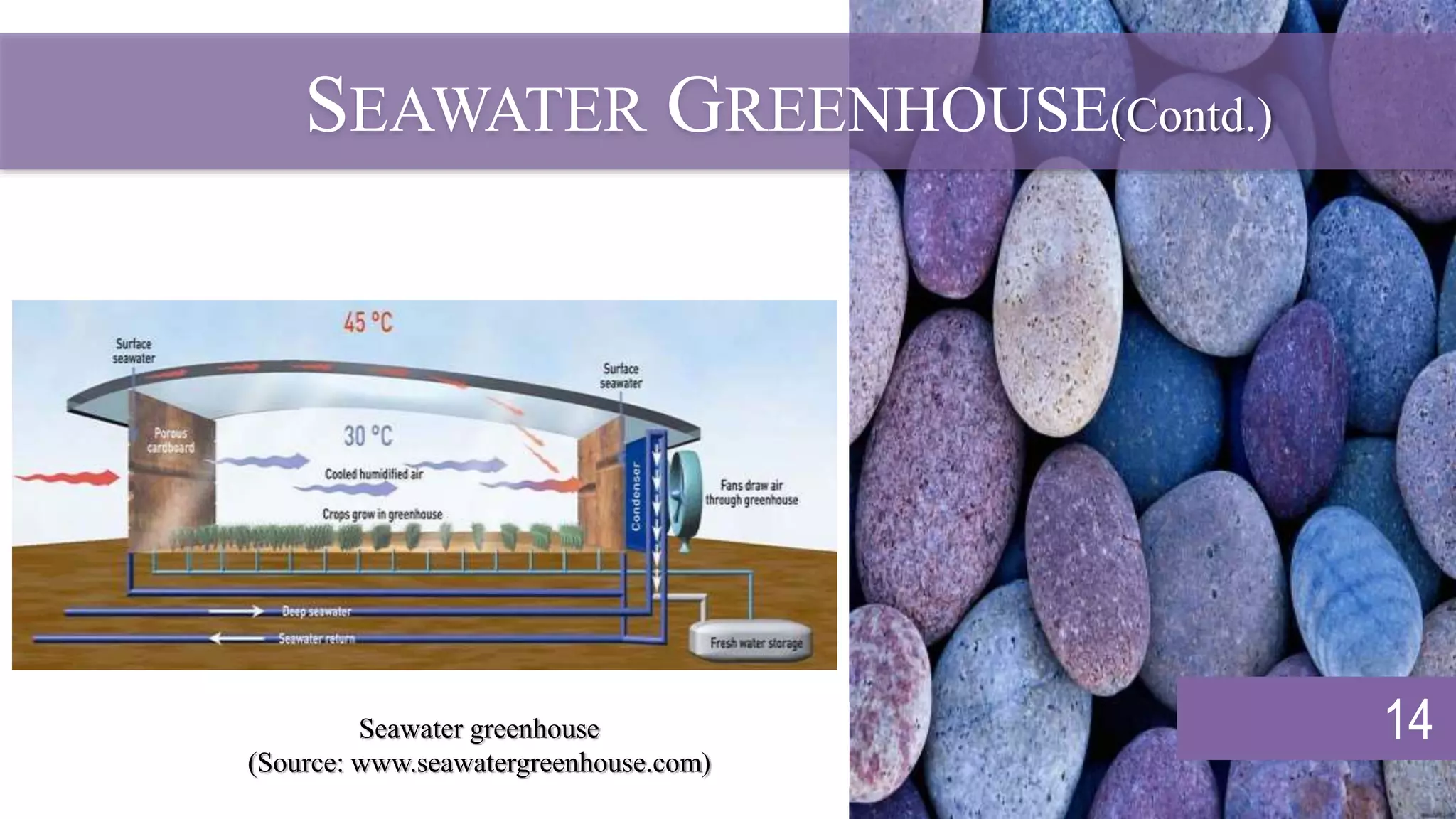
• Helps in growth of crops
• Cools air flows through the house.
• Sunlight enter the house by special roof
• Provides humidity and moisture
• Air passes through the exit wall
and gets condensed
SEAWATER GREEN HOUSE
13
SEAWATER GREENHOUSE(Contd.)
Seawater greenhouse
(Source: www.seawatergreenhouse.com)
14
CASE STUDY: HBT RO PLANT:QATAR
• HOWTAT BANI TAMIM RO PLANT,QATAR
• Aeration & Sedimentation
• Followed by Cooling towers ,Storage tanks & Sand filters
• Filtered water stored in RO building
• 16 Evaporation tanks are used to dispose:
• Rejected water:RO units
• Sludge: Sedimentation tanks
• Wash water: Filters 15
CASE STUDY: HBT RO PLANT:QATAR(Contd.)
Schematic diagram of HBT plant
(Source: http://inpressco.com/category/ijce)
16
• Concluded:
• Avg Raw water flow : 29975 cu m/day
• Avg TDS: 2000 mg/lit
• High iron concentration :(4-7) mg/lit
• Average daily product water flow :26282 cu m /day
CASE STUDY: HBT RO PLANT:QATAR(Contd.)
17
Desalination Plants & their Output
(Source:www.hitachizosen.co.jp)
GLOBAL CONTEXT
•Current global capacity : more than 15,000 desalination plants
•Number of People consuming desalinated water are likely to rise
18
DUBAI
•Reverse Osmosis system
INDIA
AUSTRALIA
• Powered by wave energy
• RO system
Garden Island Desalination Plant, Australia
(Source: www.carnegiewave.com)
Minjur Desalination Plant neaChennai, India
(Source: www.ivrcl.com)
The Jebel Ali plant in Dubai
(Source: forums.canadiancintinent.net)
•Uses Distillation Process
19
IS IT POSSIBLE TO TURN OUR DESERTS GREEN???
OASIS GENERATION PROGRAMME :
•An upcoming project
•Oasis: Isolated area of vegetation in desert
surrounded by a spring /water resources
•Critical importance :trade & transportation in deserts
•Caravans travel via oases
20
• Aim :Integrated large scale production of freshwater,
energy, biomass and ecosystem
• Simple Inputs : Nutrients, sunlight and seawater
• Work under sunny and arid conditions
• Integration of technologies: Seawater Greenhouse, Solar
Power & the extraction of seawater energy
OASIS GENERATION PROGRAMME:
THE GREEN DESERT TOWER
21
The Green Desert Tower
(Source: Chris-studio.blogspot.in)
SEAWATER TO FRESHWATER BY RO
(Source: http://m.youtube.com/watch?v=1xcGmv25rxM)
22
CONCLUSION
•Artificial solution & has both positive & negative phases
•Controversies existed until a decade ago
•Global warming turned landscapes into near deserts
•Expanding population: intense pressure on existing fresh water supplies
•Case study of HBT Plant: RO Process is less energy intensive method
23
CONCLUSION
•WORLD BANK’S RECENT REGIONAL STUDY CONCLUDED
THAT:
By Proper planning, technologies & implementation, Desalination
could be made:
Less costly
Energy efficient
Ecofriendly
“Desalination is the most expedient way to satisfy
our collective thirst.”
24
• K.H Khalil, Farouk M.W and Abdul aziz M.E (2015)“Operational Performance and
Monitoring of a Reverse Osmosis Desalination Plant: A Case Study”
• Norouz S (2015), “Suggested Strategies in Water Treatment by Using Situ Pressure
in Reverse Osmosis”, Journal of Geology, pp 367-373
• R Calvo,S Castro, G.A Osorio,G Lopez & Calvo (2014), “Novel Membrane
Materials for Reverse Osmosis Desalination”,Hydrology Current
• Copeland & Lytle (2014), “Measuring the oxidation–reduction potential of
important oxidants in drinking water”
REFERENCE
25
• Stover (2014), “a New Process for High-Recovery, Low-Energy RO Treatment”,
Journal AWWA, pp 74-77
• Shenoy, Abhita, Fathima,Jagadish & Rajalakshmi (2014), “Optimization of Pre-
Treatment Process in Sea Water Reverse Osmosis Plant”,Journal of Innovative
Research in Science, Engineering and Technology. Vol. 3, Issue 7, pp 14733-14740.
• International Journal of Environment and Sustainability ISSN 1927‐9566 | Vol. 1
No. 3, pp. 22‐37 (2012).
REFERENCE
26
THANK YOU
QUESTIONS?!

Desalination: Solution to Water Scarcity

  • 2.
    Guided By, K .AOuseph (Professor in charge) Presented By, Sahla P.I S7 CE Roll No:51
  • 3.
    Why not the“Natural Water”? 2
  • 4.
    “Our Globe possessmore Water than land!!” (Source: http//www.animatedgif.net/earthglobe/earthglobe8.shtml) 3
  • 5.
    •INTRODUCTION •USE & COSTOF DESALINATION •DESALINATION PROCESS •MAJOR DESALINATION METHODS • REVERSE OSMOSIS • SEAWATER GREENHOUSE CONTENTS 4
  • 6.
    CONTENTS • CASE STUDY:HBT RO PLANT: QATAR • GLOBAL CONTEXT • OASIS GENERATION PROGRAMME • SEAWATER TO FRESHWATER BY RO: (VIDEO CLIP) • CONCLUSION • REFERENCE 5
  • 7.
    INTRODUCTION •DESALINATION : Salinewater to fresh water •It has both merits and demerits •Positive side : Solves water scarcity issues •Negative sides includes: • High cost • High energy required • Environmental impact 6
  • 8.
    INTRODUCTION(Contd.) 7 •Regional Study ofWorld Bank : •Improve awareness on desalination. •Concluded : •Improper implementation leads to failure. •Desalination could be made: •Less costly •Energy efficient •Ecofriendly
  • 9.
    •USES OF DESALINATEDWATER •Drinking water •Domestic uses •Industrial uses •Agricultural use •“THERE ARE COUNTRIES THAT HAS TO PAY MORE FOR WATER THAN OIL” • Example: Middle east countries • Costly USE & COST OF DESALINATION 8
  • 10.
  • 11.
    MAJOR DESALINATION METHODS •REVERSE OSMOSIS • SEAWATER GREENHOUSE 10
  • 12.
    REVERSE OSMOSIS • Semipermeable membrane • Osmosis: lower to higher concentration through membrane • To dilute the higher concentrated solution • In RO, water flow from higher to lower concentrated side • Low salt • More water 11
  • 13.
    0 1 2 3 4 5 OSMOSIS REVERSE OSMOSIS WATER ONHIGHER COCENTRATION SIDE WATER ON LOWER CONCENTRATION SIDE Difference between Osmosis & Reverse Osmosis REVERSE OSMOSIS(Contd.) 12
  • 14.
    • Helps ingrowth of crops • Cools air flows through the house. • Sunlight enter the house by special roof • Provides humidity and moisture • Air passes through the exit wall and gets condensed SEAWATER GREEN HOUSE 13
  • 15.
  • 16.
    CASE STUDY: HBTRO PLANT:QATAR • HOWTAT BANI TAMIM RO PLANT,QATAR • Aeration & Sedimentation • Followed by Cooling towers ,Storage tanks & Sand filters • Filtered water stored in RO building • 16 Evaporation tanks are used to dispose: • Rejected water:RO units • Sludge: Sedimentation tanks • Wash water: Filters 15
  • 17.
    CASE STUDY: HBTRO PLANT:QATAR(Contd.) Schematic diagram of HBT plant (Source: http://inpressco.com/category/ijce) 16
  • 18.
    • Concluded: • AvgRaw water flow : 29975 cu m/day • Avg TDS: 2000 mg/lit • High iron concentration :(4-7) mg/lit • Average daily product water flow :26282 cu m /day CASE STUDY: HBT RO PLANT:QATAR(Contd.) 17
  • 19.
    Desalination Plants &their Output (Source:www.hitachizosen.co.jp) GLOBAL CONTEXT •Current global capacity : more than 15,000 desalination plants •Number of People consuming desalinated water are likely to rise 18
  • 20.
    DUBAI •Reverse Osmosis system INDIA AUSTRALIA •Powered by wave energy • RO system Garden Island Desalination Plant, Australia (Source: www.carnegiewave.com) Minjur Desalination Plant neaChennai, India (Source: www.ivrcl.com) The Jebel Ali plant in Dubai (Source: forums.canadiancintinent.net) •Uses Distillation Process 19
  • 21.
    IS IT POSSIBLETO TURN OUR DESERTS GREEN??? OASIS GENERATION PROGRAMME : •An upcoming project •Oasis: Isolated area of vegetation in desert surrounded by a spring /water resources •Critical importance :trade & transportation in deserts •Caravans travel via oases 20
  • 22.
    • Aim :Integratedlarge scale production of freshwater, energy, biomass and ecosystem • Simple Inputs : Nutrients, sunlight and seawater • Work under sunny and arid conditions • Integration of technologies: Seawater Greenhouse, Solar Power & the extraction of seawater energy OASIS GENERATION PROGRAMME: THE GREEN DESERT TOWER 21 The Green Desert Tower (Source: Chris-studio.blogspot.in)
  • 23.
    SEAWATER TO FRESHWATERBY RO (Source: http://m.youtube.com/watch?v=1xcGmv25rxM) 22
  • 24.
    CONCLUSION •Artificial solution &has both positive & negative phases •Controversies existed until a decade ago •Global warming turned landscapes into near deserts •Expanding population: intense pressure on existing fresh water supplies •Case study of HBT Plant: RO Process is less energy intensive method 23
  • 25.
    CONCLUSION •WORLD BANK’S RECENTREGIONAL STUDY CONCLUDED THAT: By Proper planning, technologies & implementation, Desalination could be made: Less costly Energy efficient Ecofriendly “Desalination is the most expedient way to satisfy our collective thirst.” 24
  • 26.
    • K.H Khalil,Farouk M.W and Abdul aziz M.E (2015)“Operational Performance and Monitoring of a Reverse Osmosis Desalination Plant: A Case Study” • Norouz S (2015), “Suggested Strategies in Water Treatment by Using Situ Pressure in Reverse Osmosis”, Journal of Geology, pp 367-373 • R Calvo,S Castro, G.A Osorio,G Lopez & Calvo (2014), “Novel Membrane Materials for Reverse Osmosis Desalination”,Hydrology Current • Copeland & Lytle (2014), “Measuring the oxidation–reduction potential of important oxidants in drinking water” REFERENCE 25
  • 27.
    • Stover (2014),“a New Process for High-Recovery, Low-Energy RO Treatment”, Journal AWWA, pp 74-77 • Shenoy, Abhita, Fathima,Jagadish & Rajalakshmi (2014), “Optimization of Pre- Treatment Process in Sea Water Reverse Osmosis Plant”,Journal of Innovative Research in Science, Engineering and Technology. Vol. 3, Issue 7, pp 14733-14740. • International Journal of Environment and Sustainability ISSN 1927‐9566 | Vol. 1 No. 3, pp. 22‐37 (2012). REFERENCE 26
  • 28.
  • 29.