Advances in Renewable
                    Energy Driven Desalination

                          George Papadakis, Professor
                          Agricultural University of Athens
                          www.renewables.aua.gr


Advancing Non-Conventional Water Resources Management in the
        Mediterranean, Hilton, 14-15 Σεπτεµβρίου 2011
Presentation Structure
1.   Desalination in the world

2.   Desalination technologies

3.   Renewable energies and desalination

4.   Wind, solar PV, solar thermal

5.   Conclusions


                                 Agricultural University of Athens
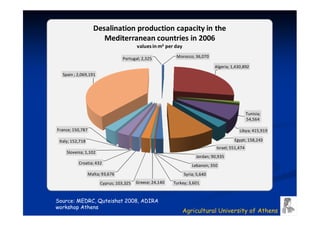
Desalination production capacity in the
                       Mediterranean countries in 2006
                                          values in m3 per day

                                   Portugal; 2,325          Morocco; 36,070

                                                                                Algeria; 1,430,892
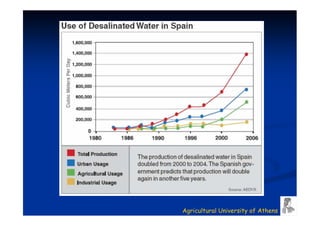
  Spain ; 2,069,191


                                                                                                   Tunisia;
                                                                                                   54,564

France; 150,787                                                                              Libya; 415,919

 Italy; 152,718                                                                           Egypt; 158,243
                                                                                 Israel; 551,474
    Slovenia; 1,102
                                                                       Jordan; 90,935
           Croatia; 432
                                                                     Lebanon; 350
                  Malta; 93,676                                  Syria; 5,640
                        Cyprus; 103,325   Greece; 24,140   Turkey; 3,601


Source: MEDRC, Quteishat 2008, ADIRA
workshop Athens
                                                                 Agricultural University of Athens
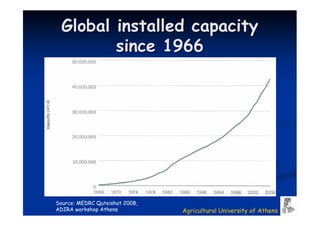
Global installed capacity
         since 1966


Source: MEDRC Quteishat 2008,
ADIRA workshop Athens           Agricultural University of Athens
Agricultural University of Athens
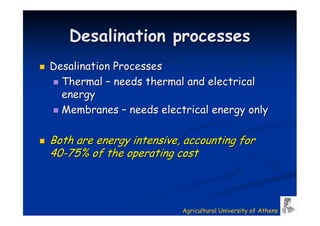
Desalination processes
Desalination Processes
  Thermal – needs thermal and electrical
  energy
  Membranes – needs electrical energy only

Both are energy intensive, accounting for
40-75% of the operating cost


                          Agricultural University of Athens
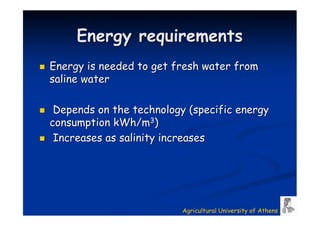
Energy requirements
Energy is needed to get fresh water from
saline water

 Depends on the technology (specific energy
consumption kWh/m3)
 Increases as salinity increases


                         Agricultural University of Athens
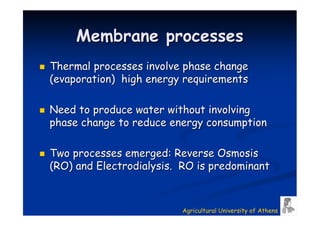
Membrane processes
Thermal processes involve phase change
(evaporation) high energy requirements

Need to produce water without involving
phase change to reduce energy consumption

Two processes emerged: Reverse Osmosis
(RO) and Electrodialysis. RO is predominant


                         Agricultural University of Athens
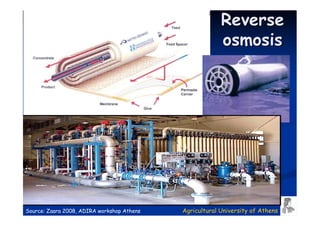
Reverse
                                                         osmosis


Source: Zaara 2008, ADIRA workshop Athens   Agricultural University of Athens
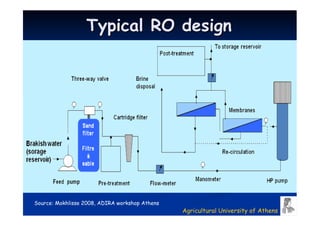
Typical RO design


Source: Mokhlisse 2008, ADIRA workshop Athens
                                                Agricultural University of Athens
Reverse osmosis

Energy consumption initially high, 12 kWh/m3

Major method to reduce energy consumption is
to recover energy from reject brine with
energy recovery devices


                         Agricultural University of Athens
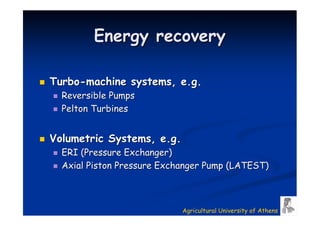
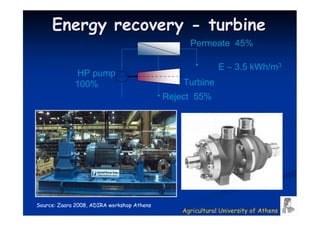
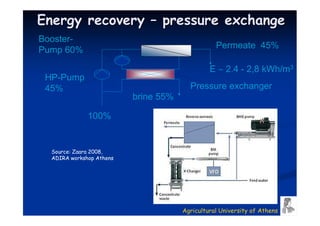
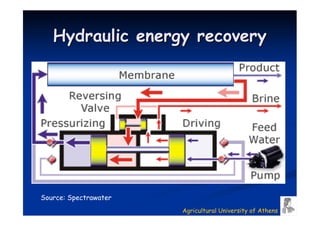
Energy recovery

Turbo-machine systems, e.g.
  Reversible Pumps
  Pelton Turbines


Volumetric Systems, e.g.
  ERI (Pressure Exchanger)
  Axial Piston Pressure Exchanger Pump (LATEST)


                            Agricultural University of Athens
Energy recovery - turbine
                                                  Permeate 45%

                                                            E ∼ 3.5 kWh/m3
              HP pump
             100%                               Turbine
                                            Reject 55%


Source: Zaara 2008, ADIRA workshop Athens
                                                Agricultural University of Athens
Energy recovery – pressure exchange
Booster-
Pump 60%                                         Permeate 45%

                                               E ∼ 2.4 - 2,8 kWh/m3
 HP-Pump
 45%                                    Pressure exchanger
                          brine 55%

              100%


  Source: Zaara 2008,
  ADIRA workshop Athens


                                      Agricultural University of Athens
Hydraulic energy recovery


Source: Spectrawater
                       Agricultural University of Athens
Desalination and renewables
Attractive to reduce dependence on fossil
fuels and CO2 emissions
Capital costs still high
Operating costs very low
  Solar thermal systems, photovoltaic, wind, wave,
  and geothermal can provide thermal, electrical or
  mechanical energy
  Can be used in remote and rural areas for small
  scale applications
  Can be used for medium scale plants
  True but commercialization is forthcoming

                              Agricultural University of Athens
Desalination and renewables
Most attractive renewable energy sources

  Wind energy
  Solar energy (PV and solar thermal collectors)
  Geothermal energy


                              Agricultural University of Athens
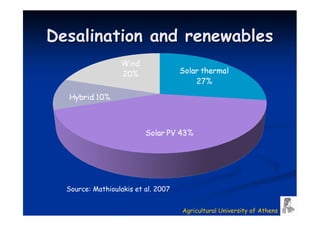
Desalination and renewables


  Source: Mathioulakis et al. 2007


                                     Agricultural University of Athens
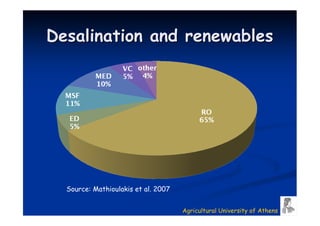
Desalination and renewables


  Source: Mathioulakis et al. 2007


                                     Agricultural University of Athens
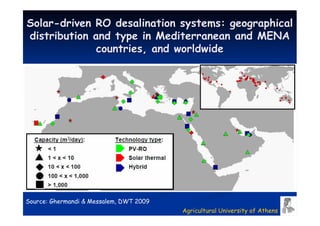
Solar-driven RO desalination systems: geographical
distribution and type in Mediterranean and MENA
              countries, and worldwide


Source: Ghermandi & Messalem, DWT 2009
                                         Agricultural University of Athens
Desalination and renewables
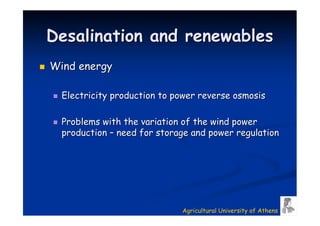
Wind energy

  Electricity production to power reverse osmosis

  Problems with the variation of the wind power
  production – need for storage and power regulation


                             Agricultural University of Athens
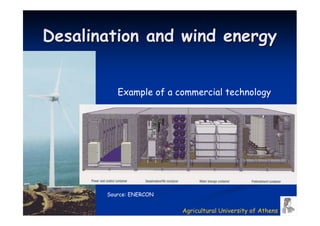
Desalination and wind energy


          Example of a commercial technology


       Source: ENERCON


                         Agricultural University of Athens
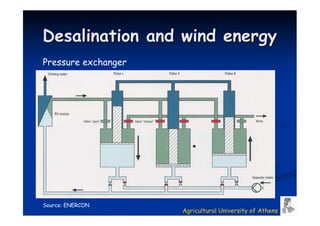
Desalination and wind energy
Pressure exchanger


Source: ENERCON
                     Agricultural University of Athens
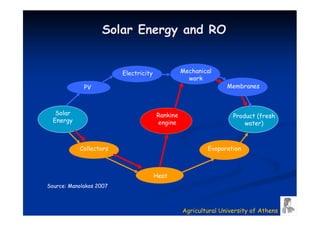
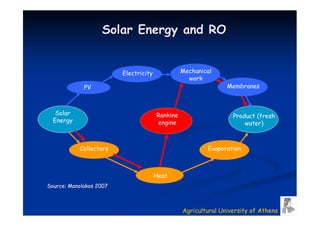
Solar Energy and RO


                         Electricity             Mechanical
                                                   work
             PV                                                 Membranes


   Solar                               Rankine                    Product (fresh
  Energy                               engine                         water)


           Collectors                                    Evaporation


                                       Heat
Source: Manolakos 2007


                                                 Agricultural University of Athens
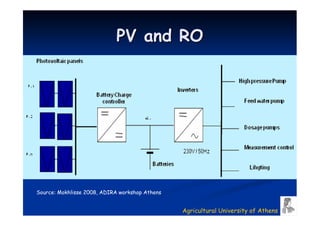
PV and RO


Source: Mokhlisse 2008, ADIRA workshop Athens


                                                Agricultural University of Athens
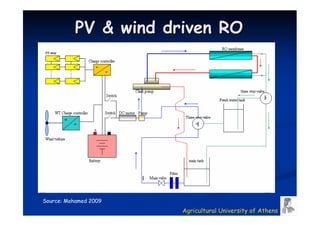
PV & wind driven RO


Source: Mohamed 2009
                       Agricultural University of Athens
The ADIRA HANDBOOK
The ADIRA HANDBOOK: A guide to Autonomous
Desalination Concepts

A guide to decision makers, project developers and
interested end users for the implementation of
renewable energy driven desalination systems

Designed for the non-specialist / non-engineer

Provides instructions for planning, installing and
maintaining of ADS and ready made material for
training local users

                                Agricultural University of Athens
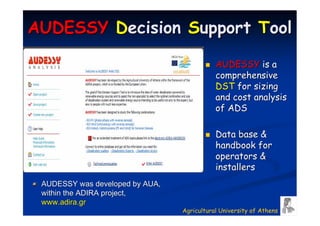
AUDESSY Decision Support Tool

                                            AUDESSY is a
                                            comprehensive
                                            DST for sizing
                                            and cost analysis
                                            of ADS

                                            Data base &
                                            handbook for
                                            operators &
                                            installers
 AUDESSY was developed by AUA,
 within the ADIRA project,
 www.adira.gr
                                 Agricultural University of Athens
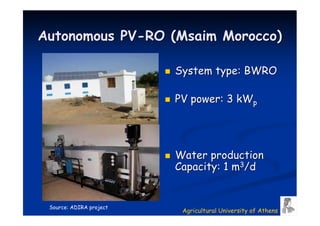
Autonomous PV-RO (Msaim Morocco)

                         System type: BWRO

                         PV power: 3 kWp


                         Water production
                         Capacity: 1 m3/d


 Source: ADIRA project
                          Agricultural University of Athens
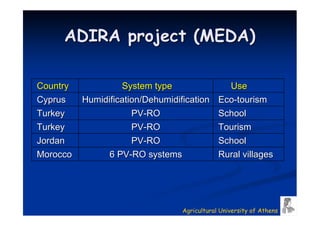
ADIRA project (MEDA)

Country            System type                  Use
Cyprus    Humidification/Dehumidification     Eco-tourism
Turkey                PV-RO                   School
Turkey                PV-RO                   Tourism
Jordan                PV-RO                   School
Morocco         6 PV-RO systems               Rural villages


                                  Agricultural University of Athens
Solar Energy and RO


                         Electricity             Mechanical
                                                   work
             PV                                                 Membranes


   Solar                               Rankine                    Product (fresh
  Energy                               engine                         water)


           Collectors                                    Evaporation


                                       Heat
Source: Manolakos 2007


                                                 Agricultural University of Athens
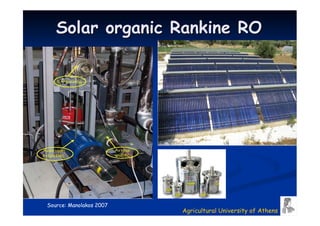
Solar organic Rankine RO


Source: Manolakos 2007
                         Agricultural University of Athens
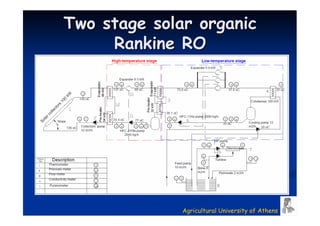
Two stage solar organic
     Rankine RO


              Agricultural University of Athens
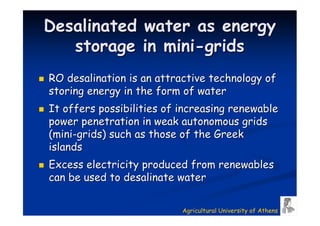
Desalinated        water as energy
   storage         in mini-grids
RO desalination is an attractive technology of
storing energy in the form of water
It offers possibilities of increasing renewable
power penetration in weak autonomous grids
(mini-grids) such as those of the Greek
islands
Excess electricity produced from renewables
can be used to desalinate water

                           Agricultural University of Athens
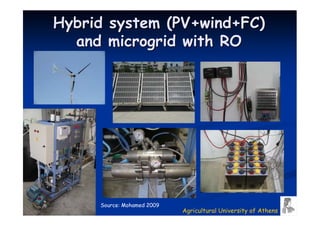
Hybrid system (PV+wind+FC)
  and microgrid with RO


     Source: Mohamed 2009
                            Agricultural University of Athens
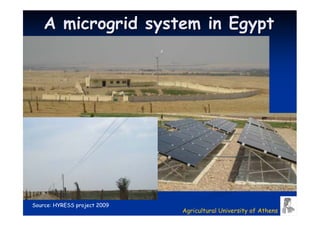
A microgrid system in Egypt


Source: HYRESS project 2009
                              Agricultural University of Athens
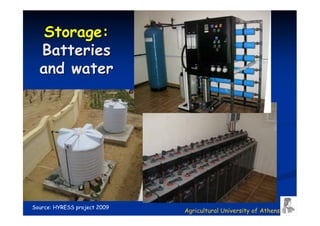
Storage:
  Batteries
  and water


Source: HYRESS project 2009
                              Agricultural University of Athens
What about the costs ?

Wind powered RO desalination can be
competitive at good wind potential
Even PV driven RO desalination is competitive
to transported water in the Greek islands
Geothermal energy fits well to thermal
desalination methods


                          Agricultural University of Athens
Are there any environmental
         effects ?
Yes

  Energy use
  Brine disposal


                   Agricultural University of Athens
Conclusions
Desalination increases at dramatic rates due to fresh
water demand and decreasing production cost

Carbon foot print of desalination will increase. Need
for measures to be introduced for RE application

Commercialization of renewable energy driven
desalination has just started

Environmental problems can become significant
especially in closed seas – research is necessary

Research is necessary for developing further the
combination of renewable energy technologies with
desalination technologies and reduce costs
                                Agricultural University of Athens
Thank you for your interest
   George Papadakis: gpap@aua.gr


        www.renewables.aua.gr, Agricultural University of Athens

006b NCWRM 2011 Papadakis_AgrUoA

  • 1.
    Advances in Renewable Energy Driven Desalination George Papadakis, Professor Agricultural University of Athens www.renewables.aua.gr Advancing Non-Conventional Water Resources Management in the Mediterranean, Hilton, 14-15 Σεπτεµβρίου 2011
  • 2.
    Presentation Structure 1. Desalination in the world 2. Desalination technologies 3. Renewable energies and desalination 4. Wind, solar PV, solar thermal 5. Conclusions Agricultural University of Athens
  • 3.
    Desalination production capacityin the Mediterranean countries in 2006 values in m3 per day Portugal; 2,325 Morocco; 36,070 Algeria; 1,430,892 Spain ; 2,069,191 Tunisia; 54,564 France; 150,787 Libya; 415,919 Italy; 152,718 Egypt; 158,243 Israel; 551,474 Slovenia; 1,102 Jordan; 90,935 Croatia; 432 Lebanon; 350 Malta; 93,676 Syria; 5,640 Cyprus; 103,325 Greece; 24,140 Turkey; 3,601 Source: MEDRC, Quteishat 2008, ADIRA workshop Athens Agricultural University of Athens
  • 4.
    Global installed capacity since 1966 Source: MEDRC Quteishat 2008, ADIRA workshop Athens Agricultural University of Athens
  • 5.
  • 6.
    Desalination processes Desalination Processes Thermal – needs thermal and electrical energy Membranes – needs electrical energy only Both are energy intensive, accounting for 40-75% of the operating cost Agricultural University of Athens
  • 7.
    Energy requirements Energy isneeded to get fresh water from saline water Depends on the technology (specific energy consumption kWh/m3) Increases as salinity increases Agricultural University of Athens
  • 8.
    Membrane processes Thermal processesinvolve phase change (evaporation) high energy requirements Need to produce water without involving phase change to reduce energy consumption Two processes emerged: Reverse Osmosis (RO) and Electrodialysis. RO is predominant Agricultural University of Athens
  • 9.
    Reverse osmosis Source: Zaara 2008, ADIRA workshop Athens Agricultural University of Athens
  • 10.
    Typical RO design Source:Mokhlisse 2008, ADIRA workshop Athens Agricultural University of Athens
  • 11.
    Reverse osmosis Energy consumptioninitially high, 12 kWh/m3 Major method to reduce energy consumption is to recover energy from reject brine with energy recovery devices Agricultural University of Athens
  • 12.
    Energy recovery Turbo-machine systems,e.g. Reversible Pumps Pelton Turbines Volumetric Systems, e.g. ERI (Pressure Exchanger) Axial Piston Pressure Exchanger Pump (LATEST) Agricultural University of Athens
  • 13.
    Energy recovery -turbine Permeate 45% E ∼ 3.5 kWh/m3 HP pump 100% Turbine Reject 55% Source: Zaara 2008, ADIRA workshop Athens Agricultural University of Athens
  • 14.
    Energy recovery –pressure exchange Booster- Pump 60% Permeate 45% E ∼ 2.4 - 2,8 kWh/m3 HP-Pump 45% Pressure exchanger brine 55% 100% Source: Zaara 2008, ADIRA workshop Athens Agricultural University of Athens
  • 15.
    Hydraulic energy recovery Source:Spectrawater Agricultural University of Athens
  • 16.
    Desalination and renewables Attractiveto reduce dependence on fossil fuels and CO2 emissions Capital costs still high Operating costs very low Solar thermal systems, photovoltaic, wind, wave, and geothermal can provide thermal, electrical or mechanical energy Can be used in remote and rural areas for small scale applications Can be used for medium scale plants True but commercialization is forthcoming Agricultural University of Athens
  • 17.
    Desalination and renewables Mostattractive renewable energy sources Wind energy Solar energy (PV and solar thermal collectors) Geothermal energy Agricultural University of Athens
  • 18.
    Desalination and renewables Source: Mathioulakis et al. 2007 Agricultural University of Athens
  • 19.
    Desalination and renewables Source: Mathioulakis et al. 2007 Agricultural University of Athens
  • 20.
    Solar-driven RO desalinationsystems: geographical distribution and type in Mediterranean and MENA countries, and worldwide Source: Ghermandi & Messalem, DWT 2009 Agricultural University of Athens
  • 21.
    Desalination and renewables Windenergy Electricity production to power reverse osmosis Problems with the variation of the wind power production – need for storage and power regulation Agricultural University of Athens
  • 22.
    Desalination and windenergy Example of a commercial technology Source: ENERCON Agricultural University of Athens
  • 23.
    Desalination and windenergy Pressure exchanger Source: ENERCON Agricultural University of Athens
  • 24.
    Solar Energy andRO Electricity Mechanical work PV Membranes Solar Rankine Product (fresh Energy engine water) Collectors Evaporation Heat Source: Manolakos 2007 Agricultural University of Athens
  • 25.
    PV and RO Source:Mokhlisse 2008, ADIRA workshop Athens Agricultural University of Athens
  • 26.
    PV & winddriven RO Source: Mohamed 2009 Agricultural University of Athens
  • 27.
    The ADIRA HANDBOOK TheADIRA HANDBOOK: A guide to Autonomous Desalination Concepts A guide to decision makers, project developers and interested end users for the implementation of renewable energy driven desalination systems Designed for the non-specialist / non-engineer Provides instructions for planning, installing and maintaining of ADS and ready made material for training local users Agricultural University of Athens
  • 28.
    AUDESSY Decision SupportTool AUDESSY is a comprehensive DST for sizing and cost analysis of ADS Data base & handbook for operators & installers AUDESSY was developed by AUA, within the ADIRA project, www.adira.gr Agricultural University of Athens
  • 29.
    Autonomous PV-RO (MsaimMorocco) System type: BWRO PV power: 3 kWp Water production Capacity: 1 m3/d Source: ADIRA project Agricultural University of Athens
  • 30.
    ADIRA project (MEDA) Country System type Use Cyprus Humidification/Dehumidification Eco-tourism Turkey PV-RO School Turkey PV-RO Tourism Jordan PV-RO School Morocco 6 PV-RO systems Rural villages Agricultural University of Athens
  • 31.
    Solar Energy andRO Electricity Mechanical work PV Membranes Solar Rankine Product (fresh Energy engine water) Collectors Evaporation Heat Source: Manolakos 2007 Agricultural University of Athens
  • 32.
    Solar organic RankineRO Source: Manolakos 2007 Agricultural University of Athens
  • 33.
    Two stage solarorganic Rankine RO Agricultural University of Athens
  • 34.
    Desalinated water as energy storage in mini-grids RO desalination is an attractive technology of storing energy in the form of water It offers possibilities of increasing renewable power penetration in weak autonomous grids (mini-grids) such as those of the Greek islands Excess electricity produced from renewables can be used to desalinate water Agricultural University of Athens
  • 35.
    Hybrid system (PV+wind+FC) and microgrid with RO Source: Mohamed 2009 Agricultural University of Athens
  • 36.
    A microgrid systemin Egypt Source: HYRESS project 2009 Agricultural University of Athens
  • 37.
    Storage: Batteries and water Source: HYRESS project 2009 Agricultural University of Athens
  • 38.
    What about thecosts ? Wind powered RO desalination can be competitive at good wind potential Even PV driven RO desalination is competitive to transported water in the Greek islands Geothermal energy fits well to thermal desalination methods Agricultural University of Athens
  • 39.
    Are there anyenvironmental effects ? Yes Energy use Brine disposal Agricultural University of Athens
  • 40.
    Conclusions Desalination increases atdramatic rates due to fresh water demand and decreasing production cost Carbon foot print of desalination will increase. Need for measures to be introduced for RE application Commercialization of renewable energy driven desalination has just started Environmental problems can become significant especially in closed seas – research is necessary Research is necessary for developing further the combination of renewable energy technologies with desalination technologies and reduce costs Agricultural University of Athens
  • 41.
    Thank you foryour interest George Papadakis: gpap@aua.gr www.renewables.aua.gr, Agricultural University of Athens