Drugs for Skin Disorders
Dr A Chansoria
Dr A Chansoria
Introduction
Introduction
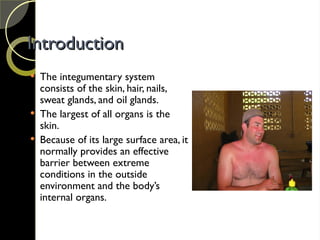
 The integumentary system
consists of the skin, hair, nails,
sweat glands, and oil glands.
 The largest of all organs is the
skin.
 Because of its large surface area, it
normally provides an effective
barrier between extreme
conditions in the outside
environment and the body’s
internal organs.
Introduction
Introduction
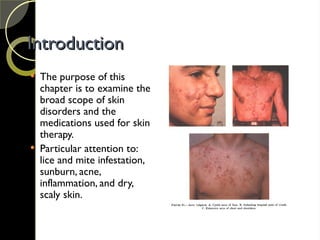
 The purpose of this
chapter is to examine the
broad scope of skin
disorders and the
medications used for skin
therapy.
 Particular attention to:
lice and mite infestation,
sunburn, acne,
inflammation, and dry,
scaly skin.
Three Layers of Skin
 Epidermis—most superficial skin layer
◦ Thick skin—5 layers
◦ Soles of feet, palms of hands
◦ Melanocytes—provide protection against the sun.
 Dermis—under epidermis
◦ Provides foundation for epidermis, hair and nails
◦ Location of receptor nerve endings, sweat glands, oil glands, blood vessels.
 Subcutaneous layer or hypodermis—deepest layer
◦ Mainly composed of adipose tissue
◦ Cushions, insulates, provides a source of energy.
◦ Involved with the maintenance of homeostasis, temperature regulation,
metabolism
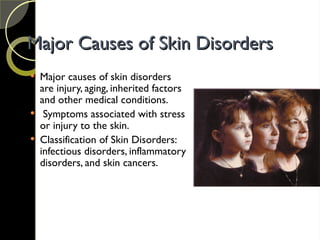
Major Causes of Skin Disorders
 Major causes of skin disorders
are injury, aging, inherited factors
and other medical conditions.
 Symptoms associated with stress
or injury to the skin.
 Classification of Skin Disorders:
infectious disorders, inflammatory
disorders, and skin cancers.
Major Causes of Skin Disorders
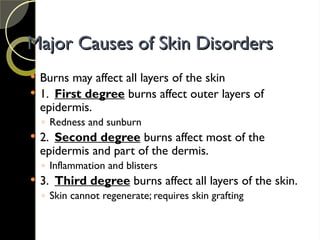
 Burns may affect all layers of the skin
 1. First degree burns affect outer layers of
epidermis.
◦ Redness and sunburn
 2. Second degree burns affect most of the
epidermis and part of the dermis.
◦ Inflammation and blisters
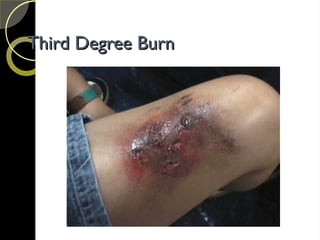
 3. Third degree burns affect all layers of the skin.
◦ Skin cannot regenerate; requires skin grafting
Third Degree Burn
Third Degree Burn
Scabicides & Peducilicides
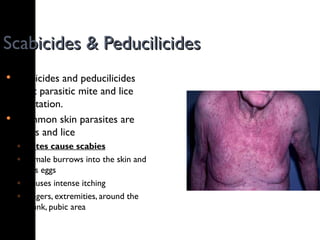
 Scabicides and peducilicides
treat parasitic mite and lice
infestation.
 Common skin parasites are
mites and lice
◦ Mites cause scabies
◦ Female burrows into the skin and
lays eggs
◦ Causes intense itching
◦ Fingers, extremities, around the
trunk, pubic area
Scabicides & Peducilicides
 Lice (Pediculus)
◦ Passed by infected
clothing or personal
contact
◦ Infest pubic area, hair
◦ Lay eggs and leave
debris called nits that
attach to body hairs.
Scabicides & Peducilicides
 Three drugs kill lice and
mites
 1. Lindane (Kwell,
Scabene)—gamma
benzene hexachloride
 2. Crotamiton (Eurax)
 3. Permethrin (Nix)—
insecticide
 Drug profile—lindane
(Kwell) pg. 628
Drugs for Sunburn & Minor Irritation
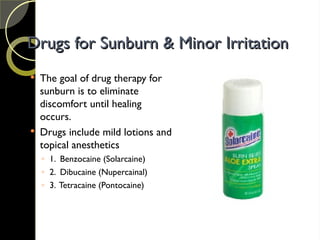
 The goal of drug therapy for
sunburn is to eliminate
discomfort until healing
occurs.
 Drugs include mild lotions and
topical anesthetics
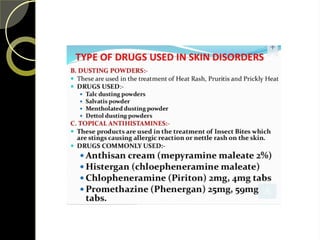
◦ 1. Benzocaine (Solarcaine)
◦ 2. Dibucaine (Nupercainal)
◦ 3. Tetracaine (Pontocaine)
Drugs for Acne
Drugs for Acne
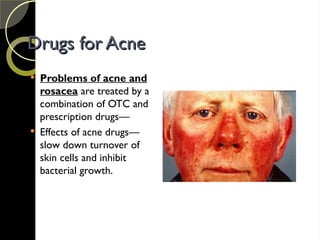
 Problems of acne and
rosacea are treated by a
combination of OTC and
prescription drugs—
 Effects of acne drugs—
slow down turnover of
skin cells and inhibit
bacterial growth.
Drugs for Acne
Drugs for Acne
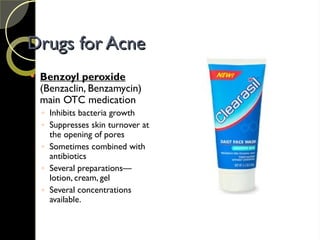
 Benzoyl peroxide
(Benzaclin, Benzamycin)
main OTC medication
◦ Inhibits bacteria growth
◦ Suppresses skin turnover at
the opening of pores
◦ Sometimes combined with
antibiotics
◦ Several preparations—
lotion, cream, gel
◦ Several concentrations
available.
Drugs for Acne
Drugs for Acne
 Retinoids—vitamin
A-like compounds
◦ Reduce oil produciton
and clogged pores
◦ Resistance to bacteria
◦ Do not use if pregnant
—may harm fetus
◦ Common reaction—
sensitivity to sunlight
Drugs for Acne
Drugs for Acne
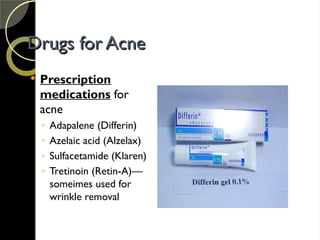
 Prescription
medications for
acne
◦ Adapalene (Differin)
◦ Azelaic acid (Alzelax)
◦ Sulfacetamide (Klaren)
◦ Tretinoin (Retin-A)—
someimes used for
wrinkle removal
Drugs for Acne
Drugs for Acne
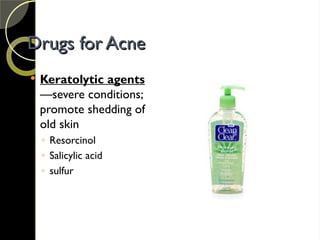
 Keratolytic agents
—severe conditions;
promote shedding of
old skin
◦ Resorcinol
◦ Salicylic acid
◦ sulfur
Drugs for Acne
Drugs for Acne
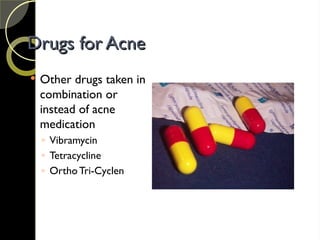
 Other drugs taken in
combination or
instead of acne
medication
◦ Vibramycin
◦ Tetracycline
◦ OrthoTri-Cyclen
Drugs for Acne
Drugs for Acne
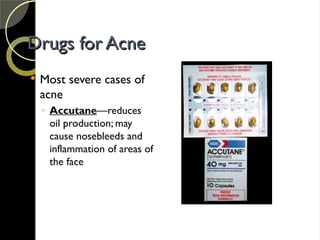
 Most severe cases of
acne
◦ Accutane—reduces
oil production; may
cause nosebleeds and
inflammation of areas of
the face
Topical Corticosteroids
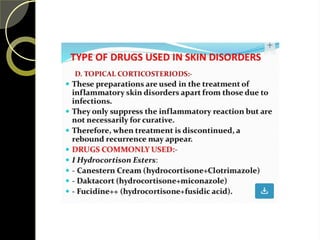
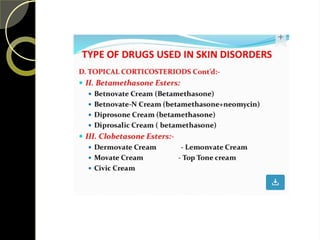
 Topical corticosteroids are used mainly
to treat dermatitis and related
symptoms—
 Eczema—aka atopic dermatitis --
resembles an allergic reaction
 Contact dermatitis—delayed type
allergic reaction
 Seborrheic dermatitis—caused by
overactive oil glands
 Stasis dermatitis—seen more in
older women
Topical Corticosteroids
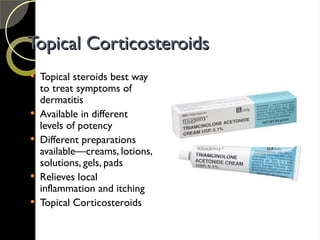
 Topical steroids best way
to treat symptoms of
dermatitis
 Available in different
levels of potency
 Different preparations
available—creams, lotions,
solutions, gels, pads
 Relieves local
inflammation and itching
 Topical Corticosteroids
Topical Corticosteroids
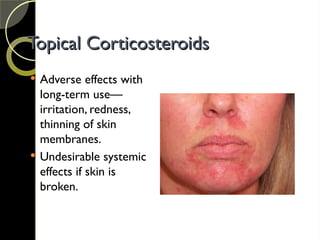
 Adverse effects with
long-term use—
irritation, redness,
thinning of skin
membranes.
 Undesirable systemic
effects if skin is
broken.
Drugs for Psoriasis
Drugs for Psoriasis
 A variety of topical and
systemic medications are
used to treat psoriatic
symptoms—
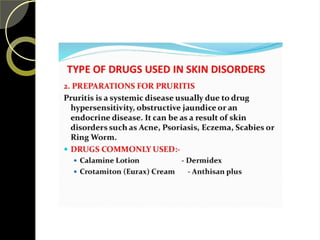
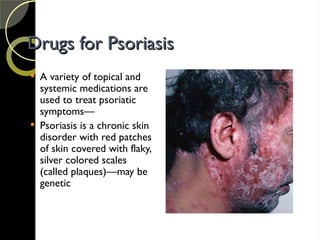
 Psoriasis is a chronic skin
disorder with red patches
of skin covered with flaky,
silver colored scales
(called plaques)—may be
genetic
Drugs for Psoriasis
Drugs for Psoriasis
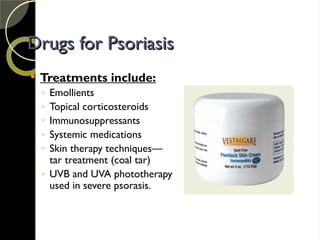
 Treatments include:
◦ Emollients
◦ Topical corticosteroids
◦ Immunosuppressants
◦ Systemic medications
◦ Skin therapy techniques—
tar treatment (coal tar)
◦ UVB and UVA phototherapy
used in severe psorasis.
THANKYOU
THANKYOU

dRUGS FOR SKIN DISORDERS.ppt............

  • 1.
    Drugs for SkinDisorders Drugs for Skin Disorders Dr A Chansoria Dr A Chansoria
  • 2.
    Introduction Introduction  The integumentarysystem consists of the skin, hair, nails, sweat glands, and oil glands.  The largest of all organs is the skin.  Because of its large surface area, it normally provides an effective barrier between extreme conditions in the outside environment and the body’s internal organs.
  • 3.
    Introduction Introduction  The purposeof this chapter is to examine the broad scope of skin disorders and the medications used for skin therapy.  Particular attention to: lice and mite infestation, sunburn, acne, inflammation, and dry, scaly skin.
  • 4.
    Three Layers ofSkin Three Layers of Skin  Epidermis—most superficial skin layer ◦ Thick skin—5 layers ◦ Soles of feet, palms of hands ◦ Melanocytes—provide protection against the sun.  Dermis—under epidermis ◦ Provides foundation for epidermis, hair and nails ◦ Location of receptor nerve endings, sweat glands, oil glands, blood vessels.  Subcutaneous layer or hypodermis—deepest layer ◦ Mainly composed of adipose tissue ◦ Cushions, insulates, provides a source of energy. ◦ Involved with the maintenance of homeostasis, temperature regulation, metabolism
  • 5.
    Major Causes ofSkin Disorders Major Causes of Skin Disorders  Major causes of skin disorders are injury, aging, inherited factors and other medical conditions.  Symptoms associated with stress or injury to the skin.  Classification of Skin Disorders: infectious disorders, inflammatory disorders, and skin cancers.
  • 12.
    Major Causes ofSkin Disorders Major Causes of Skin Disorders  Burns may affect all layers of the skin  1. First degree burns affect outer layers of epidermis. ◦ Redness and sunburn  2. Second degree burns affect most of the epidermis and part of the dermis. ◦ Inflammation and blisters  3. Third degree burns affect all layers of the skin. ◦ Skin cannot regenerate; requires skin grafting
  • 13.
  • 14.
    Scabicides & Peducilicides Scabicides& Peducilicides  Scabicides and peducilicides treat parasitic mite and lice infestation.  Common skin parasites are mites and lice ◦ Mites cause scabies ◦ Female burrows into the skin and lays eggs ◦ Causes intense itching ◦ Fingers, extremities, around the trunk, pubic area
  • 15.
    Scabicides & Peducilicides Scabicides& Peducilicides  Lice (Pediculus) ◦ Passed by infected clothing or personal contact ◦ Infest pubic area, hair ◦ Lay eggs and leave debris called nits that attach to body hairs.
  • 16.
    Scabicides & Peducilicides Scabicides& Peducilicides  Three drugs kill lice and mites  1. Lindane (Kwell, Scabene)—gamma benzene hexachloride  2. Crotamiton (Eurax)  3. Permethrin (Nix)— insecticide  Drug profile—lindane (Kwell) pg. 628
  • 17.
    Drugs for Sunburn& Minor Irritation Drugs for Sunburn & Minor Irritation  The goal of drug therapy for sunburn is to eliminate discomfort until healing occurs.  Drugs include mild lotions and topical anesthetics ◦ 1. Benzocaine (Solarcaine) ◦ 2. Dibucaine (Nupercainal) ◦ 3. Tetracaine (Pontocaine)
  • 18.
    Drugs for Acne Drugsfor Acne  Problems of acne and rosacea are treated by a combination of OTC and prescription drugs—  Effects of acne drugs— slow down turnover of skin cells and inhibit bacterial growth.
  • 19.
    Drugs for Acne Drugsfor Acne  Benzoyl peroxide (Benzaclin, Benzamycin) main OTC medication ◦ Inhibits bacteria growth ◦ Suppresses skin turnover at the opening of pores ◦ Sometimes combined with antibiotics ◦ Several preparations— lotion, cream, gel ◦ Several concentrations available.
  • 20.
    Drugs for Acne Drugsfor Acne  Retinoids—vitamin A-like compounds ◦ Reduce oil produciton and clogged pores ◦ Resistance to bacteria ◦ Do not use if pregnant —may harm fetus ◦ Common reaction— sensitivity to sunlight
  • 21.
    Drugs for Acne Drugsfor Acne  Prescription medications for acne ◦ Adapalene (Differin) ◦ Azelaic acid (Alzelax) ◦ Sulfacetamide (Klaren) ◦ Tretinoin (Retin-A)— someimes used for wrinkle removal
  • 22.
    Drugs for Acne Drugsfor Acne  Keratolytic agents —severe conditions; promote shedding of old skin ◦ Resorcinol ◦ Salicylic acid ◦ sulfur
  • 23.
    Drugs for Acne Drugsfor Acne  Other drugs taken in combination or instead of acne medication ◦ Vibramycin ◦ Tetracycline ◦ OrthoTri-Cyclen
  • 24.
    Drugs for Acne Drugsfor Acne  Most severe cases of acne ◦ Accutane—reduces oil production; may cause nosebleeds and inflammation of areas of the face
  • 25.
    Topical Corticosteroids Topical Corticosteroids Topical corticosteroids are used mainly to treat dermatitis and related symptoms—  Eczema—aka atopic dermatitis -- resembles an allergic reaction  Contact dermatitis—delayed type allergic reaction  Seborrheic dermatitis—caused by overactive oil glands  Stasis dermatitis—seen more in older women
  • 26.
    Topical Corticosteroids Topical Corticosteroids Topical steroids best way to treat symptoms of dermatitis  Available in different levels of potency  Different preparations available—creams, lotions, solutions, gels, pads  Relieves local inflammation and itching  Topical Corticosteroids
  • 27.
    Topical Corticosteroids Topical Corticosteroids Adverse effects with long-term use— irritation, redness, thinning of skin membranes.  Undesirable systemic effects if skin is broken.
  • 28.
    Drugs for Psoriasis Drugsfor Psoriasis  A variety of topical and systemic medications are used to treat psoriatic symptoms—  Psoriasis is a chronic skin disorder with red patches of skin covered with flaky, silver colored scales (called plaques)—may be genetic
  • 29.
    Drugs for Psoriasis Drugsfor Psoriasis  Treatments include: ◦ Emollients ◦ Topical corticosteroids ◦ Immunosuppressants ◦ Systemic medications ◦ Skin therapy techniques— tar treatment (coal tar) ◦ UVB and UVA phototherapy used in severe psorasis.
  • 36.