Derivatives
• Derivative is a product whose value is derived
  from the value of the underlying asset.
• Underlying asset can be equity, forex,
  commodity, or any other asset. Derivatives
  include a contract which derives its value from
  prices, or index of prices, of underlying
  securities.
Functions of Derivatives Market
• Derivatives help in discovery of future as well
  as current prices.
• The derivatives market helps to transfer risks
  from those who have them but may not like
  them in comparison to those who have an
  appetite for them.
• Speculative trades shift to a more controlled
  environment of derivatives market.
• Act as a catalyst for new entrepreneurial
  activity.
Uses of Derivatives
• Hedging
  – Done by parties who seek to offset their existing risks
    by entering into a derivatives transaction.
  – Existing risks could be an investment portfolio, price
    changes in oil for a petroleum mining company or
    perhaps investments in a foreign country.
• Speculating
  – Speculation is more commonly used by hedge funds
    or traders who aim to generate profits with only a
    marginal investment.
Uses of Derivatives (Contd.)
• Arbitrage
  – Models to price derivative products have been
    developed by researchers and practitioners.
  – Upon finding price discrepancies, one can make use
    of a specific combination of derivatives in order to
    make a riskless profit.
Growth Driving Factors
•   Increased volatility in asset prices in Financial Markets
•   Increased integration between International Markets
•   Exponential improvement in communication at exceptionally
    reduced costs
•   Development of more sophisticated Risk Management tools,
    providing economic agents a wider choice of Risk
    Management strategies
•   Innovations in the derivatives markets, which optimally
    combine the risks and returns over a large number of
    financial assets leading to higher returns, reduced risk as well
    as transactions cost as compared to individual financial
    assets
Types of Derivatives
• Forwards
 –   A forward contract is a customized contract between two
     entities, where settlement takes place on a specific date in the
     future at today’s pre-agreed price.
• Futures
 –   A future contract is an agreement between two parties to buy
     or sell an asset at a certain time in the future at a certain price.
     Futures are special types of forward contracts in the sense that
     futures are standardized exchange-traded contracts.
• Warrants
 –   Longer-dated options are called warrants and are generally
     traded over-the-counter (OTC).
Types of Derivatives (Contd.)
• LEAPS
  –   Long-Term Equity Anticipation Securities. These are options having a
      maturity of up to three years.
• Baskets
  –   Basket options are options on portfolios of underlying assets. The
      underlying asset is usually a moving average of a basket of assets.
      Equity index options are a form of basket options.
• Swaps
  –   These are private agreements between two parties to exchange cash
      flows in the future Agreement on formula to be used for exchange of
      cash-flows is determined in advance
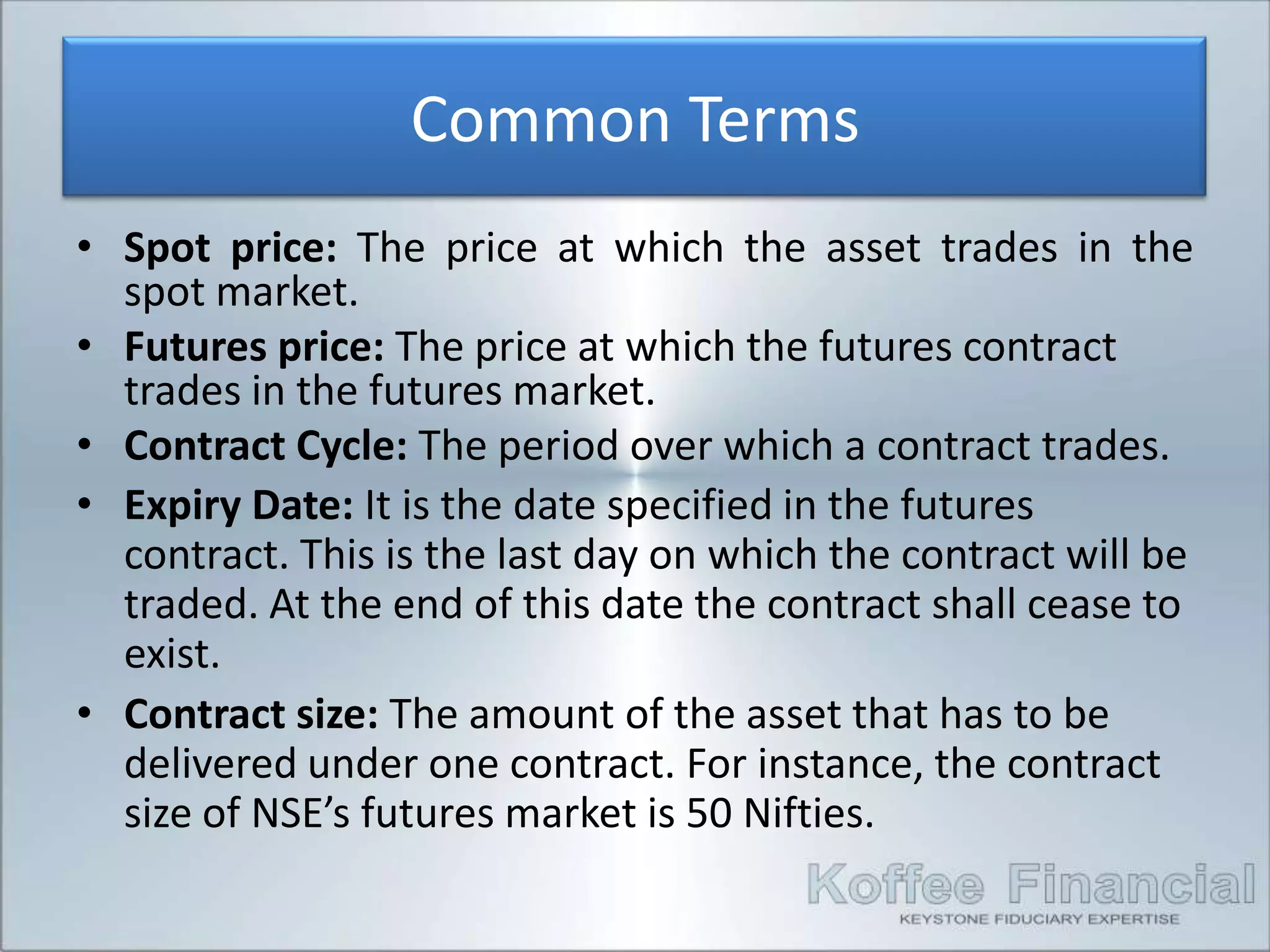
Common Terms
• Spot price: The price at which the asset trades in the
  spot market.
• Futures price: The price at which the futures contract
  trades in the futures market.
• Contract Cycle: The period over which a contract trades.
• Expiry Date: It is the date specified in the futures
  contract. This is the last day on which the contract will be
  traded. At the end of this date the contract shall cease to
  exist.
• Contract size: The amount of the asset that has to be
  delivered under one contract. For instance, the contract
  size of NSE’s futures market is 50 Nifties.
Thanks!


• For more information, explore
  – http://www.koffeefinancial.com/Static/Learn.aspx


• Or email us at learn@koffeefinancial.com

2. Trading - Understanding Derivatives

  • 2.
    Derivatives • Derivative isa product whose value is derived from the value of the underlying asset. • Underlying asset can be equity, forex, commodity, or any other asset. Derivatives include a contract which derives its value from prices, or index of prices, of underlying securities.
  • 3.
    Functions of DerivativesMarket • Derivatives help in discovery of future as well as current prices. • The derivatives market helps to transfer risks from those who have them but may not like them in comparison to those who have an appetite for them. • Speculative trades shift to a more controlled environment of derivatives market. • Act as a catalyst for new entrepreneurial activity.
  • 4.
    Uses of Derivatives •Hedging – Done by parties who seek to offset their existing risks by entering into a derivatives transaction. – Existing risks could be an investment portfolio, price changes in oil for a petroleum mining company or perhaps investments in a foreign country. • Speculating – Speculation is more commonly used by hedge funds or traders who aim to generate profits with only a marginal investment.
  • 5.
    Uses of Derivatives(Contd.) • Arbitrage – Models to price derivative products have been developed by researchers and practitioners. – Upon finding price discrepancies, one can make use of a specific combination of derivatives in order to make a riskless profit.
  • 6.
    Growth Driving Factors • Increased volatility in asset prices in Financial Markets • Increased integration between International Markets • Exponential improvement in communication at exceptionally reduced costs • Development of more sophisticated Risk Management tools, providing economic agents a wider choice of Risk Management strategies • Innovations in the derivatives markets, which optimally combine the risks and returns over a large number of financial assets leading to higher returns, reduced risk as well as transactions cost as compared to individual financial assets
  • 7.
    Types of Derivatives •Forwards – A forward contract is a customized contract between two entities, where settlement takes place on a specific date in the future at today’s pre-agreed price. • Futures – A future contract is an agreement between two parties to buy or sell an asset at a certain time in the future at a certain price. Futures are special types of forward contracts in the sense that futures are standardized exchange-traded contracts. • Warrants – Longer-dated options are called warrants and are generally traded over-the-counter (OTC).
  • 8.
    Types of Derivatives(Contd.) • LEAPS – Long-Term Equity Anticipation Securities. These are options having a maturity of up to three years. • Baskets – Basket options are options on portfolios of underlying assets. The underlying asset is usually a moving average of a basket of assets. Equity index options are a form of basket options. • Swaps – These are private agreements between two parties to exchange cash flows in the future Agreement on formula to be used for exchange of cash-flows is determined in advance
  • 9.
    Common Terms • Spotprice: The price at which the asset trades in the spot market. • Futures price: The price at which the futures contract trades in the futures market. • Contract Cycle: The period over which a contract trades. • Expiry Date: It is the date specified in the futures contract. This is the last day on which the contract will be traded. At the end of this date the contract shall cease to exist. • Contract size: The amount of the asset that has to be delivered under one contract. For instance, the contract size of NSE’s futures market is 50 Nifties.
  • 10.
    Thanks! • For moreinformation, explore – http://www.koffeefinancial.com/Static/Learn.aspx • Or email us at learn@koffeefinancial.com