Presented By:
Dhaval Dedhia (08)
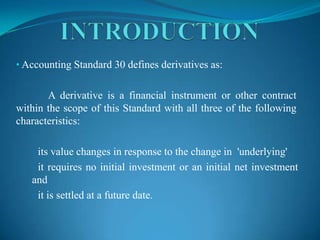
• Accounting Standard 30 defines derivatives as:


       A derivative is a financial instrument or other contract
within the scope of this Standard with all three of the following
characteristics:

   • its value changes in response to the change in 'underlying'
   • it requires no initial investment or an initial net investment
   and
   • it is settled at a future date.
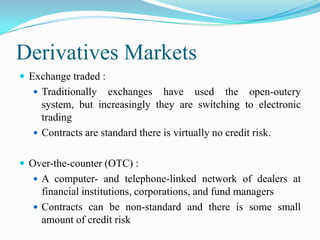
Derivatives Markets
 Exchange traded :
    Traditionally   exchanges have used the open-outcry
     system, but increasingly they are switching to electronic
     trading
    Contracts are standard there is virtually no credit risk.


 Over-the-counter (OTC) :
    A computer- and telephone-linked network of dealers at
     financial institutions, corporations, and fund managers
    Contracts can be non-standard and there is some small
     amount of credit risk
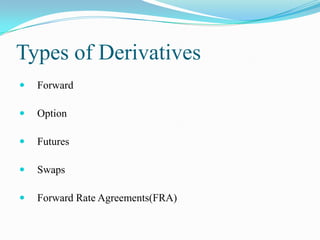
Types of Derivatives
   Forward

   Option

   Futures

   Swaps

   Forward Rate Agreements(FRA)
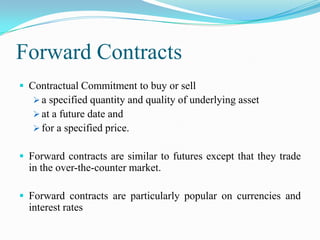
Forward Contracts
 Contractual Commitment to buy or sell
    a specified quantity and quality of underlying asset
    at a future date and
    for a specified price.


 Forward contracts are similar to futures except that they trade
  in the over-the-counter market.

 Forward contracts are particularly popular on currencies and
  interest rates
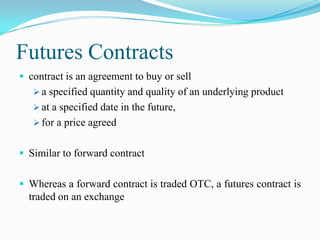
Futures Contracts
 contract is an agreement to buy or sell
    a specified quantity and quality of an underlying product
    at a specified date in the future,
    for a price agreed


 Similar to forward contract


 Whereas a forward contract is traded OTC, a futures contract is
  traded on an exchange
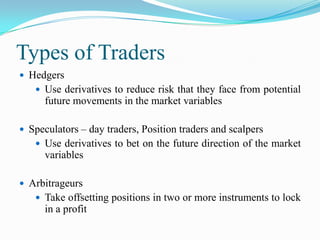
Types of Traders
 Hedgers
    Use derivatives to reduce risk that they face from potential
      future movements in the market variables

 Speculators – day traders, Position traders and scalpers
    Use derivatives to bet on the future direction of the market
      variables

 Arbitrageurs
    Take offsetting positions in two or more instruments to lock
      in a profit
Options
 An option is a contract that grants a right to the holder or
  purchaser of the contract

    to buy or sell an underlying asset
    at a specific price on a specific date or upto a specified date
    without a corresponding       obligation to perform on the
     contract.

 The holder or the purchaser pays a premium for the right.
Types of options
 Call option- The right to buy a specified amount of currency at
  a specified rate.


 Put option- The right to sell a specified amount of currency at
  a specified rate.
ITM,ATM,OTM
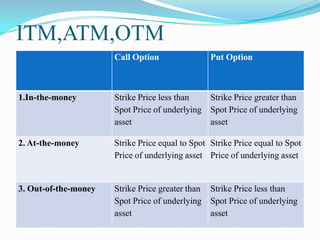
                      Call Option                 Put Option


1.In-the-money        Strike Price less than      Strike Price greater than
                      Spot Price of underlying    Spot Price of underlying
                      asset                       asset

2. At-the-money       Strike Price equal to Spot Strike Price equal to Spot
                      Price of underlying asset Price of underlying asset


3. Out-of-the-money   Strike Price greater than   Strike Price less than
                      Spot Price of underlying    Spot Price of underlying
                      asset                       asset
Margin required
 • Initial Margin :
        An Initial margin is the deposit required to maintain
  either a short or long position in a futures contract.


 • Maintenance Margin :
         Maintenance margin is the amount of initial margin
  that must be maintained for that position before a margin
  call is generated.
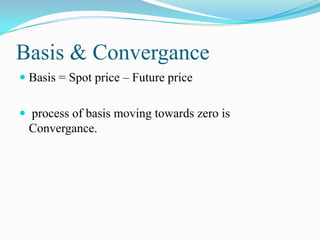
Basis & Convergance
 Basis = Spot price – Future price


 process of basis moving towards zero is
  Convergance.
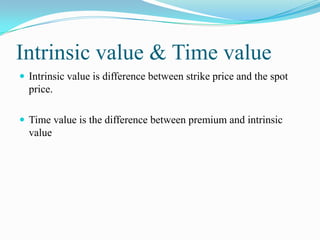
Intrinsic value & Time value
 Intrinsic value is difference between strike price and the spot
  price.

 Time value is the difference between premium and intrinsic
  value
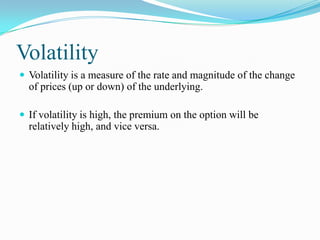
Volatility
 Volatility is a measure of the rate and magnitude of the change
  of prices (up or down) of the underlying.

 If volatility is high, the premium on the option will be
  relatively high, and vice versa.
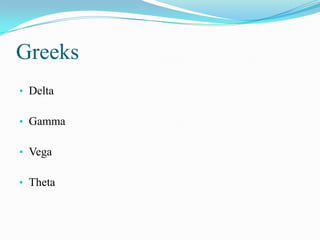
Greeks
• Delta

• Gamma

• Vega

• Theta
Delta
 The movement of the option position relative to the movement
  of the underlying position.

 It is the probability of option being itm at the expiration.

 At ATM delta of Call & Put is 0.5

 At OTM delta is between 0 to 0.5

 At ITM delta is between 0.5 to 1
Gamma
 Options Gamma is the rate of change of options delta with a
  small rise in the price of the underlying stock.


 Just as options delta measures how much the value of an option
  changes with a change in the price of the underlying
  stock, Options Gamma describes how much the options delta
  changes as the price of the underlying stock changes.
Vega
 Options Vega measures the sensitivity of a stock option's price
  to a change in implied volatility.

 When implied volatility rises, the price of stock options rises
  along with it.

 Options Vega measures how much rise in option value with
  every 1 percentage rise in implied volatility.

 Vega is highest for ATM options, and is progressively lower as
  options are ITM and OTM.
Theta
• Theta is that options Greek which tells you how much an
    option's price will diminish over time, which is the rate of time
    decay of stock options.
•   Time decay is a well known phenomena in options trading
    where the value of options reduces over time even though the
    underlying stock remains stagnant
•   Positive Theta means that the option's value will increase as the
    time passes & vice-versa.
•   Negative Theta means that the option's value will fall as the
    time passes & vice-versa.
•   Theta is highest for ATM options, and is progressively lower as
    options are ITM and OTM.
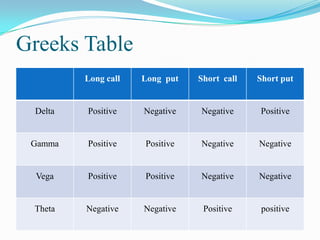
Greeks Table
         Long call   Long put   Short call   Short put


 Delta   Positive    Negative   Negative     Positive


 Gamma   Positive    Positive   Negative     Negative


  Vega   Positive    Positive   Negative     Negative


 Theta   Negative    Negative    Positive     positive
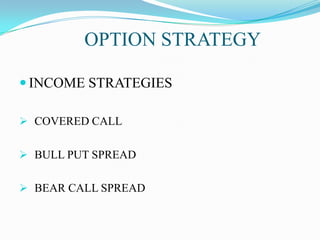
OPTION STRATEGY

 INCOME STRATEGIES

 COVERED CALL


 BULL PUT SPREAD


 BEAR CALL SPREAD
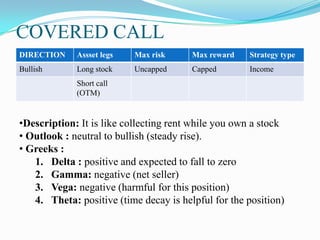
COVERED CALL
DIRECTION    Assset legs   Max risk     Max reward   Strategy type
Bullish      Long stock    Uncapped     Capped       Income
             Short call
             (OTM)


•Description: It is like collecting rent while you own a stock
• Outlook : neutral to bullish (steady rise).
• Greeks :
   1. Delta : positive and expected to fall to zero
   2. Gamma: negative (net seller)
   3. Vega: negative (harmful for this position)
   4. Theta: positive (time decay is helpful for the position)
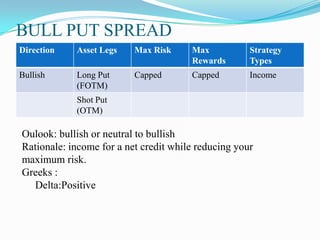
BULL PUT SPREAD
Direction   Asset Legs    Max Risk     Max           Strategy
                                       Rewards       Types
Bullish     Long Put      Capped       Capped        Income
            (FOTM)
            Shot Put
            (OTM)

Oulook: bullish or neutral to bullish
Rationale: income for a net credit while reducing your
maximum risk.
Greeks :
  Delta:Positive
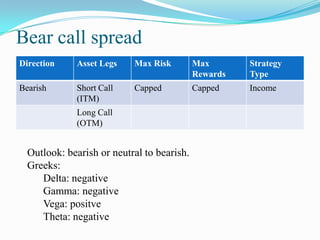
Bear call spread
Direction    Asset Legs    Max Risk         Max       Strategy
                                            Rewards   Type
Bearish      Short Call    Capped           Capped    Income
             (ITM)
             Long Call
             (OTM)


  Outlook: bearish or neutral to bearish.
  Greeks:
     Delta: negative
     Gamma: negative
     Vega: positve
     Theta: negative
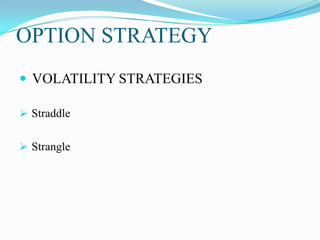
OPTION STRATEGY
 VOLATILITY STRATEGIES

 Straddle


 Strangle
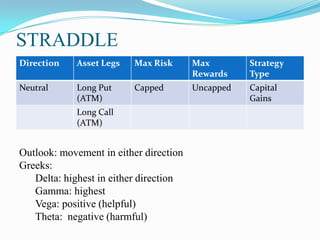
STRADDLE
Direction    Asset Legs   Max Risk      Max        Strategy
                                        Rewards    Type
Neutral      Long Put     Capped        Uncapped   Capital
             (ATM)                                 Gains
             Long Call
             (ATM)


Outlook: movement in either direction
Greeks:
   Delta: highest in either direction
   Gamma: highest
   Vega: positive (helpful)
   Theta: negative (harmful)
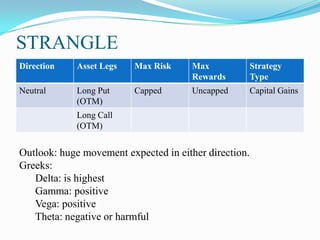
STRANGLE
Direction    Asset Legs   Max Risk     Max             Strategy
                                       Rewards         Type
Neutral      Long Put     Capped       Uncapped        Capital Gains
             (OTM)
             Long Call
             (OTM)


Outlook: huge movement expected in either direction.
Greeks:
   Delta: is highest
   Gamma: positive
   Vega: positive
   Theta: negative or harmful
THANK YOU

Derivatives

  • 1.
  • 2.
    • Accounting Standard30 defines derivatives as: A derivative is a financial instrument or other contract within the scope of this Standard with all three of the following characteristics: • its value changes in response to the change in 'underlying' • it requires no initial investment or an initial net investment and • it is settled at a future date.
  • 3.
    Derivatives Markets  Exchangetraded :  Traditionally exchanges have used the open-outcry system, but increasingly they are switching to electronic trading  Contracts are standard there is virtually no credit risk.  Over-the-counter (OTC) :  A computer- and telephone-linked network of dealers at financial institutions, corporations, and fund managers  Contracts can be non-standard and there is some small amount of credit risk
  • 4.
    Types of Derivatives  Forward  Option  Futures  Swaps  Forward Rate Agreements(FRA)
  • 5.
    Forward Contracts  ContractualCommitment to buy or sell  a specified quantity and quality of underlying asset  at a future date and  for a specified price.  Forward contracts are similar to futures except that they trade in the over-the-counter market.  Forward contracts are particularly popular on currencies and interest rates
  • 6.
    Futures Contracts  contractis an agreement to buy or sell  a specified quantity and quality of an underlying product  at a specified date in the future,  for a price agreed  Similar to forward contract  Whereas a forward contract is traded OTC, a futures contract is traded on an exchange
  • 7.
    Types of Traders Hedgers  Use derivatives to reduce risk that they face from potential future movements in the market variables  Speculators – day traders, Position traders and scalpers  Use derivatives to bet on the future direction of the market variables  Arbitrageurs  Take offsetting positions in two or more instruments to lock in a profit
  • 8.
    Options  An optionis a contract that grants a right to the holder or purchaser of the contract  to buy or sell an underlying asset  at a specific price on a specific date or upto a specified date  without a corresponding obligation to perform on the contract.  The holder or the purchaser pays a premium for the right.
  • 9.
    Types of options Call option- The right to buy a specified amount of currency at a specified rate.  Put option- The right to sell a specified amount of currency at a specified rate.
  • 10.
    ITM,ATM,OTM Call Option Put Option 1.In-the-money Strike Price less than Strike Price greater than Spot Price of underlying Spot Price of underlying asset asset 2. At-the-money Strike Price equal to Spot Strike Price equal to Spot Price of underlying asset Price of underlying asset 3. Out-of-the-money Strike Price greater than Strike Price less than Spot Price of underlying Spot Price of underlying asset asset
  • 11.
    Margin required •Initial Margin : An Initial margin is the deposit required to maintain either a short or long position in a futures contract. • Maintenance Margin : Maintenance margin is the amount of initial margin that must be maintained for that position before a margin call is generated.
  • 12.
    Basis & Convergance Basis = Spot price – Future price  process of basis moving towards zero is Convergance.
  • 13.
    Intrinsic value &Time value  Intrinsic value is difference between strike price and the spot price.  Time value is the difference between premium and intrinsic value
  • 14.
    Volatility  Volatility isa measure of the rate and magnitude of the change of prices (up or down) of the underlying.  If volatility is high, the premium on the option will be relatively high, and vice versa.
  • 15.
  • 16.
    Delta  The movementof the option position relative to the movement of the underlying position.  It is the probability of option being itm at the expiration.  At ATM delta of Call & Put is 0.5  At OTM delta is between 0 to 0.5  At ITM delta is between 0.5 to 1
  • 17.
    Gamma  Options Gammais the rate of change of options delta with a small rise in the price of the underlying stock.  Just as options delta measures how much the value of an option changes with a change in the price of the underlying stock, Options Gamma describes how much the options delta changes as the price of the underlying stock changes.
  • 18.
    Vega  Options Vegameasures the sensitivity of a stock option's price to a change in implied volatility.  When implied volatility rises, the price of stock options rises along with it.  Options Vega measures how much rise in option value with every 1 percentage rise in implied volatility.  Vega is highest for ATM options, and is progressively lower as options are ITM and OTM.
  • 19.
    Theta • Theta isthat options Greek which tells you how much an option's price will diminish over time, which is the rate of time decay of stock options. • Time decay is a well known phenomena in options trading where the value of options reduces over time even though the underlying stock remains stagnant • Positive Theta means that the option's value will increase as the time passes & vice-versa. • Negative Theta means that the option's value will fall as the time passes & vice-versa. • Theta is highest for ATM options, and is progressively lower as options are ITM and OTM.
  • 20.
    Greeks Table Long call Long put Short call Short put Delta Positive Negative Negative Positive Gamma Positive Positive Negative Negative Vega Positive Positive Negative Negative Theta Negative Negative Positive positive
  • 21.
    OPTION STRATEGY  INCOMESTRATEGIES  COVERED CALL  BULL PUT SPREAD  BEAR CALL SPREAD
  • 22.
    COVERED CALL DIRECTION Assset legs Max risk Max reward Strategy type Bullish Long stock Uncapped Capped Income Short call (OTM) •Description: It is like collecting rent while you own a stock • Outlook : neutral to bullish (steady rise). • Greeks : 1. Delta : positive and expected to fall to zero 2. Gamma: negative (net seller) 3. Vega: negative (harmful for this position) 4. Theta: positive (time decay is helpful for the position)
  • 23.
    BULL PUT SPREAD Direction Asset Legs Max Risk Max Strategy Rewards Types Bullish Long Put Capped Capped Income (FOTM) Shot Put (OTM) Oulook: bullish or neutral to bullish Rationale: income for a net credit while reducing your maximum risk. Greeks : Delta:Positive
  • 24.
    Bear call spread Direction Asset Legs Max Risk Max Strategy Rewards Type Bearish Short Call Capped Capped Income (ITM) Long Call (OTM) Outlook: bearish or neutral to bearish. Greeks: Delta: negative Gamma: negative Vega: positve Theta: negative
  • 25.
    OPTION STRATEGY  VOLATILITYSTRATEGIES  Straddle  Strangle
  • 26.
    STRADDLE Direction Asset Legs Max Risk Max Strategy Rewards Type Neutral Long Put Capped Uncapped Capital (ATM) Gains Long Call (ATM) Outlook: movement in either direction Greeks: Delta: highest in either direction Gamma: highest Vega: positive (helpful) Theta: negative (harmful)
  • 27.
    STRANGLE Direction Asset Legs Max Risk Max Strategy Rewards Type Neutral Long Put Capped Uncapped Capital Gains (OTM) Long Call (OTM) Outlook: huge movement expected in either direction. Greeks: Delta: is highest Gamma: positive Vega: positive Theta: negative or harmful
  • 28.