HISTORY CAMBRIDGE A2 (PAPER 4)
PRESENTATION 5 (HOMEWORK)
HITLER MODULE
2. HITLER’S DOMESTIC AIMS UP TO 1941
HITLER AIMS IN
GOVERNMENT AND
ADMINISTRATION
OVERVIEW
The Nazi state gave the impression of being a very good managed system,
run by an efficient government, with a decisive leadership and clear
structures and hierarchies.
As the SS was very disciplined, so seemed the government and bureaucracy
of Nazi Germany.
In practice, this was not the case, as the Nazi state was disorganised.
ADMINISTRATIVE CHAOS
There were a variety of high-ranking individual offices, government
departments, ministries, agencies and security forces – but there was no
Nazi constitution and no clear framework or division of powers.
Hitler repeatedly messed with the organisation of the state, creating new
offices or departments and shifting responsibilities from one to the other –
but there seemed to be little method or long-term planning involved in
these decisions.
In the end, Nazi government ended up being a chaos, generating more
problems than fixing.
HITLER AND HIS POWER
The only political certainty in the Nazi state was Adolf Hitler’s status as its
supreme decision-maker.
According to the Nazi doctrine of fuhrerprinzip, all power and sovereignty
was vested in the leader; he would use that power to create a Nazi state
that would serve the needs of Germany and its people.
Hitler possessed more power than any other individual or agency in the
Nazi state – but he was also ruler who left much of the work up to others.
Hitler was not an experienced politician, not interested in administration or
organisation, developing long-term planning or detailed policies.
A CULTURE OF COMPETITION
He preferred to dictate great visions and vague orders, leaving the details
and specifics to be fixed by his subordinates.
Those who pleased Hitler by presenting him with good suggestions or
policies were praised and rewarded; some were welcomed into his inner
circle, the highest honour of all.
This created a culture of competition and sycophancy, as leading Nazis
competed against each other to impress the fuhrer.
A sycophant is a person who tries to win favour from wealthy or influential
people by flattering them.
LACK OF PLANNING
During his rise to power, Hitler had offered no clear vision about the
structure or organisation that a Nazi government might take.
Once in power he ‘invented’ new departments or positions, to deal with
issues as they arose.
The Nazi state grew and evolved organically and haphazardly, with no
blueprint and no real hierarchical backbone.
Haphazard definition, characterized by lack of order or planning, by
irregularity, or by randomness; determined by or dependent on chance;
aimless.
NAZI STATE DEPARTMENTS
Over time it became a mixture of bureaucracies, organisations and offices.
The jurisdictions and responsibilities of these departments were not well
defined: in many cases it was unclear exactly who had ultimate
responsibility for a given area, so there was often ‘overlap’ or conflict
between two or more departments.
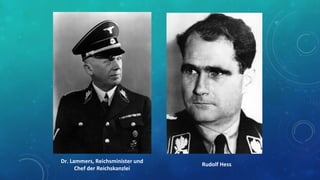
THE REICH CHANCELLARY
Overseen by Hans Lammers and Hitler’s deputy, Rudolf Hess, the
chancellery was the closest equivalent to a Nazi executive cabinet.
It met regularly with Hitler and his other advisors, playing an important role
in drafting legislation and policy, and making important decisions when
Hitler was absent or unavailable.
The chancellery was also responsible for Hitler’s finances and his
movements; anyone wanting an audience with the fuhrer had to go through
the chancellery.
Dr. Lammers, Reichsminister und
Chef der Reichskanzlei
Rudolf Hess
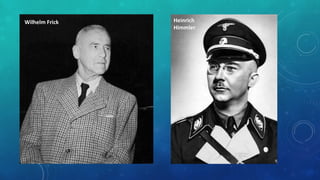
THE REICH INTERIOR MINISTRY
Headed by Wilhelm Frick, then Heinrich Himmler, this department was
responsible for overseeing the internal organisation and security of Nazi
Germany.
It was given the task of ‘Nazifying’ existing government structures and
departments, ensuring they were run by party members or sympathisers.
The Interior Ministry also played a leading role in drafting and
implementing racial laws, and suppressing other political parties and
opposition.
Wilhelm Frick Heinrich
Himmler
THE REICH MINISTRY FOR PROPAGANDA
The Reich Ministry for Propaganda and Public Enlightenment was one of the
most visible organs of Nazi rule, this department was created in 1933 and
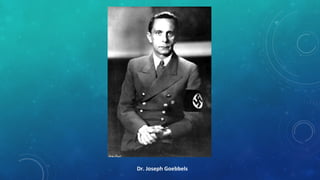
headed by the infamous Dr Joseph Goebbels.
Its main function was to influence and manipulate public opinion, which it
did through control of newspapers, film and radio.
This ministry was also involved in organising the NSDAP’s huge public rallies
in Nuremberg, as well as smaller events such as festivals and art shows.
Dr. Joseph Goebbels
THE REICH OFFICE OF THE FOUR-YEAR PLAN
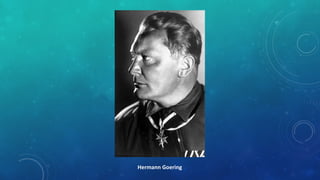
Headed by Hermann Goering, the Four-Year Plan was an economic program
announced by Hitler in 1936.
Its publicly stated aim was to make Germany self-sufficient by increasing
agriculture, building, public works, roads and production of automobiles
and synthetic materials.
But it was also intended to prepare Germany for war, by speeding up
armament and military production.
The Four-Year Plan was so successful that this office remained in operation
well into World War II, after the plan had officially ended.
Hermann Goering
THE GERMAN LABOUR FRONT
Headed by Dr Robert Ley and twelve ‘trustees’, this department not only
organised and co-ordinated the German workforce but acted as a state-run
union for industrial workers.
Factory employees were expected to be DAF members; it was almost
impossible to obtain a job without membership.
Most DAF workers wore paramilitary-style uniforms and their wages were
set by DAF leaders.
All other unions were banned.
Robert Lei
LOBBY GROUPS
Many groups outside the Nazi bureaucracy also shaped government policy.
Germany’s wealthy industrialists were an influential lobby group, since Hitler
relied on their cooperation to achieve his program of rearmament.
The upper echelons of the military provided Hitler with feedback, advice and
policy suggestions.
Echelon formation is a military hierarchical formation, a level or rank in an organization,
profession, or society.
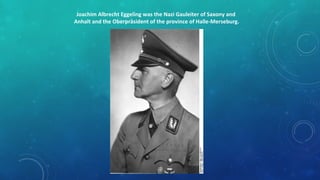
NO PROCESS OF DECISION-MAKING
Also in the fuhrer’s ear were high-ranking NSDAP members, economics
advisors, civilian ministers and politicians, Nazi Gauleiters in charge of the
former German states, important academics and other experts. Any one of
these people could suggest an idea or policy that might win Hitler’s
approval. He made these decisions as he saw fit, often on a whim and
without consulting relevant branches of the government. There was no clear
process of decision-making, and little accountability.
NAZI GAULEITER was the party leader of a regional branch of the NSDAP (more
commonly known as the Nazi Party) or the head of a Gau or of a Reichsgau. The word
can be singular or plural, depending on the context. Gauleiter was the second highest
Nazi Party paramilitary rank, subordinate only to the higher rank Reichsleiter and to
the position of Führer. During World War II, the rank of Gauleiter was obtained only
by direct appointment from Adolf Hitler.
Joachim Albrecht Eggeling was the Nazi Gauleiter of Saxony and
Anhalt and the Oberpräsident of the province of Halle-Merseburg.
OPINION
“The Nazi state has been depicted as a chaotic competition of power blocks
– those Nazi and non-Nazi groups with influence: the SS, the Nazi party, the
army, the conservative elites and Germany’s powerful industrialists. In fact
there was a coherence to this chaos: all competing groups and institutions
were attempting to create policy in the Fuhrer’s name, according to what
they believed to be the Fuhrer’s will.”
Martin Collier
INTENTIONALIST HISTORIANS
Historians have long debated why the Nazi state evolved into this jumbled
contraption of competing organisations.
Two schools of thought have emerged: intentionalism and functionalism.
Intentionalist historians argue Hitler operated with a broad, pre-conceived
plan; every decision he made was done with a purpose.
The intentionalists believe the creation of a confused and complex Nazi
state was a deliberate ploy on Hitler’s part, allowing him to ‘divide and
rule’ and enhance his own power.
FUNCTIONALIST HISTORIANS
The functionalist school contends Hitler had no such plan: he simply made
decisions on a day-by-day basis, as they were put to him.
Functionalist interpretations stress divisions, competition and rivalries as
important factors in the Nazi movement.
They also query whether Hitler’s power was as absolute as is claimed by
intentionalists, and that he often made decisions to protect his own
position.
HOMEWORK
In your opinion, which government department was the most important in
Nazi Government? Explain your answer.