Nazism
and the rise of
Hitler
The Rise of Hitler
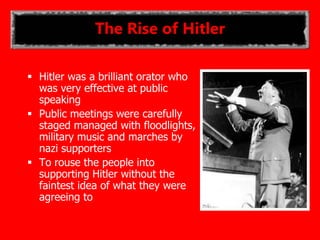
 Hitler was a brilliant orator who
was very effective at public
speaking
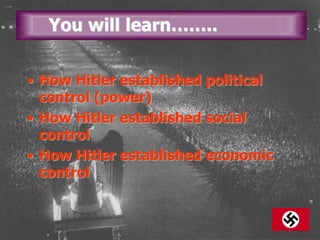
 Public meetings were carefully
staged managed with floodlights,
military music and marches by
nazi supporters
 To rouse the people into
supporting Hitler without the
faintest idea of what they were
agreeing to
The Rise of Hitler
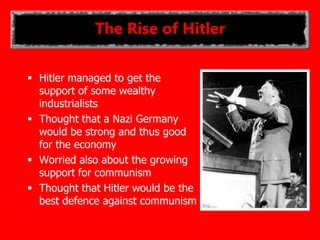
 Hitler managed to get the
support of some wealthy
industrialists
 Thought that a Nazi Germany
would be strong and thus good
for the economy
 Worried also about the growing
support for communism
 Thought that Hitler would be the
best defence against communism
The Rise of Hitler
 Eventually Hitler came to power
 Other parties could not resolve
their differences to unite
against him
 The President, Hindenburg, had
no choice but to appoint Hitler
as Chancellor in Jan 1933
 Beginning of the end for
Weimar Germany and the start
of the “Third Reich” (the third
German empire)
The Rise of Hitler
 The First Reich refers to the
rule of the Holy Roman Empires
(800-1806)
 The Second Reich refers to
the rule of the German
Emperors (1871 – 1918)
 The Third Reich refers to the
rule of Adolf Hitler (1933 –
1945)
You will learn……..
• How Hitler established political
control (power)
• How Hitler established social
control
• How Hitler established economic
control
POLITICAL CONTROL
 A “thousand year Reich”
 But Hitler’s Third Reich
only lasted 12 years
 Ended with Germany’s
defeat and Hitler’s
suicide amidst the ruins
of Berlin
 This lesson looks at what
happened inside
Germany in the years
before WWII broke out
Why Hitler was supported?
 Hitler : Chancellor in Jan
1933
 Supported by President,
German army and many
politicians
 Hoped for a strong govt
and a solution to
Germany’s economic
problems
 Then they will get rid of
Hitler
How Hitler consolidated his power?
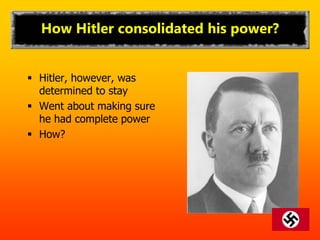
 Hitler, however, was
determined to stay
 Went about making sure
he had complete power
 How?
1. Use of Violence
 Stopped newspapers
from criticizing the Nazis
 Dismissed officials who
opposed him
 Use his unformed
followers to break up
meetings of other parties
and beat up his
opponents (SA & SS)
 Extreme Nazi violence
throughout the election
campaign, especially
against the communists
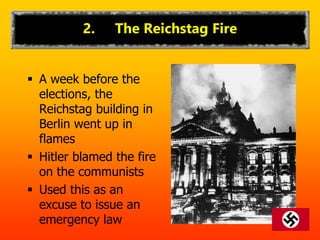
2. The Reichstag Fire
 A week before the
elections, the
Reichstag building in
Berlin went up in
flames
 Hitler blamed the fire
on the communists
 Used this as an
excuse to issue an
emergency law
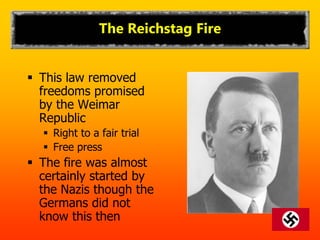
The Reichstag Fire
 This law removed
freedoms promised
by the Weimar
Republic
 Right to a fair trial
 Free press
 The fire was almost
certainly started by
the Nazis though the
Germans did not
know this then
3. Election Campaign
 Called for new
elections for the
Reichstag
(parliament)
 Although the Nazi
Party was the single
largest party in the
Reichstag, Hitler
wanted an overall
majority
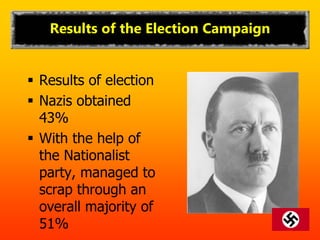
Results of the Election Campaign
 Results of election
 Nazis obtained
43%
 With the help of
the Nationalist
party, managed to
scrap through an
overall majority of
51%
4. The Enabling Act, 1933
 Hitler now schemed to
have the Reichstag give
up its powers and rule as
a dictator
 To do this, the Reichstag
had to pass an “Enabling
Act” which required 2/3
majority
 Hitler achieved this.
 How do you think he did
it?
The Enabling Act, 1933
3 WAYS
1. Banned communist
deputies from coming
to the Reichstag so
they could not use their
votes – Reichstag Fire
2. Persuaded the Centre
Party to vote for the
Act by giving vague
promises
3. Using the votes of his
allies, the Nationalist
Party
Effects of Enabling Act
 Because of the Enabling
Act, democracy died in
Germany
 Other political parties were
banned
 Trade Unions taken over
by the Nazis
 Press, radio and cinema
placed under total Nazi
control
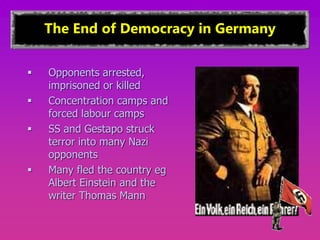
The End of Democracy in Germany
 Opponents arrested,
imprisoned or killed
 Concentration camps and
forced labour camps
 SS and Gestapo struck
terror into many Nazi
opponents
 Many fled the country eg
Albert Einstein and the
writer Thomas Mann
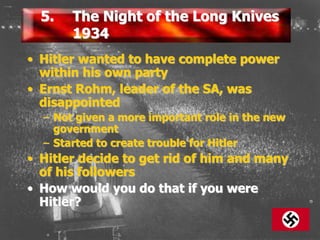
5. The Night of the Long Knives
1934
• Hitler wanted to have complete power
within his own party
• Ernst Rohm, leader of the SA, was
disappointed
– Not given a more important role in the new
government
– Started to create trouble for Hitler
• Hitler decide to get rid of him and many
of his followers
• How would you do that if you were
Hitler?
The Night of the Long Knives 1934
• Hitler called the leaders of the SA to a
special conference
• During the night, he had them dragged
out of bed and shot
• On the same night, many other
opponents all over Germany suffered
the same fate
• No public protests – demonstrated
Hitler’s power and the people’s fear
• This became known as the Night of the
Long Knives
6. Establishing post of Fuhrer
• 2 months later, President Hindenberg
died
• Hitler combined the jobs of Chancellor
and President – Fuhrer (Leader)
• He also became commander in chief of
the armed forces
• He was now the supreme dictator of
Germany
1. Education
 Aim of education – train
young people up to be
Nazis and loyal citizens
of Nazi Germany
 Education was carefully
controlled
 There was Race Studies
as well as German
History and Geography
 Strict curriculum’
indoctrinated with Nazi
ideas
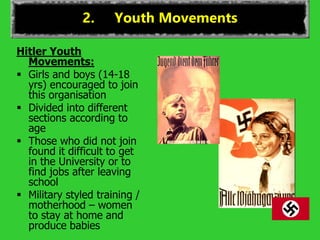
2. Youth Movements
Hitler Youth
Movements:
 Girls and boys (14-18
yrs) encouraged to join
this organisation
 Divided into different
sections according to
age
 Those who did not join
found it difficult to get
in the University or to
find jobs after leaving
school
 Military styled training /
motherhood – women
to stay at home and
produce babies
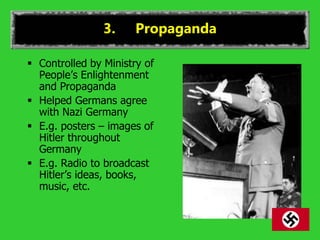
3. Propaganda
 Controlled by Ministry of
People’s Enlightenment
and Propaganda
 Helped Germans agree
with Nazi Germany
 E.g. posters – images of
Hitler throughout
Germany
 E.g. Radio to broadcast
Hitler’s ideas, books,
music, etc.
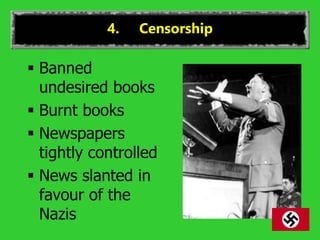
4. Censorship
 Banned
undesired books
 Burnt books
 Newspapers
tightly controlled
 News slanted in
favour of the
Nazis
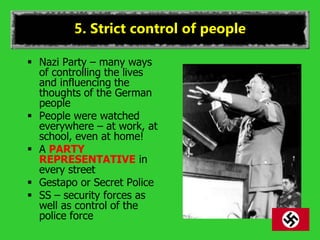
5. Strict control of people
 Nazi Party – many ways
of controlling the lives
and influencing the
thoughts of the German
people
 People were watched
everywhere – at work, at
school, even at home!
 A PARTY
REPRESENTATIVE in
every street
 Gestapo or Secret Police
 SS – security forces as
well as control of the
police force
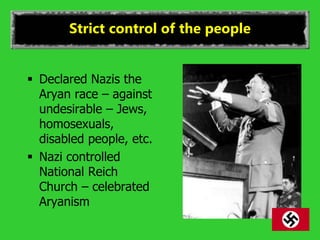
Strict control of the people
 Declared Nazis the
Aryan race – against
undesirable – Jews,
homosexuals,
disabled people, etc.
 Nazi controlled
National Reich
Church – celebrated
Aryanism
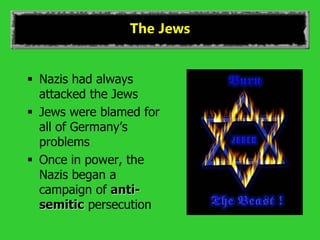
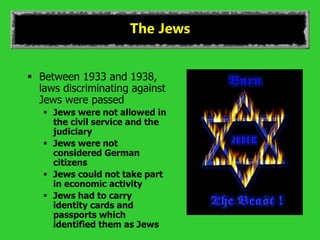
The Jews
 Nazis had always
attacked the Jews
 Jews were blamed for
all of Germany’s
problems
 Once in power, the
Nazis began a
campaign of anti-
semitic persecution
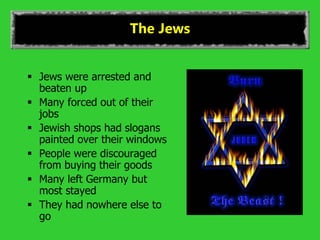
The Jews
 Jews were arrested and
beaten up
 Many forced out of their
jobs
 Jewish shops had slogans
painted over their windows
 People were discouraged
from buying their goods
 Many left Germany but
most stayed
 They had nowhere else to
go
The Jews
 Between 1933 and 1938,
laws discriminating against
Jews were passed
 Jews were not allowed in
the civil service and the
judiciary
 Jews were not
considered German
citizens
 Jews could not take part
in economic activity
 Jews had to carry
identity cards and
passports which
identified them as Jews
The Jews
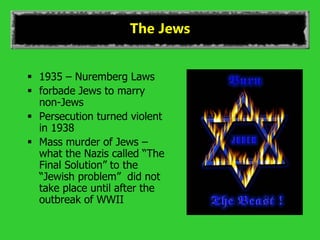
 1935 – Nuremberg Laws
 forbade Jews to marry
non-Jews
 Persecution turned violent
in 1938
 Mass murder of Jews –
what the Nazis called “The
Final Solution” to the
“Jewish problem” did not
take place until after the
outbreak of WWII
The Economy
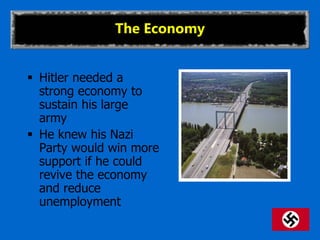
 Hitler needed a
strong economy to
sustain his large
army
 He knew his Nazi
Party would win more
support if he could
revive the economy
and reduce
unemployment
The Economy
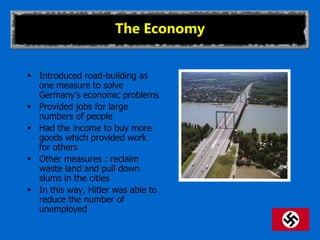
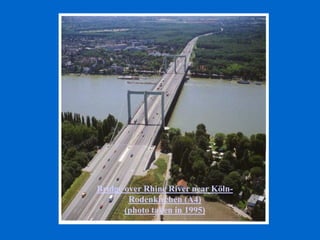
 Introduced road-building as
one measure to solve
Germany’s economic problems
 Provided jobs for large
numbers of people
 Had the income to buy more
goods which provided work
for others
 Other measures : reclaim
waste land and pull down
slums in the cities
 In this way, Hitler was able to
reduce the number of
unemployed
Bridge over Rhine River near Köln-
Rodenkirchen (A4)
(photo taken in 1995)
The Economy
 Rearmament started in 1934 -
Greater demand for
armaments – jobs for people
in the arms factories
 A large party bureaucracy was
set up, providing thousands of
jobs
 Purges of Jews and anti-Nazis
from the civil service created
more jobs for the other
Germans
The Economy
 Growth in German army
also provided jobs
 Conscription reintroduced
in 1935
 6 million unemployed in
1933 reduced to 2.5
million in 1935 to
250,000 in 1939
 Made Hitler immensely
popular with many
Germans
Conclusion
 Having fulfilled his
promise of economic
recovery, and knowing
he had the German
people’s support, Hitler
was now ready for his
next plan of action
 To extend Germany’s
border and prove to the
world Germany’s
superiority
Pl. mail ur suggestions to:
abdulshumz@hotmail.com