GILT-EDGED FUNDS
 Sunitha
Presented by:
MUTUAL FUNDS:
An investment vehicle that is made up of a
pool of funds collected from many
investors for the purpose of investing in
securities.
A mutual fund's portfolio is structured and
maintained to match the investment
objectives.
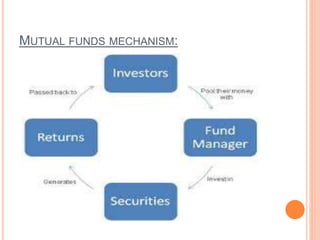
MUTUAL FUNDS MECHANISM:
GILT-EDGED FUNDS:
 Gilts originated in Britain.
 Gilt-edged Funds are mutual funds that
invest only in government securities.
 They are preferred by risk averse and
conservative investors who wish to invest in
the shadow of secure government bonds.
 These funds invest in Gilt-edged securities: state and
central government Bonds, T-bills.
 Have different maturity profiles-short term medium
term or long term.
 Gilt funds differ from bond funds because bond funds
invest in corporate bonds, government securities, and
money market instruments.
 Gilt funds stick to high quality-low risk debt, mainly
government securities.
RISKS INVOLVED ?
 Major risks in any debt instrument investment:
 Credit risk
 Liquidity risk
 Interest rate risk
 As gilt funds invest only in G-sec Credit risk is near
to zero.
 Gilts are highly liquid in nature and Gilt funds being
the mutual fund are liquid. Hence low liquidity risk.
 The biggest risk involved in Gilt funds is Interest
Rate Risk
INTEREST RATE RISK:
 Here “ Price of the bond and interest rates are
inversely related”.
 When interest rate rises , bond prices fall or vice
versa.
 Bonds prices and gilt fund unit prices tend to fall in
rising interest rate scenario.
 Fall in interest rates leads to rise in bond prices.
WHO SHOULD INVEST IN GILT FUNDS?
 These are ideal for those who want safety for their
investments or are risk-averse and, at the same
time, are looking for reasonable returns on their
money.
 When should you invest in gilt edged funds?
 These are a good option when the RBI is not likely
to raise interest rates immediately.
 situation when interest rates have peaked and a
downturn seems imminent, would be an
opportunity time to invest in gilt funds.
ADVANTAGES OF GILT FUNDS:
• Less credit risk: as they are government
securities.
• Tax benefits
• Open to retail investors: through these funds if not
only large institutional investors invest in G-sec
market.
• Diversification of portfolio
• Guaranteed returns- safe investments
DISADVANTAGES OF GILT FUNDS:
 Interest rate risk
 Not frequently traded
 Mostly ideal for short-term investment
GILT-EDGED SWITCHING:
 Gilt-edge switching involves selling of one
bond at a discount in order to purchase a
more favorably yielding instrument.
 Higher yeild bonds may increase the
potential for profits.
GILT FUNDS IN INDIA:
 The first gilt fund in India was setup in December
1998. The Reserve Bank of India is the governing
body of all gilt funds ever since.
 The RBI provides various facilities to encourage
gilt funds and to create a broader Investor base
for government securities:
 Liquidity support
 SGL and current accounts
 Funds transfer facility
 Access to call market
 Ready forward transactions
MAJOR PLAYERS:
 SBI Magnum Gilt - LTP
 HDFC Gilt Fund- LTP
 ICICI Pru Long Term Gilt
 JPMorgan India G-Sec. Fund -RP
 Reliance Gilt Sec. - RP
 Kotak Gilt Invt - Regular
 Birla Sun Life GSec - LTF
EXAMPLE:
 SBI Magnum Gilt - LTP
SBI MAGNUM GILT - LTP (G)
 Overview:
 Very Good performer in the category
 The scheme is ranked one in Gilt long term category by CRISIL
(for quarter ended Mar 2015) rank unchanged from last quarter.
 Investment Objective: To provide the investors with returns
generated through investments in government securities issued by the
Central Government and / or a State Government.
 Scheme details :
 Fund Type- Open-Ended
 Investment Plan- Growth
 Launch date- Jan 01, 2001
 Asset Size- Rs 422.63 crores (Avg. for qtr Jan-Mar 2015)
 Minimum Investment- Rs.5000
 Fund Manager- Dinesh Ahuja
ASSET ALLOCATION OF SBI GILT-
MAGNUM FUND:(AS OF 06/30/2015)
 Cash - 2.40%
 Stock - 0.00%
 Bond –97.60%
 Others - 0.00%
Investment
Cash
Stock
Bond
Others
CONCLUSION:
Investing in gilt funds though offer safe
investment option to derive maximum satisfaction
from investment factors like: timing, risk taking
ability, fund’s track record and other factors have
to be considered before investment.
REFERENCES:
 www.moneycontrol.com
 www.amfiindia.com
 www.rbi.gov.org
 Financial Services-Text by Shashi. K. Gupta
THANK YOU!

Gilt edged mutual funds

  • 1.
  • 2.
    MUTUAL FUNDS: An investmentvehicle that is made up of a pool of funds collected from many investors for the purpose of investing in securities. A mutual fund's portfolio is structured and maintained to match the investment objectives.
  • 3.
  • 4.
    GILT-EDGED FUNDS:  Giltsoriginated in Britain.  Gilt-edged Funds are mutual funds that invest only in government securities.  They are preferred by risk averse and conservative investors who wish to invest in the shadow of secure government bonds.
  • 5.
     These fundsinvest in Gilt-edged securities: state and central government Bonds, T-bills.  Have different maturity profiles-short term medium term or long term.  Gilt funds differ from bond funds because bond funds invest in corporate bonds, government securities, and money market instruments.  Gilt funds stick to high quality-low risk debt, mainly government securities.
  • 6.
    RISKS INVOLVED ? Major risks in any debt instrument investment:  Credit risk  Liquidity risk  Interest rate risk  As gilt funds invest only in G-sec Credit risk is near to zero.  Gilts are highly liquid in nature and Gilt funds being the mutual fund are liquid. Hence low liquidity risk.  The biggest risk involved in Gilt funds is Interest Rate Risk
  • 7.
    INTEREST RATE RISK: Here “ Price of the bond and interest rates are inversely related”.  When interest rate rises , bond prices fall or vice versa.  Bonds prices and gilt fund unit prices tend to fall in rising interest rate scenario.  Fall in interest rates leads to rise in bond prices.
  • 8.
    WHO SHOULD INVESTIN GILT FUNDS?  These are ideal for those who want safety for their investments or are risk-averse and, at the same time, are looking for reasonable returns on their money.  When should you invest in gilt edged funds?  These are a good option when the RBI is not likely to raise interest rates immediately.  situation when interest rates have peaked and a downturn seems imminent, would be an opportunity time to invest in gilt funds.
  • 9.
    ADVANTAGES OF GILTFUNDS: • Less credit risk: as they are government securities. • Tax benefits • Open to retail investors: through these funds if not only large institutional investors invest in G-sec market. • Diversification of portfolio • Guaranteed returns- safe investments
  • 10.
    DISADVANTAGES OF GILTFUNDS:  Interest rate risk  Not frequently traded  Mostly ideal for short-term investment
  • 11.
    GILT-EDGED SWITCHING:  Gilt-edgeswitching involves selling of one bond at a discount in order to purchase a more favorably yielding instrument.  Higher yeild bonds may increase the potential for profits.
  • 12.
    GILT FUNDS ININDIA:  The first gilt fund in India was setup in December 1998. The Reserve Bank of India is the governing body of all gilt funds ever since.  The RBI provides various facilities to encourage gilt funds and to create a broader Investor base for government securities:  Liquidity support  SGL and current accounts  Funds transfer facility  Access to call market  Ready forward transactions
  • 13.
    MAJOR PLAYERS:  SBIMagnum Gilt - LTP  HDFC Gilt Fund- LTP  ICICI Pru Long Term Gilt  JPMorgan India G-Sec. Fund -RP  Reliance Gilt Sec. - RP  Kotak Gilt Invt - Regular  Birla Sun Life GSec - LTF
  • 14.
  • 15.
    SBI MAGNUM GILT- LTP (G)  Overview:  Very Good performer in the category  The scheme is ranked one in Gilt long term category by CRISIL (for quarter ended Mar 2015) rank unchanged from last quarter.  Investment Objective: To provide the investors with returns generated through investments in government securities issued by the Central Government and / or a State Government.  Scheme details :  Fund Type- Open-Ended  Investment Plan- Growth  Launch date- Jan 01, 2001  Asset Size- Rs 422.63 crores (Avg. for qtr Jan-Mar 2015)  Minimum Investment- Rs.5000  Fund Manager- Dinesh Ahuja
  • 16.
    ASSET ALLOCATION OFSBI GILT- MAGNUM FUND:(AS OF 06/30/2015)  Cash - 2.40%  Stock - 0.00%  Bond –97.60%  Others - 0.00% Investment Cash Stock Bond Others
  • 17.
    CONCLUSION: Investing in giltfunds though offer safe investment option to derive maximum satisfaction from investment factors like: timing, risk taking ability, fund’s track record and other factors have to be considered before investment.
  • 18.
    REFERENCES:  www.moneycontrol.com  www.amfiindia.com www.rbi.gov.org  Financial Services-Text by Shashi. K. Gupta
  • 19.