
PROCESSING OF
EDIBLE OIL (PALM
OIL) PART 1
3 . 1 E X T R A C T I O N O F L I P I D F R O M N AT U R A L
S O U R C E
3 . 1 . 1 C H E M I C A L E X T R A C T I O N
3 . 1 . 2 P H Y S I C A L E X T R A C T I O N
3 . 2 R E F I N I N G P R O C E S S
3 . 2 . 1 R E F I N I N G
3 . 2 . 2 D E G U M M I N G
3 . 2 . 3 B L E A C H I N G
3 . 2 . 4 D E O D O R I Z AT I O N
3 . 3 A D V A N C E P R O C E S S I N G
3 . 3 . 1 H Y D R O G E N AT I O N
3 . 3 . 2 F R A C T I O N AT I O N
3 . 3 . 3 I N T E R E S T E R I F I C AT I O N
23/2/2020 Dr. Mohammed Danish 1
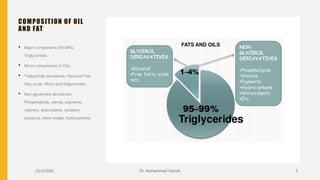
COMPOSITION OF OIL
AND FAT
• Major components (95-99%)
Triglycerides
• Minor components (1-5%)
• Triglyceride derivatives: Glycerol Free
fatty acids, Mono-and Diglycerides
• Non-glycerides derivatives:
Phospholipids, sterols, pigments,
vitamins, antioxidants, oxidation
products, trace metals, hydrocarbons
23/2/2020 Dr. Mohammed Danish 2
EXTRACTION OF LIPIDS FROM
NATURAL SOURCES
Lipids are recovered from the lipid-containing materials by two methods:
(1) Chemical extraction (Solvent extraction methods)
(2) Physical extraction (Mechanical crushing)
• Small volume processors prefer mechanical crushing to avoid having to build a costly solvent extraction system.
• High volume processors prefer solvent extraction to avoid having multiple mechanical screw presses operating in parallel.
23/2/2020 Dr. Mohammed Danish 3
CHEMICAL EXTRACTION METHODS
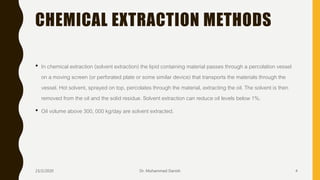
• In chemical extraction (solvent extraction) the lipid containing material passes through a percolation vessel
on a moving screen (or perforated plate or some similar device) that transports the materials through the
vessel. Hot solvent, sprayed on top, percolates through the material, extracting the oil. The solvent is then
removed from the oil and the solid residue. Solvent extraction can reduce oil levels below 1%.
• Oil volume above 300, 000 kg/day are solvent extracted.
23/2/2020 Dr. Mohammed Danish 4
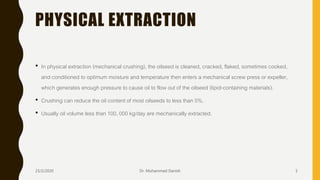
PHYSICAL EXTRACTION
• In physical extraction (mechanical crushing), the oilseed is cleaned, cracked, flaked, sometimes cooked,
and conditioned to optimum moisture and temperature then enters a mechanical screw press or expeller,
which generates enough pressure to cause oil to flow out of the oilseed (lipid-containing materials).
• Crushing can reduce the oil content of most oilseeds to less than 5%.
• Usually oil volume less than 100, 000 kg/day are mechanically extracted.
23/2/2020 Dr. Mohammed Danish 5
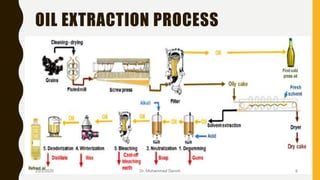
OIL EXTRACTION PROCESS
23/2/2020 Dr. Mohammed Danish 6
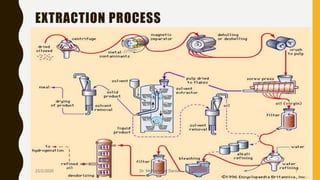
EXTRACTION PROCESS
23/2/2020 Dr. Mohammed Danish 7
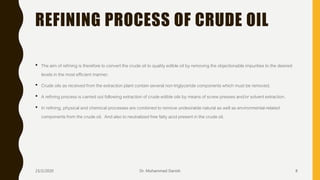
REFINING PROCESS OF CRUDE OIL
• The aim of refining is therefore to convert the crude oil to quality edible oil by removing the objectionable impurities to the desired
levels in the most efficient manner.
• Crude oils as received from the extraction plant contain several non-triglyceride components which must be removed.
• A refining process is carried out following extraction of crude edible oils by means of screw presses and/or solvent extraction.
• In refining, physical and chemical processes are combined to remove undesirable natural as well as environmental-related
components from the crude oil. And also to neutralized free fatty acid present in the crude oil.
23/2/2020 Dr. Mohammed Danish 8
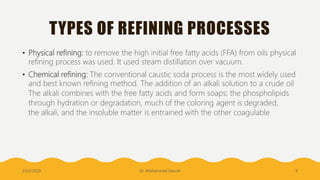
TYPES OF REFINING PROCESSES
• Physical refining: to remove the high initial free fatty acids (FFA) from oils physical
refining process was used. It used steam distillation over vacuum.
• Chemical refining: The conventional caustic soda process is the most widely used
and best known refining method. The addition of an alkali solution to a crude oil
The alkali combines with the free fatty acids and form soaps; the phospholipids
through hydration or degradation, much of the coloring agent is degraded,
the alkali, and the insoluble matter is entrained with the other coagulable
23/2/2020 Dr. Mohammed Danish 9
23/2/2020 Dr. Mohammed Danish 10
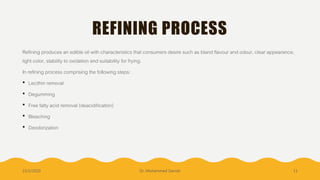
REFINING PROCESS
Refining produces an edible oil with characteristics that consumers desire such as bland flavour and odour, clear appearance,
light color, stability to oxidation and suitability for frying.
In refining process comprising the following steps:
• Lecithin removal
• Degumming
• Free fatty acid removal (deacidification)
• Bleaching
• Deodorization
23/2/2020 Dr. Mohammed Danish 11
REFINING PROCESS LAYOUT
23/2/2020 Dr. Mohammed Danish 12
PHE
PHE
PHE
H3PO4
PHE
PHE
PHE
SHE SHE SHE
Silo
Bleacher
Pre-
Stripper
FA
Condenser
FA
Condenser
Vacuum
Vacuum
Storage
Tank
From TOHTo TOH
BPO
Buffer
Tank
BPO
Trap
Filter
RBDPO
Trap
Filter
RBDPO
Niagara Filter
Slurry Tank
RBDPO
Outlet
CPO
Inlet
To Slope
Tank
Static MIxer
Motorised Mixer
Bleaching
Level
Vacuum
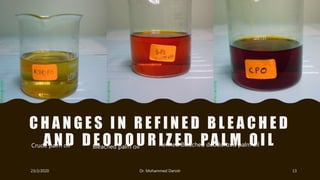
C H A N G E S I N R E F I N E D B L E A C H E D
A N D D E O D O U R I Z E D PA L M O I L
23/2/2020 Dr. Mohammed Danish 13
Crude palm oil Bleached palm oil Refined Bleached deodorized palm oil
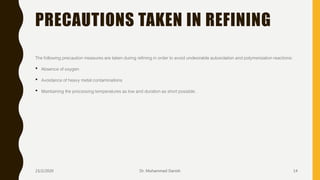
PRECAUTIONS TAKEN IN REFINING
The following precaution measures are taken during refining in order to avoid undesirable autoxidation and polymerization reactions:
• Absence of oxygen
• Avoidance of heavy metal contaminations
• Maintaining the processing temperatures as low and duration as short possible.
23/2/2020 Dr. Mohammed Danish 14
REMOVAL OF LECITHIN
• Water (2-3%) is added to crude oil, thereby enriching the phospholipids in the oil/water interface.
• The emulsion thus formed is heated up to 80 °C and then separated or clarified by centrifugation.
• This processing step is special importance for soyabean oils.
23/2/2020 Dr. Mohammed Danish 15
DEGUMMING
• The degumming processes convert the phospholipids to hydrated gums, which are insoluble in oil and
readily separated as a sludge by settling, filtrering, or centrifugal action.
• Finely dispersed protein and carbohydrate are coagulated in oil by addition of phosphoric acid (0.1% of oil
weight).
• A filtering acid is then added and the oil is clarified by filtration.
23/2/2020 Dr. Mohammed Danish 16
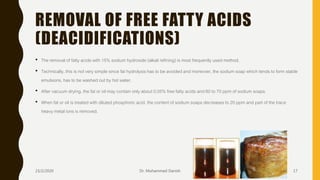
REMOVAL OF FREE FATTY ACIDS
(DEACIDIFICATIONS)
• The removal of fatty acids with 15% sodium hydroxide (alkali refining) is most frequently used method.
• Technically, this is not very simple since fat hydrolysis has to be avoided and moreover, the sodium soap which tends to form stable
emulsions, has to be washed out by hot water.
• After vacuum drying, the fat or oil may contain only about 0.05% free fatty acids and 60 to 70 ppm of sodium soaps.
• When fat or oil is treated with diluted phosphoric acid, the content of sodium soaps decreases to 20 ppm and part of the trace
heavy metal ions is removed.
23/2/2020 Dr. Mohammed Danish 17
BLEACHING
• In order to remove the plant pigment (chlorophyll, carotenoids) and autoxidation products, the fat and oil is
stirred for 30 min in the presence of Al-silicate (bleaching or Fuller’s earth) in a vacuum at 90 °C.
• The bleached oil is removed from the adsorbent by filtration.
• The retained by the adsorbent can be recovered by hexane extraction and recycled into refining process.
23/2/2020 Dr. Mohammed Danish 18
DEODORIZATION
• Deodorization is essentially vacuum steam distillations (190-230 °C, 0.5- 10 mbar)
• The volatile compounds, together with undesirable odorants present in the fat or oil, are separated in refining
steps.
• Deodorization takes place in 20 min to 6 hour depending on the type of fat or oil and the content of volatile
compounds.
23/2/2020 Dr. Mohammed Danish 19
HYDROGENATION
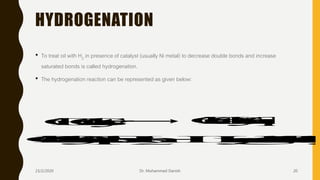
• To treat oil with H2 in presence of catalyst (usually Ni metal) to decrease double bonds and increase
saturated bonds is called hydrogenation.
• The hydrogenation reaction can be represented as given below:
Oil+Catalyst Oil-CatalystComplex
Oil-CatalystComplex+H2 HydrogenatedOil+Catalyst
23/2/2020 Dr. Mohammed Danish 20
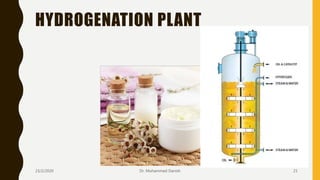
HYDROGENATION PLANT
23/2/2020 Dr. Mohammed Danish 21
The hydrogenation reaction results:
• Saturation of double bonds
• Migration of double bonds
• Trans-fatty acid formation
Advantages of hydrogenation:
• Making fat suitable for manufacture of margarine
• shortening, coating fats, cooking oil and salad dressing oils
23/2/2020 Dr. Mohammed Danish 22
FRACTIONATION
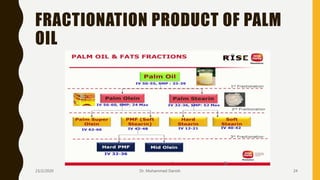
• Fractionation leads to the separation of fats and oils into two or more fractionations with different melting
points.
• Fractionation could also be used to remove the an undesirable minor component such as waxes in oils
during de-waxing and winterization processes to produce salad oil.
23/2/2020 Dr. Mohammed Danish 23
FRACTIONATION PRODUCT OF PALM
OIL
23/2/2020 Dr. Mohammed Danish 24
INTERESTERIFICATION
The interesterification process can alter the original order of distribution of the fatty acids in the triglyceride
producing products with melting and crystallization characteristics different from the original oil and fats.
The interesterification can be performed in two way:
• Chemical interesterification
• Enzymatic interesterification
23/2/2020 Dr. Mohammed Danish 25
CHEMICAL INTERESTERIFICATION
• Chemical interesterification can be performed in presence of basic catalyst e.g. sodium methoxide.
• It give the non-selective or random rearrangements of fatty acids.
23/2/2020 Dr. Mohammed Danish 26
ENZYMATIC INTERESTERIFICATION
• Enzymatic interesterification is done by using immobilized lipases.
• It is highly selective in modifying the fatty acids in triglycerides.
• Commonly used in the European industry.
23/2/2020 Dr. Mohammed Danish 27
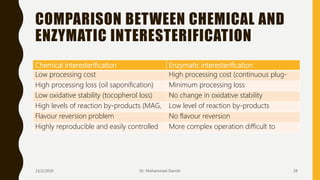
COMPARISON BETWEEN CHEMICAL AND
ENZYMATIC INTERESTERIFICATION
Chemical interesterification Enzymatic interesterification
Low processing cost High processing cost (continuous plug-
High processing loss (oil saponification) Minimum processing loss
Low oxidative stability (tocopherol loss) No change in oxidative stability
High levels of reaction by-products (MAG, Low level of reaction by-products
Flavour reversion problem No flavour reversion
Highly reproducible and easily controlled More complex operation difficult to
23/2/2020 Dr. Mohammed Danish 28
END OF SLIDES
T H A N K S F O R Y O U R AT T E N T I O N !
23/2/2020 Dr. Mohammed Danish 29

Processing of edible oil (Unit 3)

  • 1.
    PROCESSING OF EDIBLE OIL(PALM OIL) PART 1 3 . 1 E X T R A C T I O N O F L I P I D F R O M N AT U R A L S O U R C E 3 . 1 . 1 C H E M I C A L E X T R A C T I O N 3 . 1 . 2 P H Y S I C A L E X T R A C T I O N 3 . 2 R E F I N I N G P R O C E S S 3 . 2 . 1 R E F I N I N G 3 . 2 . 2 D E G U M M I N G 3 . 2 . 3 B L E A C H I N G 3 . 2 . 4 D E O D O R I Z AT I O N 3 . 3 A D V A N C E P R O C E S S I N G 3 . 3 . 1 H Y D R O G E N AT I O N 3 . 3 . 2 F R A C T I O N AT I O N 3 . 3 . 3 I N T E R E S T E R I F I C AT I O N 23/2/2020 Dr. Mohammed Danish 1
  • 2.
    COMPOSITION OF OIL ANDFAT • Major components (95-99%) Triglycerides • Minor components (1-5%) • Triglyceride derivatives: Glycerol Free fatty acids, Mono-and Diglycerides • Non-glycerides derivatives: Phospholipids, sterols, pigments, vitamins, antioxidants, oxidation products, trace metals, hydrocarbons 23/2/2020 Dr. Mohammed Danish 2
  • 3.
    EXTRACTION OF LIPIDSFROM NATURAL SOURCES Lipids are recovered from the lipid-containing materials by two methods: (1) Chemical extraction (Solvent extraction methods) (2) Physical extraction (Mechanical crushing) • Small volume processors prefer mechanical crushing to avoid having to build a costly solvent extraction system. • High volume processors prefer solvent extraction to avoid having multiple mechanical screw presses operating in parallel. 23/2/2020 Dr. Mohammed Danish 3
  • 4.
    CHEMICAL EXTRACTION METHODS •In chemical extraction (solvent extraction) the lipid containing material passes through a percolation vessel on a moving screen (or perforated plate or some similar device) that transports the materials through the vessel. Hot solvent, sprayed on top, percolates through the material, extracting the oil. The solvent is then removed from the oil and the solid residue. Solvent extraction can reduce oil levels below 1%. • Oil volume above 300, 000 kg/day are solvent extracted. 23/2/2020 Dr. Mohammed Danish 4
  • 5.
    PHYSICAL EXTRACTION • Inphysical extraction (mechanical crushing), the oilseed is cleaned, cracked, flaked, sometimes cooked, and conditioned to optimum moisture and temperature then enters a mechanical screw press or expeller, which generates enough pressure to cause oil to flow out of the oilseed (lipid-containing materials). • Crushing can reduce the oil content of most oilseeds to less than 5%. • Usually oil volume less than 100, 000 kg/day are mechanically extracted. 23/2/2020 Dr. Mohammed Danish 5
  • 6.
    OIL EXTRACTION PROCESS 23/2/2020Dr. Mohammed Danish 6
  • 7.
  • 8.
    REFINING PROCESS OFCRUDE OIL • The aim of refining is therefore to convert the crude oil to quality edible oil by removing the objectionable impurities to the desired levels in the most efficient manner. • Crude oils as received from the extraction plant contain several non-triglyceride components which must be removed. • A refining process is carried out following extraction of crude edible oils by means of screw presses and/or solvent extraction. • In refining, physical and chemical processes are combined to remove undesirable natural as well as environmental-related components from the crude oil. And also to neutralized free fatty acid present in the crude oil. 23/2/2020 Dr. Mohammed Danish 8
  • 9.
    TYPES OF REFININGPROCESSES • Physical refining: to remove the high initial free fatty acids (FFA) from oils physical refining process was used. It used steam distillation over vacuum. • Chemical refining: The conventional caustic soda process is the most widely used and best known refining method. The addition of an alkali solution to a crude oil The alkali combines with the free fatty acids and form soaps; the phospholipids through hydration or degradation, much of the coloring agent is degraded, the alkali, and the insoluble matter is entrained with the other coagulable 23/2/2020 Dr. Mohammed Danish 9
  • 10.
  • 11.
    REFINING PROCESS Refining producesan edible oil with characteristics that consumers desire such as bland flavour and odour, clear appearance, light color, stability to oxidation and suitability for frying. In refining process comprising the following steps: • Lecithin removal • Degumming • Free fatty acid removal (deacidification) • Bleaching • Deodorization 23/2/2020 Dr. Mohammed Danish 11
  • 12.
    REFINING PROCESS LAYOUT 23/2/2020Dr. Mohammed Danish 12 PHE PHE PHE H3PO4 PHE PHE PHE SHE SHE SHE Silo Bleacher Pre- Stripper FA Condenser FA Condenser Vacuum Vacuum Storage Tank From TOHTo TOH BPO Buffer Tank BPO Trap Filter RBDPO Trap Filter RBDPO Niagara Filter Slurry Tank RBDPO Outlet CPO Inlet To Slope Tank Static MIxer Motorised Mixer Bleaching Level Vacuum
  • 13.
    C H AN G E S I N R E F I N E D B L E A C H E D A N D D E O D O U R I Z E D PA L M O I L 23/2/2020 Dr. Mohammed Danish 13 Crude palm oil Bleached palm oil Refined Bleached deodorized palm oil
  • 14.
    PRECAUTIONS TAKEN INREFINING The following precaution measures are taken during refining in order to avoid undesirable autoxidation and polymerization reactions: • Absence of oxygen • Avoidance of heavy metal contaminations • Maintaining the processing temperatures as low and duration as short possible. 23/2/2020 Dr. Mohammed Danish 14
  • 15.
    REMOVAL OF LECITHIN •Water (2-3%) is added to crude oil, thereby enriching the phospholipids in the oil/water interface. • The emulsion thus formed is heated up to 80 °C and then separated or clarified by centrifugation. • This processing step is special importance for soyabean oils. 23/2/2020 Dr. Mohammed Danish 15
  • 16.
    DEGUMMING • The degummingprocesses convert the phospholipids to hydrated gums, which are insoluble in oil and readily separated as a sludge by settling, filtrering, or centrifugal action. • Finely dispersed protein and carbohydrate are coagulated in oil by addition of phosphoric acid (0.1% of oil weight). • A filtering acid is then added and the oil is clarified by filtration. 23/2/2020 Dr. Mohammed Danish 16
  • 17.
    REMOVAL OF FREEFATTY ACIDS (DEACIDIFICATIONS) • The removal of fatty acids with 15% sodium hydroxide (alkali refining) is most frequently used method. • Technically, this is not very simple since fat hydrolysis has to be avoided and moreover, the sodium soap which tends to form stable emulsions, has to be washed out by hot water. • After vacuum drying, the fat or oil may contain only about 0.05% free fatty acids and 60 to 70 ppm of sodium soaps. • When fat or oil is treated with diluted phosphoric acid, the content of sodium soaps decreases to 20 ppm and part of the trace heavy metal ions is removed. 23/2/2020 Dr. Mohammed Danish 17
  • 18.
    BLEACHING • In orderto remove the plant pigment (chlorophyll, carotenoids) and autoxidation products, the fat and oil is stirred for 30 min in the presence of Al-silicate (bleaching or Fuller’s earth) in a vacuum at 90 °C. • The bleached oil is removed from the adsorbent by filtration. • The retained by the adsorbent can be recovered by hexane extraction and recycled into refining process. 23/2/2020 Dr. Mohammed Danish 18
  • 19.
    DEODORIZATION • Deodorization isessentially vacuum steam distillations (190-230 °C, 0.5- 10 mbar) • The volatile compounds, together with undesirable odorants present in the fat or oil, are separated in refining steps. • Deodorization takes place in 20 min to 6 hour depending on the type of fat or oil and the content of volatile compounds. 23/2/2020 Dr. Mohammed Danish 19
  • 20.
    HYDROGENATION • To treatoil with H2 in presence of catalyst (usually Ni metal) to decrease double bonds and increase saturated bonds is called hydrogenation. • The hydrogenation reaction can be represented as given below: Oil+Catalyst Oil-CatalystComplex Oil-CatalystComplex+H2 HydrogenatedOil+Catalyst 23/2/2020 Dr. Mohammed Danish 20
  • 21.
  • 22.
    The hydrogenation reactionresults: • Saturation of double bonds • Migration of double bonds • Trans-fatty acid formation Advantages of hydrogenation: • Making fat suitable for manufacture of margarine • shortening, coating fats, cooking oil and salad dressing oils 23/2/2020 Dr. Mohammed Danish 22
  • 23.
    FRACTIONATION • Fractionation leadsto the separation of fats and oils into two or more fractionations with different melting points. • Fractionation could also be used to remove the an undesirable minor component such as waxes in oils during de-waxing and winterization processes to produce salad oil. 23/2/2020 Dr. Mohammed Danish 23
  • 24.
    FRACTIONATION PRODUCT OFPALM OIL 23/2/2020 Dr. Mohammed Danish 24
  • 25.
    INTERESTERIFICATION The interesterification processcan alter the original order of distribution of the fatty acids in the triglyceride producing products with melting and crystallization characteristics different from the original oil and fats. The interesterification can be performed in two way: • Chemical interesterification • Enzymatic interesterification 23/2/2020 Dr. Mohammed Danish 25
  • 26.
    CHEMICAL INTERESTERIFICATION • Chemicalinteresterification can be performed in presence of basic catalyst e.g. sodium methoxide. • It give the non-selective or random rearrangements of fatty acids. 23/2/2020 Dr. Mohammed Danish 26
  • 27.
    ENZYMATIC INTERESTERIFICATION • Enzymaticinteresterification is done by using immobilized lipases. • It is highly selective in modifying the fatty acids in triglycerides. • Commonly used in the European industry. 23/2/2020 Dr. Mohammed Danish 27
  • 28.
    COMPARISON BETWEEN CHEMICALAND ENZYMATIC INTERESTERIFICATION Chemical interesterification Enzymatic interesterification Low processing cost High processing cost (continuous plug- High processing loss (oil saponification) Minimum processing loss Low oxidative stability (tocopherol loss) No change in oxidative stability High levels of reaction by-products (MAG, Low level of reaction by-products Flavour reversion problem No flavour reversion Highly reproducible and easily controlled More complex operation difficult to 23/2/2020 Dr. Mohammed Danish 28
  • 29.
    END OF SLIDES TH A N K S F O R Y O U R AT T E N T I O N ! 23/2/2020 Dr. Mohammed Danish 29