SEMINAR
ON
DEMONSTRATION METHOD OF TEACHING
INTRODUCTION
DEFINITION
Teaching strategies stands for plans, means and
specific ways used by the teachers to guide, direct
and to show path to the learners to make them
understand the set of instructions or teaching -
learning objectives. E Stones and M Metisis 1972
OBJECTIVES
• To ensure that certain learning will be acquired
in a brief period.
• To induce students to engage in exchange of
ideas.
• To minimize the number of wrong responses
on the students attempt to learn as concepts,
principles etc.
CHARACTERISTICS
.
• Developing the desire to work with the highest
measures of efficiency of which one is capable.
• Training the students to know the art of study.
• Also training the students to use reference
materials.
• Ensuring the balanced way of individual work
with group work in a cooperative manner.
• Developing the capacity for clear thinking.
• Expanding the range of students desires and
interests.
• Providing opportunities to students to apply
the knowledge which they acquired practically.
• Emphasizing on reciprocal method of learning.
• Transforming present style of bookish
schooling into practical .
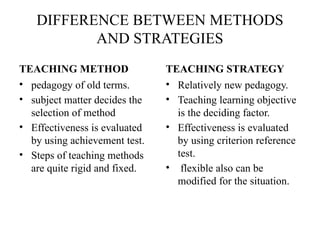
DIFFERENCE BETWEEN METHODS
AND STRATEGIES
TEACHING METHOD
• pedagogy of old terms.
• subject matter decides the
selection of method
• Effectiveness is evaluated
by using achievement test.
• Steps of teaching methods
are quite rigid and fixed.
TEACHING STRATEGY
• Relatively new pedagogy.
• Teaching learning objective
is the deciding factor.
• Effectiveness is evaluated
by using criterion reference
test.
• flexible also can be
modified for the situation.
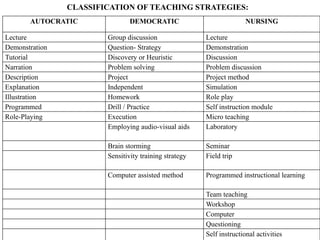
AUTOCRATIC DEMOCRATIC NURSING
Lecture Group discussion Lecture
Demonstration Question- Strategy Demonstration
Tutorial Discovery or Heuristic Discussion
Narration Problem solving Problem discussion
Description Project Project method
Explanation Independent Simulation
Illustration Homework Role play
Programmed Drill / Practice Self instruction module
Role-Playing Execution Micro teaching
Employing audio-visual aids Laboratory
Brain storming Seminar
Sensitivity training strategy Field trip
Computer assisted method Programmed instructional learning
Team teaching
Workshop
Computer
Questioning
Self instructional activities
CLASSIFICATION OF TEACHING STRATEGIES:
DEMONSTRATION
• A demonstration can be defined as visualized,
explanation of facts, concepts and procedures.
• It is physical display of the form, outline or a
substance of object or events for the purpose
of increasing knowledge of such objects or
events
GUIDELINES
• It should be planned and rehearsed by the teacher
before hand
• The equipments used for the demonstration must be
visible for the whole class
• Adequate lighting arrangements be made on
demonstration table and a proper background table
need to be provided
• All the equipments are placed in order before starting
the demonstration.
• Before the demonstration a clear statement
about the purpose of demonstration to be made
to the students.
• The teacher make sure that the demonstration
method leads to active participation of the
students in the process of teaching.
• The demonstration should be quick and
interesting.
• The teacher should write the summary of the
principles.
CHARACTERISTICS
STEPS TO DEMONSTRARE PSYCHOMOTOR SKILL
BEFORE DEMONSTRATION:
•Perform the skills and analysis thereby determine pre-requisites.
•Assess entry behaviors of learners and determine prerequisites.
•Formulate the lesson plan with particular reference to
1.Ensure optimum level visibility
2.Preparation for all materials
•Formulate behavioral objectives.
•DURING THE DEMONSTRATION:
•State the objectives to the learners
•Motivate them by explaining why the skill is important
•Demonstrate the total skill at normal speed.
•Write the sequence of skills on the chalk board as checklist.
•Demonstrate them according to the sequence.
Obtain feedback by questioning and observation of non-verbal behavior.
•Avoid the use of negative examples and the variations in technique.
AFTER THE DEMONSTRATION:
•Provide immediate supervised practice with adequate time allowance
•Provide verbal rather than physical guidance
•Make the environment psychologically safe by providing friendly
atmosphere and constructive criticism
COMMON ERRORS
• Equipment may not be ready for use.
• There may not be an apparent relation between
demonstration and the topic dealt.
• Blackboard not up to the mark.
• Teacher may be in a hurry to arrive at
generalization.
• Teacher may talk too much which will mask the
enthusiasm of the students.
• Teacher may not have allowed sufficient time for
re-coloring of data.
• Teacher may fail to ask the right type of questions
level.
• Teacher may fail to ask for return demonstration.
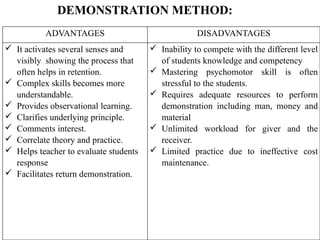
ADVANTAGES DISADVANTAGES
 It activates several senses and
visibly showing the process that
often helps in retention.
 Complex skills becomes more
understandable.
 Provides observational learning.
 Clarifies underlying principle.
 Comments interest.
 Correlate theory and practice.
 Helps teacher to evaluate students
response
 Facilitates return demonstration.
 Inability to compete with the different level
of students knowledge and competency
 Mastering psychomotor skill is often
stressful to the students.
 Requires adequate resources to perform
demonstration including man, money and
material
 Unlimited workload for giver and the
receiver.
 Limited practice due to ineffective cost
maintenance.
DEMONSTRATION METHOD:
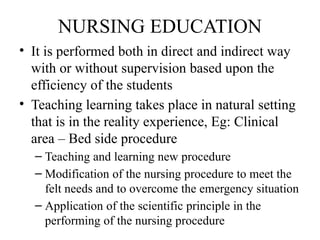
NURSING EDUCATION
• It is performed both in direct and indirect way
with or without supervision based upon the
efficiency of the students
• Teaching learning takes place in natural setting
that is in the reality experience, Eg: Clinical
area – Bed side procedure
– Teaching and learning new procedure
– Modification of the nursing procedure to meet the
felt needs and to overcome the emergency situation
– Application of the scientific principle in the
performing of the nursing procedure
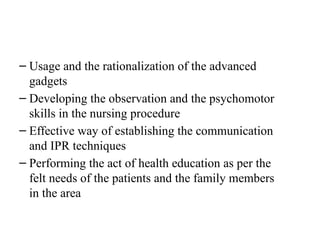
– Usage and the rationalization of the advanced
gadgets
– Developing the observation and the psychomotor
skills in the nursing procedure
– Effective way of establishing the communication
and IPR techniques
– Performing the act of health education as per the
felt needs of the patients and the family members
in the area
SUMMARY
CONCLUSION
REFERENCES
Book Reference:
• Basavanthappa B.T. “Nursing Education” 2nd
edition by
Jaypee brothers & Co publishing unit, Pg: No. 483 – 486
• Neeraja K.P. “Textbook of Nursing Education” 1st
edition
published by Jaypee brothers, 2003, Page : No. 251 – 254
• Pramila R. “Nursing Communication and Educational
Technology” 1st
edition by Jaypee brothers, Pg : No. 256
E - Reference:
• www.http/J.G Nyquist wehrli Teaching and Education
development creating and educational curriculum for
learners at any level AABB conference-2003
Demonstration method use in teaching and learning ppt.pptx

  • 1.
  • 2.
  • 3.
    DEFINITION Teaching strategies standsfor plans, means and specific ways used by the teachers to guide, direct and to show path to the learners to make them understand the set of instructions or teaching - learning objectives. E Stones and M Metisis 1972
  • 4.
    OBJECTIVES • To ensurethat certain learning will be acquired in a brief period. • To induce students to engage in exchange of ideas. • To minimize the number of wrong responses on the students attempt to learn as concepts, principles etc.
  • 5.
    CHARACTERISTICS . • Developing thedesire to work with the highest measures of efficiency of which one is capable. • Training the students to know the art of study. • Also training the students to use reference materials. • Ensuring the balanced way of individual work with group work in a cooperative manner.
  • 6.
    • Developing thecapacity for clear thinking. • Expanding the range of students desires and interests. • Providing opportunities to students to apply the knowledge which they acquired practically. • Emphasizing on reciprocal method of learning.
  • 7.
    • Transforming presentstyle of bookish schooling into practical .
  • 8.
    DIFFERENCE BETWEEN METHODS ANDSTRATEGIES TEACHING METHOD • pedagogy of old terms. • subject matter decides the selection of method • Effectiveness is evaluated by using achievement test. • Steps of teaching methods are quite rigid and fixed. TEACHING STRATEGY • Relatively new pedagogy. • Teaching learning objective is the deciding factor. • Effectiveness is evaluated by using criterion reference test. • flexible also can be modified for the situation.
  • 9.
    AUTOCRATIC DEMOCRATIC NURSING LectureGroup discussion Lecture Demonstration Question- Strategy Demonstration Tutorial Discovery or Heuristic Discussion Narration Problem solving Problem discussion Description Project Project method Explanation Independent Simulation Illustration Homework Role play Programmed Drill / Practice Self instruction module Role-Playing Execution Micro teaching Employing audio-visual aids Laboratory Brain storming Seminar Sensitivity training strategy Field trip Computer assisted method Programmed instructional learning Team teaching Workshop Computer Questioning Self instructional activities CLASSIFICATION OF TEACHING STRATEGIES:
  • 10.
    DEMONSTRATION • A demonstrationcan be defined as visualized, explanation of facts, concepts and procedures. • It is physical display of the form, outline or a substance of object or events for the purpose of increasing knowledge of such objects or events
  • 11.
    GUIDELINES • It shouldbe planned and rehearsed by the teacher before hand • The equipments used for the demonstration must be visible for the whole class • Adequate lighting arrangements be made on demonstration table and a proper background table need to be provided • All the equipments are placed in order before starting the demonstration.
  • 12.
    • Before thedemonstration a clear statement about the purpose of demonstration to be made to the students. • The teacher make sure that the demonstration method leads to active participation of the students in the process of teaching. • The demonstration should be quick and interesting. • The teacher should write the summary of the principles.
  • 13.
  • 14.
    STEPS TO DEMONSTRAREPSYCHOMOTOR SKILL
  • 15.
    BEFORE DEMONSTRATION: •Perform theskills and analysis thereby determine pre-requisites. •Assess entry behaviors of learners and determine prerequisites. •Formulate the lesson plan with particular reference to 1.Ensure optimum level visibility 2.Preparation for all materials •Formulate behavioral objectives.
  • 16.
    •DURING THE DEMONSTRATION: •Statethe objectives to the learners •Motivate them by explaining why the skill is important •Demonstrate the total skill at normal speed. •Write the sequence of skills on the chalk board as checklist. •Demonstrate them according to the sequence. Obtain feedback by questioning and observation of non-verbal behavior. •Avoid the use of negative examples and the variations in technique.
  • 17.
    AFTER THE DEMONSTRATION: •Provideimmediate supervised practice with adequate time allowance •Provide verbal rather than physical guidance •Make the environment psychologically safe by providing friendly atmosphere and constructive criticism
  • 18.
    COMMON ERRORS • Equipmentmay not be ready for use. • There may not be an apparent relation between demonstration and the topic dealt. • Blackboard not up to the mark. • Teacher may be in a hurry to arrive at generalization.
  • 19.
    • Teacher maytalk too much which will mask the enthusiasm of the students. • Teacher may not have allowed sufficient time for re-coloring of data. • Teacher may fail to ask the right type of questions level. • Teacher may fail to ask for return demonstration.
  • 20.
    ADVANTAGES DISADVANTAGES  Itactivates several senses and visibly showing the process that often helps in retention.  Complex skills becomes more understandable.  Provides observational learning.  Clarifies underlying principle.  Comments interest.  Correlate theory and practice.  Helps teacher to evaluate students response  Facilitates return demonstration.  Inability to compete with the different level of students knowledge and competency  Mastering psychomotor skill is often stressful to the students.  Requires adequate resources to perform demonstration including man, money and material  Unlimited workload for giver and the receiver.  Limited practice due to ineffective cost maintenance. DEMONSTRATION METHOD:
  • 21.
    NURSING EDUCATION • Itis performed both in direct and indirect way with or without supervision based upon the efficiency of the students • Teaching learning takes place in natural setting that is in the reality experience, Eg: Clinical area – Bed side procedure – Teaching and learning new procedure – Modification of the nursing procedure to meet the felt needs and to overcome the emergency situation – Application of the scientific principle in the performing of the nursing procedure
  • 22.
    – Usage andthe rationalization of the advanced gadgets – Developing the observation and the psychomotor skills in the nursing procedure – Effective way of establishing the communication and IPR techniques – Performing the act of health education as per the felt needs of the patients and the family members in the area
  • 23.
  • 24.
  • 25.
    REFERENCES Book Reference: • BasavanthappaB.T. “Nursing Education” 2nd edition by Jaypee brothers & Co publishing unit, Pg: No. 483 – 486 • Neeraja K.P. “Textbook of Nursing Education” 1st edition published by Jaypee brothers, 2003, Page : No. 251 – 254 • Pramila R. “Nursing Communication and Educational Technology” 1st edition by Jaypee brothers, Pg : No. 256 E - Reference: • www.http/J.G Nyquist wehrli Teaching and Education development creating and educational curriculum for learners at any level AABB conference-2003