CONTENTS
INTRODUCTION
DEFINITION
PURPOSES
PRINCIPLES
PHASES
TECHNIQUES
“A DEMO is a visual
presentation showing how to
do something or how it works.”
Demonstration is a teaching method used
to communicate an idea with the aid of
visuals such as flip charts, posters,
PowerPoint, etc. A demonstration is the
process of teaching someone how to make
or do something in a step-by-step process.
As you show how, you “tell” what you are
doing. A demonstration always has a
finished product. The key to a good
demonstration is for the audience to be
able to go home and do what you have
taught them how to do.
“Demonstration is a planned
manipulation and equipment to the
end that learners are able to observe
all or at least some of the
manifestations of one or more
scientific principles and operations
within a phenomena”.
-Woodburn & Obourn
“Demonstration is a process where the
teacher shows or illustrates a skill or a
principle.”
-Kramer
Gaining
Knowledge
Problem
Solving
Verify
Facts
Develop
Scientific Skills
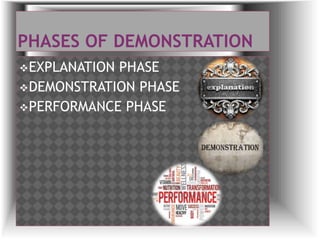
EXPLANATION PHASE
EXPLANATION PHASE
DEMONSTRATION PHASE
EXPLANATION PHASE
DEMONSTRATION PHASE
PERFORMANCE PHASE
EXPLANATION PHASE
DEMONSTRATION PHASE
PERFORMANCE PHASE
SUPERVISION PHASE
EXPLANATION PHASE
DEMONSTRATION PHASE
PERFORMANCE PHASE
SUPERVISION PHASE
EVALUATION PHASE
 Explanation must be clear.
 Objectives of the particular
lesson must be presented.
 The instructor must convey to the
students the precise action to be
performed.
 Instructor should describe the end results
of these efforts.
 Before leaving, the instructor should
encourage learners to ask questions.
 The instructor must show
learners the actions necessary
to perform a skill.
 Extraneous activities as possible
should be included in the demonstration.
 To clearly understand, the instructor
should accurately performing the actions
previously explained.
 It is related to learners
performance of the physical
and mental skills.
 Learners performance require learners to act
and do.
 Through doing, students learn to follow
correct procedures and to reach established
standards.
 Learners should be given an opportunity to
perform skill as soon as possible the
instructor completed performing the actions
explained before.
 During performance phase,
the supervision phase is also
happening by the instructor.
 The instructor supervised the
performance of the learners and observed
their learning and understanding of the
demonstration.
 They were allowed to independently
complete the task at least once with
supervision and coaching as necessary.
 In this phase, the instructor
judges learners performance.
 The instructor discovers just
how well the skill has been learned.
 From this measurement of learners
achievement, the instructor determines
the effectiveness of the instruction.
Demonstration

Demonstration

  • 2.
  • 3.
    “A DEMO isa visual presentation showing how to do something or how it works.”
  • 4.
    Demonstration is ateaching method used to communicate an idea with the aid of visuals such as flip charts, posters, PowerPoint, etc. A demonstration is the process of teaching someone how to make or do something in a step-by-step process. As you show how, you “tell” what you are doing. A demonstration always has a finished product. The key to a good demonstration is for the audience to be able to go home and do what you have taught them how to do.
  • 6.
    “Demonstration is aplanned manipulation and equipment to the end that learners are able to observe all or at least some of the manifestations of one or more scientific principles and operations within a phenomena”. -Woodburn & Obourn “Demonstration is a process where the teacher shows or illustrates a skill or a principle.” -Kramer
  • 7.
  • 9.
  • 10.
  • 11.
  • 12.
  • 13.
    EXPLANATION PHASE DEMONSTRATION PHASE PERFORMANCEPHASE SUPERVISION PHASE EVALUATION PHASE
  • 14.
     Explanation mustbe clear.  Objectives of the particular lesson must be presented.  The instructor must convey to the students the precise action to be performed.  Instructor should describe the end results of these efforts.  Before leaving, the instructor should encourage learners to ask questions.
  • 15.
     The instructormust show learners the actions necessary to perform a skill.  Extraneous activities as possible should be included in the demonstration.  To clearly understand, the instructor should accurately performing the actions previously explained.
  • 16.
     It isrelated to learners performance of the physical and mental skills.  Learners performance require learners to act and do.  Through doing, students learn to follow correct procedures and to reach established standards.  Learners should be given an opportunity to perform skill as soon as possible the instructor completed performing the actions explained before.
  • 17.
     During performancephase, the supervision phase is also happening by the instructor.  The instructor supervised the performance of the learners and observed their learning and understanding of the demonstration.  They were allowed to independently complete the task at least once with supervision and coaching as necessary.
  • 18.
     In thisphase, the instructor judges learners performance.  The instructor discovers just how well the skill has been learned.  From this measurement of learners achievement, the instructor determines the effectiveness of the instruction.