Democratic Theory Michael P. Fix
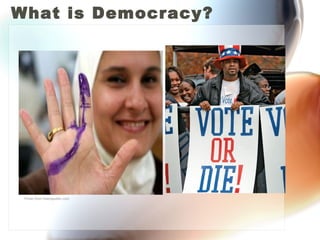
What is Democracy? Photo from freerepublic.com
What is Democracy?
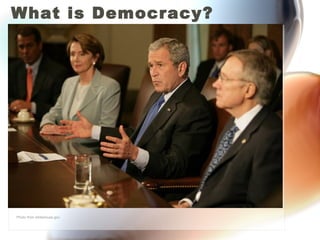
What is Democracy? Photo from whitehouse.gov
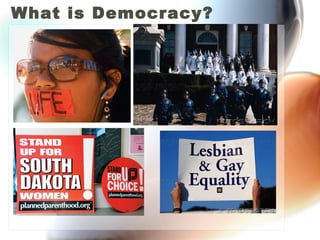
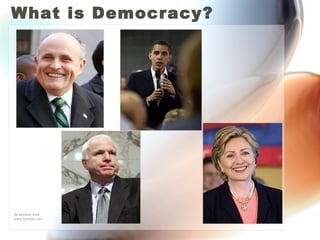
What is Democracy? All pictures from www.nytimes.com
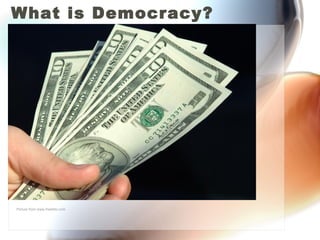
What is Democracy? Picture from www.freefoto.com
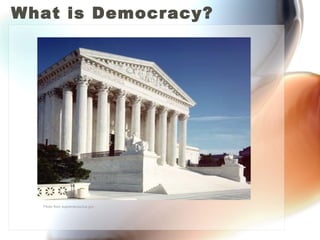
What is Democracy? Photo from supremecourtus.gov
What is Democracy? Certain basic principles are necessary in any definition of democracy. Free and fair elections Majority rule Freedom of expression Freedom of assembly and the right to protest
3 Types of Democracy Direct Democracy Aka Participatory Democracy Representative Democracy Elite Democracy Aka Revisionist Democracy
Direct Democracy δημοκρατία – demokratia Rule by the people Built on the Athenian model. Still present in US town hall meetings. Is this practical on a large scale?
Representative Democracy Delegate representation Citizens elected political actors who will represent their preferences. Assumptions: Voters are  aware. Voters are  rational. Voters are  tolerant. Voters are  informed.
Representative Democracy Problems: Tyranny of the Majority Complexity of Issues Utility of voting
Elitist Democracy The Masses are Asses
Elitist Democracy Trustee Representation Voters should select those most able to run the government and trust that they will make the best decisions. Only elites should have any real power over government policy. Most individuals are too ignorant, unaware, or apathetic to have an informed role.
Critics of Democracy Elite democracy  serves those persons possessing a disproportionate share of money or power. Marxists  perceive that government is dominated by capitalists. The  power elite  perspective holds that government is dominated by a few top leaders, most of whom are outside of government. The bureaucratic view holds that the government is dominated by appointed officials.
More optimistic theory Pluralist view  is the belief that competition among all affected interests shapes public policy. No single group dominates the political process. Competing interests often check each other.
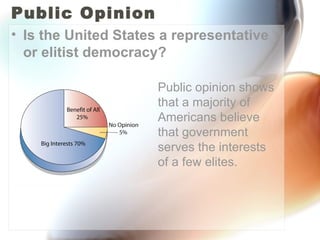
Public Opinion  Is the United States a representative or elitist democracy? Public opinion shows that a majority of Americans believe that government serves the interests of a few elites.
The American Creed In the abstract, nearly all Americans support certain fundamental principles. Freedom Political Equality Liberty Majority Rule Procedural Fairness
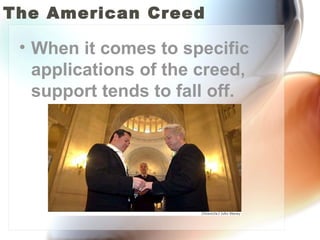
The American Creed When it comes to specific applications of the creed, support tends to fall off.
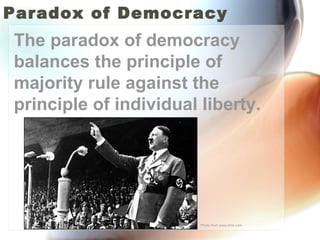
Paradox of Democracy The paradox of democracy balances the principle of majority rule against the principle of individual liberty. Photo from www.time.com

Democratic Theory

  • 1.
  • 2.
    What is Democracy?Photo from freerepublic.com
  • 3.
  • 4.
    What is Democracy?Photo from whitehouse.gov
  • 5.
    What is Democracy?All pictures from www.nytimes.com
  • 6.
    What is Democracy?Picture from www.freefoto.com
  • 7.
    What is Democracy?Photo from supremecourtus.gov
  • 8.
    What is Democracy?Certain basic principles are necessary in any definition of democracy. Free and fair elections Majority rule Freedom of expression Freedom of assembly and the right to protest
  • 9.
    3 Types ofDemocracy Direct Democracy Aka Participatory Democracy Representative Democracy Elite Democracy Aka Revisionist Democracy
  • 10.
    Direct Democracy δημοκρατία– demokratia Rule by the people Built on the Athenian model. Still present in US town hall meetings. Is this practical on a large scale?
  • 11.
    Representative Democracy Delegaterepresentation Citizens elected political actors who will represent their preferences. Assumptions: Voters are aware. Voters are rational. Voters are tolerant. Voters are informed.
  • 12.
    Representative Democracy Problems:Tyranny of the Majority Complexity of Issues Utility of voting
  • 13.
    Elitist Democracy TheMasses are Asses
  • 14.
    Elitist Democracy TrusteeRepresentation Voters should select those most able to run the government and trust that they will make the best decisions. Only elites should have any real power over government policy. Most individuals are too ignorant, unaware, or apathetic to have an informed role.
  • 15.
    Critics of DemocracyElite democracy serves those persons possessing a disproportionate share of money or power. Marxists perceive that government is dominated by capitalists. The power elite perspective holds that government is dominated by a few top leaders, most of whom are outside of government. The bureaucratic view holds that the government is dominated by appointed officials.
  • 16.
    More optimistic theoryPluralist view is the belief that competition among all affected interests shapes public policy. No single group dominates the political process. Competing interests often check each other.
  • 17.
    Public Opinion Is the United States a representative or elitist democracy? Public opinion shows that a majority of Americans believe that government serves the interests of a few elites.
  • 18.
    The American CreedIn the abstract, nearly all Americans support certain fundamental principles. Freedom Political Equality Liberty Majority Rule Procedural Fairness
  • 19.
    The American CreedWhen it comes to specific applications of the creed, support tends to fall off.
  • 20.
    Paradox of DemocracyThe paradox of democracy balances the principle of majority rule against the principle of individual liberty. Photo from www.time.com