By The Bulgarian
Team
DEMOCRATIC
INSTITUTIONS
National Assembly
Council of Ministers
Constitutional Court
President
TYPES OF DEMOCRATIC INSTITUTIONS
IN BULGARIA
 National Assembly exercises the legislative power and exercises
parliamentary control.
It is already an established practice of ministers to attend regular
meetings of the National Assembly and the parliamentary committees and
answer questions.
Deputies are not criminally liable for their opinions or votes in Parliament.
Now the National Assembly of Bulgaria has 240 members.
NATIONAL ASSEMBLY
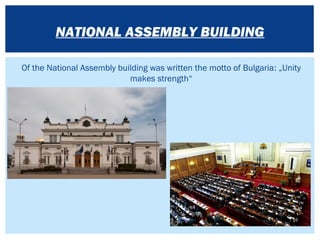
Of the National Assembly building was written the motto of Bulgaria: „Unity
makes strength“
NATIONAL ASSEMBLY BUILDING
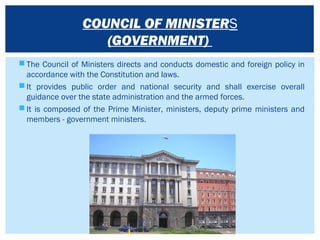
 The Council of Ministers directs and conducts domestic and foreign policy in
accordance with the Constitution and laws.
 It provides public order and national security and shall exercise overall
guidance over the state administration and the armed forces.
 It is composed of the Prime Minister, ministers, deputy prime ministers and
members - government ministers.
COUNCIL OF MINISTERS
(GOVERNMENT)
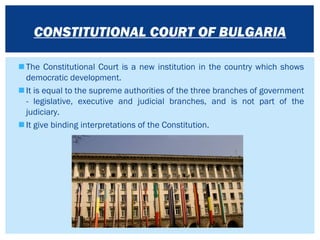
The Constitutional Court is a new institution in the country which shows
democratic development.
It is equal to the supreme authorities of the three branches of government
- legislative, executive and judicial branches, and is not part of the
judiciary.
It give binding interpretations of the Constitution.
CONSTITUTIONAL COURT OF BULGARIA
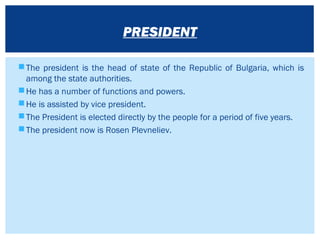
The president is the head of state of the Republic of Bulgaria, which is
among the state authorities.
He has a number of functions and powers.
He is assisted by vice president.
The President is elected directly by the people for a period of five years.
The president now is Rosen Plevneliev.
PRESIDENT
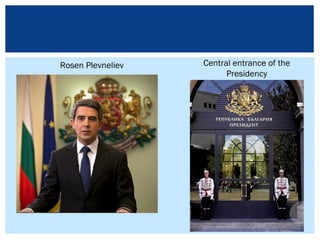
Central entrance of the
Presidency
Rosen Plevneliev
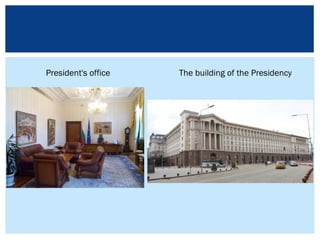
President's office The building of the Presidency
Democracy is everywhere. The school also has democracy. Teachers take
advises and make decisions. Students also express their opinion. People
are arranged in a hierarchy.
In everything there must be democracy so the people will be able to make
good and fair decisions.
Thank you for your
attention!

Democratic institutions in Bulgaria

  • 1.
  • 2.
    National Assembly Council ofMinisters Constitutional Court President TYPES OF DEMOCRATIC INSTITUTIONS IN BULGARIA
  • 3.
     National Assemblyexercises the legislative power and exercises parliamentary control. It is already an established practice of ministers to attend regular meetings of the National Assembly and the parliamentary committees and answer questions. Deputies are not criminally liable for their opinions or votes in Parliament. Now the National Assembly of Bulgaria has 240 members. NATIONAL ASSEMBLY
  • 4.
    Of the NationalAssembly building was written the motto of Bulgaria: „Unity makes strength“ NATIONAL ASSEMBLY BUILDING
  • 5.
     The Councilof Ministers directs and conducts domestic and foreign policy in accordance with the Constitution and laws.  It provides public order and national security and shall exercise overall guidance over the state administration and the armed forces.  It is composed of the Prime Minister, ministers, deputy prime ministers and members - government ministers. COUNCIL OF MINISTERS (GOVERNMENT)
  • 6.
    The Constitutional Courtis a new institution in the country which shows democratic development. It is equal to the supreme authorities of the three branches of government - legislative, executive and judicial branches, and is not part of the judiciary. It give binding interpretations of the Constitution. CONSTITUTIONAL COURT OF BULGARIA
  • 7.
    The president isthe head of state of the Republic of Bulgaria, which is among the state authorities. He has a number of functions and powers. He is assisted by vice president. The President is elected directly by the people for a period of five years. The president now is Rosen Plevneliev. PRESIDENT
  • 8.
    Central entrance ofthe Presidency Rosen Plevneliev
  • 9.
    President's office Thebuilding of the Presidency
  • 10.
    Democracy is everywhere.The school also has democracy. Teachers take advises and make decisions. Students also express their opinion. People are arranged in a hierarchy. In everything there must be democracy so the people will be able to make good and fair decisions.
  • 11.
    Thank you foryour attention!