BULGARIA
TYPE OF STATE AND REGIME
• Government Name: Republic of Bulgaria
• Chief of State: President ROSEN Plevneliev
• Head of Government: Prime Minister Boyko Borisov
• Constitution: The Constitution of the Republic of Bulgaria is the supreme and basic law of
the Republic of Bulgaria.The current constitution was adopted on 12 July 1991 by the 7th
Grand NationalAssembly of Bulgaria, and defines the country as a unitary parliamentary
republic.
• It has been amended five times in 2003 , 2005 , 2006 , 2007 and 2015 .
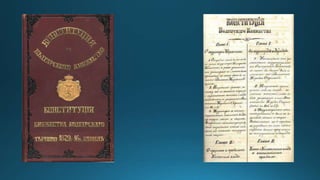
• The first Constitution of Bulgaria, was in theTarnovo , 1879 .
• In July 1991 the National Assembly adopted a
new constitution establishing a
parliamentary government and guaranteeing
direct presidential elections , separation of
powers, and freedom of speech, press,
conscience, and religion .
Constitutional framework
•Under the terms of the 1991 constitution, Bulgaria is
a parliamentary republic, i.e., the prime minister is
elected by the majority party (or coalition of parties)
in the National Assembly (parliament) .
•The president, who is elected for a five-year term, is
the head of state.The president schedules national
referenda and elections for the National Assembly,
serves diplomatic and other functions, and
promulgates and can veto laws.
•The National Assembly, a unicameral, representative
body composed of 240 members, constitutes the
legislative branch of the government. It passes and
amends laws, ratifies treaties, levies taxes, and retains
the power to pass a motion of no confidence in the
Council of Ministers or the prime minister, thereby
compelling the resignation of the council. Members of
the National Assembly serve four-year terms.
LOCAL GOVERNMENT
•Township councils embody state power at the local
government level.The members of the township
councils are elected by the inhabitants of the
township to four-year terms.
•The court system consists of the Supreme Court of
Cassation, the Supreme Administrative Court, local
courts, courts of appeal, and military courts.
•The High Judicial Council, consisting of 25 members,
appoints judges, prosecutors, and investigators.The
members of this council are appointed by the
National Assembly and judicial authorities
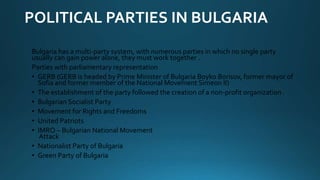
POLITICAL PARTIES IN BULGARIA
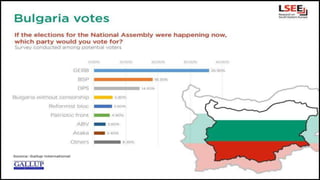
Bulgaria has a multi-party system, with numerous parties in which no single party
usually can gain power alone, they must work together .
Parties with parliamentary representation
• GERB (GERB is headed by Prime Minister of Bulgaria Boyko Borisov, former mayor of
Sofia and former member of the National Movement Simeon II)
• The establishment of the party followed the creation of a non-profit organization .
• Bulgarian Socialist Party
• Movement for Rights and Freedoms
• United Patriots
• IMRO – Bulgarian National Movement
Attack
• Nationalist Party of Bulgaria
• Green Party of Bulgaria
Source of information
• Bulgaria's First Non-Communist Government Gains Power. (n.d.). Retrieved November 01, 2016,
from http://www.infoplease.com/country/bulgaria.html
• Detrez, Raymond. Historical Dictionary of Bulgaria. 2nd ed. Lanham, Md.: Scarecrow, 2006.
• Otfinoski, Steven. Bulgaria. 2nd ed. NewYork: Facts On File, 2004.
• EU-pledged extra border protection(published on 9/19/16 1:39 PM ) Retrieved November 01, 2016,
from http://bnr.bg/en/post/100738613/eu-pledged-extra-border-protection-support-implies-greater-
responsibility-for-bulgaria
• Bulgaria Political parties and leaders Retrieved November 01, 2016,
http://www.indexmundi.com/bulgaria/political_parties_and_leaders.html

Bulgaria

  • 1.
  • 6.
    TYPE OF STATEAND REGIME • Government Name: Republic of Bulgaria • Chief of State: President ROSEN Plevneliev • Head of Government: Prime Minister Boyko Borisov • Constitution: The Constitution of the Republic of Bulgaria is the supreme and basic law of the Republic of Bulgaria.The current constitution was adopted on 12 July 1991 by the 7th Grand NationalAssembly of Bulgaria, and defines the country as a unitary parliamentary republic. • It has been amended five times in 2003 , 2005 , 2006 , 2007 and 2015 . • The first Constitution of Bulgaria, was in theTarnovo , 1879 .
  • 8.
    • In July1991 the National Assembly adopted a new constitution establishing a parliamentary government and guaranteeing direct presidential elections , separation of powers, and freedom of speech, press, conscience, and religion . Constitutional framework
  • 9.
    •Under the termsof the 1991 constitution, Bulgaria is a parliamentary republic, i.e., the prime minister is elected by the majority party (or coalition of parties) in the National Assembly (parliament) . •The president, who is elected for a five-year term, is the head of state.The president schedules national referenda and elections for the National Assembly, serves diplomatic and other functions, and promulgates and can veto laws.
  • 10.
    •The National Assembly,a unicameral, representative body composed of 240 members, constitutes the legislative branch of the government. It passes and amends laws, ratifies treaties, levies taxes, and retains the power to pass a motion of no confidence in the Council of Ministers or the prime minister, thereby compelling the resignation of the council. Members of the National Assembly serve four-year terms.
  • 11.
    LOCAL GOVERNMENT •Township councilsembody state power at the local government level.The members of the township councils are elected by the inhabitants of the township to four-year terms.
  • 12.
    •The court systemconsists of the Supreme Court of Cassation, the Supreme Administrative Court, local courts, courts of appeal, and military courts. •The High Judicial Council, consisting of 25 members, appoints judges, prosecutors, and investigators.The members of this council are appointed by the National Assembly and judicial authorities
  • 13.
    POLITICAL PARTIES INBULGARIA Bulgaria has a multi-party system, with numerous parties in which no single party usually can gain power alone, they must work together . Parties with parliamentary representation • GERB (GERB is headed by Prime Minister of Bulgaria Boyko Borisov, former mayor of Sofia and former member of the National Movement Simeon II) • The establishment of the party followed the creation of a non-profit organization . • Bulgarian Socialist Party • Movement for Rights and Freedoms • United Patriots • IMRO – Bulgarian National Movement Attack • Nationalist Party of Bulgaria • Green Party of Bulgaria
  • 19.
    Source of information •Bulgaria's First Non-Communist Government Gains Power. (n.d.). Retrieved November 01, 2016, from http://www.infoplease.com/country/bulgaria.html • Detrez, Raymond. Historical Dictionary of Bulgaria. 2nd ed. Lanham, Md.: Scarecrow, 2006. • Otfinoski, Steven. Bulgaria. 2nd ed. NewYork: Facts On File, 2004. • EU-pledged extra border protection(published on 9/19/16 1:39 PM ) Retrieved November 01, 2016, from http://bnr.bg/en/post/100738613/eu-pledged-extra-border-protection-support-implies-greater- responsibility-for-bulgaria • Bulgaria Political parties and leaders Retrieved November 01, 2016, http://www.indexmundi.com/bulgaria/political_parties_and_leaders.html