www.aua.ac.uk inspiring professional higher education
A Toolkit for New Professionals
Catherine Lillie and Nicola Owen
Manchester, Friday 27 June 2014
www.aua.ac.uk inspiring professional higher education
Welcome and Introductions
By the end of the day you will be able to:
• Understand a range of approaches to workload planning, time
management and prioritisation
• Consider how to use resources and solve problems effectively
• Have a greater understanding of how to work well with others
• Have an appreciation of communication skills
• Know how to identify your own competencies and confidence
in a range of professional behaviours
• Adopt a planned approach to career development
• Share best practice and learn from the experiences of others
• Take a range of tools and techniques back to the workplace
www.aua.ac.uk inspiring professional higher education
Introductions
• Who you are
• What you do and where
• Two images-
1. how you feel right now
2. where you’d like to be by the end of the day
www.aua.ac.uk inspiring professional higher education
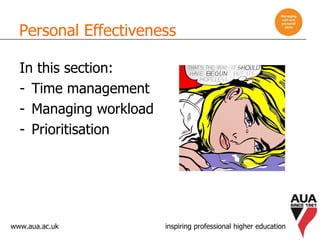
Personal Effectiveness
In this section:
- Time management
- Managing workload
- Prioritisation
www.aua.ac.uk inspiring professional higher education
Time management
Wasters and drains
Top tips
www.aua.ac.uk inspiring professional higher education
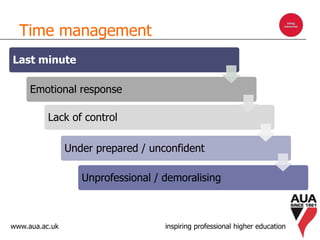
Time management
Last minute
Emotional response
Lack of control
Under prepared / unconfident
Unprofessional / demoralising
www.aua.ac.uk inspiring professional higher education
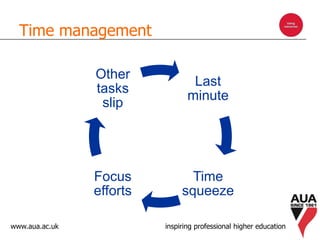
Time management
Last
minute
Time
squeeze
Focus
efforts
Other
tasks
slip
www.aua.ac.uk inspiring professional higher education
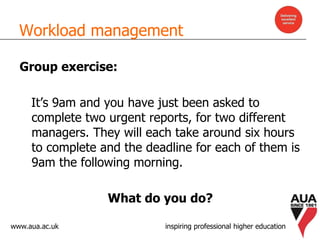
Workload management
Group exercise:
It’s 9am and you have just been asked to
complete two urgent reports, for two different
managers. They will each take around six hours
to complete and the deadline for each of them is
9am the following morning.
What do you do?
www.aua.ac.uk inspiring professional higher education
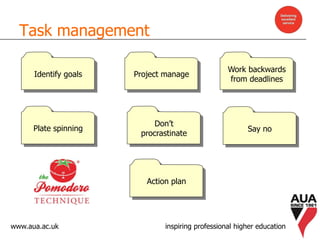
Task management
Identify goals Project manage
Work backwards
from deadlines
Plate spinning
Action plan
Say no
Don’t
procrastinate
www.aua.ac.uk inspiring professional higher education
Prioritisation
Exercise: In Trays
www.aua.ac.uk inspiring professional higher education
Refreshment break!
www.aua.ac.uk inspiring professional higher education
Role Effectiveness
In this section:
- Creative problem solving
- Lateral thinking
- Using resources
www.aua.ac.uk inspiring professional higher education
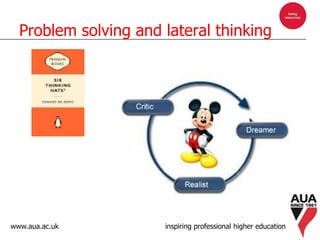
Problem solving and lateral thinking
www.aua.ac.uk inspiring professional higher education
Problem solving
EXERCISE:
communication break-down
www.aua.ac.uk inspiring professional higher education
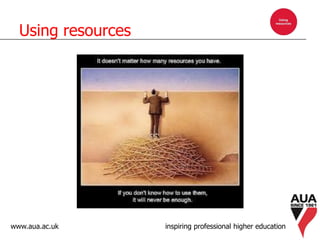
Using resources
www.aua.ac.uk inspiring professional higher education
Lunch!
www.aua.ac.uk inspiring professional higher education
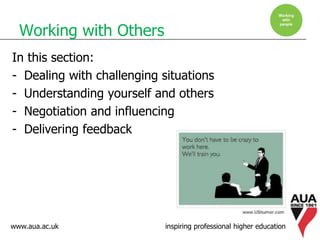
Working with Others
In this section:
- Dealing with challenging situations
- Understanding yourself and others
- Negotiation and influencing
- Delivering feedback
www.aua.ac.uk inspiring professional higher education
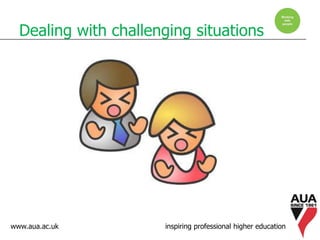
Dealing with challenging situations
“It’s my tag”
www.aua.ac.uk inspiring professional higher education
Dealing with challenging situations
www.aua.ac.uk inspiring professional higher education
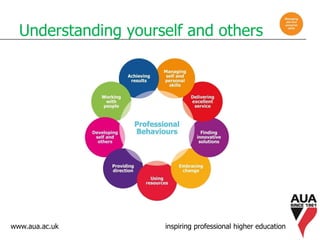
Understanding yourself and others
www.aua.ac.uk inspiring professional higher education
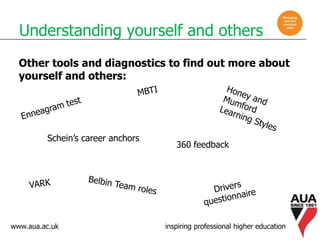
Understanding yourself and others
Other tools and diagnostics to find out more about
yourself and others:
Schein’s career anchors
360 feedback
www.aua.ac.uk inspiring professional higher education
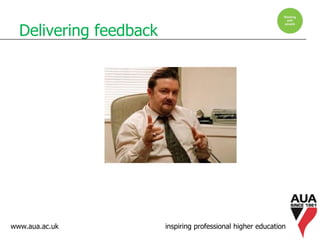
Delivering feedback
www.aua.ac.uk inspiring professional higher education
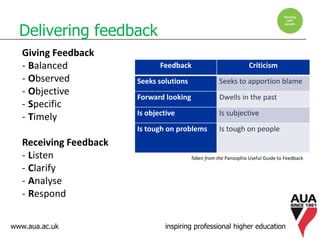
Delivering feedback
Feedback Criticism
Seeks solutions Seeks to apportion blame
Forward looking Dwells in the past
Is objective Is subjective
Is tough on problems Is tough on people
Giving Feedback
- Balanced
- Observed
- Objective
- Specific
- Timely
Receiving Feedback
- Listen
- Clarify
- Analyse
- Respond
Taken from the Pansophix Useful Guide to Feedback
www.aua.ac.uk inspiring professional higher education
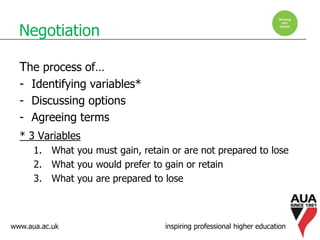
Negotiation
The process of…
- Identifying variables*
- Discussing options
- Agreeing terms
* 3 Variables
1. What you must gain, retain or are not prepared to lose
2. What you would prefer to gain or retain
3. What you are prepared to lose
www.aua.ac.uk inspiring professional higher education
Influencing
www.aua.ac.uk inspiring professional higher education
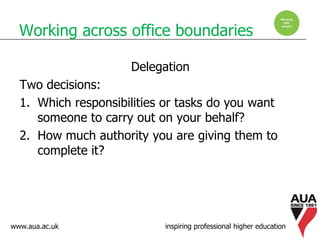
Working across office boundaries
Delegation
Two decisions:
1. Which responsibilities or tasks do you want
someone to carry out on your behalf?
2. How much authority you are giving them to
complete it?
www.aua.ac.uk inspiring professional higher education
Working across office boundaries
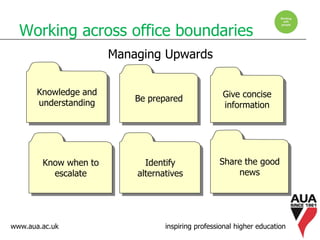
Managing Upwards
Knowledge and
understanding Be prepared Give concise
information
Know when to
escalate
Share the good
news
Identify
alternatives
www.aua.ac.uk inspiring professional higher education
Good Communication
In this section:
- Professional writing
- Using meetings
- Getting your message across verbally
- Effective Powerpoint
www.aua.ac.uk inspiring professional higher education
Professional Writing
www.aua.ac.uk inspiring professional higher education
Using meetings
www.aua.ac.uk inspiring professional higher education
Verbal communication
www.aua.ac.uk inspiring professional higher education
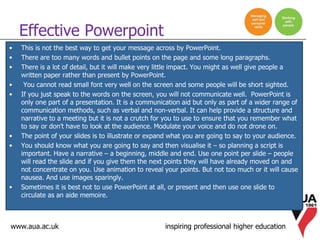
• This is not the best way to get your message across by PowerPoint.
• There are too many words and bullet points on the page and some long paragraphs.
• There is a lot of detail, but it will make very little impact. You might as well give people a
written paper rather than present by PowerPoint.
• You cannot read small font very well on the screen and some people will be short sighted.
• If you just speak to the words on the screen, you will not communicate well. PowerPoint is
only one part of a presentation. It is a communication aid but only as part of a wider range of
communication methods, such as verbal and non-verbal. It can help provide a structure and
narrative to a meeting but it is not a crutch for you to use to ensure that you remember what
to say or don’t have to look at the audience. Modulate your voice and do not drone on.
• The point of your slides is to illustrate or expand what you are going to say to your audience.
• You should know what you are going to say and then visualise it – so planning a script is
important. Have a narrative – a beginning, middle and end. Use one point per slide – people
will read the slide and if you give them the next points they will have already moved on and
not concentrate on you. Use animation to reveal your points. But not too much or it will cause
nausea. And use images sparingly.
• Sometimes it is best not to use PowerPoint at all, or present and then use one slide to
circulate as an aide memoire.
Effective Powerpoint
www.aua.ac.uk inspiring professional higher education
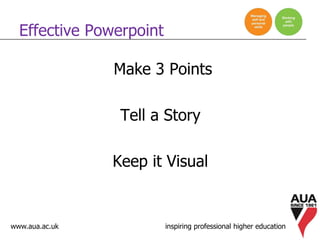
Effective Powerpoint
Make 3 Points
Tell a Story
Keep it Visual
www.aua.ac.uk inspiring professional higher education
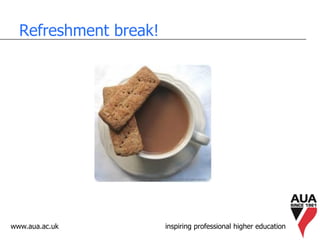
Refreshment break!
www.aua.ac.uk inspiring professional higher education
Career Planning and Development
In this section:
- Careers in HE
- Career planning and recording
development
- Using the AUA Accredited Membership
Framework
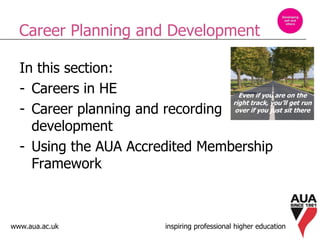
Even if you are on the
right track, you’ll get run
over if you just sit there
www.aua.ac.uk inspiring professional higher education
Career Planning and Development
Career (n): one’s advancement through
life, especially in a profession
Career (v): to move or swerve about
wildly
www.aua.ac.uk inspiring professional higher education
Careers in HE
Did you intend to build a career in HE or
was it an ‘accident’?
Was your current role a planned and
managed career move?
www.aua.ac.uk inspiring professional higher education
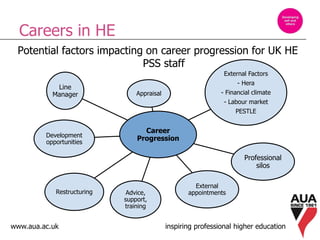
Careers in HE
Potential factors impacting on career progression for UK HE
PSS staff
Career
Progression
Appraisal
External Factors
- Hera
- Financial climate
- Labour market
PESTLE
Professional
silos
External
appointmentsAdvice,
support,
training
Restructuring
Development
opportunities
Line
Manager
www.aua.ac.uk inspiring professional higher education
Career Planning
Visualisation Exercise
Spend two minutes imagining you could design
your perfect job description- with its own pay
structure, working hours and conditions and job
elements. Note down your ideas.
What would you do in your career? What
elements of your current role would you keep, lose
or change?
www.aua.ac.uk inspiring professional higher education
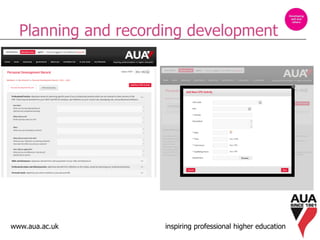
Planning and recording development
www.aua.ac.uk inspiring professional higher education
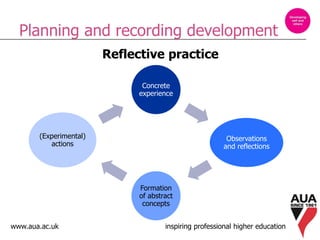
Planning and recording development
Reflective practice
Concrete
experience
Observations
and reflections
Formation
of abstract
concepts
(Experimental)
actions
www.aua.ac.uk inspiring professional higher education
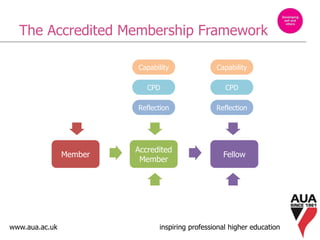
The Accredited Membership Framework
CPD
Capability
Reflection
CPD
Capability
Reflection
Accredited
Member
Member Fellow
www.aua.ac.uk inspiring professional higher education
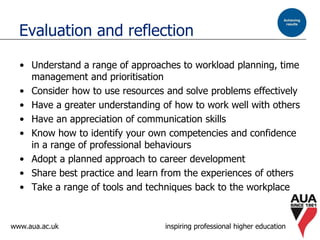
Evaluation and reflection
• Understand a range of approaches to workload planning, time
management and prioritisation
• Consider how to use resources and solve problems effectively
• Have a greater understanding of how to work well with others
• Have an appreciation of communication skills
• Know how to identify your own competencies and confidence
in a range of professional behaviours
• Adopt a planned approach to career development
• Share best practice and learn from the experiences of others
• Take a range of tools and techniques back to the workplace
www.aua.ac.uk inspiring professional higher education
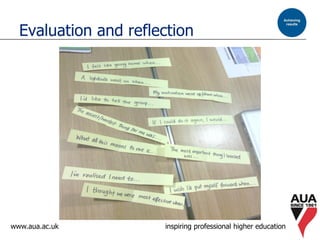
Evaluation and reflection
www.aua.ac.uk inspiring professional higher education
More information at www.aua.ac.uk
Email: aua@aua.ac.uk
Call: 0161 275 2063
Association of University Administrators (AUA)
@The_AUA

A Toolkit for New Professionals (June 2014)

  • 1.
    www.aua.ac.uk inspiring professionalhigher education A Toolkit for New Professionals Catherine Lillie and Nicola Owen Manchester, Friday 27 June 2014
  • 2.
    www.aua.ac.uk inspiring professionalhigher education Welcome and Introductions By the end of the day you will be able to: • Understand a range of approaches to workload planning, time management and prioritisation • Consider how to use resources and solve problems effectively • Have a greater understanding of how to work well with others • Have an appreciation of communication skills • Know how to identify your own competencies and confidence in a range of professional behaviours • Adopt a planned approach to career development • Share best practice and learn from the experiences of others • Take a range of tools and techniques back to the workplace
  • 3.
    www.aua.ac.uk inspiring professionalhigher education Introductions • Who you are • What you do and where • Two images- 1. how you feel right now 2. where you’d like to be by the end of the day
  • 4.
    www.aua.ac.uk inspiring professionalhigher education Personal Effectiveness In this section: - Time management - Managing workload - Prioritisation
  • 5.
    www.aua.ac.uk inspiring professionalhigher education Time management Wasters and drains Top tips
  • 6.
    www.aua.ac.uk inspiring professionalhigher education Time management Last minute Emotional response Lack of control Under prepared / unconfident Unprofessional / demoralising
  • 7.
    www.aua.ac.uk inspiring professionalhigher education Time management Last minute Time squeeze Focus efforts Other tasks slip
  • 8.
    www.aua.ac.uk inspiring professionalhigher education Workload management Group exercise: It’s 9am and you have just been asked to complete two urgent reports, for two different managers. They will each take around six hours to complete and the deadline for each of them is 9am the following morning. What do you do?
  • 9.
    www.aua.ac.uk inspiring professionalhigher education Task management Identify goals Project manage Work backwards from deadlines Plate spinning Action plan Say no Don’t procrastinate
  • 10.
    www.aua.ac.uk inspiring professionalhigher education Prioritisation Exercise: In Trays
  • 11.
    www.aua.ac.uk inspiring professionalhigher education Refreshment break!
  • 12.
    www.aua.ac.uk inspiring professionalhigher education Role Effectiveness In this section: - Creative problem solving - Lateral thinking - Using resources
  • 13.
    www.aua.ac.uk inspiring professionalhigher education Problem solving and lateral thinking
  • 14.
    www.aua.ac.uk inspiring professionalhigher education Problem solving EXERCISE: communication break-down
  • 15.
    www.aua.ac.uk inspiring professionalhigher education Using resources
  • 16.
    www.aua.ac.uk inspiring professionalhigher education Lunch!
  • 17.
    www.aua.ac.uk inspiring professionalhigher education Working with Others In this section: - Dealing with challenging situations - Understanding yourself and others - Negotiation and influencing - Delivering feedback
  • 18.
    www.aua.ac.uk inspiring professionalhigher education Dealing with challenging situations “It’s my tag”
  • 19.
    www.aua.ac.uk inspiring professionalhigher education Dealing with challenging situations
  • 20.
    www.aua.ac.uk inspiring professionalhigher education Understanding yourself and others
  • 21.
    www.aua.ac.uk inspiring professionalhigher education Understanding yourself and others Other tools and diagnostics to find out more about yourself and others: Schein’s career anchors 360 feedback
  • 22.
    www.aua.ac.uk inspiring professionalhigher education Delivering feedback
  • 23.
    www.aua.ac.uk inspiring professionalhigher education Delivering feedback Feedback Criticism Seeks solutions Seeks to apportion blame Forward looking Dwells in the past Is objective Is subjective Is tough on problems Is tough on people Giving Feedback - Balanced - Observed - Objective - Specific - Timely Receiving Feedback - Listen - Clarify - Analyse - Respond Taken from the Pansophix Useful Guide to Feedback
  • 24.
    www.aua.ac.uk inspiring professionalhigher education Negotiation The process of… - Identifying variables* - Discussing options - Agreeing terms * 3 Variables 1. What you must gain, retain or are not prepared to lose 2. What you would prefer to gain or retain 3. What you are prepared to lose
  • 25.
    www.aua.ac.uk inspiring professionalhigher education Influencing
  • 26.
    www.aua.ac.uk inspiring professionalhigher education Working across office boundaries Delegation Two decisions: 1. Which responsibilities or tasks do you want someone to carry out on your behalf? 2. How much authority you are giving them to complete it?
  • 27.
    www.aua.ac.uk inspiring professionalhigher education Working across office boundaries Managing Upwards Knowledge and understanding Be prepared Give concise information Know when to escalate Share the good news Identify alternatives
  • 28.
    www.aua.ac.uk inspiring professionalhigher education Good Communication In this section: - Professional writing - Using meetings - Getting your message across verbally - Effective Powerpoint
  • 29.
    www.aua.ac.uk inspiring professionalhigher education Professional Writing
  • 30.
    www.aua.ac.uk inspiring professionalhigher education Using meetings
  • 31.
    www.aua.ac.uk inspiring professionalhigher education Verbal communication
  • 32.
    www.aua.ac.uk inspiring professionalhigher education • This is not the best way to get your message across by PowerPoint. • There are too many words and bullet points on the page and some long paragraphs. • There is a lot of detail, but it will make very little impact. You might as well give people a written paper rather than present by PowerPoint. • You cannot read small font very well on the screen and some people will be short sighted. • If you just speak to the words on the screen, you will not communicate well. PowerPoint is only one part of a presentation. It is a communication aid but only as part of a wider range of communication methods, such as verbal and non-verbal. It can help provide a structure and narrative to a meeting but it is not a crutch for you to use to ensure that you remember what to say or don’t have to look at the audience. Modulate your voice and do not drone on. • The point of your slides is to illustrate or expand what you are going to say to your audience. • You should know what you are going to say and then visualise it – so planning a script is important. Have a narrative – a beginning, middle and end. Use one point per slide – people will read the slide and if you give them the next points they will have already moved on and not concentrate on you. Use animation to reveal your points. But not too much or it will cause nausea. And use images sparingly. • Sometimes it is best not to use PowerPoint at all, or present and then use one slide to circulate as an aide memoire. Effective Powerpoint
  • 33.
    www.aua.ac.uk inspiring professionalhigher education Effective Powerpoint Make 3 Points Tell a Story Keep it Visual
  • 34.
    www.aua.ac.uk inspiring professionalhigher education Refreshment break!
  • 35.
    www.aua.ac.uk inspiring professionalhigher education Career Planning and Development In this section: - Careers in HE - Career planning and recording development - Using the AUA Accredited Membership Framework Even if you are on the right track, you’ll get run over if you just sit there
  • 36.
    www.aua.ac.uk inspiring professionalhigher education Career Planning and Development Career (n): one’s advancement through life, especially in a profession Career (v): to move or swerve about wildly
  • 37.
    www.aua.ac.uk inspiring professionalhigher education Careers in HE Did you intend to build a career in HE or was it an ‘accident’? Was your current role a planned and managed career move?
  • 38.
    www.aua.ac.uk inspiring professionalhigher education Careers in HE Potential factors impacting on career progression for UK HE PSS staff Career Progression Appraisal External Factors - Hera - Financial climate - Labour market PESTLE Professional silos External appointmentsAdvice, support, training Restructuring Development opportunities Line Manager
  • 39.
    www.aua.ac.uk inspiring professionalhigher education Career Planning Visualisation Exercise Spend two minutes imagining you could design your perfect job description- with its own pay structure, working hours and conditions and job elements. Note down your ideas. What would you do in your career? What elements of your current role would you keep, lose or change?
  • 40.
    www.aua.ac.uk inspiring professionalhigher education Planning and recording development
  • 41.
    www.aua.ac.uk inspiring professionalhigher education Planning and recording development Reflective practice Concrete experience Observations and reflections Formation of abstract concepts (Experimental) actions
  • 42.
    www.aua.ac.uk inspiring professionalhigher education The Accredited Membership Framework CPD Capability Reflection CPD Capability Reflection Accredited Member Member Fellow
  • 43.
    www.aua.ac.uk inspiring professionalhigher education Evaluation and reflection • Understand a range of approaches to workload planning, time management and prioritisation • Consider how to use resources and solve problems effectively • Have a greater understanding of how to work well with others • Have an appreciation of communication skills • Know how to identify your own competencies and confidence in a range of professional behaviours • Adopt a planned approach to career development • Share best practice and learn from the experiences of others • Take a range of tools and techniques back to the workplace
  • 44.
    www.aua.ac.uk inspiring professionalhigher education Evaluation and reflection
  • 45.
    www.aua.ac.uk inspiring professionalhigher education More information at www.aua.ac.uk Email: aua@aua.ac.uk Call: 0161 275 2063 Association of University Administrators (AUA) @The_AUA