Coaching and
communication
techniques
Apply coaching techniques to assist
learners
The creation of personalisation
of learning activities where
immediate interaction and
feedback is provided
Showing an individual how to
perform a task via on the job
instruction on a one to one
basis
Providing encouragement with
a commitment to action aimed
at achieving a particular level
of performance
Asking questions Goal setting and assessment
Providing positive and non-
judgemental support
Factors to
consider
when
coaching
New skills
New techniques to replace old ways
Safer techniques
New employees
Existing employees
Management
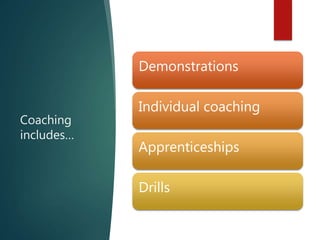
Coaching
includes…
Demonstrations
Individual coaching
Apprenticeships
Drills
USE COMMUNICATION SKILLS
TO PROVIDE INFORMATION,
INSTRUCT LEARNERS AND
DEMONSTRATE RELEVANT
WORK SKILLS
Stages of instruction and
demonstration
Stage
Stage 1 Instructor/trainer provides verbal instructions that are followed by silent
demonstration to show how the work should be accomplished
Stage 2 Expert demonstration is repeated but in this stage is carried out with breaks
and commentary to emphasise the significance of each instruction in relation
to the task being undertaken
Stage 3 Learner attempts the work skill task under the supervision and observation of
the trainer/instructor
Stage 4 Trainer/instructor provides detailed feedback to the learner about their
performance task/skill. The feedback should have a composition of 50:30:20
where 50 percent focuses on positive affirmation, 30% on where the learner
can improve and 20% should focus on encouragement to motivate the learner
to keep striving to improve
Stage 5 The learner repeats their performance from stage 3. Trainer, if possible, should
provide as much opportunities for the learner as possible to practice the work
skill till the trainee is comfortable
Stage 6 Final feedback by the trainer/instructor is followed by documentation of the
outcomes of the instruction as per the learning plan
Provide opportunities for
practice during instruction
and through work activities
 Trainer demonstrates a skill or how to
perform a task to the learners
 Learners carry out the task slowly by
imitating what they have observed while
being supervised by their learners
 The learners are coached through the
steps to ensure they are performing them
correctly and are given the opportunity to
refine their skills through self-reflection
and feedback
 Learners are given the opportunity to
practice on their own.
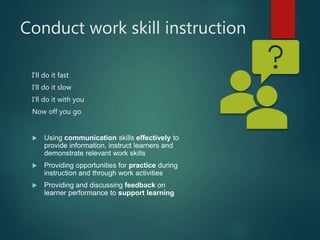
Conduct work skill instruction
I’ll do it fast
I’ll do it slow
I’ll do it with you
Now off you go
 Using communication skills effectively to
provide information, instruct learners and
demonstrate relevant work skills
 Providing opportunities for practice during
instruction and through work activities
 Providing and discussing feedback on
learner performance to support learning

Coaching and communication techniques

  • 1.
  • 2.
    Apply coaching techniquesto assist learners The creation of personalisation of learning activities where immediate interaction and feedback is provided Showing an individual how to perform a task via on the job instruction on a one to one basis Providing encouragement with a commitment to action aimed at achieving a particular level of performance Asking questions Goal setting and assessment Providing positive and non- judgemental support
  • 3.
    Factors to consider when coaching New skills Newtechniques to replace old ways Safer techniques New employees Existing employees Management
  • 4.
  • 5.
    USE COMMUNICATION SKILLS TOPROVIDE INFORMATION, INSTRUCT LEARNERS AND DEMONSTRATE RELEVANT WORK SKILLS
  • 6.
    Stages of instructionand demonstration Stage Stage 1 Instructor/trainer provides verbal instructions that are followed by silent demonstration to show how the work should be accomplished Stage 2 Expert demonstration is repeated but in this stage is carried out with breaks and commentary to emphasise the significance of each instruction in relation to the task being undertaken Stage 3 Learner attempts the work skill task under the supervision and observation of the trainer/instructor Stage 4 Trainer/instructor provides detailed feedback to the learner about their performance task/skill. The feedback should have a composition of 50:30:20 where 50 percent focuses on positive affirmation, 30% on where the learner can improve and 20% should focus on encouragement to motivate the learner to keep striving to improve Stage 5 The learner repeats their performance from stage 3. Trainer, if possible, should provide as much opportunities for the learner as possible to practice the work skill till the trainee is comfortable Stage 6 Final feedback by the trainer/instructor is followed by documentation of the outcomes of the instruction as per the learning plan
  • 7.
    Provide opportunities for practiceduring instruction and through work activities  Trainer demonstrates a skill or how to perform a task to the learners  Learners carry out the task slowly by imitating what they have observed while being supervised by their learners  The learners are coached through the steps to ensure they are performing them correctly and are given the opportunity to refine their skills through self-reflection and feedback  Learners are given the opportunity to practice on their own.
  • 8.
    Conduct work skillinstruction I’ll do it fast I’ll do it slow I’ll do it with you Now off you go  Using communication skills effectively to provide information, instruct learners and demonstrate relevant work skills  Providing opportunities for practice during instruction and through work activities  Providing and discussing feedback on learner performance to support learning