PM/RM Concept in Bertrand
Model
Algorithm – Project 1
Kavi Pandya
Roll- 131020
SEM-5
04-09-2015
Understanding Bertrand
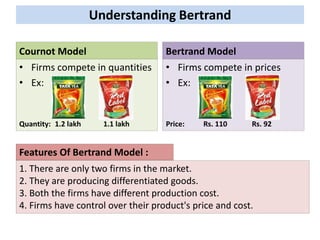
Cournot Model
• Firms compete in quantities
• Ex:
Bertrand Model
• Firms compete in prices
• Ex:
Quantity: 1.2 lakh 1.1 lakh Price: Rs. 110 Rs. 92
Features Of Bertrand Model :
1. There are only two firms in the market.
2. They are producing differentiated goods.
3. Both the firms have different production cost.
4. Firms have control over their product's price and cost.
PM/RM in Bertrand
Equations:
Production Level(xi) for two firms are:
1st firm : x1 = a - b1*p1 + b2*p2
2nd firm : x2 = a - b1*p2 + b2*p1
Utility(Ui) of firms:
PM : Ui = (pi - ci)*xi
RM : Ui = pi*xi
pi = Price,
ci = Production Cost
bi = +ve constants
LEMMA’s :
4. If both the firms are in PM, then
If the Higher-price firm switches to RM then the lower-price firm should also switch
to RM.
1. If a firm switches from RM to PM then its price increases
2. If a firm switches from PM to RM then it is in capacity to reduce its price to
certain extent and the minimum price is given by:
p1rm = [(a + b2*p2)/(2*b1)] - [(( ((a + b2*p2)/b1)^2 - 4*(p1pm - c1pm)(a -
b1*p1pm + b2*p2)/b1 )^1/2)/2]
3. If both the firms are in RM, then
(i). If lower-price firm switches to PM then the higher-price firm should stick to RM
(ii). If higher-price firm switches to PM then the lower-price firm should also switch
to PM.
Cost Delegation Game in Bertrand
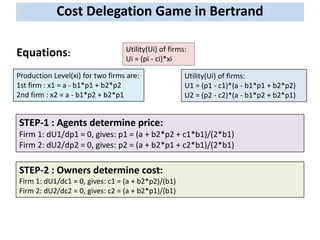
STEP-1 : Agents determine price:
Firm 1: dU1/dp1 = 0, gives: p1 = (a + b2*p2 + c1*b1)/(2*b1)
Firm 2: dU2/dp2 = 0, gives: p2 = (a + b2*p1 + c2*b1)/(2*b1)
STEP-2 : Owners determine cost:
Firm 1: dU1/dc1 = 0, gives: c1 = (a + b2*p2)/(b1)
Firm 2: dU2/dc2 = 0, gives: c2 = (a + b2*p1)/(b1)
Equations: Utility(Ui) of firms:
Ui = (pi - ci)*xi
Production Level(xi) for two firms are:
1st firm : x1 = a - b1*p1 + b2*p2
2nd firm : x2 = a - b1*p2 + b2*p1
Utility(Ui) of firms:
U1 = (p1 - c1)*(a - b1*p1 + b2*p2)
U2 = (p2 - c2)*(a - b1*p2 + b2*p1)
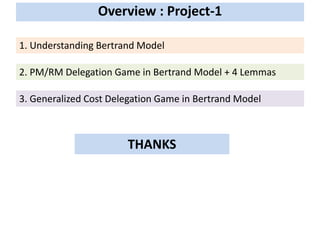
Overview : Project-1
1. Understanding Bertrand Model
2. PM/RM Delegation Game in Bertrand Model + 4 Lemmas
3. Generalized Cost Delegation Game in Bertrand Model
THANKS

Delegation Game in Bertrand Competition

  • 1.
    PM/RM Concept inBertrand Model Algorithm – Project 1 Kavi Pandya Roll- 131020 SEM-5 04-09-2015
  • 2.
    Understanding Bertrand Cournot Model •Firms compete in quantities • Ex: Bertrand Model • Firms compete in prices • Ex: Quantity: 1.2 lakh 1.1 lakh Price: Rs. 110 Rs. 92 Features Of Bertrand Model : 1. There are only two firms in the market. 2. They are producing differentiated goods. 3. Both the firms have different production cost. 4. Firms have control over their product's price and cost.
  • 3.
    PM/RM in Bertrand Equations: ProductionLevel(xi) for two firms are: 1st firm : x1 = a - b1*p1 + b2*p2 2nd firm : x2 = a - b1*p2 + b2*p1 Utility(Ui) of firms: PM : Ui = (pi - ci)*xi RM : Ui = pi*xi pi = Price, ci = Production Cost bi = +ve constants LEMMA’s : 4. If both the firms are in PM, then If the Higher-price firm switches to RM then the lower-price firm should also switch to RM. 1. If a firm switches from RM to PM then its price increases 2. If a firm switches from PM to RM then it is in capacity to reduce its price to certain extent and the minimum price is given by: p1rm = [(a + b2*p2)/(2*b1)] - [(( ((a + b2*p2)/b1)^2 - 4*(p1pm - c1pm)(a - b1*p1pm + b2*p2)/b1 )^1/2)/2] 3. If both the firms are in RM, then (i). If lower-price firm switches to PM then the higher-price firm should stick to RM (ii). If higher-price firm switches to PM then the lower-price firm should also switch to PM.
  • 4.
    Cost Delegation Gamein Bertrand STEP-1 : Agents determine price: Firm 1: dU1/dp1 = 0, gives: p1 = (a + b2*p2 + c1*b1)/(2*b1) Firm 2: dU2/dp2 = 0, gives: p2 = (a + b2*p1 + c2*b1)/(2*b1) STEP-2 : Owners determine cost: Firm 1: dU1/dc1 = 0, gives: c1 = (a + b2*p2)/(b1) Firm 2: dU2/dc2 = 0, gives: c2 = (a + b2*p1)/(b1) Equations: Utility(Ui) of firms: Ui = (pi - ci)*xi Production Level(xi) for two firms are: 1st firm : x1 = a - b1*p1 + b2*p2 2nd firm : x2 = a - b1*p2 + b2*p1 Utility(Ui) of firms: U1 = (p1 - c1)*(a - b1*p1 + b2*p2) U2 = (p2 - c2)*(a - b1*p2 + b2*p1)
  • 5.
    Overview : Project-1 1.Understanding Bertrand Model 2. PM/RM Delegation Game in Bertrand Model + 4 Lemmas 3. Generalized Cost Delegation Game in Bertrand Model THANKS