Costs

    Total, Fixed, Variable, Average and Marginal


ECON3
Fixed Costs (FC)

• ‘A cost which is independent of output in the short run’
• This can include Rent on a Premises
  – In the short run this has to be paid no matter what so is seen
    as fixed
  – In the long run the firm may close so rent doesn’t have to be
    paid, so is then variable.
• They are costs which need to be paid even if production
  is zero.
• Fixed Costs can include:
  – Salaries of Permanent Employees
  – Costs of Machinery
  – Depreciation
Variable Costs (VC)


• ‘A cost which is related to output produced in the short
  run’
• These vary directly with output
• An increase in output will require more raw materials so
  this cost is directly linked to output
Semi Variable Costs
• Costs which have both a fixed element and a variable
  one
• They vary with output but not proportionately
• E.g. you will use a telephone if you produce more, but
  not twice as much if you produce twice as much
Average Costs (AC)
• 3 Types
  – Average Fixed Costs (AFC)
    • Found by dividing the total fixed costs by the number of units
      produced
  – Average Variable Costs (AVC)
    • Found by dividing the total variable costs by the number of units
      produced
  – Average Total Cost (ATC)
    • Found by dividing the total costs of a firm by the number of units
      produced
• Each one of these can be plotted on a graph
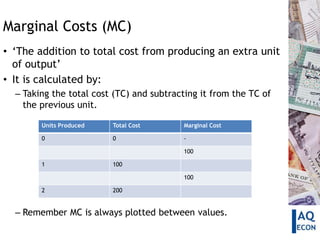
Marginal Costs (MC)
• ‘The addition to total cost from producing an extra unit
  of output’
• It is calculated by:
  – Taking the total cost (TC) and subtracting it from the TC of
    the previous unit.

        Units Produced   Total Cost       Marginal Cost

        0                0                -

                                          100

        1                100

                                          100

        2                200


  – Remember MC is always plotted between values.
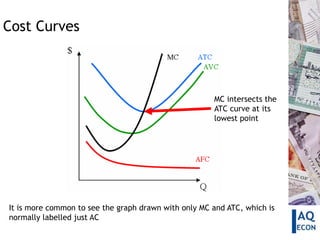
Cost Curves


                                                      MC intersects the
                                                      ATC curve at its
                                                      lowest point


It is more common to see the graph drawn with only MC and ATC, which is
normally labelled just AC
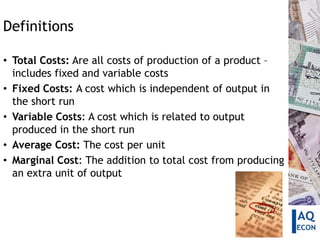
Definitions

• Total Costs: Are all costs of production of a product –
  includes fixed and variable costs
• Fixed Costs: A cost which is independent of output in
  the short run
• Variable Costs: A cost which is related to output
  produced in the short run
• Average Cost: The cost per unit
• Marginal Cost: The addition to total cost from producing
  an extra unit of output

Costs

  • 1.
    Costs Total, Fixed, Variable, Average and Marginal ECON3
  • 2.
    Fixed Costs (FC) •‘A cost which is independent of output in the short run’ • This can include Rent on a Premises – In the short run this has to be paid no matter what so is seen as fixed – In the long run the firm may close so rent doesn’t have to be paid, so is then variable. • They are costs which need to be paid even if production is zero. • Fixed Costs can include: – Salaries of Permanent Employees – Costs of Machinery – Depreciation
  • 3.
    Variable Costs (VC) •‘A cost which is related to output produced in the short run’ • These vary directly with output • An increase in output will require more raw materials so this cost is directly linked to output Semi Variable Costs • Costs which have both a fixed element and a variable one • They vary with output but not proportionately • E.g. you will use a telephone if you produce more, but not twice as much if you produce twice as much
  • 4.
    Average Costs (AC) •3 Types – Average Fixed Costs (AFC) • Found by dividing the total fixed costs by the number of units produced – Average Variable Costs (AVC) • Found by dividing the total variable costs by the number of units produced – Average Total Cost (ATC) • Found by dividing the total costs of a firm by the number of units produced • Each one of these can be plotted on a graph
  • 5.
    Marginal Costs (MC) •‘The addition to total cost from producing an extra unit of output’ • It is calculated by: – Taking the total cost (TC) and subtracting it from the TC of the previous unit. Units Produced Total Cost Marginal Cost 0 0 - 100 1 100 100 2 200 – Remember MC is always plotted between values.
  • 6.
    Cost Curves MC intersects the ATC curve at its lowest point It is more common to see the graph drawn with only MC and ATC, which is normally labelled just AC
  • 7.
    Definitions • Total Costs:Are all costs of production of a product – includes fixed and variable costs • Fixed Costs: A cost which is independent of output in the short run • Variable Costs: A cost which is related to output produced in the short run • Average Cost: The cost per unit • Marginal Cost: The addition to total cost from producing an extra unit of output