DEGREES OF BURNS
By M.Haseeb Tariq
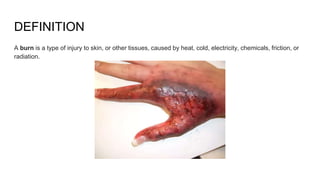
DEFINITION
A burn is a type of injury to skin, or other tissues, caused by heat, cold, electricity, chemicals, friction, or
radiation.
ANATOMY OF SKIN
We assess the damage done to skin and deeper tissues by measuring the extent
of layers of skin affected by the burn along with any of the deeper tissues
involved.
A basic understanding of anatomy of skin is therefore required.
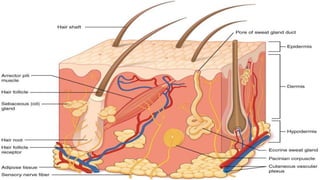
LAYERS OF SKIN
Mainly there are following main layers of skin:
➔ Epidermis
➔ Dermis
➔ Hypodermis
Burns are assesed as:
● Superficial partial thickness burn
● Deep partial thickness burn
● Full thickness burn
SUPERFICIAL PARTIAL THICKNESS
● Damage no deeper than Papillary Dermis
● Blistering
● Loss of epidermis
● Underlying Dermis Pink & Moist
● Pinprick sensations intact
● Heals without scarring in 2 weeks
DEEP PARTIAL THICKNESS
● Damage deeper to Reticular Dermis
● Epidermis is lost
● Exposed dermis is not moist
● Fixed capillary staining
● Pinprick sensations reduced
● Heals with hypertrophic scarring
● Takes 3 weeks or more
FULL THICKNESS
● Whole Dermis destroyed
● Hard, Leathery feel
● No Capillary return
● Burns compeletely anaesthetized (Needle can be stuck)
DEGREE OF BURNS
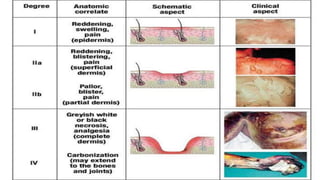
THERE ARE 4 DEGREES OF BURNS CLASSIFIED ON THE BASIS OF
EXTENT OF LAYERS INVOLVED BY THE INJURY.
❖ 1ST DEGREE BURN
❖ 2ND DEGREE BURN
❖ 3RD DEGREE BURN
❖ 4TH DEGREE BURN
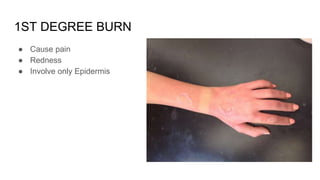
1ST DEGREE BURN
● Cause pain
● Redness
● Involve only Epidermis
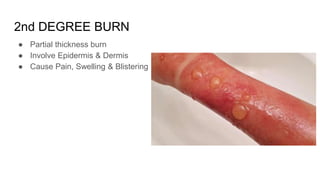
2nd DEGREE BURN
● Partial thickness burn
● Involve Epidermis & Dermis
● Cause Pain, Swelling & Blistering
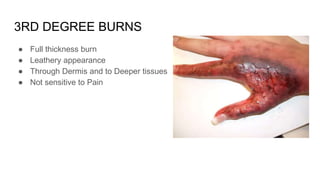
3RD DEGREE BURNS
● Full thickness burn
● Leathery appearance
● Through Dermis and to Deeper tissues
● Not sensitive to Pain
THANK YOU
FOR LISTENING….

Degrees of burns

  • 1.
    DEGREES OF BURNS ByM.Haseeb Tariq
  • 2.
    DEFINITION A burn isa type of injury to skin, or other tissues, caused by heat, cold, electricity, chemicals, friction, or radiation.
  • 3.
    ANATOMY OF SKIN Weassess the damage done to skin and deeper tissues by measuring the extent of layers of skin affected by the burn along with any of the deeper tissues involved. A basic understanding of anatomy of skin is therefore required.
  • 4.
    LAYERS OF SKIN Mainlythere are following main layers of skin: ➔ Epidermis ➔ Dermis ➔ Hypodermis
  • 6.
    Burns are assesedas: ● Superficial partial thickness burn ● Deep partial thickness burn ● Full thickness burn
  • 7.
    SUPERFICIAL PARTIAL THICKNESS ●Damage no deeper than Papillary Dermis ● Blistering ● Loss of epidermis ● Underlying Dermis Pink & Moist ● Pinprick sensations intact ● Heals without scarring in 2 weeks
  • 8.
    DEEP PARTIAL THICKNESS ●Damage deeper to Reticular Dermis ● Epidermis is lost ● Exposed dermis is not moist ● Fixed capillary staining ● Pinprick sensations reduced ● Heals with hypertrophic scarring ● Takes 3 weeks or more
  • 9.
    FULL THICKNESS ● WholeDermis destroyed ● Hard, Leathery feel ● No Capillary return ● Burns compeletely anaesthetized (Needle can be stuck)
  • 10.
    DEGREE OF BURNS THEREARE 4 DEGREES OF BURNS CLASSIFIED ON THE BASIS OF EXTENT OF LAYERS INVOLVED BY THE INJURY. ❖ 1ST DEGREE BURN ❖ 2ND DEGREE BURN ❖ 3RD DEGREE BURN ❖ 4TH DEGREE BURN
  • 11.
    1ST DEGREE BURN ●Cause pain ● Redness ● Involve only Epidermis
  • 12.
    2nd DEGREE BURN ●Partial thickness burn ● Involve Epidermis & Dermis ● Cause Pain, Swelling & Blistering
  • 13.
    3RD DEGREE BURNS ●Full thickness burn ● Leathery appearance ● Through Dermis and to Deeper tissues ● Not sensitive to Pain
  • 15.

Editor's Notes

  • #2  hypermetabolic state. CLASSIFIED ON BASIS OF depth of injury.
  • #3 At temperatures greater than 44 °C (111 °F), proteins begin losing their three-dimensional shape and start breaking down.This results in cell and tissue damage Many of the direct health effects of a burn are secondary to disruption in the normal functioning of the skin. They include disruption of the skin's sensation, ability to prevent water loss through evaporation, and ability to control body temperature.Disruption of cell membranes causes cells to lose potassium to the spaces outside the cell and to take up water and sodium.In large burns (over 30% of the total body surface area), there is a significant inflammatory response] This results in increased leakage of fluid from the capillaries,and subsequent tissue edema This causes overall blood volume loss, with the remaining blood suffering significant plasma loss, making the blood more concentrated.Poor blood flow to organs such as the kidneys and gastrointestinal tract may result in renal failure and stomach ulcers.