Prepared by
Ms Shiwani Sah
Lecturer
Review Anatomy and Physiology
• The skin is the largest organ of the body.
• The skin is composed of three layers:
epidermis,
dermis,
subcutaneous
• The thickness of these layers varies considerably,0.5
mm to 6mm depending on location.
• The PH of skin is 4-5.5.
• The renewal of skin takes place in 28-50
Types of skin
There are two types of skin
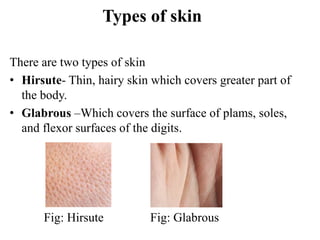
• Hirsute- Thin, hairy skin which covers greater part of
the body.
• Glabrous –Which covers the surface of plams, soles,
and flexor surfaces of the digits.
Fig: Hirsute Fig: Glabrous
Structure of the skin
The skin has three layers with different thickness,
strength and function:
• Epidermis: Thin outer layer
• Dermis: Thick inner layer
• Hypodermis or subcutis: A fatty layer of
subcutaneous tissue
Functions of skin
• Protecting the body against trauma
• Regulating body temperature
• Maintaining water and electrolyte balance
• Sensing painful and pleasant stimuli
• Participating in vitamin D synthesis
Definition:
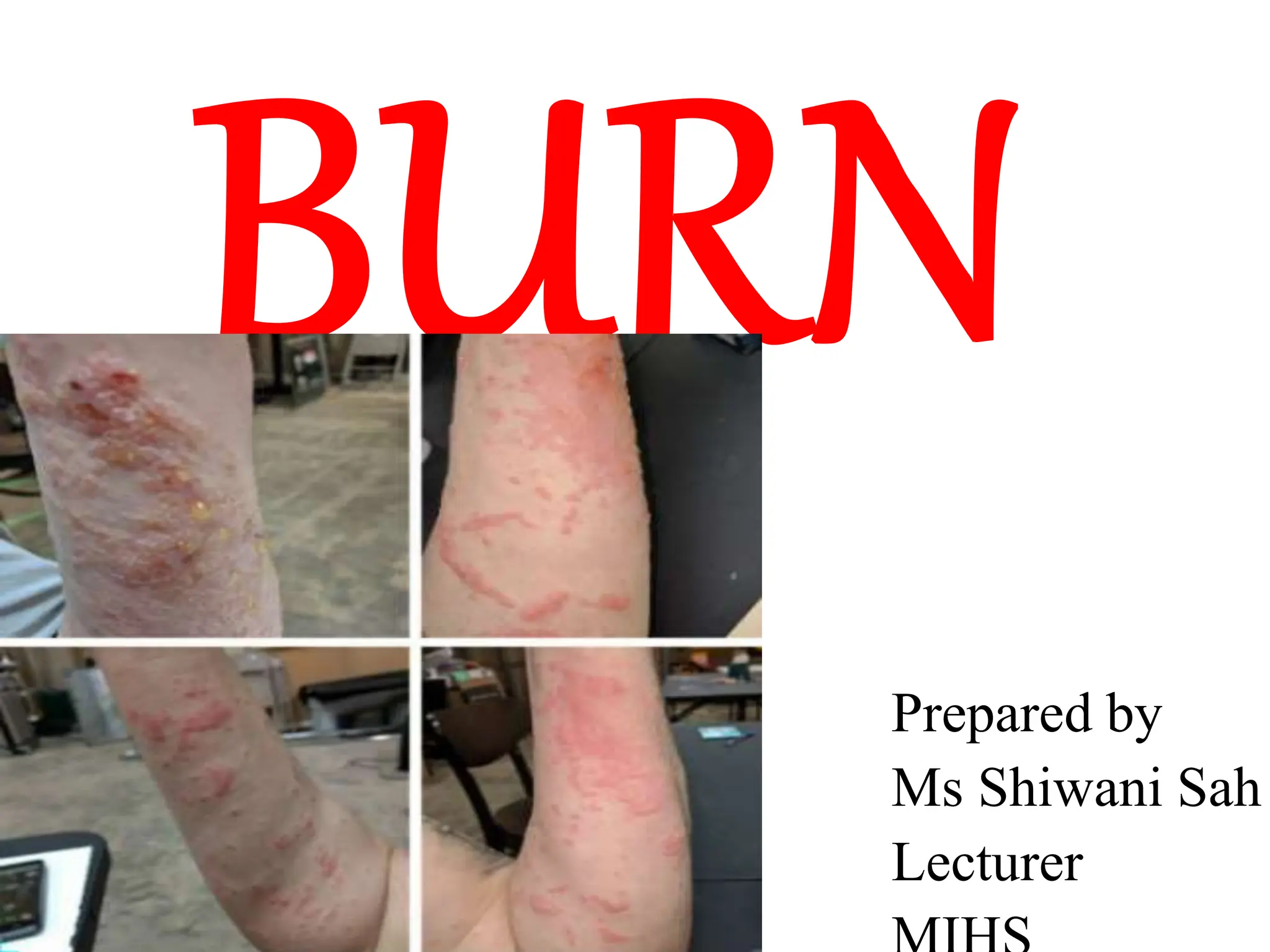
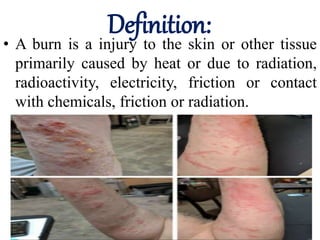
• A burn is a injury to the skin or other tissue
primarily caused by heat or due to radiation,
radioactivity, electricity, friction or contact
with chemicals, friction or radiation.
Causes
1. Thermal burn: Majority of burns results from contact
with thermal agents such as flames, hot surfaces, or hot
liquids.
a)Scald burn: This type of burn is caused by contact with
moist heat (water or oil) and steam. The most common
hot liquids are liquid foods such as hot water, tea,
coffee, milk. It is common in toddlers, because of
curiosity they pull hot water, spills hot cup of tea or
may enter into a tub of hot water.
a)Flame burns: This type of burn is the 2nd common
cause of burn and a leading cause of mortality among
children. During playing with lighter, candles, matches
or open fire in winter seasons or from fireworks during
festivals.
b)Contact with hot objects: This type of burn occurs due
to direct contact with stove, heater, cylinder of
motorbike, cigarettes smoking in bed and
unextinguished cigarettes etc.
c) Cold exposure (frostbite): Frostbite is a severe,
localized cold-induced injury due to freezing of
tissue. Immersion foot (also referred to as trench foot)
is a nonfreezing cold injury (NFCI) that may also
cause tissue loss and long-term squeal.
2. Electrical burns: These burn injuries are common in
toddler and adolescent, specially associated with risk
taking behavior of the boys, i.e., when sticking fingers
or objects in electrical out let, biting of extension cords,
touching high tension wires and using electrical
appliance. Young children may poke objects in electrical
outlets, bite or suck connected electrical cord leading to:
 cardiac arrhythmias,
 cardiac arrest and
 unexpected falls with resultant factures
3. Chemical burn: Chemical burn is caused by
chemicals mostly acid and alkali ,because of the curious
nature, children are exposed with the different kinds of
household chemical products, especially cleaning
products contains noxious agents which may cause
localized damage as well as systemic toxicity. Contact
burns may occur due to heated liquids as Tars.
4.Radiation burn: This type of burn occurs due to
prolonged exposure to ultraviolet rays (UV) of the sun
or to other sources of radiation, such as x-ray or gamma
radiation therapy for cancer. Damage may occur due to
exposure to ionizing radiation
Others causes:
 Inhalation burn : Results from inhalation of smoke,
gases, vapors etc.
 Therapeutic burn: Resulting from an operation or
laser treatment
 Friction burn: Burns from direct damage to the cells
and from the heat generated by the friction that may
occur in children falling on or touching a treadmill in
motion or a rope burn from a rope sliding through
hands.
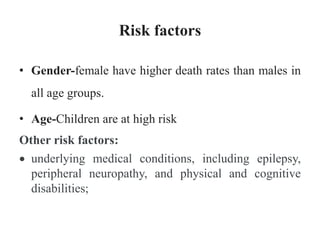
Risk factors
• Gender-female have higher death rates than males in
all age groups.
• Age-Children are at high risk
Other risk factors:
 underlying medical conditions, including epilepsy,
peripheral neuropathy, and physical and cognitive
disabilities;
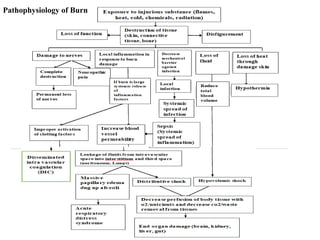
Pathophysiology of Burn
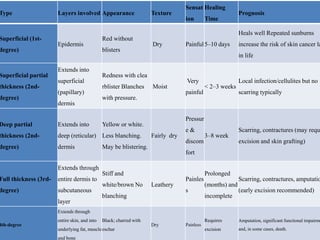
Type Layers involved Appearance Texture
Sensat
ion
Healing
Time
Prognosis
Superficial (1st-
degree)
Epidermis
Red without
blisters
Dry Painful5–10 days
Heals well Repeated sunburns
increase the risk of skin cancer la
in life
Superficial partial
thickness (2nd-
degree)
Extends into
superficial
(papillary)
dermis
Redness with clea
rblister Blanches
with pressure.
Moist
Very
painful
< 2–3 weeks
Local infection/cellulites but no
scarring typically
Deep partial
thickness (2nd-
degree)
Extends into
deep (reticular)
dermis
Yellow or white.
Less blanching.
May be blistering.
Fairly dry
Pressur
e &
discom
fort
3–8 week
Scarring, contractures (may requ
excision and skin grafting)
Full thickness (3rd-
degree)
Extends through
entire dermis to
subcutaneous
layer
Stiff and
white/brown No
blanching
Leathery
Painles
s
Prolonged
(months) and
incomplete
Scarring, contractures, amputatio
(early excision recommended)
4th-degree
Extends through
entire skin, and into
underlying fat, muscle
and bone
Black; charred with
eschar
Dry Painless
Requires
excision
Amputation, significant functional impairme
and, in some cases, death.
Effects of Burn
The effect of burn injury on the patients can be considered as
• Local
• Regional
• systemic
a. Local effects of burn:
• Burn wounds will almost be colonized by microorganisms
within 24-48 hours and may remain as a local wound or
regional infection.
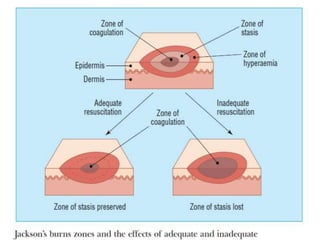
• Local response experimental work by Jackson has shown
that a burn wound consists of 3 zones
Contd..
Zone of coagulation
• This occurs at the point of maximum cellular damage from
the heat source.
• Destruction of blood vessels, resulting in ischemia to the
area. (coagulative necrosis & gangrene).
• Irreversible tissue loss.
Contd..
Zone of stasis
• Damage in microcirculation resulting in compromised
circulation, untreated it will lead to necrosis.
• The main aim of burns resuscitation is to increase tissue
perfusion here and prevent any damage becoming
irreversible.
• This is the main areas of focus when treating burn
injuries.
Contd..
Zone of hyperemia
• It is the area surrounding the zone of stasis but it is
red due to inflammation.
• Perfusion is adequate due to patent blood vessels
• Erythema occurs due to increased vascular
permeability.
• Not at risk for further necrosis
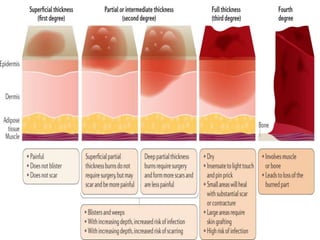
Classification of Burn Injury
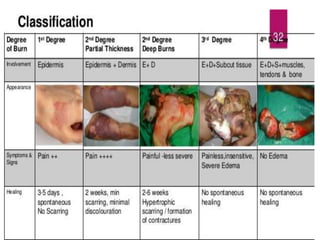
1. According to depth/degree of burn injury
1. Superficial (1st degree) Burn
2. Partial thickness (2nd degree) burn
• Superficial partial-thickness
• Deep partial-thickness burns
3. Full-thickness (3rd degree) burn
4. Fourth degree burn
1. Superficial Burn Injuries (1st degree Burn)
• Usually involves epidermal layer
• Minor in nature.
• There is minimal tissue damage with no blistering.
• Protective function of skin remains intact and systemic
effects are rare.
• Pain is a predominant symptom.
• Burn injury heals within 5 to 10 days without scarring.
• Eg Mild sunburn
2. Partial-thickness (Second degree Burn)
• This type of injuries involves epidermis and varying
degree of the dermis.
• Wounds are painful, moist, red and blistered.
• Some portion of the skin appendages remains viable
• Epithelial repair of the burn wound without skin grafting.
a. Superficial partial-thickness
• Burn involves the epidermis and superficial (papillary)
dermis, dermal elements are intact.
• Pink, moist, and soft and presence of blister and very
painful.
• Very sensitive to temperature change, exposure to air
and even to light touch.
• Wound heals within 14 to 21 days with varying degree
of scarring
b. Deep partial-thickness burns
• Full thickness injuries in many respects except that sweat
glands and hair follicles remains intact
• Burn may appear mottled, pink, red or waxy white area
exhibiting blisters and edema formation.
• Less painful than superficial partial thickness burns.
• Systemic effect may present as in full thickness burn.
• Many wounds may heals spontaneously and may extend
beyond 21 days with extensive scarring.
3. Full-thickness (Third degree) burn
• It involve the entire epidermis, dermis and extend into
subcutaneous tissue.
• Capillary network of the dermis is completely destroyed.
• The nerve endings, hair follicles and sweat glands, are
destroyed.
• Color varies from red to tan, waxy white, brown, or black
and is distinguished by dry leathery appearance.
• Full thickness injuries are not capable of re-epithelialization
so requires surgical excision and grafting to close the wound
4. Fourth degree burn
• Destruction of the skin and subcutaneous tissue and also
involve the underlying structures as fascia, muscle, bone.
• The wound appears dull and dry, and ligaments, tendons,
and bone may be exposed.
• It results from prolonged exposure to the usual causes of
third-degree burns.
• These injuries require extensive debridement and
complex reconstruction of specialized tissues.
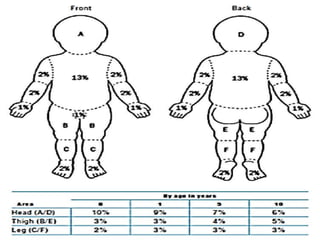
2. According to extent of burn Injury
• The extent of burn is expressed as a percentage of the
total Body Surface Area (TBSA).Various methods are
used to estimate the TBSA affected by burn. Among
them are
– Rule of nine
– Lund and Browder
– Palm method
a. Modified Rule of Nine
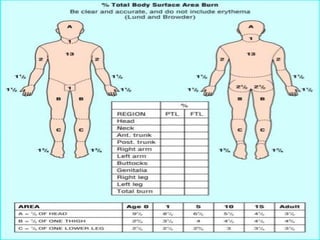
b. Lund-Browder Chart
• Lund-Brower charts with age-appropriate diagrams can
be used to better estimate the area of burn injury in
children.
• It gives the exact percentage at different age groups in
different parts of the body.
• It subdivides body areas into segments and assigns a
proportionate percentage of body surface to each area
based on age.
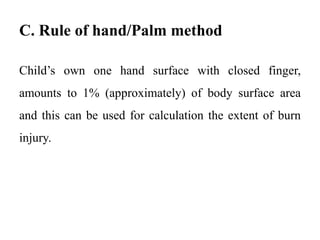
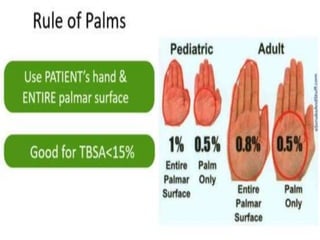
C. Rule of hand/Palm method
Child’s own one hand surface with closed finger,
amounts to 1% (approximately) of body surface area
and this can be used for calculation the extent of burn
injury.
3. According to the severity of burn injury
• Major Burn Injury
• Moderate Burn Injury
• Minor Burn Injuries
a. Major Burn Injury
Major burn injury includes:
• Partial-thickness burns ( 2nd degree) involving
• >25% of TBSA in >10 years
• >20% of TBSA in children < 10 years or
• Full-thickness burns ( 3rd degree) involving >10% of
TBSA.
Contd..
• All burns involving the face, eyes, ears, hands, feet,
or perineum that may result in functional or cosmetic
impairment.
• Burns caused by caustic chemical agents, high-
voltage electrical injury, complicated by inhalation
injury or major trauma etc.
b. Moderate Burn Injury
• Moderate burn injury includes:
• Partial-thickness (2nd degree) burns of
• 15-25% of TBSA in >10 years
• or 10-20% of TBSA in children < 10 years or
• Full-thickness (3rd degree) burns involving < 10% of
TBSA that do not present serious threat of functional or
cosmetic impairment of the eyes, ears, face, hands, feet,
or perineum.
c. Minor Burn Injuries:
 Minor burn injury includes:
• Partial thickness ( 2nd degree) burns involving
• < 10% of TBSA in <10 years
• and <15% of TBSA in >10 years and
• Full-thickness (3rd degree) burns involving less than 2%
of TBSA that do not present a serious threat of functional
or cosmetic risk to eyes, ears, face, hands, feet, or
perineum.
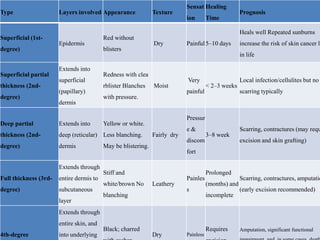
Signs and symptoms
Type Layers involved Appearance Texture
Sensat
ion
Healing
Time
Prognosis
Superficial (1st-
degree)
Epidermis
Red without
blisters
Dry Painful5–10 days
Heals well Repeated sunburns
increase the risk of skin cancer la
in life
Superficial partial
thickness (2nd-
degree)
Extends into
superficial
(papillary)
dermis
Redness with clea
rblister Blanches
with pressure.
Moist
Very
painful
< 2–3 weeks
Local infection/cellulites but no
scarring typically
Deep partial
thickness (2nd-
degree)
Extends into
deep (reticular)
dermis
Yellow or white.
Less blanching.
May be blistering.
Fairly dry
Pressur
e &
discom
fort
3–8 week
Scarring, contractures (may requ
excision and skin grafting)
Full thickness (3rd-
degree)
Extends through
entire dermis to
subcutaneous
layer
Stiff and
white/brown No
blanching
Leathery
Painles
s
Prolonged
(months) and
incomplete
Scarring, contractures, amputatio
(early excision recommended)
4th-degree
Extends through
entire skin, and
into underlying
Black; charred
Dry Painless
Requires Amputation, significant functional
Indications for Hospitalization for Burns
• Burns affecting >10% of BSA
• Burns >10–20% of BSA in adolescent/adult
• 3rd-degree burns
• Electrical burns caused by high-tension wires or
lightning
• Chemical burns
• Inhalation injury, regardless of the amount of BSA
burned
Contd..
• Suspected child abuse or neglect
• Burns to the face, hands, feet, perineum, genitals, or
major joints
• Burns in patients with preexisting medical conditions
that may complicate the acute recovery phase
• Associated injuries (fractures)
• Pregnancy
Laboratory and diagnostic tests
• Complete blood count—decreased
• Arterial blood gas values—metabolic acidosis
(decreased pH, increased partial pressure of carbon
dioxide [Pco2], and decreased partial pressure of
oxygen [Po2])
• Serum electrolyte levels—decreased because of loss to
traumatized areas and interstitial spaces
• Serum glucose level—increased because of stress-
invoked glycogen breakdown or glyconeogenesis
Contd.
• Blood urea nitrogen level—increased because of
tissue breakdown and oliguria
• Creatinine clearance—increased because of tissue
breakdown and oliguria
• Serum protein levels—decreased because of protein
breakdown for massive energy needs
• Chest radiographic study
Management of Burn Injury
Three phases of burn management are:
a. Emergent/Resuscitative Phase
b. Intermediate Phase
c. Rehabilitative Phase
A. Emergent/ Resuscitative Phase
• This phase begins from the onset of injury to the
completion of fluid resuscitation.
• It includes:
- First Aid
- Initial management: ADCDEF
- Pain management
- Supportive measures
First Aid
• Ensure own safety
• Stop the process of burning
• Remove the child from the area of accident
• Reassure the child and parents
• Extinguish flames with a blanket or by pouring water
• "stop, drop, cover and roll" the child in case of open
flame burn
• Remove the victim’s wet clothes, rings, shoes etc.
carefully
• Cover the burned areas with clean clothes or dressing if
available
• Remove the secretion if present in the nose and mouth
and turn the head of the child to side to prevent
aspiration
• In thermal burn: put burned areas under running water,
if running water is not available, immerse the burned
areas in cool water for 20 minutes
• In case of chemical burn: brush off any remaining
chemical, if powdered or solid, then irrigate or wash the
affected areas with water
• If the burn is caused by hot tar, use mineral oil to
remove the tar
• In electrical burn: turn off or switch off the main
source
• Seek medical help as soon as possible (The first 6
hour of injuries is critical)
Initial Management/Primary Survey
A: Airway with cervical spine control
B: Breathing and ventilation
C: Circulation
D: Disability
E: Exposure (Includes burn assessment)
F: Fluid Resuscitation
Airway with cervical spine Control
• Stabilize cervical spine: maintain alignment,
prevent movement
• Manage the airway:
• Insert oral airway tube, if airway is still not
secured
• Administer oxygen
• Intubate, if sign of impending obstruction
Breathing and Ventilation
• Inspect for respiratory movement, rate, colour,
burn area
• Extensive burn to the chest and abdomen can
restrict ventilation: escharotomy is needed
Circulation
• Inspect for hemorrhage, pallor and capillary
refill time
• Palpate for presence of pulse, pulse rate ,
peripheral temperature
• Check for BP, conscious level
Disability
Check level of consciousness using AVPU
A: Alertness (Ask questions such as name and
address)
V: Voice (Response to vocal stimuli)
P: Pain (Response to painful stimuli)
U: Unresponsive
Check pupillary response to light
Exposure
• Expose the patient completely to assess burned
surface area as well as type and depth of burn
• Keep the patient warm to prevent hypothermia
• Remove clothing and jewellery
Fluid Resuscitation
• It is done if the patient has burn more than 10% of TBSA.
• The objectives of fluid therapy are to:
- Compensate for water and sodium losses
- Correct electrolyte abnormalities
- Restore adequate intravascular volume
- Provide adequate perfusion
- Improve renal function
- Correct acidosis
Types of fluid given
Crystalloids: Ringer lactate, Hartmann’s solution,
Normal saline are given during the initial 1st 24 hour
after burn
Colloids: Albumin, blood, electrolytes are given during
the 2nd 24 hour and thereafter
The Parkland formula estimates the amount of fluid to be
replaced over 24 hours as follows:
• Volume of Ringer lactate (ml) = 4ml x weight (kg) x %
TBSA burn
• Half of the resuscitation volume should be given in the
initial 8 hours
• And, the remaining half in the following 16 hours
• Subsequent fluid management (after 24 hours)
comprises of maintenance therapy and ongoing fluid
losses. Hourly ongoing fluid loss is calculated as:
• The adequacy of fluid resuscitation should be
constantly assessed and is based on different parameters
like vital signs, urine output, capillary refill time, blood
gas analysis, hematocrit, serum protein and mental state.
• Albumin (5%) infusions may be used to maintain the
serum albumin levels at a desired level of 2 g/dL and is
infused over 24 hours as:
• Packed red blood cells infusion is recommended if the
hematocrit falls below 24% (hemoglobin ≤8 g/dL).
• Fresh frozen plasma (FFP) is indicated if clinical and
laboratory assessment shows deficiency of clotting
factors or are scheduled for an invasive procedure or a
grafting procedure that could result in an estimated blood
loss of more than half of blood volume.
• Sodium supplementation may be required for children
having burns greater than 20% BSA if 0.5% silver nitrate
solution is used as the topical antibacterial burn dressing.
- Oral sodium chloride supplement of 4 g/m2 burn area
• Intravenous potassium supplementation is supplied
to maintain serum potassium level over 3 mEq/dL.
• Potassium losses may be significantly increased when
0.5% silver nitrate solution is used as the topical
antibacterial agent
Pain Management
Pharmacological method
Analgesics: (according to WHO)
Mild: paracetamol, Ibuprofen
Moderate: Codomol, Codeine, Tramadol
Strong: Morphine, Diamorphine
Non-pharmacological methods
Non-pharmacological methods include:
Positioning: comfortable positioning reduces pain
Elevation: elevation of limbs and head reduces pain and
swelling
Dressings: open wounds are more painful than dressed
wound
Communication : reassurance and explanation reduce
anxiety
Distraction: play materials, telling a story, TV, music therapy
etc
Timing: carrying out the dressing and other procedure after
feeding
Education: understanding of the condition
Supportive Measures
• Assess vital sign
• Initial wound care
• Tetanus prophylaxis
• Catheterization if needed
• Maintain intake and output
• Reassurance to patient and visitors
• Inform concerned authority (police case)
B. Intermediate Phase
• The acute or intermediate phase of burn care
follows the emergent/resuscitative phase and begins
48 to 72 hours after the burn injury and ends to near
completion of wound closure. It includes;
- Infection prevention and hygiene
- Burn wound care
- Pain management
- Nutritional management
Measures to prevent infection are as follows:
• maintaining good general hygiene, keeping hands,
wound and dressing clean and using aseptic
technique.
• aware of the sign and symptoms of infection, send
culture swab.
• local application of antimicrobials, cleaning of the
wound and surgical debridement
• provide a nutrient-rich diet
Burn Wound Care
It comprises:
a. Wound cleaning
b. Topical antimicrobial therapy
c. Wound dressing
d. Wound debridement
e. Wound grafting
Wound Cleaning
- Done by antibacterial wash (iodine or
chlorhexidine), saline or water (hydrotherapy).
- Hydrotherapy involves the soaking in tub or
shower at least once a day for no more than 20
minutes as water acts to loosen and remove
sloughing tissue, exudates and topical medications.
Topical Antimicrobial Therapy
- Topical antimicrobial agents are applied directly to
burn areas as ointments, creams whereas some are
packaged and prepared on a fine meshed gauze.
- The commonly used topical antibiotics are:
• Silver nitrate 0.5%
• Silver sulfadiazine1 %
• Mafenide acetate
• Bacitracin/Polysporin
• Placentrix
• Mupirocin
Wound Dressing
The overall aims of burn dressing are:
• Preventing infection
• Promoting wound healing
• Reducing pain and swelling
• Allowing for movement and function
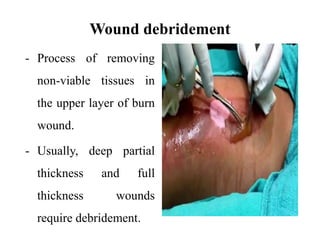
Wound debridement
- Process of removing
non-viable tissues in
the upper layer of burn
wound.
- Usually, deep partial
thickness and full
thickness wounds
require debridement.
Wound Grafting
- If wounds are deep (full thickness) or extensive,
spontaneous epithelialization is not possible.
Therefore, covering of the burn wound is necessary
until coverage with a graft of the patient’s own skin
(autograft) is possible.
Types of wound coverings
a. Temporary skin coverings
b. Permanent skin coverings
Temporary Skin Coverings
i. Allograft (Homograft)
- Skin is obtained from living or recently deceased
human (human cadavers) and even the amniotic
membrane can be used.
- Particularly, useful when available donor site are
limited.
ii. Xenograft (Heterograft)
- Skin is obtained from variety of species, most commonly
pigs
- Particularly effective in children with partial thickness scald
burns of hands and face.
iii. Synthetic Skin Coverings
- Biobrane is widely used synthetic dressing that remains in
place for 3 – 4 weeks.
- Used in superficial partial thickness burns and donor site
Nutritional Management
- Burn injury produces a hypermetabolic response
characterized by both protein and fat catabolism.
- Therefore, high calorie and high protein diet are
provided for survival and recovery.
- Calories are provided at approximately 1.5 times the
basal metabolic rate.
- Protein requirement: 2-3 gm/kg body weight
- Multivitamins, particularly the vitamin A, B, C and
zinc are also necessary
- Oral feeding is encouraged unless the child is intubated
or paralytic ileus persists.
- Parenteral nutrition is considered in children with
extensive burns, inhalation injury or prolonged
paralytic ileus.
Rehabilitative Phase
- The principles of rehabilitation programmes are:
1. Minimizing swelling and oedema
2. Preventing deformity
3. Mobilizing/Maintaining function
4. Treating long-term scarring problems
5. Psychosocial care
Plastic and re-constructive surgery
Complications of Burn
Early Complications:
• Respiratory distress
• Shock (Hypovolemic, Neurogenic,
septic)
• Fluid and electrolytes disturbances
• Increase metabolic rate leading to
weight loss
• Curling GI Ulcer
• Gangrene
Late complications:
• Disfigurement
• Contracture
• Severe disability
• Psychological upset
• Chronic ulcer leading to
malignancy
Nursing Diagnosis of Burn
• Impaired gas exchange related to inhalation injury as
evidenced by dyspnea, tachypnea.
• Ineffective airway clearance related to mucosal edema
and loss of ciliary action / circumferential full-thickness
burns of the neck/ thorax/ chest as evidenced by dyspnea,
cough.
• Deficit fluid volume related to intravascular fluid loss as
evidenced by edema, dry mucus membrane
Nsg contd…
• Acute pain related to destruction of skin/tissues and nerve
injury as evidenced by crying, irritability
• Impaired skin integrity related to burn injury as evidenced by
disruption of skin surface/layers.
• Imbalance nutrition : less than body requirements related to
hyper-metabolic state as evidenced by weight loss
• Parental anxiety related to threat of death and/or
disfigurement as evidenced by expressed concern regarding
changes in life, fear of unspecified consequences
Nsg contd…
• Disturbed body image related to disfigurement as
evidenced by negative feelings about body/self, fear of
rejection/reaction by others.
• Risk of infection related to destruction of skin barrier and
decreased immunity.
• Risk of development of contractures related to scarring of
tissue and immobility.
burn.pptx

burn.pptx

  • 1.
  • 2.
    Review Anatomy andPhysiology • The skin is the largest organ of the body. • The skin is composed of three layers: epidermis, dermis, subcutaneous • The thickness of these layers varies considerably,0.5 mm to 6mm depending on location. • The PH of skin is 4-5.5. • The renewal of skin takes place in 28-50
  • 3.
    Types of skin Thereare two types of skin • Hirsute- Thin, hairy skin which covers greater part of the body. • Glabrous –Which covers the surface of plams, soles, and flexor surfaces of the digits. Fig: Hirsute Fig: Glabrous
  • 4.
    Structure of theskin The skin has three layers with different thickness, strength and function: • Epidermis: Thin outer layer • Dermis: Thick inner layer • Hypodermis or subcutis: A fatty layer of subcutaneous tissue
  • 5.
    Functions of skin •Protecting the body against trauma • Regulating body temperature • Maintaining water and electrolyte balance • Sensing painful and pleasant stimuli • Participating in vitamin D synthesis
  • 6.
    Definition: • A burnis a injury to the skin or other tissue primarily caused by heat or due to radiation, radioactivity, electricity, friction or contact with chemicals, friction or radiation.
  • 7.
    Causes 1. Thermal burn:Majority of burns results from contact with thermal agents such as flames, hot surfaces, or hot liquids. a)Scald burn: This type of burn is caused by contact with moist heat (water or oil) and steam. The most common hot liquids are liquid foods such as hot water, tea, coffee, milk. It is common in toddlers, because of curiosity they pull hot water, spills hot cup of tea or may enter into a tub of hot water.
  • 8.
    a)Flame burns: Thistype of burn is the 2nd common cause of burn and a leading cause of mortality among children. During playing with lighter, candles, matches or open fire in winter seasons or from fireworks during festivals. b)Contact with hot objects: This type of burn occurs due to direct contact with stove, heater, cylinder of motorbike, cigarettes smoking in bed and unextinguished cigarettes etc.
  • 9.
    c) Cold exposure(frostbite): Frostbite is a severe, localized cold-induced injury due to freezing of tissue. Immersion foot (also referred to as trench foot) is a nonfreezing cold injury (NFCI) that may also cause tissue loss and long-term squeal.
  • 10.
    2. Electrical burns:These burn injuries are common in toddler and adolescent, specially associated with risk taking behavior of the boys, i.e., when sticking fingers or objects in electrical out let, biting of extension cords, touching high tension wires and using electrical appliance. Young children may poke objects in electrical outlets, bite or suck connected electrical cord leading to:  cardiac arrhythmias,  cardiac arrest and  unexpected falls with resultant factures
  • 11.
    3. Chemical burn:Chemical burn is caused by chemicals mostly acid and alkali ,because of the curious nature, children are exposed with the different kinds of household chemical products, especially cleaning products contains noxious agents which may cause localized damage as well as systemic toxicity. Contact burns may occur due to heated liquids as Tars.
  • 12.
    4.Radiation burn: Thistype of burn occurs due to prolonged exposure to ultraviolet rays (UV) of the sun or to other sources of radiation, such as x-ray or gamma radiation therapy for cancer. Damage may occur due to exposure to ionizing radiation
  • 13.
    Others causes:  Inhalationburn : Results from inhalation of smoke, gases, vapors etc.  Therapeutic burn: Resulting from an operation or laser treatment  Friction burn: Burns from direct damage to the cells and from the heat generated by the friction that may occur in children falling on or touching a treadmill in motion or a rope burn from a rope sliding through hands.
  • 14.
    Risk factors • Gender-femalehave higher death rates than males in all age groups. • Age-Children are at high risk Other risk factors:  underlying medical conditions, including epilepsy, peripheral neuropathy, and physical and cognitive disabilities;
  • 15.
  • 16.
    Type Layers involvedAppearance Texture Sensat ion Healing Time Prognosis Superficial (1st- degree) Epidermis Red without blisters Dry Painful5–10 days Heals well Repeated sunburns increase the risk of skin cancer la in life Superficial partial thickness (2nd- degree) Extends into superficial (papillary) dermis Redness with clea rblister Blanches with pressure. Moist Very painful < 2–3 weeks Local infection/cellulites but no scarring typically Deep partial thickness (2nd- degree) Extends into deep (reticular) dermis Yellow or white. Less blanching. May be blistering. Fairly dry Pressur e & discom fort 3–8 week Scarring, contractures (may requ excision and skin grafting) Full thickness (3rd- degree) Extends through entire dermis to subcutaneous layer Stiff and white/brown No blanching Leathery Painles s Prolonged (months) and incomplete Scarring, contractures, amputatio (early excision recommended) 4th-degree Extends through entire skin, and into underlying fat, muscle and bone Black; charred with eschar Dry Painless Requires excision Amputation, significant functional impairme and, in some cases, death.
  • 17.
    Effects of Burn Theeffect of burn injury on the patients can be considered as • Local • Regional • systemic a. Local effects of burn: • Burn wounds will almost be colonized by microorganisms within 24-48 hours and may remain as a local wound or regional infection. • Local response experimental work by Jackson has shown that a burn wound consists of 3 zones
  • 19.
    Contd.. Zone of coagulation •This occurs at the point of maximum cellular damage from the heat source. • Destruction of blood vessels, resulting in ischemia to the area. (coagulative necrosis & gangrene). • Irreversible tissue loss.
  • 20.
    Contd.. Zone of stasis •Damage in microcirculation resulting in compromised circulation, untreated it will lead to necrosis. • The main aim of burns resuscitation is to increase tissue perfusion here and prevent any damage becoming irreversible. • This is the main areas of focus when treating burn injuries.
  • 21.
    Contd.. Zone of hyperemia •It is the area surrounding the zone of stasis but it is red due to inflammation. • Perfusion is adequate due to patent blood vessels • Erythema occurs due to increased vascular permeability. • Not at risk for further necrosis
  • 22.
    Classification of BurnInjury 1. According to depth/degree of burn injury 1. Superficial (1st degree) Burn 2. Partial thickness (2nd degree) burn • Superficial partial-thickness • Deep partial-thickness burns 3. Full-thickness (3rd degree) burn 4. Fourth degree burn
  • 24.
    1. Superficial BurnInjuries (1st degree Burn) • Usually involves epidermal layer • Minor in nature. • There is minimal tissue damage with no blistering. • Protective function of skin remains intact and systemic effects are rare. • Pain is a predominant symptom. • Burn injury heals within 5 to 10 days without scarring. • Eg Mild sunburn
  • 25.
    2. Partial-thickness (Seconddegree Burn) • This type of injuries involves epidermis and varying degree of the dermis. • Wounds are painful, moist, red and blistered. • Some portion of the skin appendages remains viable • Epithelial repair of the burn wound without skin grafting.
  • 26.
    a. Superficial partial-thickness •Burn involves the epidermis and superficial (papillary) dermis, dermal elements are intact. • Pink, moist, and soft and presence of blister and very painful. • Very sensitive to temperature change, exposure to air and even to light touch. • Wound heals within 14 to 21 days with varying degree of scarring
  • 27.
    b. Deep partial-thicknessburns • Full thickness injuries in many respects except that sweat glands and hair follicles remains intact • Burn may appear mottled, pink, red or waxy white area exhibiting blisters and edema formation. • Less painful than superficial partial thickness burns. • Systemic effect may present as in full thickness burn. • Many wounds may heals spontaneously and may extend beyond 21 days with extensive scarring.
  • 28.
    3. Full-thickness (Thirddegree) burn • It involve the entire epidermis, dermis and extend into subcutaneous tissue. • Capillary network of the dermis is completely destroyed. • The nerve endings, hair follicles and sweat glands, are destroyed. • Color varies from red to tan, waxy white, brown, or black and is distinguished by dry leathery appearance. • Full thickness injuries are not capable of re-epithelialization so requires surgical excision and grafting to close the wound
  • 29.
    4. Fourth degreeburn • Destruction of the skin and subcutaneous tissue and also involve the underlying structures as fascia, muscle, bone. • The wound appears dull and dry, and ligaments, tendons, and bone may be exposed. • It results from prolonged exposure to the usual causes of third-degree burns. • These injuries require extensive debridement and complex reconstruction of specialized tissues.
  • 31.
    2. According toextent of burn Injury • The extent of burn is expressed as a percentage of the total Body Surface Area (TBSA).Various methods are used to estimate the TBSA affected by burn. Among them are – Rule of nine – Lund and Browder – Palm method
  • 32.
  • 33.
    b. Lund-Browder Chart •Lund-Brower charts with age-appropriate diagrams can be used to better estimate the area of burn injury in children. • It gives the exact percentage at different age groups in different parts of the body. • It subdivides body areas into segments and assigns a proportionate percentage of body surface to each area based on age.
  • 36.
    C. Rule ofhand/Palm method Child’s own one hand surface with closed finger, amounts to 1% (approximately) of body surface area and this can be used for calculation the extent of burn injury.
  • 38.
    3. According tothe severity of burn injury • Major Burn Injury • Moderate Burn Injury • Minor Burn Injuries
  • 39.
    a. Major BurnInjury Major burn injury includes: • Partial-thickness burns ( 2nd degree) involving • >25% of TBSA in >10 years • >20% of TBSA in children < 10 years or • Full-thickness burns ( 3rd degree) involving >10% of TBSA.
  • 40.
    Contd.. • All burnsinvolving the face, eyes, ears, hands, feet, or perineum that may result in functional or cosmetic impairment. • Burns caused by caustic chemical agents, high- voltage electrical injury, complicated by inhalation injury or major trauma etc.
  • 41.
    b. Moderate BurnInjury • Moderate burn injury includes: • Partial-thickness (2nd degree) burns of • 15-25% of TBSA in >10 years • or 10-20% of TBSA in children < 10 years or • Full-thickness (3rd degree) burns involving < 10% of TBSA that do not present serious threat of functional or cosmetic impairment of the eyes, ears, face, hands, feet, or perineum.
  • 42.
    c. Minor BurnInjuries:  Minor burn injury includes: • Partial thickness ( 2nd degree) burns involving • < 10% of TBSA in <10 years • and <15% of TBSA in >10 years and • Full-thickness (3rd degree) burns involving less than 2% of TBSA that do not present a serious threat of functional or cosmetic risk to eyes, ears, face, hands, feet, or perineum.
  • 43.
    Signs and symptoms TypeLayers involved Appearance Texture Sensat ion Healing Time Prognosis Superficial (1st- degree) Epidermis Red without blisters Dry Painful5–10 days Heals well Repeated sunburns increase the risk of skin cancer la in life Superficial partial thickness (2nd- degree) Extends into superficial (papillary) dermis Redness with clea rblister Blanches with pressure. Moist Very painful < 2–3 weeks Local infection/cellulites but no scarring typically Deep partial thickness (2nd- degree) Extends into deep (reticular) dermis Yellow or white. Less blanching. May be blistering. Fairly dry Pressur e & discom fort 3–8 week Scarring, contractures (may requ excision and skin grafting) Full thickness (3rd- degree) Extends through entire dermis to subcutaneous layer Stiff and white/brown No blanching Leathery Painles s Prolonged (months) and incomplete Scarring, contractures, amputatio (early excision recommended) 4th-degree Extends through entire skin, and into underlying Black; charred Dry Painless Requires Amputation, significant functional
  • 44.
    Indications for Hospitalizationfor Burns • Burns affecting >10% of BSA • Burns >10–20% of BSA in adolescent/adult • 3rd-degree burns • Electrical burns caused by high-tension wires or lightning • Chemical burns • Inhalation injury, regardless of the amount of BSA burned
  • 45.
    Contd.. • Suspected childabuse or neglect • Burns to the face, hands, feet, perineum, genitals, or major joints • Burns in patients with preexisting medical conditions that may complicate the acute recovery phase • Associated injuries (fractures) • Pregnancy
  • 46.
    Laboratory and diagnostictests • Complete blood count—decreased • Arterial blood gas values—metabolic acidosis (decreased pH, increased partial pressure of carbon dioxide [Pco2], and decreased partial pressure of oxygen [Po2]) • Serum electrolyte levels—decreased because of loss to traumatized areas and interstitial spaces • Serum glucose level—increased because of stress- invoked glycogen breakdown or glyconeogenesis
  • 47.
    Contd. • Blood ureanitrogen level—increased because of tissue breakdown and oliguria • Creatinine clearance—increased because of tissue breakdown and oliguria • Serum protein levels—decreased because of protein breakdown for massive energy needs • Chest radiographic study
  • 48.
    Management of BurnInjury Three phases of burn management are: a. Emergent/Resuscitative Phase b. Intermediate Phase c. Rehabilitative Phase
  • 49.
    A. Emergent/ ResuscitativePhase • This phase begins from the onset of injury to the completion of fluid resuscitation. • It includes: - First Aid - Initial management: ADCDEF - Pain management - Supportive measures
  • 50.
    First Aid • Ensureown safety • Stop the process of burning • Remove the child from the area of accident • Reassure the child and parents • Extinguish flames with a blanket or by pouring water • "stop, drop, cover and roll" the child in case of open flame burn • Remove the victim’s wet clothes, rings, shoes etc. carefully
  • 51.
    • Cover theburned areas with clean clothes or dressing if available • Remove the secretion if present in the nose and mouth and turn the head of the child to side to prevent aspiration • In thermal burn: put burned areas under running water, if running water is not available, immerse the burned areas in cool water for 20 minutes • In case of chemical burn: brush off any remaining chemical, if powdered or solid, then irrigate or wash the affected areas with water
  • 52.
    • If theburn is caused by hot tar, use mineral oil to remove the tar • In electrical burn: turn off or switch off the main source • Seek medical help as soon as possible (The first 6 hour of injuries is critical)
  • 53.
    Initial Management/Primary Survey A:Airway with cervical spine control B: Breathing and ventilation C: Circulation D: Disability E: Exposure (Includes burn assessment) F: Fluid Resuscitation
  • 54.
    Airway with cervicalspine Control • Stabilize cervical spine: maintain alignment, prevent movement • Manage the airway: • Insert oral airway tube, if airway is still not secured • Administer oxygen • Intubate, if sign of impending obstruction
  • 55.
    Breathing and Ventilation •Inspect for respiratory movement, rate, colour, burn area • Extensive burn to the chest and abdomen can restrict ventilation: escharotomy is needed
  • 56.
    Circulation • Inspect forhemorrhage, pallor and capillary refill time • Palpate for presence of pulse, pulse rate , peripheral temperature • Check for BP, conscious level
  • 57.
    Disability Check level ofconsciousness using AVPU A: Alertness (Ask questions such as name and address) V: Voice (Response to vocal stimuli) P: Pain (Response to painful stimuli) U: Unresponsive Check pupillary response to light
  • 58.
    Exposure • Expose thepatient completely to assess burned surface area as well as type and depth of burn • Keep the patient warm to prevent hypothermia • Remove clothing and jewellery
  • 59.
    Fluid Resuscitation • Itis done if the patient has burn more than 10% of TBSA. • The objectives of fluid therapy are to: - Compensate for water and sodium losses - Correct electrolyte abnormalities - Restore adequate intravascular volume - Provide adequate perfusion - Improve renal function - Correct acidosis
  • 60.
    Types of fluidgiven Crystalloids: Ringer lactate, Hartmann’s solution, Normal saline are given during the initial 1st 24 hour after burn Colloids: Albumin, blood, electrolytes are given during the 2nd 24 hour and thereafter
  • 61.
    The Parkland formulaestimates the amount of fluid to be replaced over 24 hours as follows: • Volume of Ringer lactate (ml) = 4ml x weight (kg) x % TBSA burn • Half of the resuscitation volume should be given in the initial 8 hours • And, the remaining half in the following 16 hours • Subsequent fluid management (after 24 hours) comprises of maintenance therapy and ongoing fluid losses. Hourly ongoing fluid loss is calculated as:
  • 62.
    • The adequacyof fluid resuscitation should be constantly assessed and is based on different parameters like vital signs, urine output, capillary refill time, blood gas analysis, hematocrit, serum protein and mental state. • Albumin (5%) infusions may be used to maintain the serum albumin levels at a desired level of 2 g/dL and is infused over 24 hours as:
  • 63.
    • Packed redblood cells infusion is recommended if the hematocrit falls below 24% (hemoglobin ≤8 g/dL). • Fresh frozen plasma (FFP) is indicated if clinical and laboratory assessment shows deficiency of clotting factors or are scheduled for an invasive procedure or a grafting procedure that could result in an estimated blood loss of more than half of blood volume. • Sodium supplementation may be required for children having burns greater than 20% BSA if 0.5% silver nitrate solution is used as the topical antibacterial burn dressing.
  • 64.
    - Oral sodiumchloride supplement of 4 g/m2 burn area • Intravenous potassium supplementation is supplied to maintain serum potassium level over 3 mEq/dL. • Potassium losses may be significantly increased when 0.5% silver nitrate solution is used as the topical antibacterial agent
  • 65.
  • 66.
    Pharmacological method Analgesics: (accordingto WHO) Mild: paracetamol, Ibuprofen Moderate: Codomol, Codeine, Tramadol Strong: Morphine, Diamorphine
  • 67.
    Non-pharmacological methods Non-pharmacological methodsinclude: Positioning: comfortable positioning reduces pain Elevation: elevation of limbs and head reduces pain and swelling Dressings: open wounds are more painful than dressed wound Communication : reassurance and explanation reduce anxiety Distraction: play materials, telling a story, TV, music therapy etc Timing: carrying out the dressing and other procedure after feeding Education: understanding of the condition
  • 68.
    Supportive Measures • Assessvital sign • Initial wound care • Tetanus prophylaxis • Catheterization if needed • Maintain intake and output • Reassurance to patient and visitors • Inform concerned authority (police case)
  • 69.
    B. Intermediate Phase •The acute or intermediate phase of burn care follows the emergent/resuscitative phase and begins 48 to 72 hours after the burn injury and ends to near completion of wound closure. It includes; - Infection prevention and hygiene - Burn wound care - Pain management - Nutritional management
  • 70.
    Measures to preventinfection are as follows: • maintaining good general hygiene, keeping hands, wound and dressing clean and using aseptic technique. • aware of the sign and symptoms of infection, send culture swab. • local application of antimicrobials, cleaning of the wound and surgical debridement • provide a nutrient-rich diet
  • 71.
    Burn Wound Care Itcomprises: a. Wound cleaning b. Topical antimicrobial therapy c. Wound dressing d. Wound debridement e. Wound grafting
  • 72.
    Wound Cleaning - Doneby antibacterial wash (iodine or chlorhexidine), saline or water (hydrotherapy). - Hydrotherapy involves the soaking in tub or shower at least once a day for no more than 20 minutes as water acts to loosen and remove sloughing tissue, exudates and topical medications.
  • 73.
    Topical Antimicrobial Therapy -Topical antimicrobial agents are applied directly to burn areas as ointments, creams whereas some are packaged and prepared on a fine meshed gauze. - The commonly used topical antibiotics are: • Silver nitrate 0.5% • Silver sulfadiazine1 % • Mafenide acetate
  • 74.
    • Bacitracin/Polysporin • Placentrix •Mupirocin Wound Dressing The overall aims of burn dressing are: • Preventing infection • Promoting wound healing • Reducing pain and swelling • Allowing for movement and function
  • 75.
    Wound debridement - Processof removing non-viable tissues in the upper layer of burn wound. - Usually, deep partial thickness and full thickness wounds require debridement.
  • 76.
    Wound Grafting - Ifwounds are deep (full thickness) or extensive, spontaneous epithelialization is not possible. Therefore, covering of the burn wound is necessary until coverage with a graft of the patient’s own skin (autograft) is possible.
  • 77.
    Types of woundcoverings a. Temporary skin coverings b. Permanent skin coverings Temporary Skin Coverings i. Allograft (Homograft) - Skin is obtained from living or recently deceased human (human cadavers) and even the amniotic membrane can be used. - Particularly, useful when available donor site are limited.
  • 78.
    ii. Xenograft (Heterograft) -Skin is obtained from variety of species, most commonly pigs - Particularly effective in children with partial thickness scald burns of hands and face. iii. Synthetic Skin Coverings - Biobrane is widely used synthetic dressing that remains in place for 3 – 4 weeks. - Used in superficial partial thickness burns and donor site
  • 79.
    Nutritional Management - Burninjury produces a hypermetabolic response characterized by both protein and fat catabolism. - Therefore, high calorie and high protein diet are provided for survival and recovery. - Calories are provided at approximately 1.5 times the basal metabolic rate.
  • 80.
    - Protein requirement:2-3 gm/kg body weight - Multivitamins, particularly the vitamin A, B, C and zinc are also necessary - Oral feeding is encouraged unless the child is intubated or paralytic ileus persists. - Parenteral nutrition is considered in children with extensive burns, inhalation injury or prolonged paralytic ileus.
  • 81.
    Rehabilitative Phase - Theprinciples of rehabilitation programmes are: 1. Minimizing swelling and oedema 2. Preventing deformity 3. Mobilizing/Maintaining function 4. Treating long-term scarring problems 5. Psychosocial care
  • 82.
  • 83.
    Complications of Burn EarlyComplications: • Respiratory distress • Shock (Hypovolemic, Neurogenic, septic) • Fluid and electrolytes disturbances • Increase metabolic rate leading to weight loss • Curling GI Ulcer • Gangrene Late complications: • Disfigurement • Contracture • Severe disability • Psychological upset • Chronic ulcer leading to malignancy
  • 84.
    Nursing Diagnosis ofBurn • Impaired gas exchange related to inhalation injury as evidenced by dyspnea, tachypnea. • Ineffective airway clearance related to mucosal edema and loss of ciliary action / circumferential full-thickness burns of the neck/ thorax/ chest as evidenced by dyspnea, cough. • Deficit fluid volume related to intravascular fluid loss as evidenced by edema, dry mucus membrane
  • 85.
    Nsg contd… • Acutepain related to destruction of skin/tissues and nerve injury as evidenced by crying, irritability • Impaired skin integrity related to burn injury as evidenced by disruption of skin surface/layers. • Imbalance nutrition : less than body requirements related to hyper-metabolic state as evidenced by weight loss • Parental anxiety related to threat of death and/or disfigurement as evidenced by expressed concern regarding changes in life, fear of unspecified consequences
  • 86.
    Nsg contd… • Disturbedbody image related to disfigurement as evidenced by negative feelings about body/self, fear of rejection/reaction by others. • Risk of infection related to destruction of skin barrier and decreased immunity. • Risk of development of contractures related to scarring of tissue and immobility.