Problem Number (1)
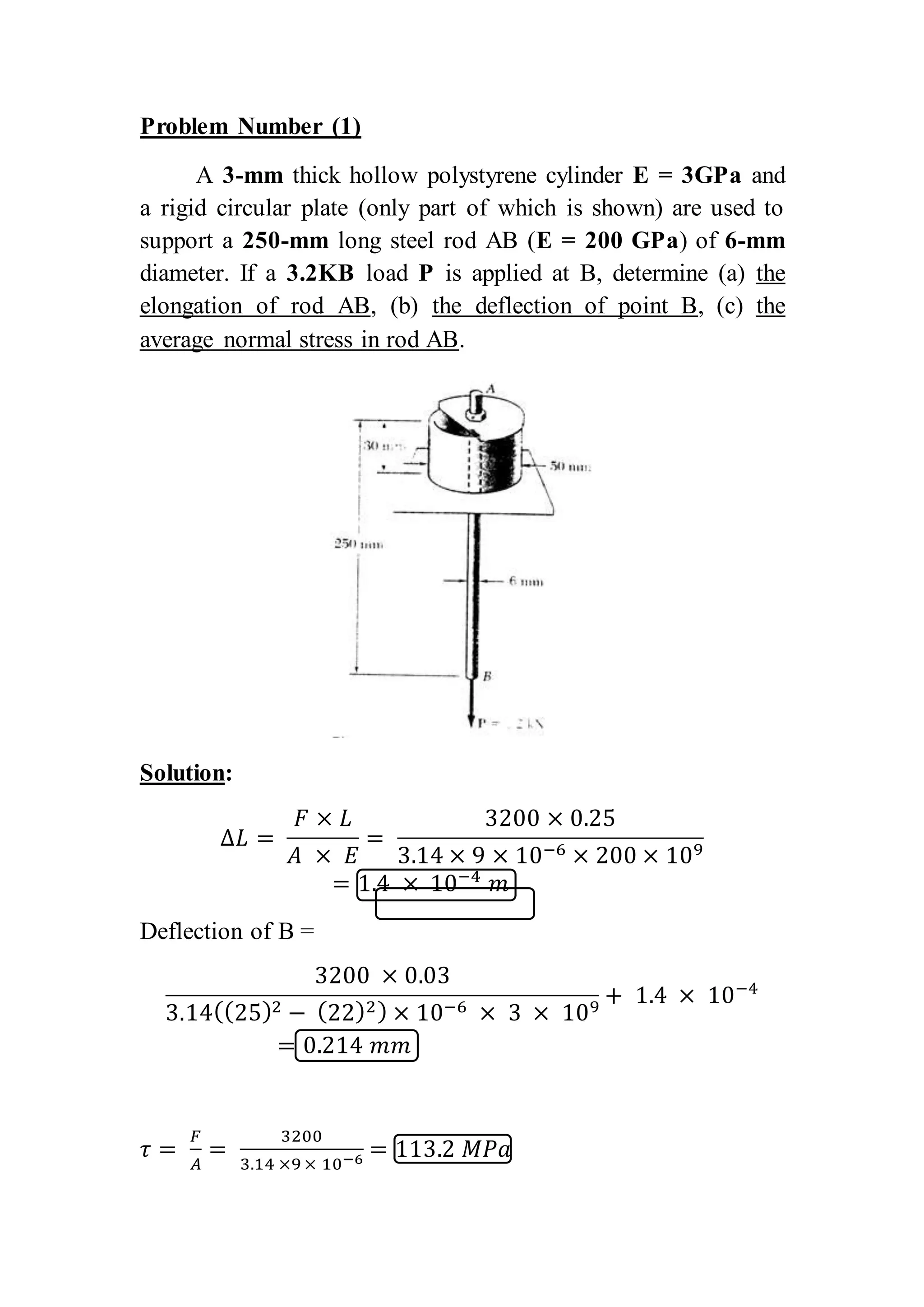
A 3-mm thick hollow polystyrene cylinder E = 3GPa and
a rigid circular plate (only part of which is shown) are used to
support a 250-mm long steel rod AB (E = 200 GPa) of 6-mm
diameter. If a 3.2KB load P is applied at B, determine (a) the
elongation of rod AB, (b) the deflection of point B, (c) the
average normal stress in rod AB.
Solution:
∆𝐿 =
𝐹 × 𝐿
𝐴 × 𝐸
=
3200 × 0.25
3.14 × 9 × 10−6 × 200 × 109
= 1.4 × 10⁻⁴
𝑚
Deflection of B =
3200 × 0.03
3.14((25)2 − (22)2) × 10−6 × 3 × 109
+ 1.4 × 10−4
= 0.214 𝑚𝑚
𝜏 =
𝐹
𝐴
=
3200
3.14 ×9 × 10−6 = 113.2 𝑀𝑃𝑎
Problem Number (2)
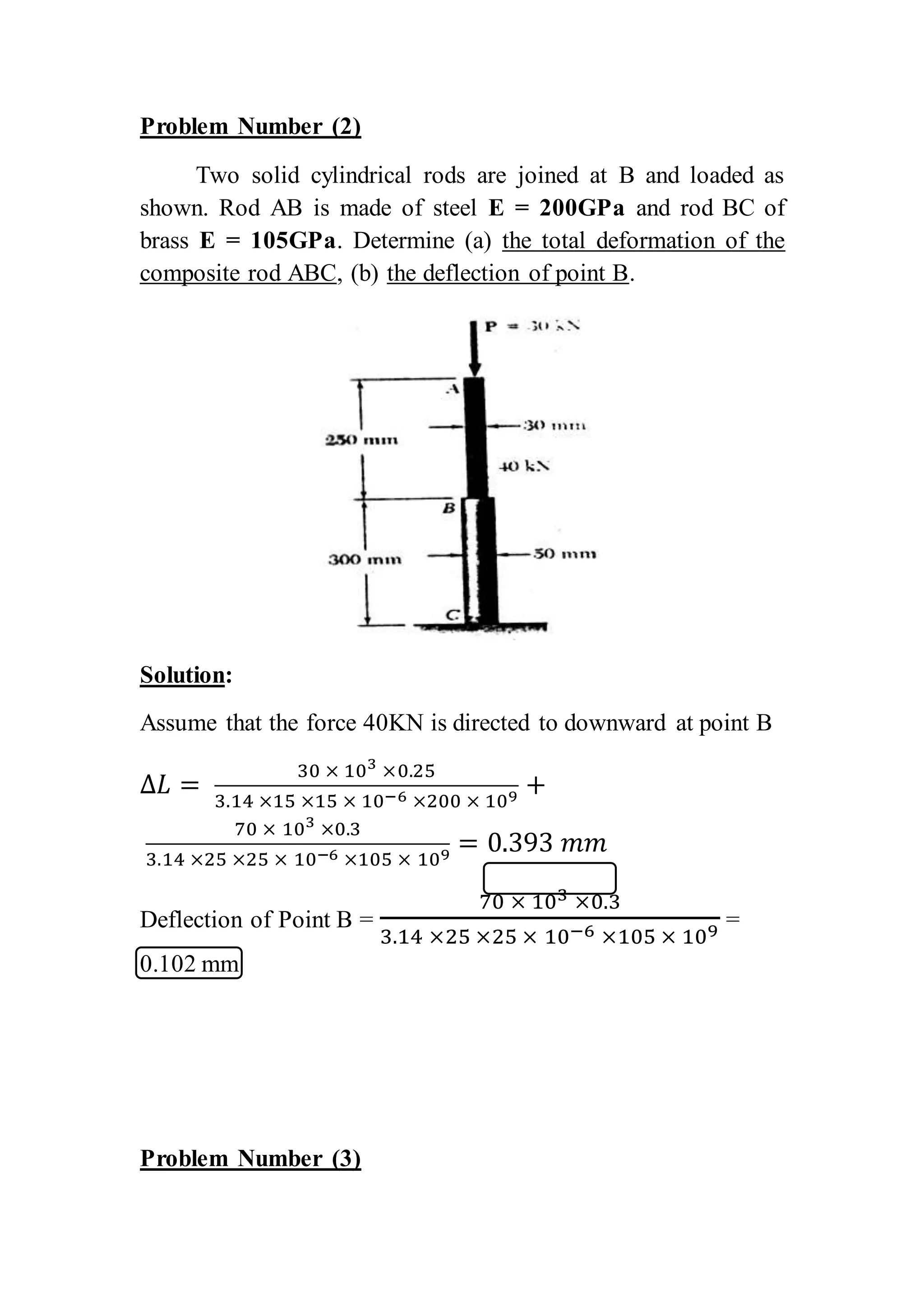
Two solid cylindrical rods are joined at B and loaded as
shown. Rod AB is made of steel E = 200GPa and rod BC of
brass E = 105GPa. Determine (a) the total deformation of the
composite rod ABC, (b) the deflection of point B.
Solution:
Assume that the force 40KN is directed to downward at point B
∆𝐿 =
30 × 103
×0.25
3.14 ×15 ×15 × 10−6 ×200 × 109
+
70 × 103
×0.3
3.14 ×25 ×25 × 10−6 ×105 × 109
= 0.393 𝑚𝑚
Deflection of Point B =
70 × 103 ×0.3
3.14 ×25 ×25 × 10−6 ×105 × 109
=
0.102 mm
Problem Number (3)
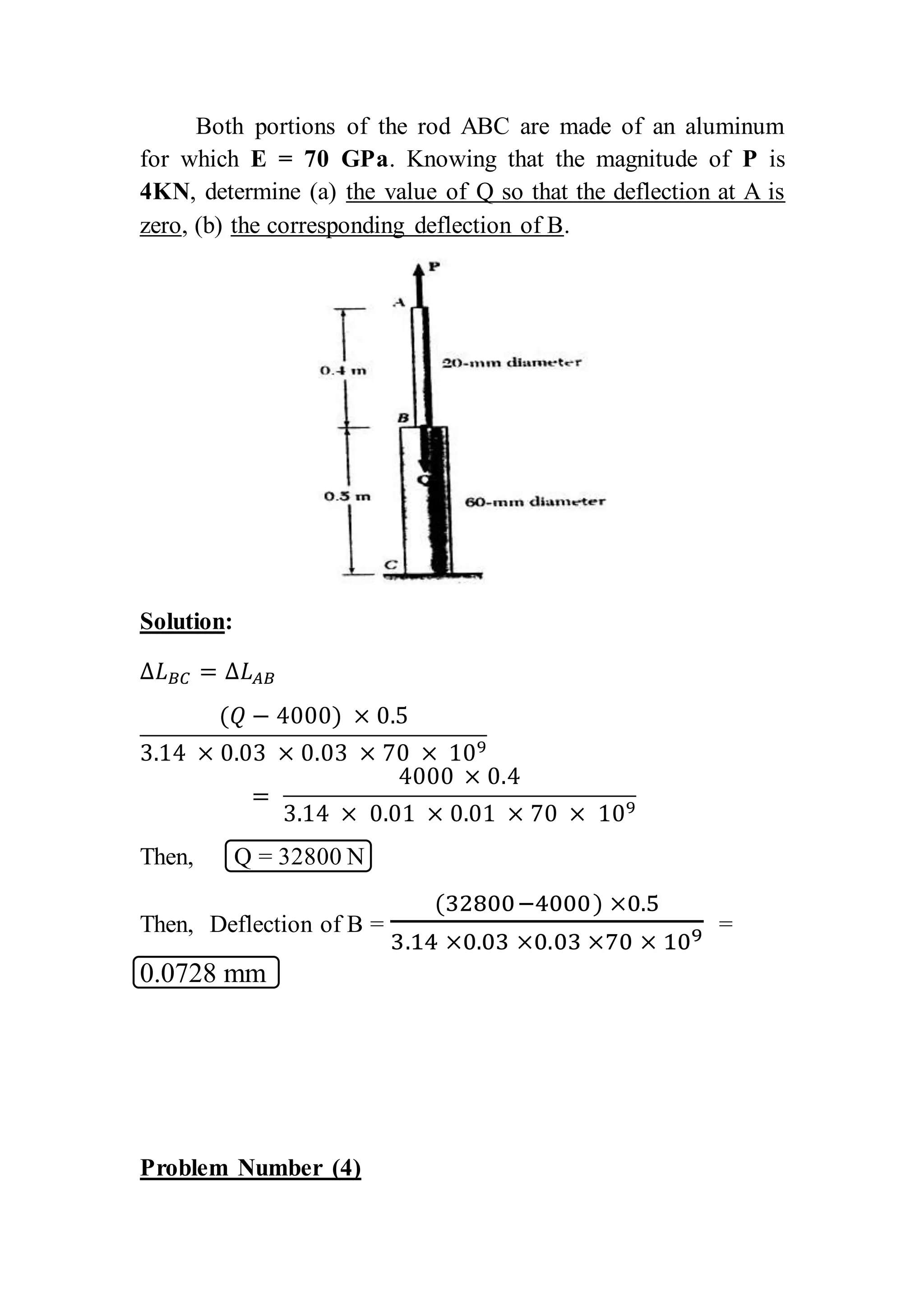
Both portions of the rod ABC are made of an aluminum
for which E = 70 GPa. Knowing that the magnitude of P is
4KN, determine (a) the value of Q so that the deflection at A is
zero, (b) the corresponding deflection of B.
Solution:
∆𝐿 𝐵𝐶 = ∆𝐿 𝐴𝐵
(𝑄 − 4000) × 0.5
3.14 × 0.03 × 0.03 × 70 × 109
=
4000 × 0.4
3.14 × 0.01 × 0.01 × 70 × 109
Then, Q = 32800 N
Then, Deflection of B =
(32800−4000) ×0.5
3.14 ×0.03 ×0.03 ×70 × 109 =
0.0728 mm
Problem Number (4)
The rod ABC is made of an aluminum for which E =
70GPa. Knowing that P = 6KN and Q = 42 KN, determine the
deflection of (a) point A, (b) point B.
Solution:
Deflection of A = ∆𝐿 𝐴𝐵 − ∆𝐿 𝐵𝐶
=
6000 ×0.4
3.14 × 0.01 ×0.01 ×70 × 109
−
(42000−6000) ×0.5
3.14 ×0.03 ×0.03 ×70 × 109
=
0.01819 𝑚𝑚
Deflection of B =
(42000−6000)×0.5
3.14 ×0.03 ×0.03 ×70 × 109
= 0.091 𝑚𝑚
Problem Number (5)
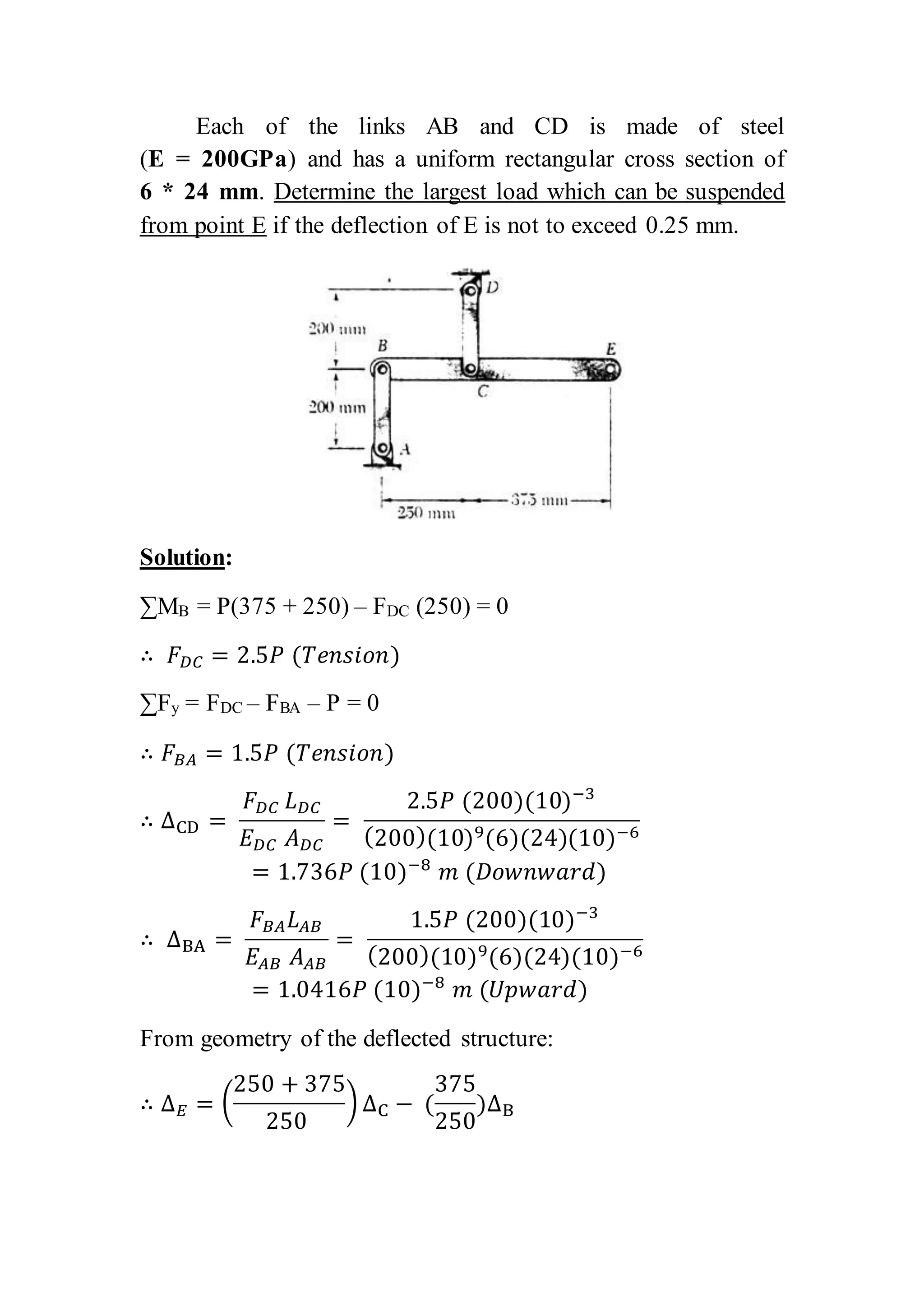
Each of the links AB and CD is made of steel
(E = 200GPa) and has a uniform rectangular cross section of
6 * 24 mm. Determine the largest load which can be suspended
from point E if the deflection of E is not to exceed 0.25 mm.
Solution:
∑MB = P(375 + 250) – FDC (250) = 0
∴ 𝐹 𝐷𝐶 = 2.5𝑃 (𝑇𝑒𝑛𝑠𝑖𝑜𝑛)
∑Fy = FDC – FBA – P = 0
∴ 𝐹 𝐵𝐴 = 1.5𝑃 (𝑇𝑒𝑛𝑠𝑖𝑜𝑛)
∴ ΔCD =
𝐹 𝐷𝐶 𝐿 𝐷𝐶
𝐸 𝐷𝐶 𝐴 𝐷𝐶
=
2.5𝑃 (200)(10)−3
(200)(10)9(6)(24)(10)−6
= 1.736𝑃 (10)−8
𝑚 (𝐷𝑜𝑤𝑛𝑤𝑎𝑟𝑑)
∴ ΔBA =
𝐹 𝐵𝐴 𝐿 𝐴𝐵
𝐸𝐴𝐵 𝐴 𝐴𝐵
=
1.5𝑃 (200)(10)−3
(200)(10)9(6)(24)(10)−6
= 1.0416𝑃 (10)−8
𝑚 (𝑈𝑝𝑤𝑎𝑟𝑑)
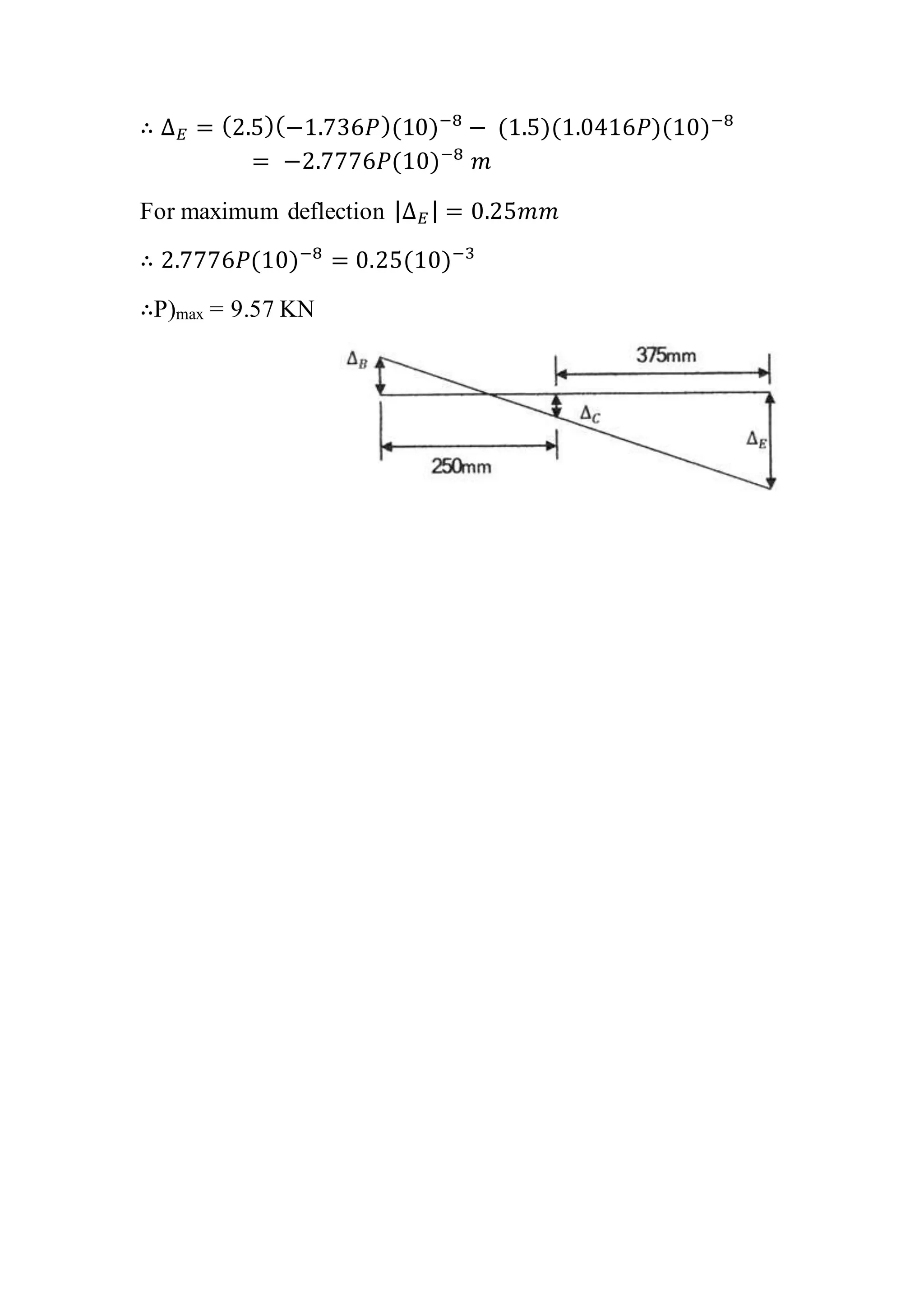
From geometry of the deflected structure:
∴ Δ 𝐸 = (
250 + 375
250
) ΔC − (
375
250
)ΔB
∴ Δ 𝐸 = (2.5)(−1.736𝑃)(10)−8
− (1.5)(1.0416𝑃)(10)−8
= −2.7776𝑃(10)−8
𝑚
For maximum deflection |Δ 𝐸 | = 0.25𝑚𝑚
∴ 2.7776𝑃(10)−8
= 0.25(10)−3
∴P)max = 9.57 KN
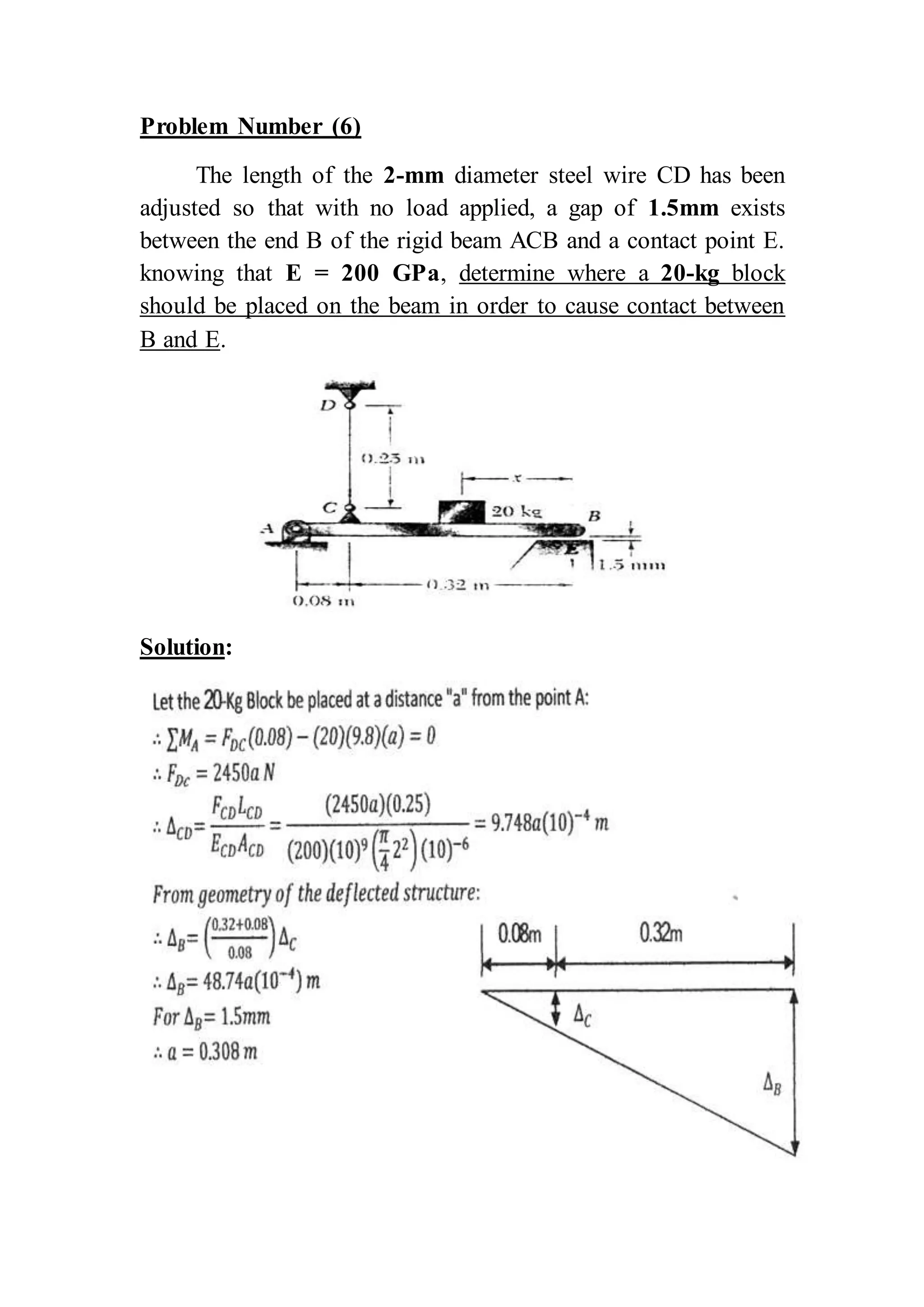
Problem Number (6)
The length of the 2-mm diameter steel wire CD has been
adjusted so that with no load applied, a gap of 1.5mm exists
between the end B of the rigid beam ACB and a contact point E.
knowing that E = 200 GPa, determine where a 20-kg block
should be placed on the beam in order to cause contact between
B and E.
Solution:

Deflection and member deformation

  • 1.
    Problem Number (1) A3-mm thick hollow polystyrene cylinder E = 3GPa and a rigid circular plate (only part of which is shown) are used to support a 250-mm long steel rod AB (E = 200 GPa) of 6-mm diameter. If a 3.2KB load P is applied at B, determine (a) the elongation of rod AB, (b) the deflection of point B, (c) the average normal stress in rod AB. Solution: ∆𝐿 = 𝐹 × 𝐿 𝐴 × 𝐸 = 3200 × 0.25 3.14 × 9 × 10−6 × 200 × 109 = 1.4 × 10⁻⁴ 𝑚 Deflection of B = 3200 × 0.03 3.14((25)2 − (22)2) × 10−6 × 3 × 109 + 1.4 × 10−4 = 0.214 𝑚𝑚 𝜏 = 𝐹 𝐴 = 3200 3.14 ×9 × 10−6 = 113.2 𝑀𝑃𝑎
  • 2.
    Problem Number (2) Twosolid cylindrical rods are joined at B and loaded as shown. Rod AB is made of steel E = 200GPa and rod BC of brass E = 105GPa. Determine (a) the total deformation of the composite rod ABC, (b) the deflection of point B. Solution: Assume that the force 40KN is directed to downward at point B ∆𝐿 = 30 × 103 ×0.25 3.14 ×15 ×15 × 10−6 ×200 × 109 + 70 × 103 ×0.3 3.14 ×25 ×25 × 10−6 ×105 × 109 = 0.393 𝑚𝑚 Deflection of Point B = 70 × 103 ×0.3 3.14 ×25 ×25 × 10−6 ×105 × 109 = 0.102 mm Problem Number (3)
  • 3.
    Both portions ofthe rod ABC are made of an aluminum for which E = 70 GPa. Knowing that the magnitude of P is 4KN, determine (a) the value of Q so that the deflection at A is zero, (b) the corresponding deflection of B. Solution: ∆𝐿 𝐵𝐶 = ∆𝐿 𝐴𝐵 (𝑄 − 4000) × 0.5 3.14 × 0.03 × 0.03 × 70 × 109 = 4000 × 0.4 3.14 × 0.01 × 0.01 × 70 × 109 Then, Q = 32800 N Then, Deflection of B = (32800−4000) ×0.5 3.14 ×0.03 ×0.03 ×70 × 109 = 0.0728 mm Problem Number (4)
  • 4.
    The rod ABCis made of an aluminum for which E = 70GPa. Knowing that P = 6KN and Q = 42 KN, determine the deflection of (a) point A, (b) point B. Solution: Deflection of A = ∆𝐿 𝐴𝐵 − ∆𝐿 𝐵𝐶 = 6000 ×0.4 3.14 × 0.01 ×0.01 ×70 × 109 − (42000−6000) ×0.5 3.14 ×0.03 ×0.03 ×70 × 109 = 0.01819 𝑚𝑚 Deflection of B = (42000−6000)×0.5 3.14 ×0.03 ×0.03 ×70 × 109 = 0.091 𝑚𝑚 Problem Number (5)
  • 5.
    Each of thelinks AB and CD is made of steel (E = 200GPa) and has a uniform rectangular cross section of 6 * 24 mm. Determine the largest load which can be suspended from point E if the deflection of E is not to exceed 0.25 mm. Solution: ∑MB = P(375 + 250) – FDC (250) = 0 ∴ 𝐹 𝐷𝐶 = 2.5𝑃 (𝑇𝑒𝑛𝑠𝑖𝑜𝑛) ∑Fy = FDC – FBA – P = 0 ∴ 𝐹 𝐵𝐴 = 1.5𝑃 (𝑇𝑒𝑛𝑠𝑖𝑜𝑛) ∴ ΔCD = 𝐹 𝐷𝐶 𝐿 𝐷𝐶 𝐸 𝐷𝐶 𝐴 𝐷𝐶 = 2.5𝑃 (200)(10)−3 (200)(10)9(6)(24)(10)−6 = 1.736𝑃 (10)−8 𝑚 (𝐷𝑜𝑤𝑛𝑤𝑎𝑟𝑑) ∴ ΔBA = 𝐹 𝐵𝐴 𝐿 𝐴𝐵 𝐸𝐴𝐵 𝐴 𝐴𝐵 = 1.5𝑃 (200)(10)−3 (200)(10)9(6)(24)(10)−6 = 1.0416𝑃 (10)−8 𝑚 (𝑈𝑝𝑤𝑎𝑟𝑑) From geometry of the deflected structure: ∴ Δ 𝐸 = ( 250 + 375 250 ) ΔC − ( 375 250 )ΔB
  • 6.
    ∴ Δ 𝐸= (2.5)(−1.736𝑃)(10)−8 − (1.5)(1.0416𝑃)(10)−8 = −2.7776𝑃(10)−8 𝑚 For maximum deflection |Δ 𝐸 | = 0.25𝑚𝑚 ∴ 2.7776𝑃(10)−8 = 0.25(10)−3 ∴P)max = 9.57 KN
  • 7.
    Problem Number (6) Thelength of the 2-mm diameter steel wire CD has been adjusted so that with no load applied, a gap of 1.5mm exists between the end B of the rigid beam ACB and a contact point E. knowing that E = 200 GPa, determine where a 20-kg block should be placed on the beam in order to cause contact between B and E. Solution: