Review of Chapters 11 & 12: METHODS FOR DEVELOPING ESSAYS
                        And ANALYSIS
 PLUS Chapter 8 review of Thesis & Using Sources For Support


    CLASS FIVE / CLASS SIX

                     EN 102
Chapter 11 --                              Highlights

  Method for Developing Essays:
  Multiple Methods Combined


   *Turn to p 178; “If The Genes Fit” by
   Dan Neil*


List the six different methods Neil uses…
Chapter 11 (Continued)

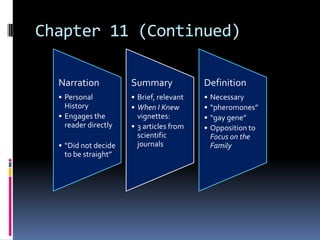
  Narration           Summary             Definition
  • Personal          • Brief, relevant   •   Necessary
    History           • When I Knew       •   “pheromones”
  • Engages the         vignettes:        •   “gay gene”
    reader directly   • 3 articles from   •   Opposition to
                        scientific            Focus on the
  • “Did not decide     journals              Family
    to be straight”
Chapter 11 (Continued)

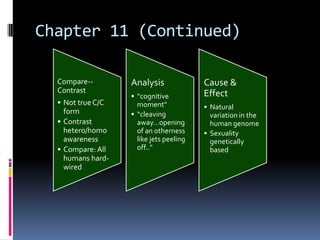
  Compare--        Analysis              Cause &
  Contrast                               Effect
                   • “cognitive
  • Not true C/C     moment”             • Natural
    form           • “cleaving             variation in the
  • Contrast         away…opening          human genome
    hetero/homo      of an otherness     • Sexuality
    awareness        like jets peeling     genetically
  • Compare: All     off..”                based
    humans hard-
    wired
Chapter 11 (Continued)

  Summary: Purpose= Give a reader a condensed, complete view of an
                     original work. (P. 425).


• Thesis reflects author’s full point: uses memorable phrase or
  expression, parallels the work it summarizes in tone & order.
• Tone is objective: no emotions reflected in tone or statements.

• In larger contexts: Used to introduce difficult material /
  ideas, give context for material, and to produce credibility that
  the writer is using the content appropriately.


                                Summary:
                                 Short, co
                                  mplete
Chapter 11 (Continued)
           Narration: Telling a single story, or several related ones.
                   Purpose: Use firsthand experiences to
               engage, entertain, inform, persuade. (P. 429).


• Powerful if focused on a provocative insight; details carefully picked & shaped.
• Help writer establish significance of event; usually no library research, but can
  add a dimension to research of the idea / topic presented.
• Dramatized; Not necessary to have “life shattering/ altering” event: can be
  humorous, witty, ironic. Thesis has to be developed from to keep surprise.
• Makes the reader “see for themselves” if skillfully done.

                                      Narration:
                                    Personal tale
                                    inside bigger
                                         idea
Chapter 11 (Continued)
      Evaluative Response: Assess the value, or quality of a movie, editorial, song
     lyric, college course, etc. Purpose: Give your judgment of a work based your
                       experience and reading of the text. (P. 438).


• Present the author’s thesis, key points and then your response: Include quotes
  from the text, and a discussion of each quotation. Analyze, evaluate central points.
• Think of it as a conversation between the author and you: Insert our examples to
  parallel, extend, or counter the author’s perspective.
• Restate your thesis in the conclusion in a different way; reread the material to
  make sure you have a complete analysis , and all relevant quotes.

                                    Evaluative
                                    Response:
                                 Assessment of
                                 written material
Chapter 11 (Continued)
   Definition: Explanation of a term or phrase. Purpose: Brief at times, also
       necessary to develop an understanding of a topic/ idea. (P. 445)


• Besides “dictionary definition”, we have 5 other types of definition that can
  help a writer develop their essay:
  Expert, Compare/Contrast, Description, Exemplify, and Negation.
• Read “You Call That Irony?” by Jon Winokur, page 446.
• How does Winokur develop his essay, using 5 of the 6 types of definition?


                                   Definition:
                                    Clarifies
                                   terms, or
                                     ideas
Chapter 11 (Continued)
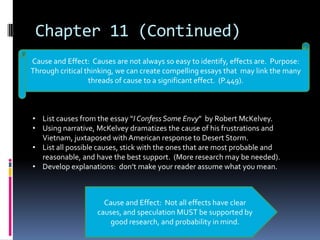
Cause and Effect: Causes are not always so easy to identify, effects are. Purpose:
Through critical thinking, we can create compelling essays that may link the many
                  threads of cause to a significant effect. (P.449).


• List causes from the essay “I Confess Some Envy” by Robert McKelvey.
• Using narrative, McKelvey dramatizes the cause of his frustrations and
  Vietnam, juxtaposed with American response to Desert Storm.
• List all possible causes, stick with the ones that are most probable and
  reasonable, and have the best support. (More research may be needed).
• Develop explanations: don’t make your reader assume what you mean.


                      Cause and Effect: Not all effects have clear
                    causes, and speculation MUST be supported by
                       good research, and probability in mind.
Chapter 11 (Concluded)
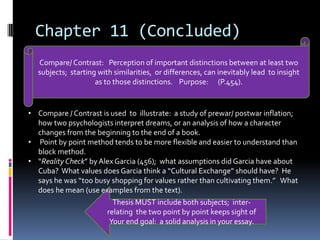
  Compare/ Contrast: Perception of important distinctions between at least two
  subjects; starting with similarities, or differences, can inevitably lead to insight
                    as to those distinctions. Purpose: (P.454).


• Compare / Contrast is used to illustrate: a study of prewar/ postwar inflation;
  how two psychologists interpret dreams, or an analysis of how a character
  changes from the beginning to the end of a book.
• Point by point method tends to be more flexible and easier to understand than
  block method.
• “Reality Check” by Alex Garcia (456); what assumptions did Garcia have about
  Cuba? What values does Garcia think a “Cultural Exchange” should have? He
  says he was “too busy shopping for values rather than cultivating them.” What
  does he mean (use examples from the text).
                          Thesis MUST include both subjects; inter-
                        relating the two point by point keeps sight of
                         Your end goal: a solid analysis in your essay.
Chapter 12   Highlights

                     Analysis:
                     Process, Problem, or
                     Subject
                     (P. 461).
Chapter 12 (continued)
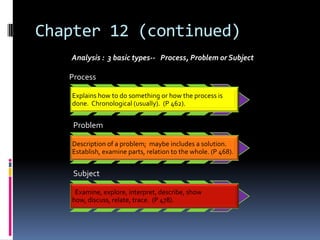
   Analysis : 3 basic types-- Process, Problem or Subject

   Process

   Explains how to do something or how the process is
   done. Chronological (usually). (P 462).


    Problem

   Description of a problem; maybe includes a solution.
   Establish, examine parts, relation to the whole. (P 468).


    Subject

    Examine, explore, interpret, describe, show
   how, discuss, relate, trace. (P 478).
Chapter 12 (Continued)
For our Poetry Assignment, we will be using “Subject Analysis”: Turn to 476.


                              Key words:
                        Denotation, Connotation
                            Images: 5 senses
                           Figures of Speech:
                           Metaphor or Simile
                        Personification, Symboli
                                   sm
Chapter 12 (Continued)
On page 478, review “Breaking Tradition” analysis; on pages 480-
483, review the MLA cited work by student Robert Sakatani: note how each
quote from the poem is followed by line citations. What sentence is the
thesis?


                         Also, when the poem
                           line ends (called a
                        break) Robert inserts a
                           “ / “, with space on
                        either side of the break.
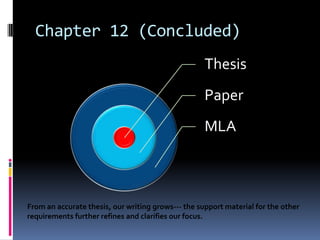
Chapter 12 (Concluded)
                                                    Thesis
                                                    Paper
                                                    MLA


From an accurate thesis, our writing grows--- the support material for the other
requirements further refines and clarifies our focus.
Chapter 8 Review: THESIS                                                  (p 353)


             A THESIS is: An assertion or claim about a limited subject
           , expressed in a single sentence… the essay will support / prove /
                                        describe.

            (Read the 10 sentences on 354– which make suitable thesis’?)


The “ideal” is a Forecasting or Blueprint Thesis: it has clarity of ideas, and
anticipates development of the paper.

A “Missing” Thesis: the main idea is implied throughout the text, but not stated
outright.

Many Thesis statements are placed inside the introduction: this helps both the
writer, and reader follow the text much easier. Use the “So What” strategy to
hew a strong thesis for your essay.
Chapter 8 Review: Using
  Sources for Support (P 372).

                                          Give Credit to Avoid Plagiarism!!!

                                Use the “sandwich” technique: start with a LEAD IN
                                             Next: the direct quotation
                                           Then: Analysis or Commentary
                                          [Look @ the examples on 374-5.]


Make sure the text is integrated into the writing: like puzzle pieces, if it
doesn’t fit, you have got to keep looking… (Examples : 375).

Power point presentation - class five six ch 11 12 --ch 2

  • 1.
    Review of Chapters11 & 12: METHODS FOR DEVELOPING ESSAYS And ANALYSIS PLUS Chapter 8 review of Thesis & Using Sources For Support CLASS FIVE / CLASS SIX EN 102
  • 2.
    Chapter 11 -- Highlights Method for Developing Essays: Multiple Methods Combined *Turn to p 178; “If The Genes Fit” by Dan Neil* List the six different methods Neil uses…
  • 3.
    Chapter 11 (Continued) Narration Summary Definition • Personal • Brief, relevant • Necessary History • When I Knew • “pheromones” • Engages the vignettes: • “gay gene” reader directly • 3 articles from • Opposition to scientific Focus on the • “Did not decide journals Family to be straight”
  • 4.
    Chapter 11 (Continued) Compare-- Analysis Cause & Contrast Effect • “cognitive • Not true C/C moment” • Natural form • “cleaving variation in the • Contrast away…opening human genome hetero/homo of an otherness • Sexuality awareness like jets peeling genetically • Compare: All off..” based humans hard- wired
  • 5.
    Chapter 11 (Continued) Summary: Purpose= Give a reader a condensed, complete view of an original work. (P. 425). • Thesis reflects author’s full point: uses memorable phrase or expression, parallels the work it summarizes in tone & order. • Tone is objective: no emotions reflected in tone or statements. • In larger contexts: Used to introduce difficult material / ideas, give context for material, and to produce credibility that the writer is using the content appropriately. Summary: Short, co mplete
  • 6.
    Chapter 11 (Continued) Narration: Telling a single story, or several related ones. Purpose: Use firsthand experiences to engage, entertain, inform, persuade. (P. 429). • Powerful if focused on a provocative insight; details carefully picked & shaped. • Help writer establish significance of event; usually no library research, but can add a dimension to research of the idea / topic presented. • Dramatized; Not necessary to have “life shattering/ altering” event: can be humorous, witty, ironic. Thesis has to be developed from to keep surprise. • Makes the reader “see for themselves” if skillfully done. Narration: Personal tale inside bigger idea
  • 7.
    Chapter 11 (Continued) Evaluative Response: Assess the value, or quality of a movie, editorial, song lyric, college course, etc. Purpose: Give your judgment of a work based your experience and reading of the text. (P. 438). • Present the author’s thesis, key points and then your response: Include quotes from the text, and a discussion of each quotation. Analyze, evaluate central points. • Think of it as a conversation between the author and you: Insert our examples to parallel, extend, or counter the author’s perspective. • Restate your thesis in the conclusion in a different way; reread the material to make sure you have a complete analysis , and all relevant quotes. Evaluative Response: Assessment of written material
  • 8.
    Chapter 11 (Continued) Definition: Explanation of a term or phrase. Purpose: Brief at times, also necessary to develop an understanding of a topic/ idea. (P. 445) • Besides “dictionary definition”, we have 5 other types of definition that can help a writer develop their essay: Expert, Compare/Contrast, Description, Exemplify, and Negation. • Read “You Call That Irony?” by Jon Winokur, page 446. • How does Winokur develop his essay, using 5 of the 6 types of definition? Definition: Clarifies terms, or ideas
  • 9.
    Chapter 11 (Continued) Causeand Effect: Causes are not always so easy to identify, effects are. Purpose: Through critical thinking, we can create compelling essays that may link the many threads of cause to a significant effect. (P.449). • List causes from the essay “I Confess Some Envy” by Robert McKelvey. • Using narrative, McKelvey dramatizes the cause of his frustrations and Vietnam, juxtaposed with American response to Desert Storm. • List all possible causes, stick with the ones that are most probable and reasonable, and have the best support. (More research may be needed). • Develop explanations: don’t make your reader assume what you mean. Cause and Effect: Not all effects have clear causes, and speculation MUST be supported by good research, and probability in mind.
  • 10.
    Chapter 11 (Concluded) Compare/ Contrast: Perception of important distinctions between at least two subjects; starting with similarities, or differences, can inevitably lead to insight as to those distinctions. Purpose: (P.454). • Compare / Contrast is used to illustrate: a study of prewar/ postwar inflation; how two psychologists interpret dreams, or an analysis of how a character changes from the beginning to the end of a book. • Point by point method tends to be more flexible and easier to understand than block method. • “Reality Check” by Alex Garcia (456); what assumptions did Garcia have about Cuba? What values does Garcia think a “Cultural Exchange” should have? He says he was “too busy shopping for values rather than cultivating them.” What does he mean (use examples from the text). Thesis MUST include both subjects; inter- relating the two point by point keeps sight of Your end goal: a solid analysis in your essay.
  • 11.
    Chapter 12 Highlights Analysis: Process, Problem, or Subject (P. 461).
  • 12.
    Chapter 12 (continued) Analysis : 3 basic types-- Process, Problem or Subject Process Explains how to do something or how the process is done. Chronological (usually). (P 462). Problem Description of a problem; maybe includes a solution. Establish, examine parts, relation to the whole. (P 468). Subject Examine, explore, interpret, describe, show how, discuss, relate, trace. (P 478).
  • 13.
    Chapter 12 (Continued) Forour Poetry Assignment, we will be using “Subject Analysis”: Turn to 476. Key words: Denotation, Connotation Images: 5 senses Figures of Speech: Metaphor or Simile Personification, Symboli sm
  • 14.
    Chapter 12 (Continued) Onpage 478, review “Breaking Tradition” analysis; on pages 480- 483, review the MLA cited work by student Robert Sakatani: note how each quote from the poem is followed by line citations. What sentence is the thesis? Also, when the poem line ends (called a break) Robert inserts a “ / “, with space on either side of the break.
  • 15.
    Chapter 12 (Concluded) Thesis Paper MLA From an accurate thesis, our writing grows--- the support material for the other requirements further refines and clarifies our focus.
  • 16.
    Chapter 8 Review:THESIS (p 353) A THESIS is: An assertion or claim about a limited subject , expressed in a single sentence… the essay will support / prove / describe. (Read the 10 sentences on 354– which make suitable thesis’?) The “ideal” is a Forecasting or Blueprint Thesis: it has clarity of ideas, and anticipates development of the paper. A “Missing” Thesis: the main idea is implied throughout the text, but not stated outright. Many Thesis statements are placed inside the introduction: this helps both the writer, and reader follow the text much easier. Use the “So What” strategy to hew a strong thesis for your essay.
  • 17.
    Chapter 8 Review:Using Sources for Support (P 372). Give Credit to Avoid Plagiarism!!! Use the “sandwich” technique: start with a LEAD IN Next: the direct quotation Then: Analysis or Commentary [Look @ the examples on 374-5.] Make sure the text is integrated into the writing: like puzzle pieces, if it doesn’t fit, you have got to keep looking… (Examples : 375).