Presenting
Reasonable
Arguments
Presented by: Group 4
ENGLISH FOR ACADEMIC AND PROFESSIONAL PURPOSES
QUARTER 2 – MODULE 2:
BusinessPlan PPT Template
Page 2
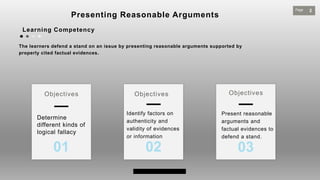
Learning Competency:
Presenting Reasonable Arguments
Determine
different kinds of
logical fallacy
Identify factors on
authenticity and
validity of evidences
or information
Present reasonable
arguments and
factual evidences to
defend a stand.
Objectives Objectives Objectives
The learners defend a stand on an issue by presenting reasonable arguments supported by
properly cited factual evidences.
3
Page
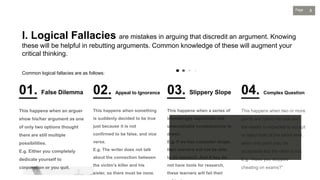
I. Logical Fallacies are mistakes in arguing that discredit an argument. Knowing
these will be helpful in rebutting arguments. Common knowledge of these will augment your
critical thinking.
Common logical fallacies are as follows:
01. False Dilemma 02. Appeal to Ignorance 03. Slippery Slope 04. Complex Question
4
Page
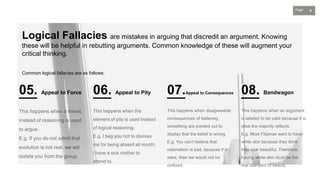
Logical Fallacies are mistakes in arguing that discredit an argument. Knowing
these will be helpful in rebutting arguments. Common knowledge of these will augment your
critical thinking.
Common logical fallacies are as follows:
05. Appeal to Force 06. Appeal to Pity 07.Appeal to Consequences 08. Bandwagon
5
Page
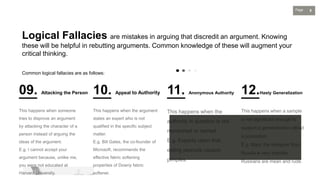
Logical Fallacies are mistakes in arguing that discredit an argument. Knowing
these will be helpful in rebutting arguments. Common knowledge of these will augment your
critical thinking.
Common logical fallacies are as follows:
09. Attacking the Person 10. Appeal to Authority 11. Anonymous Authority 12.Hasty Generalization
6
Page
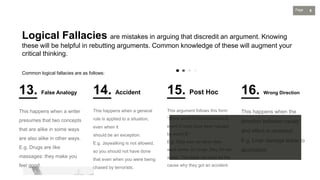
Logical Fallacies are mistakes in arguing that discredit an argument. Knowing
these will be helpful in rebutting arguments. Common knowledge of these will augment your
critical thinking.
Common logical fallacies are as follows:
13. False Analogy 14. Accident 15. Post Hoc 16. Wrong Direction
7
Page
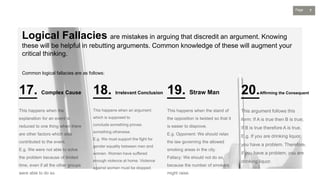
Logical Fallacies are mistakes in arguing that discredit an argument. Knowing
these will be helpful in rebutting arguments. Common knowledge of these will augment your
critical thinking.
Common logical fallacies are as follows:
17. Complex Cause 18. Irrelevant Conclusion 19. Straw Man 20.Affirming the Consequent
8
Page
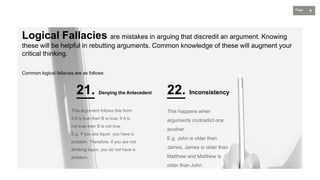
Logical Fallacies are mistakes in arguing that discredit an argument. Knowing
these will be helpful in rebutting arguments. Common knowledge of these will augment your
critical thinking.
Common logical fallacies are as follows:
21. Denying the Antecedent 22. Inconsistency
II. FACTORS ON AUTHENTICITY
AND VALIDITY OF EVIDENCES
OR INFORMATION
With myriad of information found in the net, it is a necessity to validate
every information. The following factors are necessary to validate
evidences:
1. Relevance of the Source
• The source should support
your position
• Title, table of contents,
summary, introduction or
headings of the text should
have a sense of its content.
2.Authority/Author’s
Qualifications
• The author’s name
should be identified.
• Author’s background,
education or training
should be related to the
topic.
3. Currency/Date of
Publication
• Date of the publication is
indicated
• The date of publication
should be at most five
years earlier.
II. FACTORS ON AUTHENTICITY
AND VALIDITY OF EVIDENCES
OR INFORMATION
With myriad of information found in the net, it is a necessity to validate
every information. The following factors are necessary to validate
evidences:
4. Contents/Accuracy
of Information
• The author uses citation and
shows ample references.
• Sources are verifiable.
5. Location of Sources
• Publication should be indicated either digital or printed.
• Type should be indicated either a book, academic journal, reputable news, etc.
• It provides complete publication information such as author/s, editor/s, title, date
of publication and publisher
• Refrain from using blogs or personal homepage and wiki sites.
• If the URL includes the top-level domain .edu, then that means that it has been
published by an academic institution such as university.
• Common URLs include .gov (government), .org (organizations), .com
(commercial sites) and .net (network infrastructures). In academic writing,
trustworthy sites are those with .edu, .gov, .net and .org in URL.
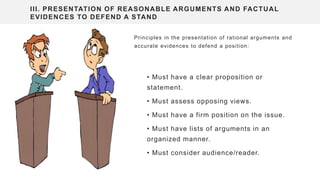
III. PRESENTATION OF REASONABLE ARGUMENTS AND FACTUAL
EVIDENCES TO DEFEND A STAND
• Must have a clear proposition or
statement.
• Must assess opposing views.
• Must have a firm position on the issue.
• Must have lists of arguments in an
organized manner.
• Must consider audience/reader.
Principles in the presentation of rational arguments and
accurate evidences to defend a position:

Presenting Reasonable Arguments (group 4).pptx

  • 1.
    Presenting Reasonable Arguments Presented by: Group4 ENGLISH FOR ACADEMIC AND PROFESSIONAL PURPOSES QUARTER 2 – MODULE 2:
  • 2.
    BusinessPlan PPT Template Page2 Learning Competency: Presenting Reasonable Arguments Determine different kinds of logical fallacy Identify factors on authenticity and validity of evidences or information Present reasonable arguments and factual evidences to defend a stand. Objectives Objectives Objectives The learners defend a stand on an issue by presenting reasonable arguments supported by properly cited factual evidences.
  • 3.
    3 Page I. Logical Fallaciesare mistakes in arguing that discredit an argument. Knowing these will be helpful in rebutting arguments. Common knowledge of these will augment your critical thinking. Common logical fallacies are as follows: 01. False Dilemma 02. Appeal to Ignorance 03. Slippery Slope 04. Complex Question
  • 4.
    4 Page Logical Fallacies aremistakes in arguing that discredit an argument. Knowing these will be helpful in rebutting arguments. Common knowledge of these will augment your critical thinking. Common logical fallacies are as follows: 05. Appeal to Force 06. Appeal to Pity 07.Appeal to Consequences 08. Bandwagon
  • 5.
    5 Page Logical Fallacies aremistakes in arguing that discredit an argument. Knowing these will be helpful in rebutting arguments. Common knowledge of these will augment your critical thinking. Common logical fallacies are as follows: 09. Attacking the Person 10. Appeal to Authority 11. Anonymous Authority 12.Hasty Generalization
  • 6.
    6 Page Logical Fallacies aremistakes in arguing that discredit an argument. Knowing these will be helpful in rebutting arguments. Common knowledge of these will augment your critical thinking. Common logical fallacies are as follows: 13. False Analogy 14. Accident 15. Post Hoc 16. Wrong Direction
  • 7.
    7 Page Logical Fallacies aremistakes in arguing that discredit an argument. Knowing these will be helpful in rebutting arguments. Common knowledge of these will augment your critical thinking. Common logical fallacies are as follows: 17. Complex Cause 18. Irrelevant Conclusion 19. Straw Man 20.Affirming the Consequent
  • 8.
    8 Page Logical Fallacies aremistakes in arguing that discredit an argument. Knowing these will be helpful in rebutting arguments. Common knowledge of these will augment your critical thinking. Common logical fallacies are as follows: 21. Denying the Antecedent 22. Inconsistency
  • 9.
    II. FACTORS ONAUTHENTICITY AND VALIDITY OF EVIDENCES OR INFORMATION With myriad of information found in the net, it is a necessity to validate every information. The following factors are necessary to validate evidences: 1. Relevance of the Source • The source should support your position • Title, table of contents, summary, introduction or headings of the text should have a sense of its content. 2.Authority/Author’s Qualifications • The author’s name should be identified. • Author’s background, education or training should be related to the topic. 3. Currency/Date of Publication • Date of the publication is indicated • The date of publication should be at most five years earlier.
  • 10.
    II. FACTORS ONAUTHENTICITY AND VALIDITY OF EVIDENCES OR INFORMATION With myriad of information found in the net, it is a necessity to validate every information. The following factors are necessary to validate evidences: 4. Contents/Accuracy of Information • The author uses citation and shows ample references. • Sources are verifiable. 5. Location of Sources • Publication should be indicated either digital or printed. • Type should be indicated either a book, academic journal, reputable news, etc. • It provides complete publication information such as author/s, editor/s, title, date of publication and publisher • Refrain from using blogs or personal homepage and wiki sites. • If the URL includes the top-level domain .edu, then that means that it has been published by an academic institution such as university. • Common URLs include .gov (government), .org (organizations), .com (commercial sites) and .net (network infrastructures). In academic writing, trustworthy sites are those with .edu, .gov, .net and .org in URL.
  • 11.
    III. PRESENTATION OFREASONABLE ARGUMENTS AND FACTUAL EVIDENCES TO DEFEND A STAND • Must have a clear proposition or statement. • Must assess opposing views. • Must have a firm position on the issue. • Must have lists of arguments in an organized manner. • Must consider audience/reader. Principles in the presentation of rational arguments and accurate evidences to defend a position: