UNDERSTANDING VERB
TENSE
What are the verb tenses?
Present and present perfect
Past and past perfect
Future and future perfect
Consistency of tense
Modals
Review A
Review B
What are the verb tenses?
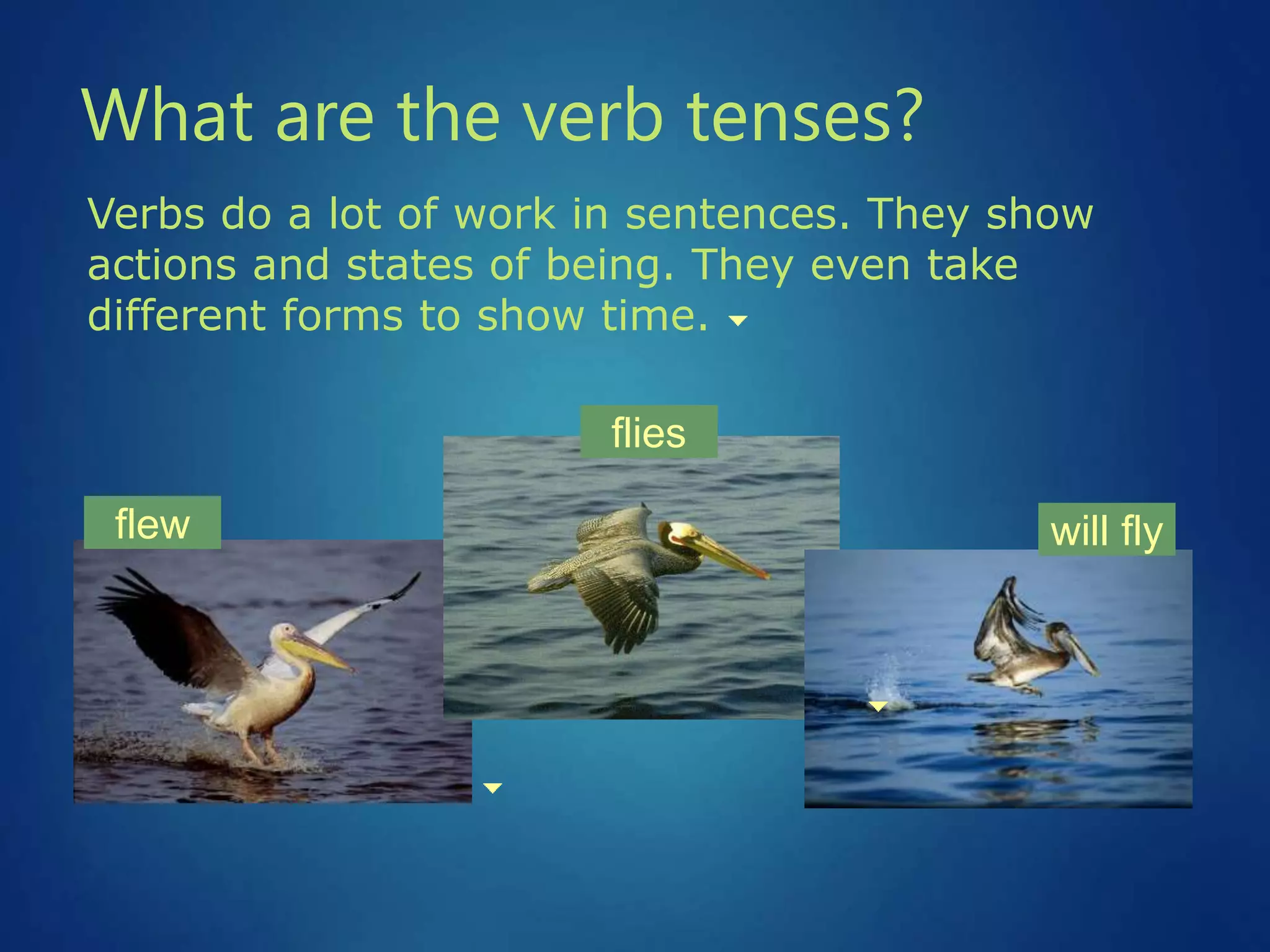
Verbs do a lot of work in sentences. They show
actions and states of being. They even take
different forms to show time.
flies
flew will fly
Gwen plays guitar in a jazz band.
The tense of a verb indicates the time of the
action or state of being expressed by the verb.
Past Future
Present
Present Perfect
She has played in the band for three years.
Future
Future Perfect
Perfect tenses indicate that something happened
or existed before a specific point in time.
Gwen will play in a concert tomorrow.
She will have played in ten concerts by April.
Past
Gwen played last year as well.
Past Perfect
She had played violin before then.
Present
What are the verb tenses?
The tenses of verbs are formed from the four
principal parts of verbs.
Present Participle
Base Form
Past
Past Participle
smile choose
[is] smil [is] choos ing
smile d cho se
[have] smile d [have] cho sen
ing
What are the verb tenses?
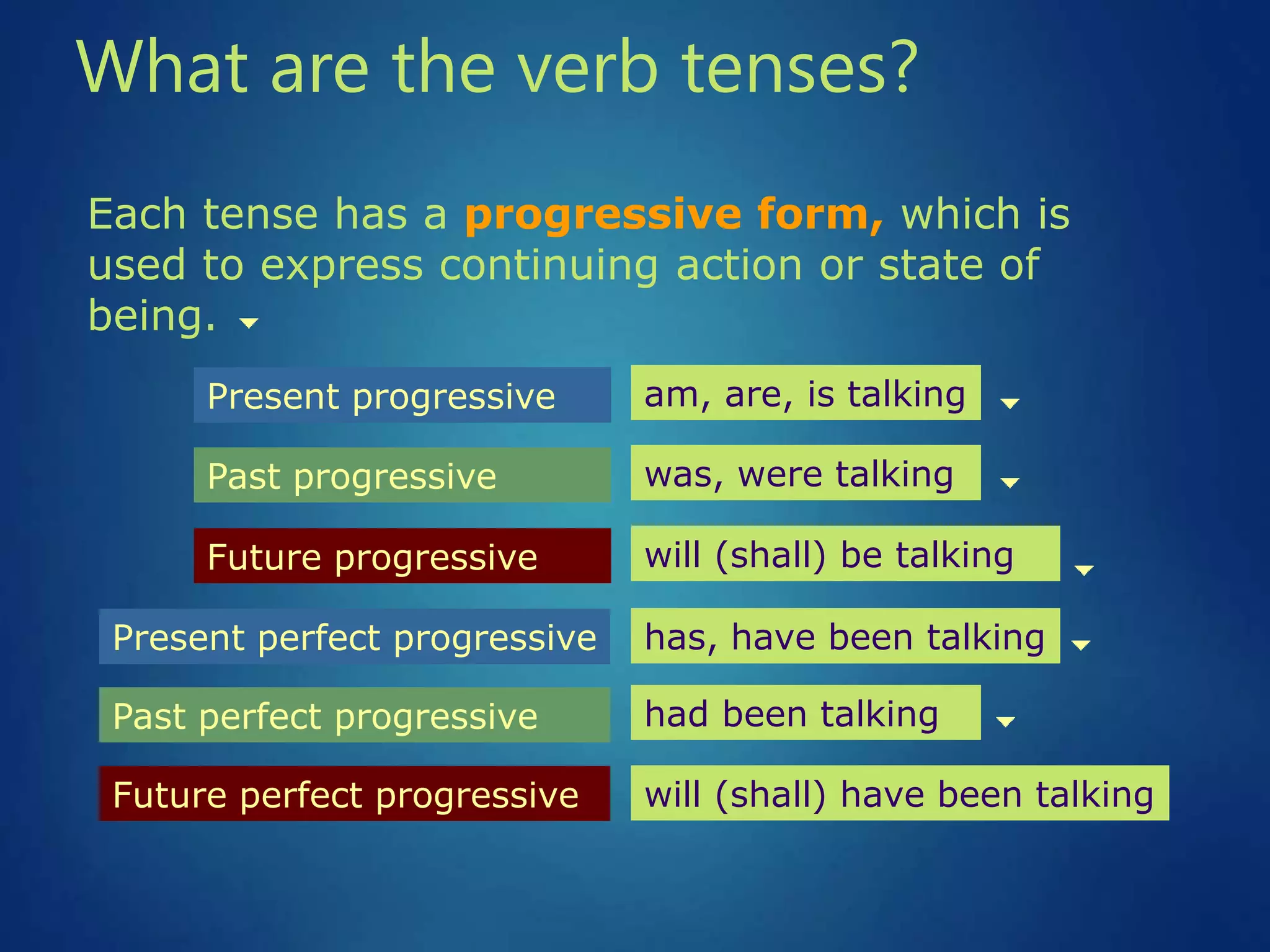
Each tense has a progressive form, which is
used to express continuing action or state of
being.
What are the verb tenses?
Present progressive am, are, is talking
Past progressive was, were talking
Future progressive will (shall) be talking
Present perfect progressive has, have been talking
Past perfect progressive had been talking
Future perfect progressive will (shall) have been talking
What are the verb tenses?
Present and present perfect
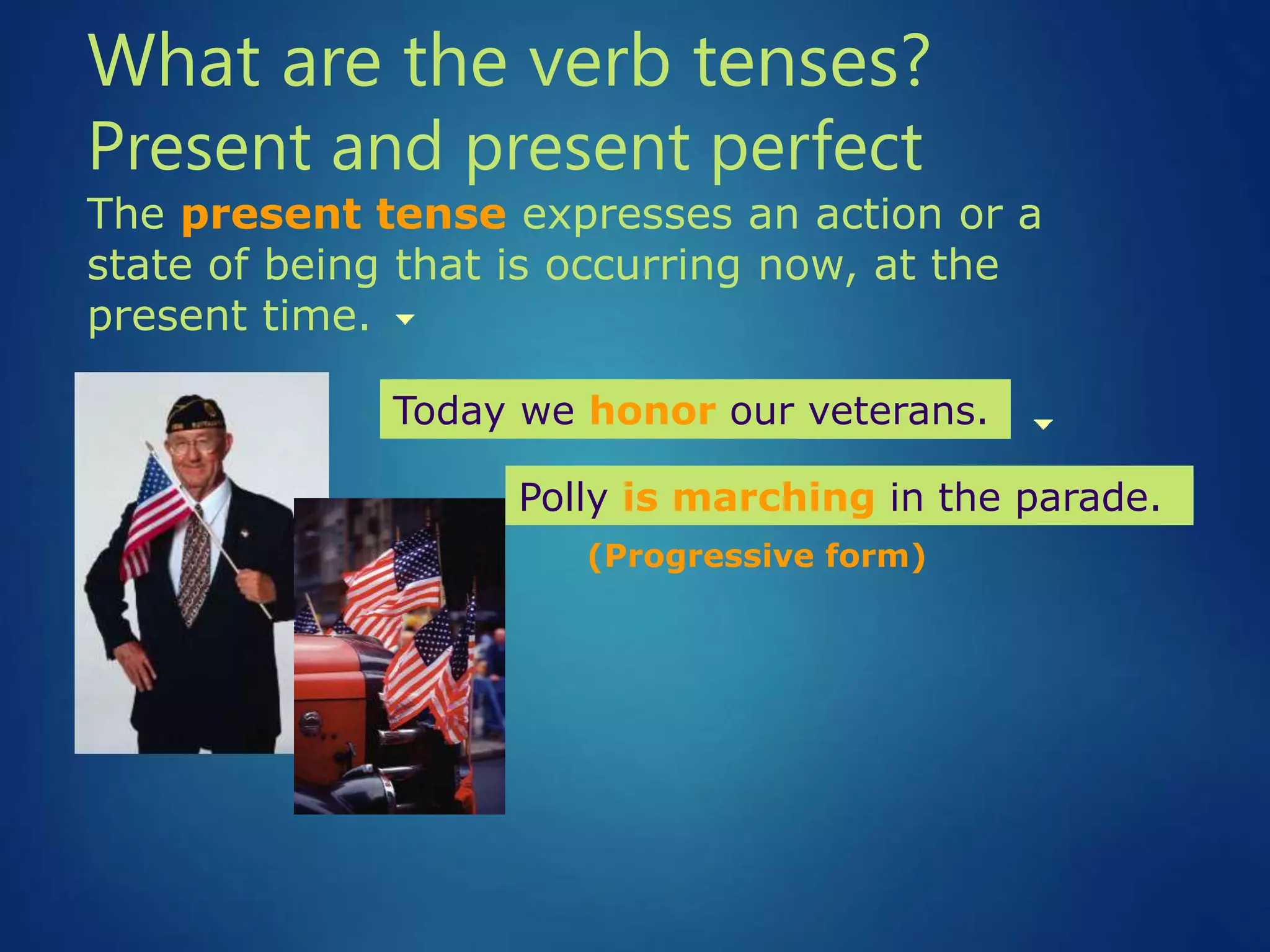
The present tense expresses an action or a
state of being that is occurring now, at the
present time.
Today we honor our veterans.
Polly is marching in the parade.
(Progressive form)
What are the verb tenses?
Present and present perfect
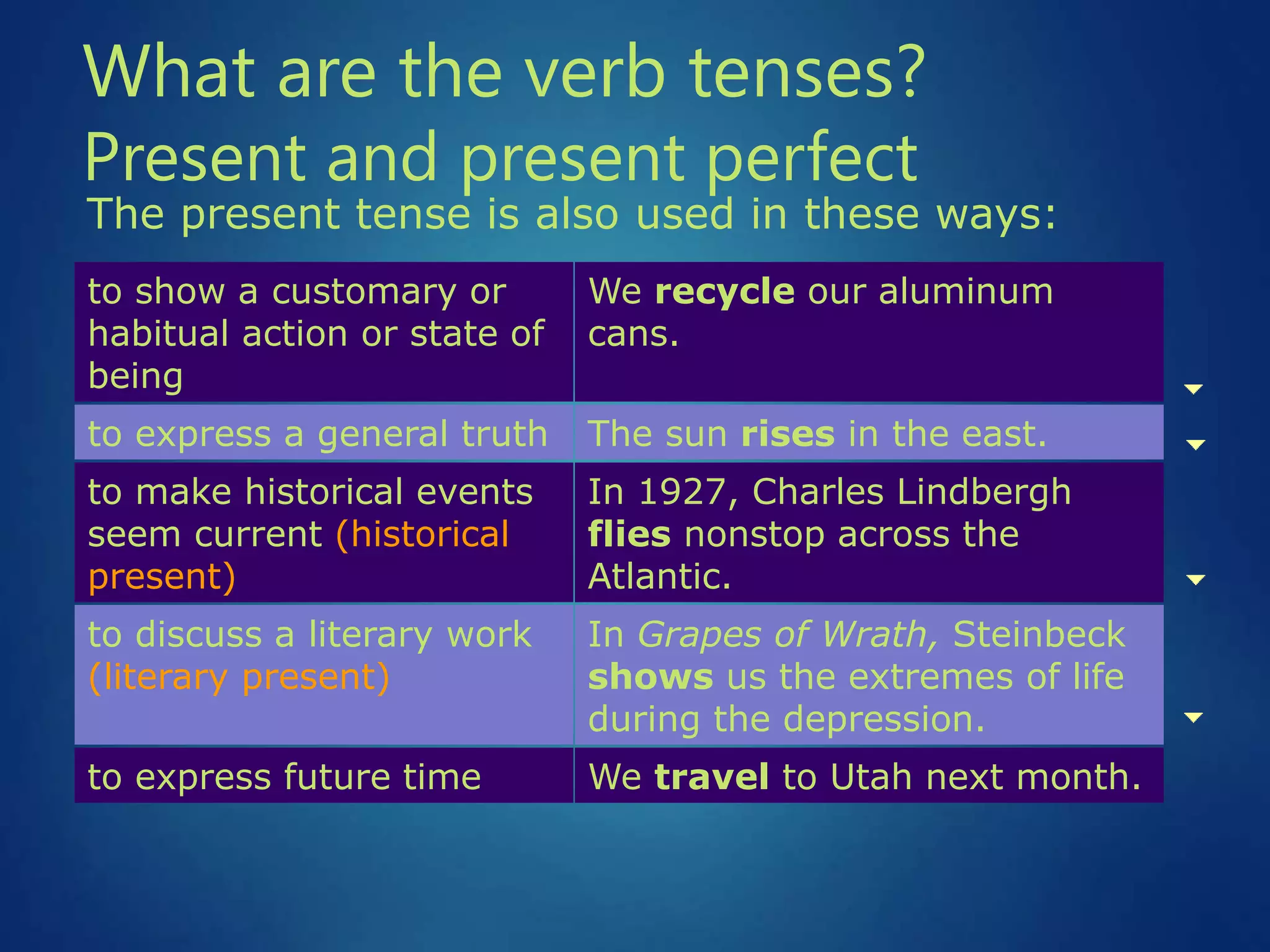
The present tense is also used in these ways:
In Grapes of Wrath, Steinbeck
shows us the extremes of life
during the depression.
to discuss a literary work
(literary present)
In 1927, Charles Lindbergh
flies nonstop across the
Atlantic.
to make historical events
seem current (historical
present)
The sun rises in the east.
to express a general truth
We recycle our aluminum
cans.
to show a customary or
habitual action or state of
being
We travel to Utah next month.
to express future time
What are the verb tenses?
Present and present perfect
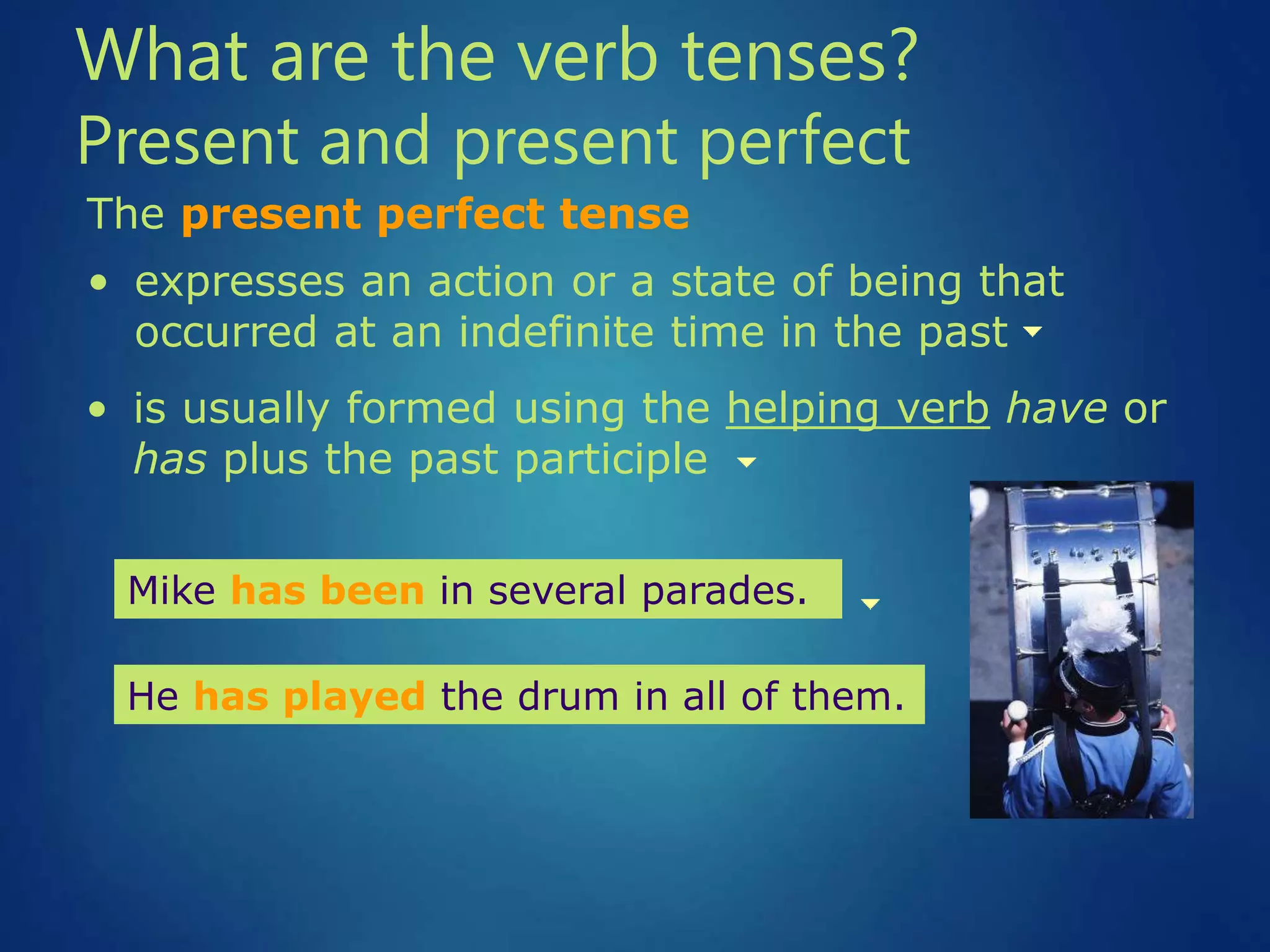
The present perfect tense
• is usually formed using the helping verb have or
has plus the past participle
• expresses an action or a state of being that
occurred at an indefinite time in the past
Mike has been in several parades.
He has played the drum in all of them.
What are the verb tenses?
A helping verb (also called an auxiliary verb) is
used with a main verb to create a verb phrase.
I was reading a novel by Sandra Cisneros.
I was reading a book by Sandra Cisneros.
Helping
verb
Main
verb
Verb phrase
Some commonly used helping verbs include is,
are, has, had, did, does, can, could, should, and
will.
What are the verb tenses?
Present and present perfect
The present perfect tense is also used to
express an action or state of being that began in
the past and continues into the present. In this
case, perfect means complete.
Yoko has been taking flute lessons for
six years.
Mr. Lee has taught music at our
school since 2004.
(Progressive form)
What are the verb tenses?
Past and past perfect
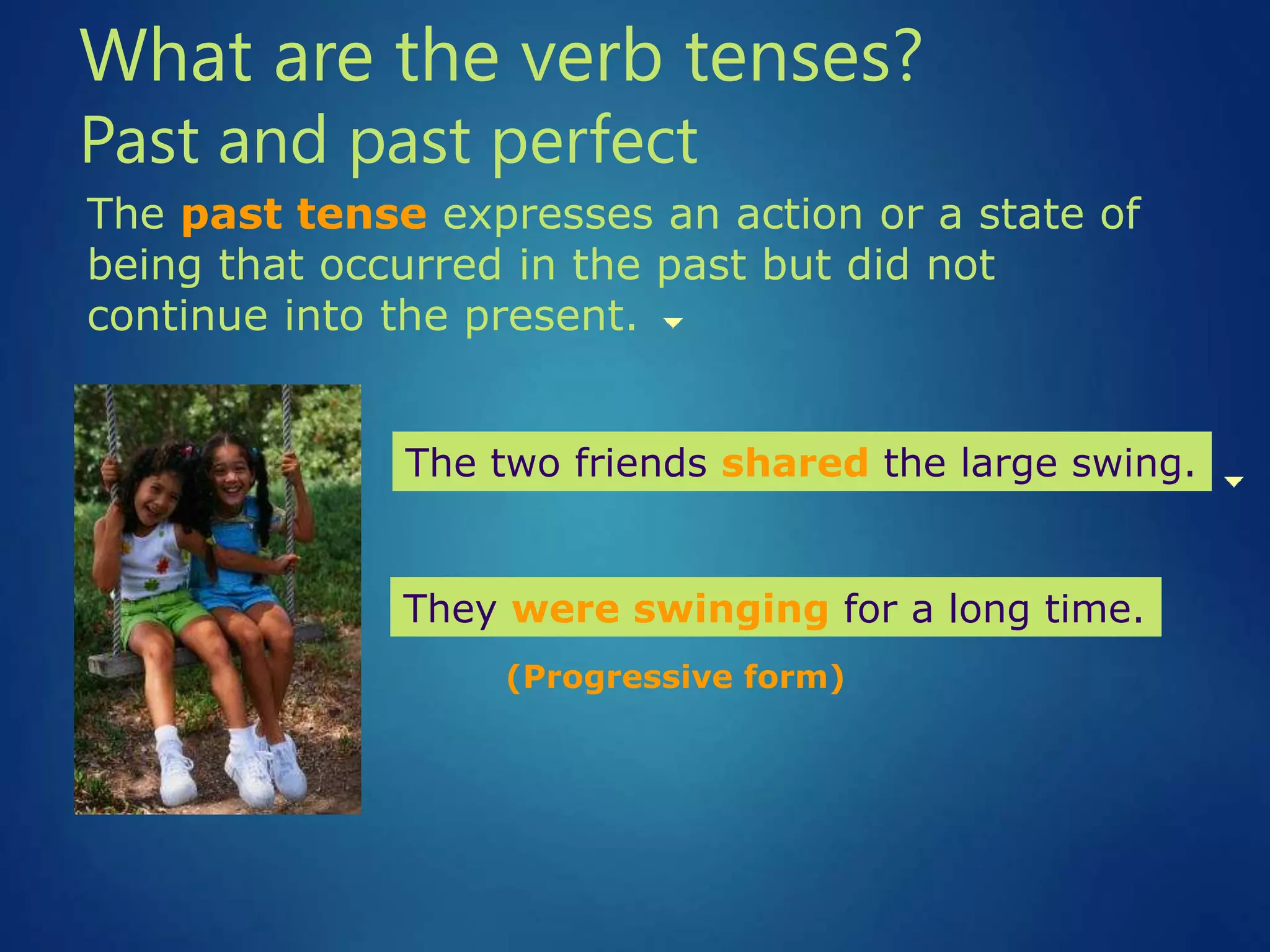
The past tense expresses an action or a state of
being that occurred in the past but did not
continue into the present.
They were swinging for a long time.
The two friends shared the large swing.
(Progressive form)
What are the verb tenses?
Past and past perfect
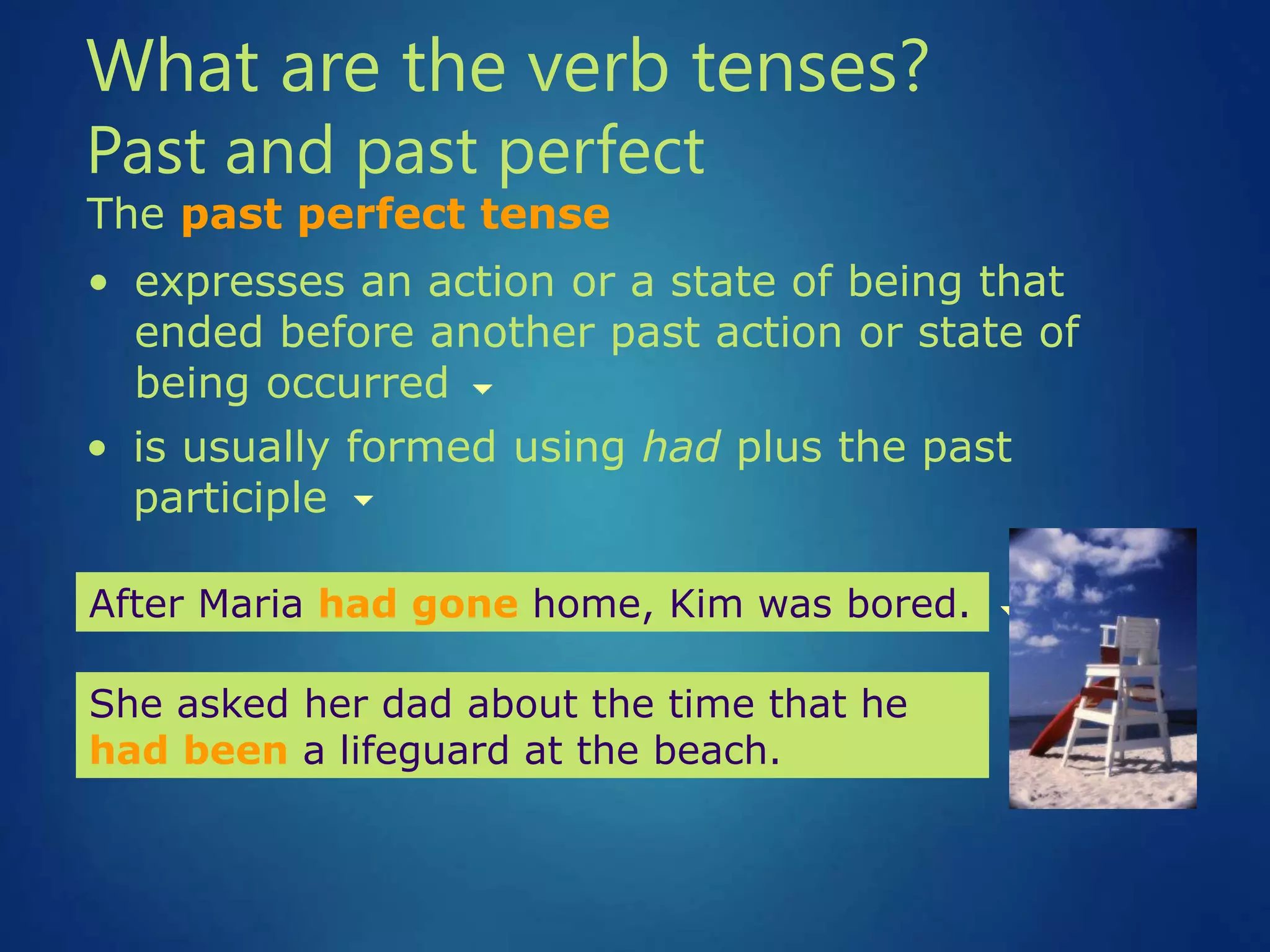
The past perfect tense
• is usually formed using had plus the past
participle
• expresses an action or a state of being that
ended before another past action or state of
being occurred
After Maria had gone home, Kim was bored.
She asked her dad about the time that he
had been a lifeguard at the beach.
What are the verb tenses?
Future and future perfect
The future tense
• is usually formed using will or shall plus the
base form
• expresses an action or a state of being that will
occur
My family will ride the train to Chicago.
We will be arriving at five o’clock.
(Progressive form)
What are the verb tenses?
We can also express future
action in other ways.
We are going to make our
own costumes.
They are about to begin
the awards ceremony.
I have a test tomorrow.
What are the verb tenses?
Future and future perfect
The future perfect tense
• is usually formed using will have or shall have
plus the past participle
• expresses an action or a state of being that will
end before another future action or state of
being
By the time you receive this letter, she will have
returned home.
After this trip, he will have been to Chicago
three times.
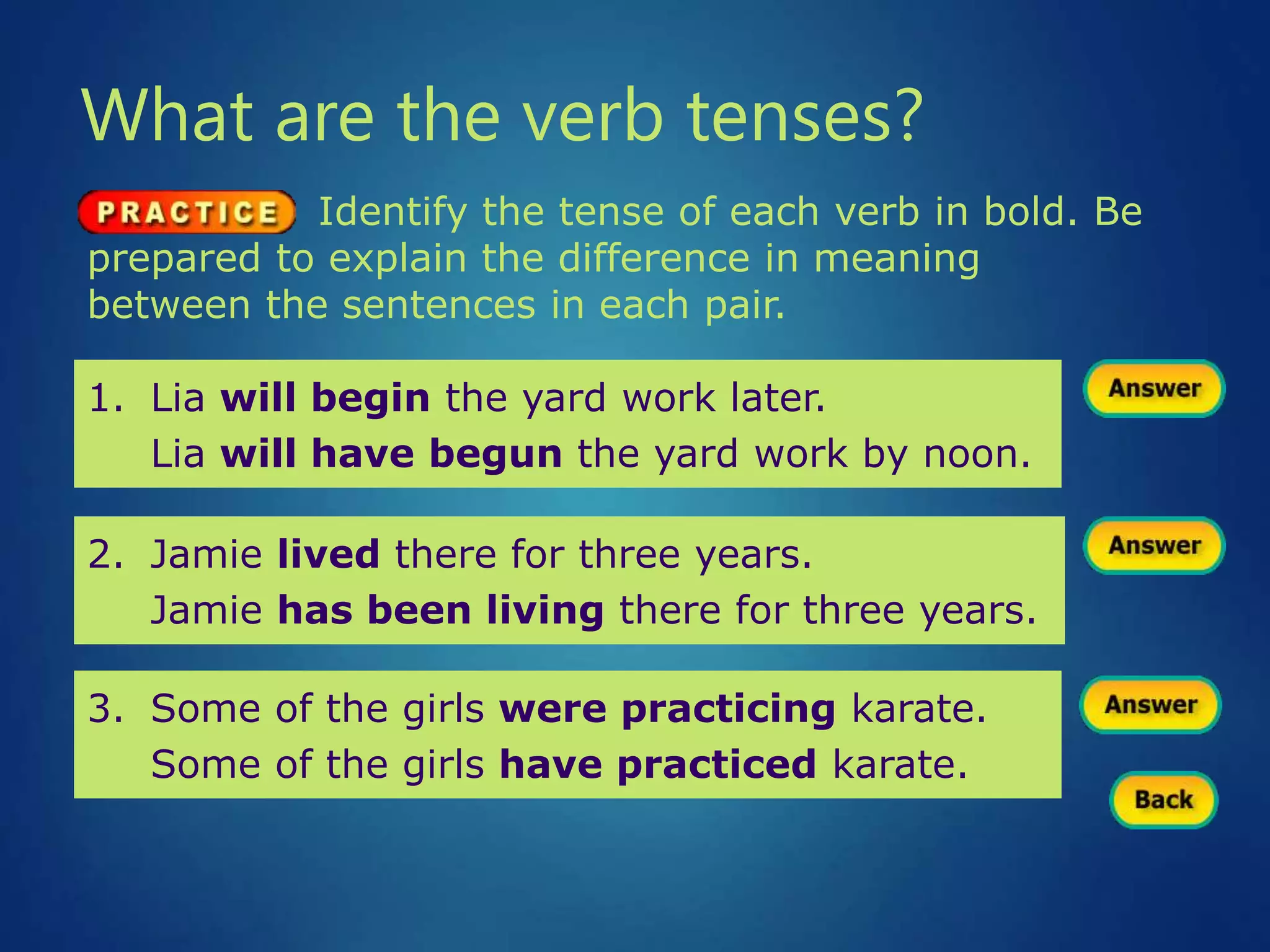
1. Lia will begin the yard work later.
Lia will have begun the yard work by noon.
Identify the tense of each verb in bold. Be
prepared to explain the difference in meaning
between the sentences in each pair.
What are the verb tenses?
2. Jamie lived there for three years.
Jamie has been living there for three years.
3. Some of the girls were practicing karate.
Some of the girls have practiced karate.
What are the verb tenses?
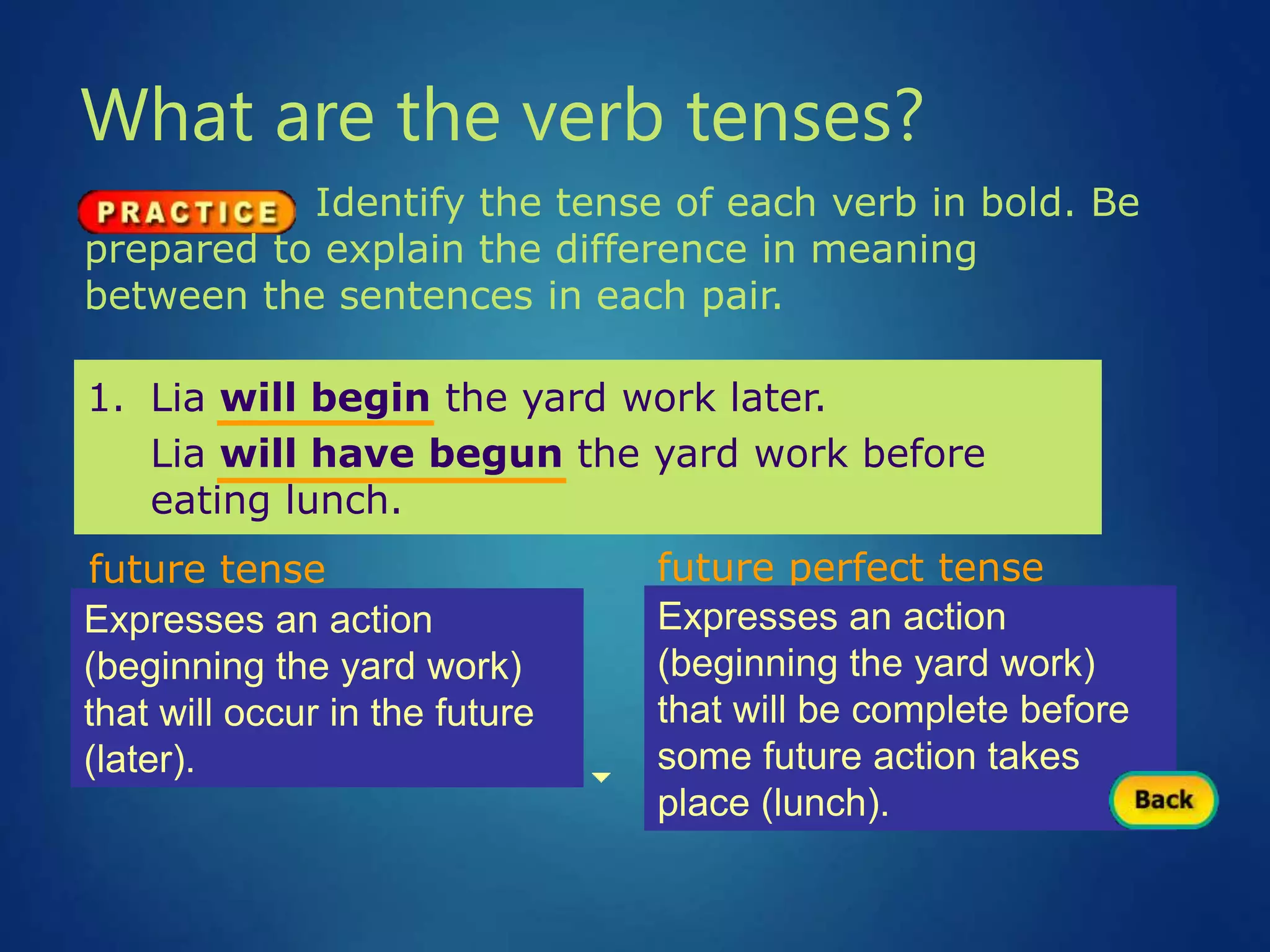
1. Lia will begin the yard work later.
Lia will have begun the yard work before
eating lunch.
Identify the tense of each verb in bold. Be
prepared to explain the difference in meaning
between the sentences in each pair.
future tense future perfect tense
Expresses an action
(beginning the yard work)
that will occur in the future
(later).
Expresses an action
(beginning the yard work)
that will be complete before
some future action takes
place (lunch).
What are the verb tenses?
Identify the tense of each verb in bold. Be
prepared to explain the difference in meaning
between the sentences in each pair.
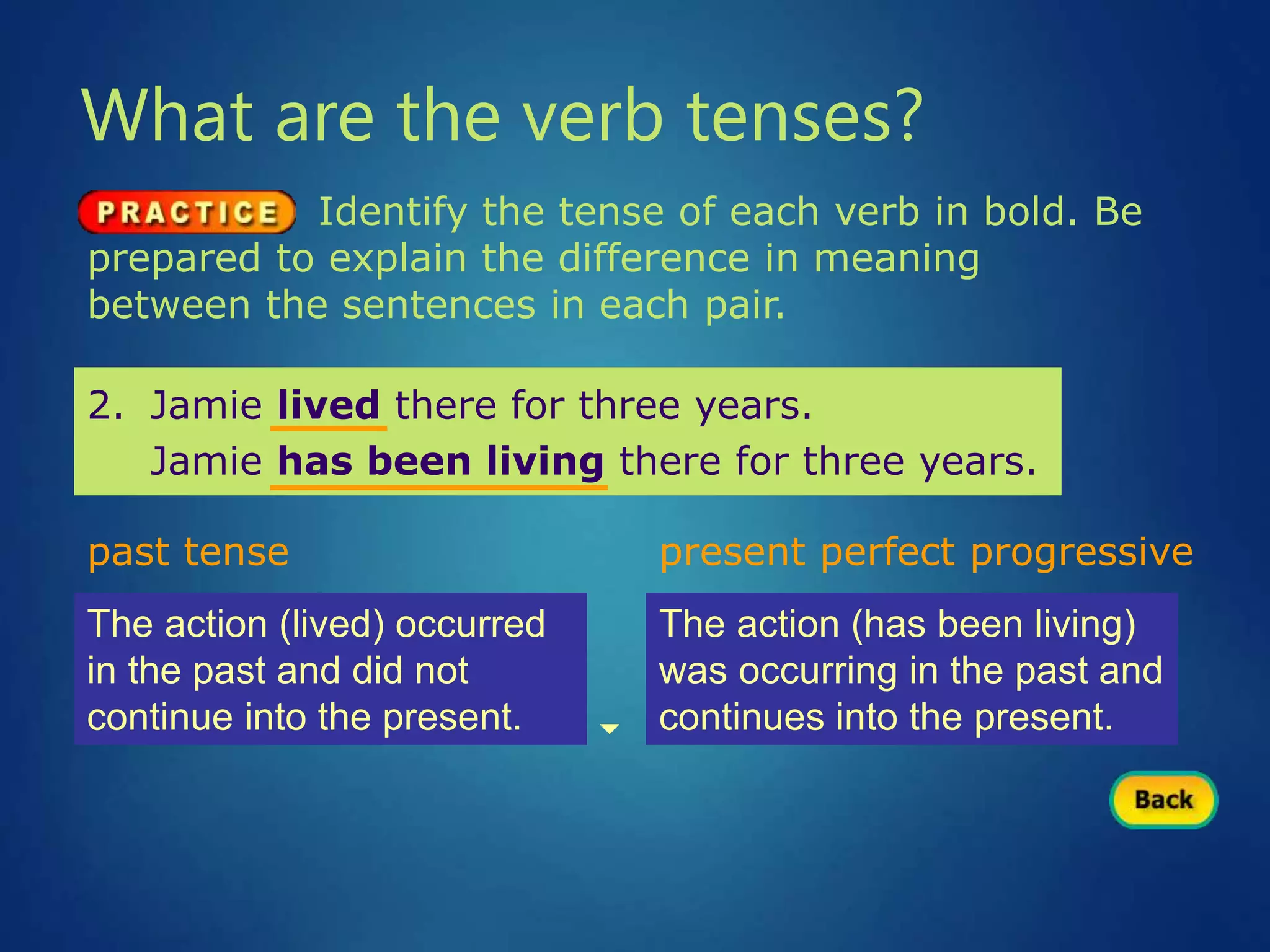
past tense present perfect progressive
The action (lived) occurred
in the past and did not
continue into the present.
The action (has been living)
was occurring in the past and
continues into the present.
2. Jamie lived there for three years.
Jamie has been living there for three years.
What are the verb tenses?
Identify the tense of each verb in bold. Be
prepared to explain the difference in meaning
between the sentences in each pair.
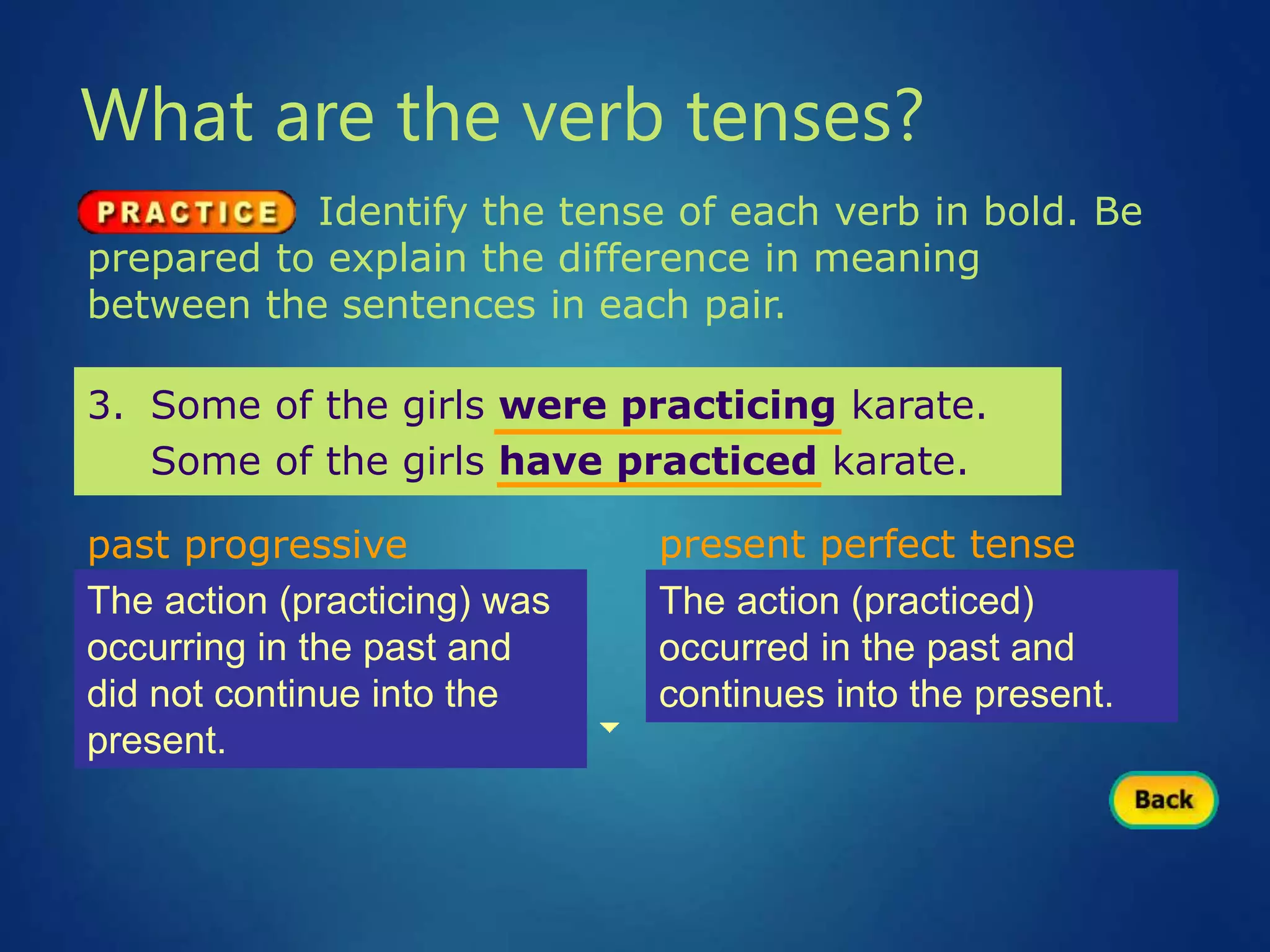
past progressive present perfect tense
The action (practicing) was
occurring in the past and
did not continue into the
present.
The action (practiced)
occurred in the past and
continues into the present.
3. Some of the girls were practicing karate.
Some of the girls have practiced karate.
[End of Section]
Change the tense of the verb in each sentence, as indicated
in parentheses.
1. I do not miss the bus. (Change to future.)
2. Were they at the party? (Change to past perfect.)
3. By then, Keith had returned. (Change to future perfect.)
4. The team will practice for an hour with no break. (Change
to future perfect progressive.)
5. My sister dances well. (Change to past.)
On Your Own
What are the verb tenses?
Change the tense of the verb in each sentence, as indicated
in parentheses.
1. I do not miss the bus. (Change to future.)
2. Were they at the party? (Change to past perfect.)
3. By then, Keith had returned. (Change to future perfect.)
4. The team will practice for an hour with no break.
(Change to future perfect progressive.)
5. My sister dances well. (Change to past.)
Answers
What are the verb tenses?
1. I will not miss the bus.
2. Had they been at the party?
3. By then, Keith will have returned.
4. The team will have been practicing for an hour with
no break.
5. My sister danced well.
Consistency of tense
Do not change needlessly from one tense to
another.
To describe events that occur at the same time,
use verbs in the same tense.
Sara peeked over the fence and saw a cornfield.
Sara peeks over the fence and sees a cornfield.
past tense past tense
present tense present tense
Consistency of tense
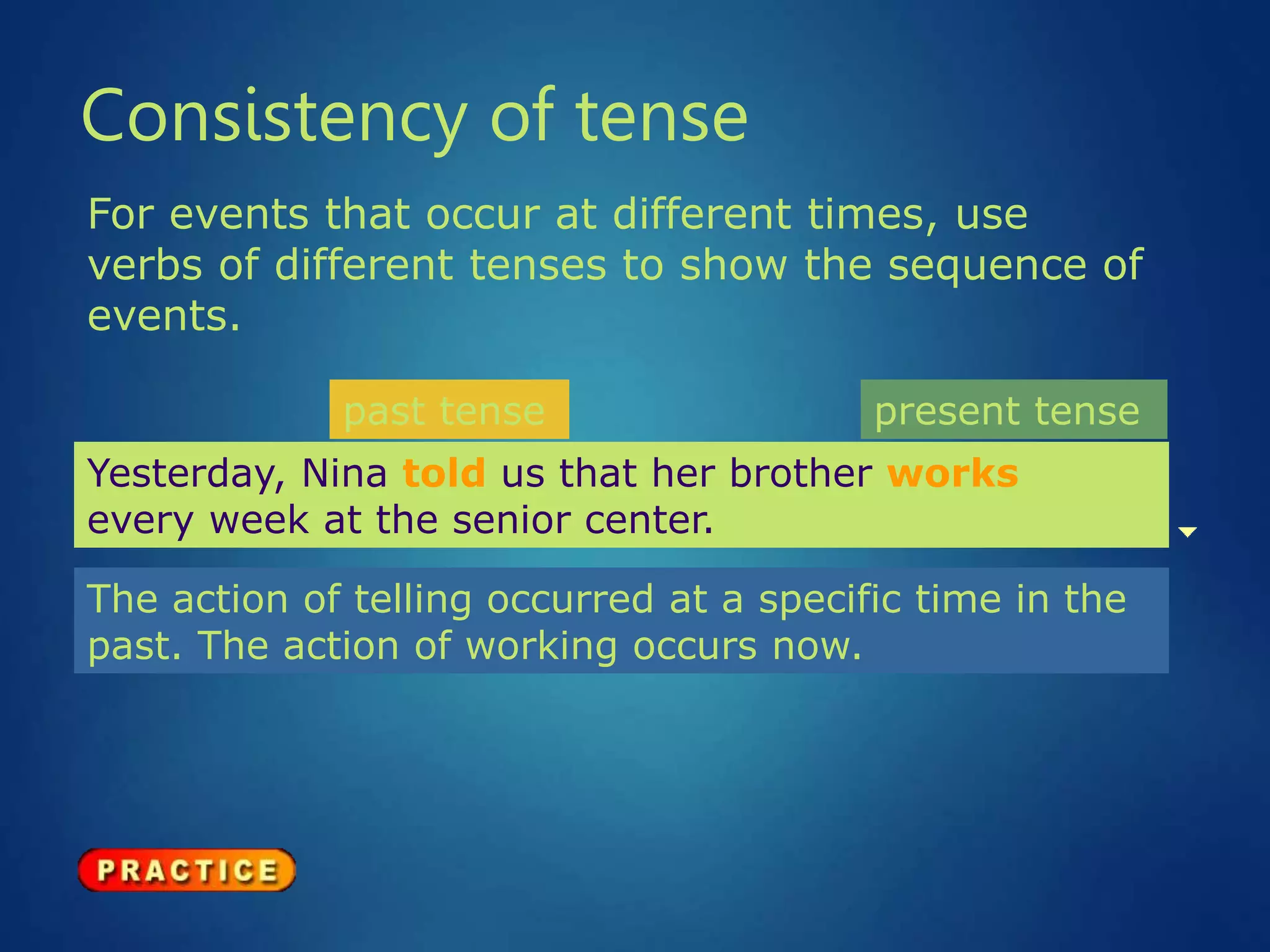
For events that occur at different times, use
verbs of different tenses to show the sequence of
events.
The pitcher wished that he had practiced more
before the game.
past tense past perfect tense
The action of wishing happened after the action of
practicing was complete.
Consistency of tense
For events that occur at different times, use
verbs of different tenses to show the sequence of
events.
Yesterday, Nina told us that her brother works
every week at the senior center.
past tense
The action of telling occurred at a specific time in the
past. The action of working occurs now.
present tense
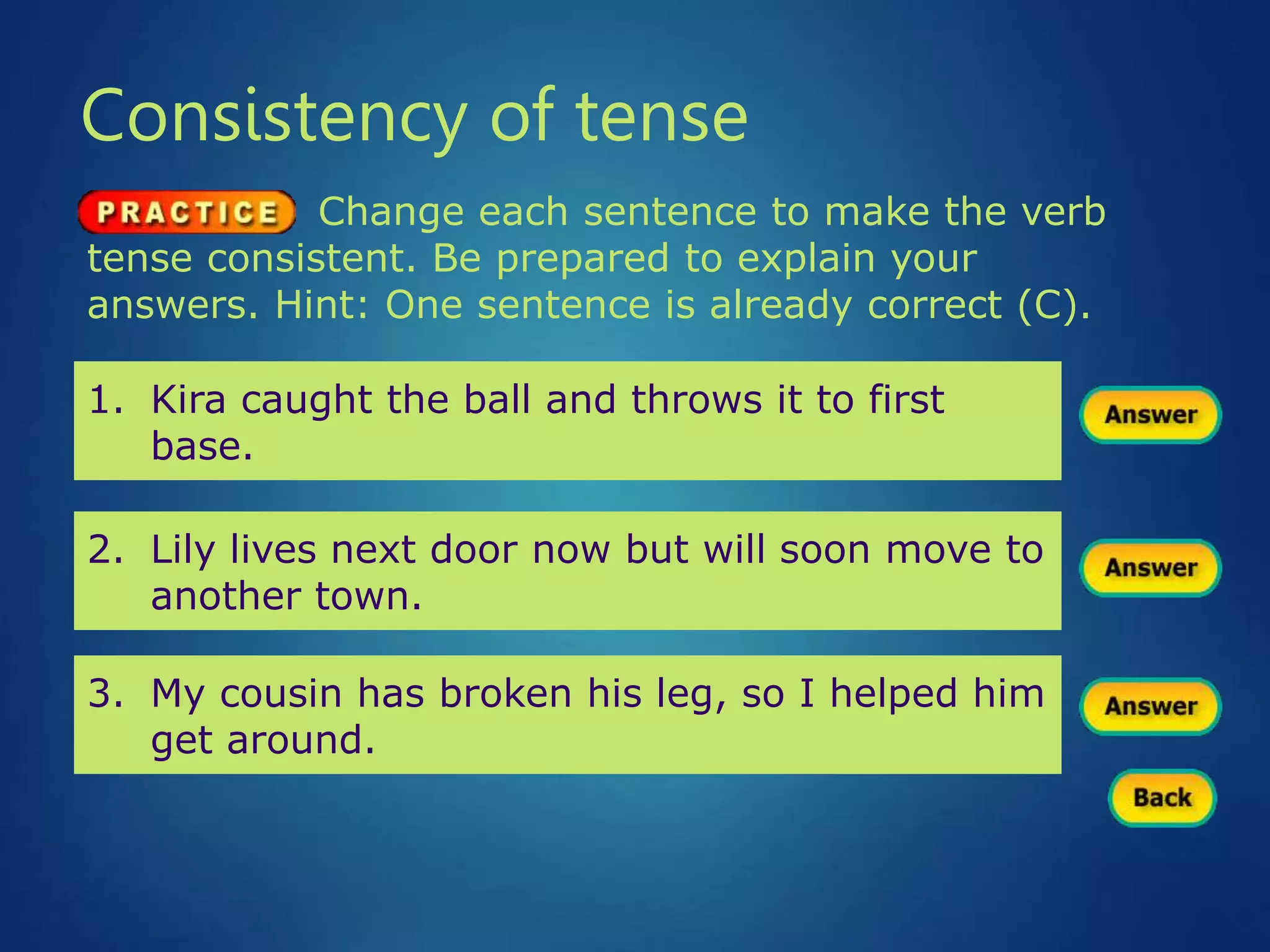
1. Kira caught the ball and throws it to first
base.
2. Lily lives next door now but will soon move to
another town.
3. My cousin has broken his leg, so I helped him
get around.
Change each sentence to make the verb
tense consistent. Be prepared to explain your
answers. Hint: One sentence is already correct (C).
Consistency of tense
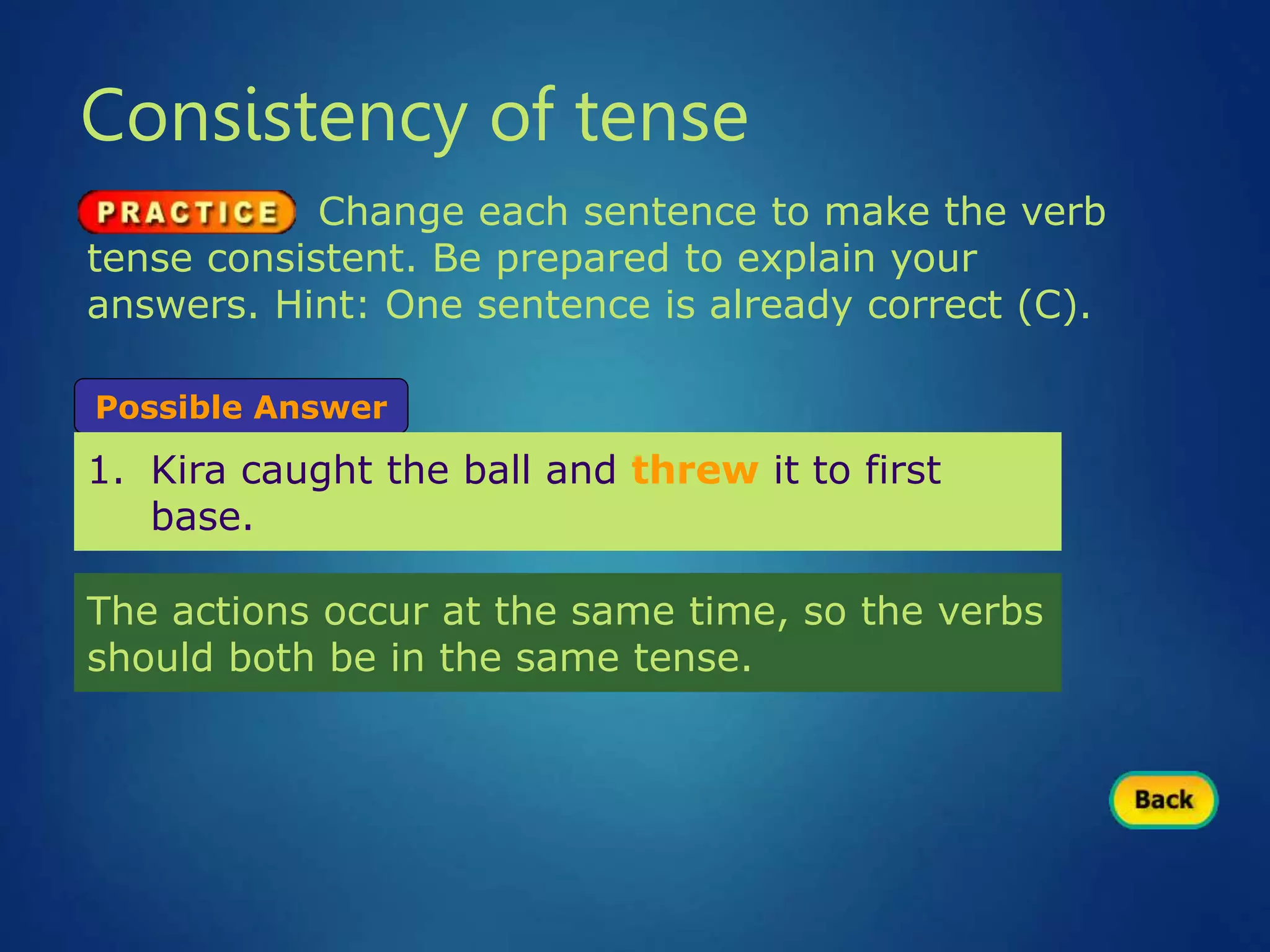
Possible Answer
1. Kira caught the ball and threw it to first
base.
The actions occur at the same time, so the verbs
should both be in the same tense.
Change each sentence to make the verb
tense consistent. Be prepared to explain your
answers. Hint: One sentence is already correct (C).
Consistency of tense
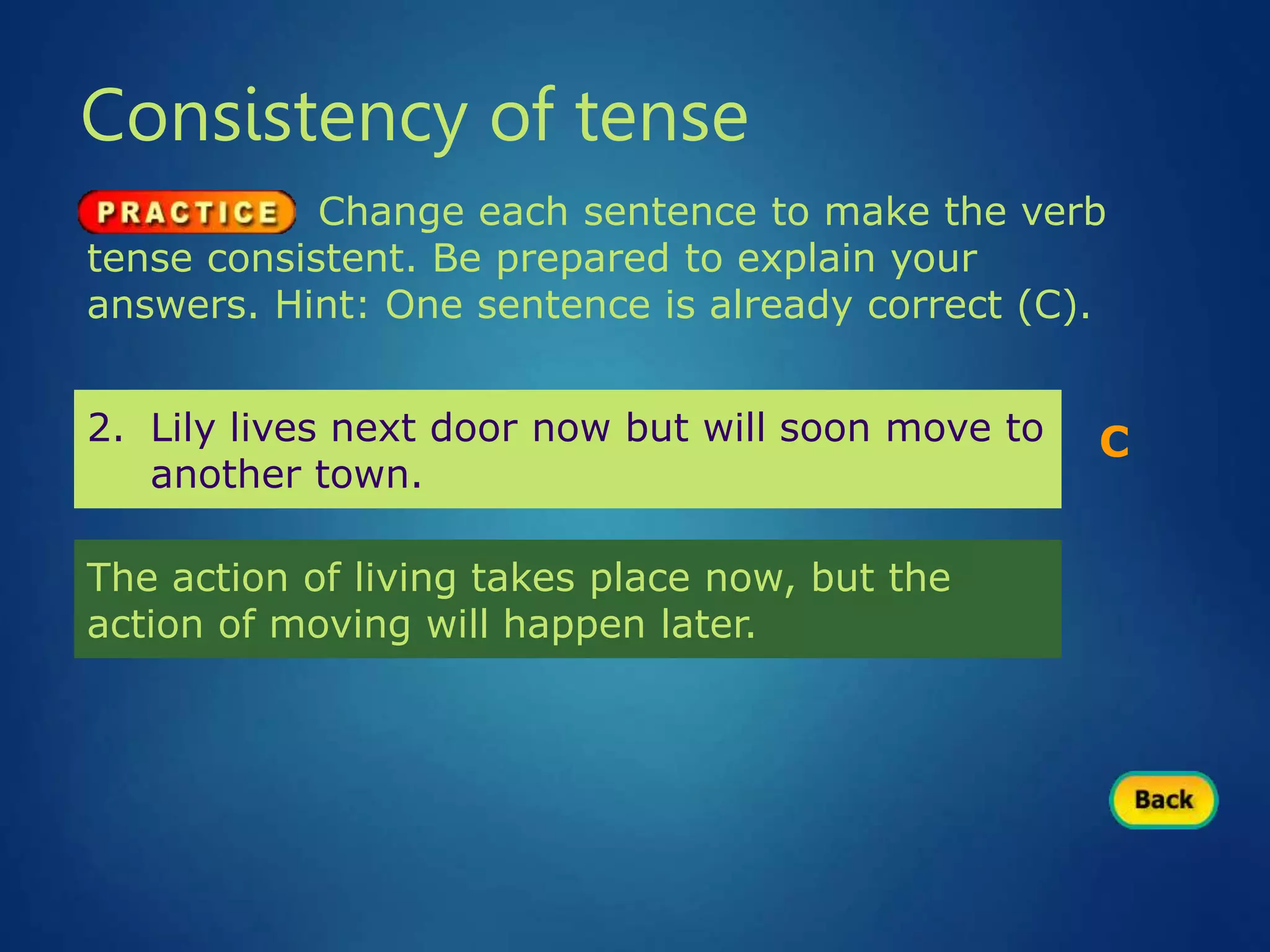
The action of living takes place now, but the
action of moving will happen later.
Change each sentence to make the verb
tense consistent. Be prepared to explain your
answers. Hint: One sentence is already correct (C).
2. Lily lives next door now but will soon move to
another town.
C
Consistency of tense
Possible Answer
The action of breaking the leg happened before
the action of helping.
Change each sentence to make the verb
tense consistent. Be prepared to explain your
answers. Hint: One sentence is already correct (C).
3. My cousin had broken his leg, so I helped
him get around.
Consistency of tense
[End of Section]
On Your Own
Proofread the paragraph for unnecessary changes of verb
tense. Change the verbs to make the tenses consistent.
(1) I was in my room Saturday morning, planning to
study for two hours. (2) To my surprise, Nancy Chang drops
by. (3) She dashed into the house, runs up the stairs, and
calls my name. (4) What she wanted was a fishing
companion. (5) As I get my fishing gear together, I was so
happy. (6) On our way to the lake, we notice some dark
clouds. (7) We wished we checked the weather first.
Consistency of tense
Possible Answers
(1) I was in my room Saturday morning, planning to
study for two hours. (2) To my surprise, Nancy Chang
drops by. (3) She dashed into the house, runs up the
stairs, and calls my name. (4) What she wanted was a
fishing companion. (5) As I get my fishing gear together, I
was so happy. (6) On our way to the lake, we notice some
dark clouds. (7) We wished we checked the weather first.
dropped ran
called
got
noticed
had
Modals
A modal is a helping verb that is joined with a
main verb or an infinitive to express an attitude
toward the action or state of being of the main
verb.
Helping verbs used as modals
can could may might must
ought shall should will would
Modals
The modal can or could is used to express ability.
Tammy can play point guard in the second half.
The team could have made better shots.
Modals
The modal may is used to express permission or
possibility.
Yes, you may borrow my sweater.
I might give some of my clothing to charity.
The modal might is used to express possibility.
Permission
My clothes closet may be too full.
Possibility
Might/May
Often, the possibility expressed
by might is less likely than the
possibility expressed by may.
The mechanic said the brakes
may need work.
We might finish early, but I
doubt it.
likely
less likely
Modals
The modal must is used most often to express a
requirement. Sometimes, must is used to express
an explanation.
We must conserve energy in our homes.
My brother must have left the lights on.
Requirement
Explanation
Modals
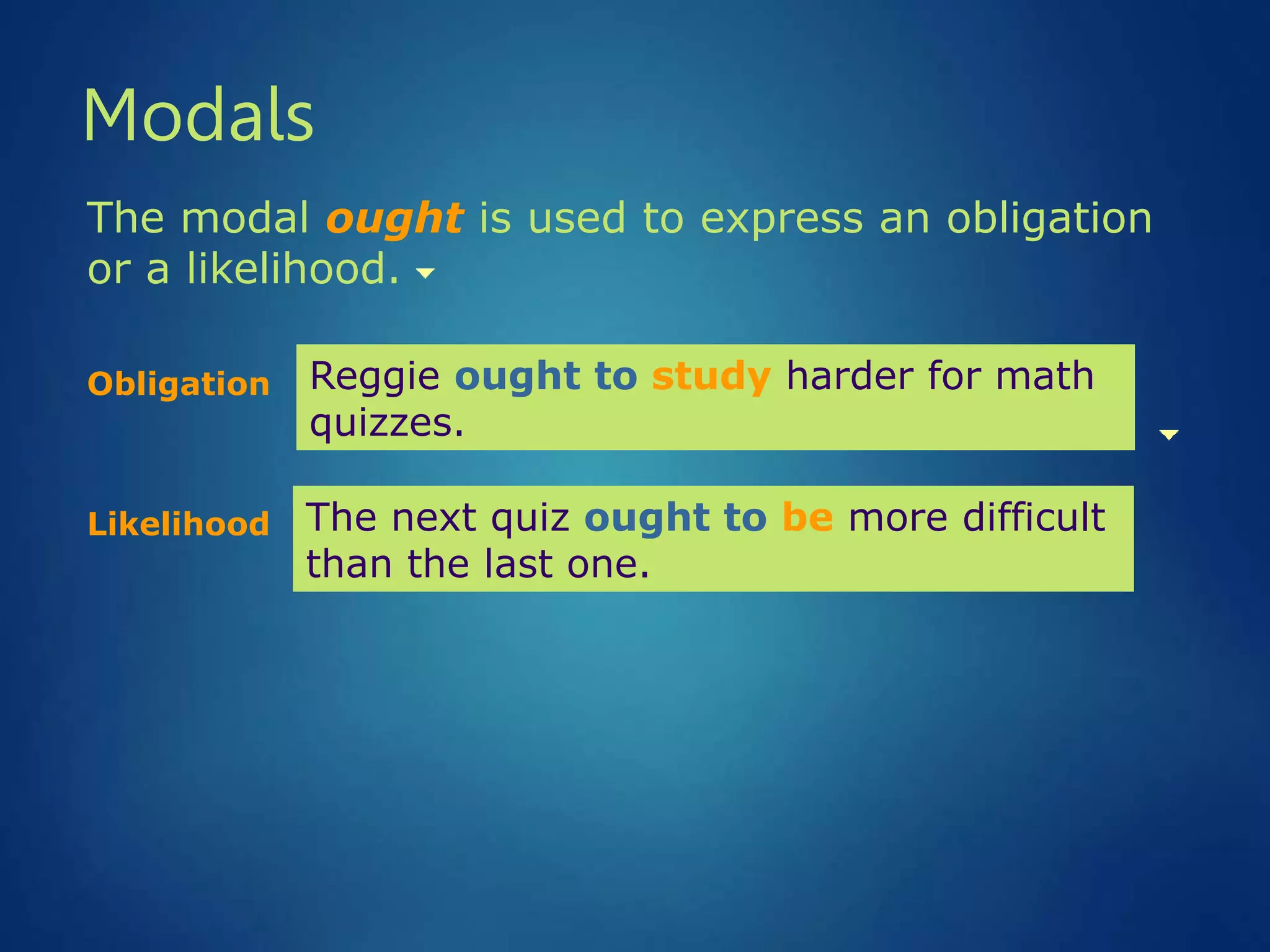
The modal ought is used to express an obligation
or a likelihood.
Reggie ought to study harder for math
quizzes.
The next quiz ought to be more difficult
than the last one.
Obligation
Likelihood
Modals
The modal will or shall is used to express future
time.
After reviewing the entries, the
panel will announce the winner.
I shall enter my painting in the contest.
Modals
The modal should is used to express a
recommendation, an obligation, or a possibility.
Terrell should leave soon to catch
the bus.
All students should get to school
on time.
Recommendation
Obligation
Possibility Should you arrive late, please go
to the office first.
Modals
The modal would is used to express the
conditional form of a verb. In other words, it is
used to express a situation that is contrary to fact.
If the weather had been more pleasant,
they would have gone on a picnic.
Mrs. Chang would be happy to prepare
food if you bring the plates and forks.
Modals
Would can also be used to express future time in
a subordinate clause when the main verb in the
independent clause is in the past tense.
They promised us that they would bring the music.
past tense verb
Main clause
They promised us that they would bring the music.
Subordinate clause
modal expresses future time
Modals
Would is sometimes used to express
Every day she would wake early and feed the hens.
Would you like a nice, fresh salad?
• an action that was repeated in the past
• an invitation or offer
• a polite request
Would you please bring me those books?
1. The weather report said it may snow.
2. I tried, but I could not learn the program.
3. All participants must return their permission
slips by Friday.
Identify the modal in each of the following
sentences. Be prepared to tell what is expressed by
the modal.
Modals
Identify the modal in each of the following
sentences.
Modals
1. The weather report said it may snow.
The modal may expresses possibility.
Identify the modal in each of the following
sentences.
Modals
The modal could expresses ability.
2. I tried, but I could not learn the program.
Identify the modal in each of the following
sentences.
Modals
The modal must expresses a requirement.
3. All participants must return their permission
slips by Friday.
Modals
[End of Section]
Supply an appropriate modal for each sentence.
1. Jen _____ have cleaned out the garage yesterday.
2. _____ you please help Merrill with that large box?
3. You _____ probably guess what I am about to say.
4. If the train had been faster, we _____ have arrived
sooner.
5. I’m not certain, but I think Dad _____ be cooking stew
for dinner tonight.
On Your Own
Modals
Possible Answers
Supply an appropriate modal for each sentence.
1. Jen must have cleaned out the garage yesterday.
2. Would you please help Merrill with that large box?
3. You can probably guess what I am about to say.
5. I’m not certain, but I think Dad might be cooking stew
for dinner tonight.
4. If the train had been faster, we would have arrived
sooner.
Review A
Change the tense of each boldface verb to the tense
indicated in parentheses.
1. The otter swam to the edge of the pond. (present
perfect)
2. Our class will read Shakespeare’s Macbeth. (future
progressive)
3. The three sisters regularly meet for lunch. (past)
4. Each student chooses a lab partner. (past perfect)
5. Wasps were entering the house through the torn screen.
(present)
Review A
Change the tense of each boldface verb to the tense
indicated in parentheses.
1. The otter has swum to the edge of the pond. (present
perfect)
2. Our class will be reading Shakespeare’s Macbeth.
(future progressive)
3. The three sisters regularly met for lunch. (past)
4. Each student has chosen a lab partner. (past perfect)
5. Wasps enter the house through the torn screen.
(present)
Review B
[End of Section]
1. Colleen _____ almost reach the light bulb. (shows ability)
2. Jack _____ repair the bicycle tomorrow. (future tense)
3. Most of the girls _____ already left. (present perfect)
4. I _____ attend the concert if only I had more time.
(shows a condition)
5. Tamara opens the refrigerator and _____ inside.
(consistent tense)
Supply an appropriate modal, helping verb, or main verb to
complete each sentence correctly. The hints in parentheses
will help you.
Review B
Supply an appropriate modal, helping verb, or main verb to
complete each sentence correctly. The hints in parentheses
will help you. (Some answers may vary.)
1. Colleen can almost reach the light bulb. (shows ability)
2. Jack will repair the bicycle tomorrow. (future tense)
3. Most of the girls have already left. (present perfect)
4. I would attend the concert if only I had more time.
(shows a condition)
5. Tamara opens the refrigerator and looks inside.
(consistent tense)
The End

understanding verb tense.ppt

  • 1.
    UNDERSTANDING VERB TENSE What arethe verb tenses? Present and present perfect Past and past perfect Future and future perfect Consistency of tense Modals Review A Review B
  • 2.
    What are theverb tenses? Verbs do a lot of work in sentences. They show actions and states of being. They even take different forms to show time. flies flew will fly
  • 3.
    Gwen plays guitarin a jazz band. The tense of a verb indicates the time of the action or state of being expressed by the verb. Past Future Present Present Perfect She has played in the band for three years. Future Future Perfect Perfect tenses indicate that something happened or existed before a specific point in time. Gwen will play in a concert tomorrow. She will have played in ten concerts by April. Past Gwen played last year as well. Past Perfect She had played violin before then. Present What are the verb tenses?
  • 4.
    The tenses ofverbs are formed from the four principal parts of verbs. Present Participle Base Form Past Past Participle smile choose [is] smil [is] choos ing smile d cho se [have] smile d [have] cho sen ing What are the verb tenses?
  • 5.
    Each tense hasa progressive form, which is used to express continuing action or state of being. What are the verb tenses? Present progressive am, are, is talking Past progressive was, were talking Future progressive will (shall) be talking Present perfect progressive has, have been talking Past perfect progressive had been talking Future perfect progressive will (shall) have been talking
  • 6.
    What are theverb tenses? Present and present perfect The present tense expresses an action or a state of being that is occurring now, at the present time. Today we honor our veterans. Polly is marching in the parade. (Progressive form)
  • 7.
    What are theverb tenses? Present and present perfect The present tense is also used in these ways: In Grapes of Wrath, Steinbeck shows us the extremes of life during the depression. to discuss a literary work (literary present) In 1927, Charles Lindbergh flies nonstop across the Atlantic. to make historical events seem current (historical present) The sun rises in the east. to express a general truth We recycle our aluminum cans. to show a customary or habitual action or state of being We travel to Utah next month. to express future time
  • 8.
    What are theverb tenses? Present and present perfect The present perfect tense • is usually formed using the helping verb have or has plus the past participle • expresses an action or a state of being that occurred at an indefinite time in the past Mike has been in several parades. He has played the drum in all of them.
  • 9.
    What are theverb tenses? A helping verb (also called an auxiliary verb) is used with a main verb to create a verb phrase. I was reading a novel by Sandra Cisneros. I was reading a novel by Sandra Cisneros. I was reading a book by Sandra Cisneros. Helping verb Main verb Verb phrase Some commonly used helping verbs include is, are, has, had, did, does, can, could, should, and will.
  • 10.
    What are theverb tenses? Present and present perfect The present perfect tense is also used to express an action or state of being that began in the past and continues into the present. In this case, perfect means complete. Yoko has been taking flute lessons for six years. Mr. Lee has taught music at our school since 2004. (Progressive form)
  • 11.
    What are theverb tenses? Past and past perfect The past tense expresses an action or a state of being that occurred in the past but did not continue into the present. They were swinging for a long time. The two friends shared the large swing. (Progressive form)
  • 12.
    What are theverb tenses? Past and past perfect The past perfect tense • is usually formed using had plus the past participle • expresses an action or a state of being that ended before another past action or state of being occurred After Maria had gone home, Kim was bored. She asked her dad about the time that he had been a lifeguard at the beach.
  • 13.
    What are theverb tenses? Future and future perfect The future tense • is usually formed using will or shall plus the base form • expresses an action or a state of being that will occur My family will ride the train to Chicago. We will be arriving at five o’clock. (Progressive form)
  • 14.
    What are theverb tenses? We can also express future action in other ways. We are going to make our own costumes. They are about to begin the awards ceremony. I have a test tomorrow.
  • 15.
    What are theverb tenses? Future and future perfect The future perfect tense • is usually formed using will have or shall have plus the past participle • expresses an action or a state of being that will end before another future action or state of being By the time you receive this letter, she will have returned home. After this trip, he will have been to Chicago three times.
  • 16.
    1. Lia willbegin the yard work later. Lia will have begun the yard work by noon. Identify the tense of each verb in bold. Be prepared to explain the difference in meaning between the sentences in each pair. What are the verb tenses? 2. Jamie lived there for three years. Jamie has been living there for three years. 3. Some of the girls were practicing karate. Some of the girls have practiced karate.
  • 17.
    What are theverb tenses? 1. Lia will begin the yard work later. Lia will have begun the yard work before eating lunch. Identify the tense of each verb in bold. Be prepared to explain the difference in meaning between the sentences in each pair. future tense future perfect tense Expresses an action (beginning the yard work) that will occur in the future (later). Expresses an action (beginning the yard work) that will be complete before some future action takes place (lunch).
  • 18.
    What are theverb tenses? Identify the tense of each verb in bold. Be prepared to explain the difference in meaning between the sentences in each pair. past tense present perfect progressive The action (lived) occurred in the past and did not continue into the present. The action (has been living) was occurring in the past and continues into the present. 2. Jamie lived there for three years. Jamie has been living there for three years.
  • 19.
    What are theverb tenses? Identify the tense of each verb in bold. Be prepared to explain the difference in meaning between the sentences in each pair. past progressive present perfect tense The action (practicing) was occurring in the past and did not continue into the present. The action (practiced) occurred in the past and continues into the present. 3. Some of the girls were practicing karate. Some of the girls have practiced karate.
  • 20.
    [End of Section] Changethe tense of the verb in each sentence, as indicated in parentheses. 1. I do not miss the bus. (Change to future.) 2. Were they at the party? (Change to past perfect.) 3. By then, Keith had returned. (Change to future perfect.) 4. The team will practice for an hour with no break. (Change to future perfect progressive.) 5. My sister dances well. (Change to past.) On Your Own What are the verb tenses?
  • 21.
    Change the tenseof the verb in each sentence, as indicated in parentheses. 1. I do not miss the bus. (Change to future.) 2. Were they at the party? (Change to past perfect.) 3. By then, Keith had returned. (Change to future perfect.) 4. The team will practice for an hour with no break. (Change to future perfect progressive.) 5. My sister dances well. (Change to past.) Answers What are the verb tenses? 1. I will not miss the bus. 2. Had they been at the party? 3. By then, Keith will have returned. 4. The team will have been practicing for an hour with no break. 5. My sister danced well.
  • 22.
    Consistency of tense Donot change needlessly from one tense to another. To describe events that occur at the same time, use verbs in the same tense. Sara peeked over the fence and saw a cornfield. Sara peeks over the fence and sees a cornfield. past tense past tense present tense present tense
  • 23.
    Consistency of tense Forevents that occur at different times, use verbs of different tenses to show the sequence of events. The pitcher wished that he had practiced more before the game. past tense past perfect tense The action of wishing happened after the action of practicing was complete.
  • 24.
    Consistency of tense Forevents that occur at different times, use verbs of different tenses to show the sequence of events. Yesterday, Nina told us that her brother works every week at the senior center. past tense The action of telling occurred at a specific time in the past. The action of working occurs now. present tense
  • 25.
    1. Kira caughtthe ball and throws it to first base. 2. Lily lives next door now but will soon move to another town. 3. My cousin has broken his leg, so I helped him get around. Change each sentence to make the verb tense consistent. Be prepared to explain your answers. Hint: One sentence is already correct (C). Consistency of tense
  • 26.
    Consistency of tense PossibleAnswer 1. Kira caught the ball and threw it to first base. The actions occur at the same time, so the verbs should both be in the same tense. Change each sentence to make the verb tense consistent. Be prepared to explain your answers. Hint: One sentence is already correct (C).
  • 27.
    Consistency of tense Theaction of living takes place now, but the action of moving will happen later. Change each sentence to make the verb tense consistent. Be prepared to explain your answers. Hint: One sentence is already correct (C). 2. Lily lives next door now but will soon move to another town. C
  • 28.
    Consistency of tense PossibleAnswer The action of breaking the leg happened before the action of helping. Change each sentence to make the verb tense consistent. Be prepared to explain your answers. Hint: One sentence is already correct (C). 3. My cousin had broken his leg, so I helped him get around.
  • 29.
    Consistency of tense [Endof Section] On Your Own Proofread the paragraph for unnecessary changes of verb tense. Change the verbs to make the tenses consistent. (1) I was in my room Saturday morning, planning to study for two hours. (2) To my surprise, Nancy Chang drops by. (3) She dashed into the house, runs up the stairs, and calls my name. (4) What she wanted was a fishing companion. (5) As I get my fishing gear together, I was so happy. (6) On our way to the lake, we notice some dark clouds. (7) We wished we checked the weather first.
  • 30.
    Consistency of tense PossibleAnswers (1) I was in my room Saturday morning, planning to study for two hours. (2) To my surprise, Nancy Chang drops by. (3) She dashed into the house, runs up the stairs, and calls my name. (4) What she wanted was a fishing companion. (5) As I get my fishing gear together, I was so happy. (6) On our way to the lake, we notice some dark clouds. (7) We wished we checked the weather first. dropped ran called got noticed had
  • 31.
    Modals A modal isa helping verb that is joined with a main verb or an infinitive to express an attitude toward the action or state of being of the main verb. Helping verbs used as modals can could may might must ought shall should will would
  • 32.
    Modals The modal canor could is used to express ability. Tammy can play point guard in the second half. The team could have made better shots.
  • 33.
    Modals The modal mayis used to express permission or possibility. Yes, you may borrow my sweater. I might give some of my clothing to charity. The modal might is used to express possibility. Permission My clothes closet may be too full. Possibility
  • 34.
    Might/May Often, the possibilityexpressed by might is less likely than the possibility expressed by may. The mechanic said the brakes may need work. We might finish early, but I doubt it. likely less likely
  • 35.
    Modals The modal mustis used most often to express a requirement. Sometimes, must is used to express an explanation. We must conserve energy in our homes. My brother must have left the lights on. Requirement Explanation
  • 36.
    Modals The modal oughtis used to express an obligation or a likelihood. Reggie ought to study harder for math quizzes. The next quiz ought to be more difficult than the last one. Obligation Likelihood
  • 37.
    Modals The modal willor shall is used to express future time. After reviewing the entries, the panel will announce the winner. I shall enter my painting in the contest.
  • 38.
    Modals The modal shouldis used to express a recommendation, an obligation, or a possibility. Terrell should leave soon to catch the bus. All students should get to school on time. Recommendation Obligation Possibility Should you arrive late, please go to the office first.
  • 39.
    Modals The modal wouldis used to express the conditional form of a verb. In other words, it is used to express a situation that is contrary to fact. If the weather had been more pleasant, they would have gone on a picnic. Mrs. Chang would be happy to prepare food if you bring the plates and forks.
  • 40.
    Modals Would can alsobe used to express future time in a subordinate clause when the main verb in the independent clause is in the past tense. They promised us that they would bring the music. past tense verb Main clause They promised us that they would bring the music. Subordinate clause modal expresses future time
  • 41.
    Modals Would is sometimesused to express Every day she would wake early and feed the hens. Would you like a nice, fresh salad? • an action that was repeated in the past • an invitation or offer • a polite request Would you please bring me those books?
  • 42.
    1. The weatherreport said it may snow. 2. I tried, but I could not learn the program. 3. All participants must return their permission slips by Friday. Identify the modal in each of the following sentences. Be prepared to tell what is expressed by the modal. Modals
  • 43.
    Identify the modalin each of the following sentences. Modals 1. The weather report said it may snow. The modal may expresses possibility.
  • 44.
    Identify the modalin each of the following sentences. Modals The modal could expresses ability. 2. I tried, but I could not learn the program.
  • 45.
    Identify the modalin each of the following sentences. Modals The modal must expresses a requirement. 3. All participants must return their permission slips by Friday.
  • 46.
    Modals [End of Section] Supplyan appropriate modal for each sentence. 1. Jen _____ have cleaned out the garage yesterday. 2. _____ you please help Merrill with that large box? 3. You _____ probably guess what I am about to say. 4. If the train had been faster, we _____ have arrived sooner. 5. I’m not certain, but I think Dad _____ be cooking stew for dinner tonight. On Your Own
  • 47.
    Modals Possible Answers Supply anappropriate modal for each sentence. 1. Jen must have cleaned out the garage yesterday. 2. Would you please help Merrill with that large box? 3. You can probably guess what I am about to say. 5. I’m not certain, but I think Dad might be cooking stew for dinner tonight. 4. If the train had been faster, we would have arrived sooner.
  • 48.
    Review A Change thetense of each boldface verb to the tense indicated in parentheses. 1. The otter swam to the edge of the pond. (present perfect) 2. Our class will read Shakespeare’s Macbeth. (future progressive) 3. The three sisters regularly meet for lunch. (past) 4. Each student chooses a lab partner. (past perfect) 5. Wasps were entering the house through the torn screen. (present)
  • 49.
    Review A Change thetense of each boldface verb to the tense indicated in parentheses. 1. The otter has swum to the edge of the pond. (present perfect) 2. Our class will be reading Shakespeare’s Macbeth. (future progressive) 3. The three sisters regularly met for lunch. (past) 4. Each student has chosen a lab partner. (past perfect) 5. Wasps enter the house through the torn screen. (present)
  • 50.
    Review B [End ofSection] 1. Colleen _____ almost reach the light bulb. (shows ability) 2. Jack _____ repair the bicycle tomorrow. (future tense) 3. Most of the girls _____ already left. (present perfect) 4. I _____ attend the concert if only I had more time. (shows a condition) 5. Tamara opens the refrigerator and _____ inside. (consistent tense) Supply an appropriate modal, helping verb, or main verb to complete each sentence correctly. The hints in parentheses will help you.
  • 51.
    Review B Supply anappropriate modal, helping verb, or main verb to complete each sentence correctly. The hints in parentheses will help you. (Some answers may vary.) 1. Colleen can almost reach the light bulb. (shows ability) 2. Jack will repair the bicycle tomorrow. (future tense) 3. Most of the girls have already left. (present perfect) 4. I would attend the concert if only I had more time. (shows a condition) 5. Tamara opens the refrigerator and looks inside. (consistent tense)
  • 52.