(Established under the Presidency University Act, 2013 of the Karnataka Act 41 of 2013)
Introduction of defects
• Based on the geometry crystalline imperfections are
classified:
Point defects, Line defects, Interfacial defects and bulk or
volume defects
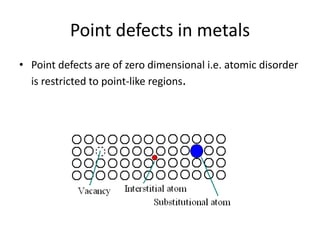
Point defects in metals
• Point defects are of zero dimensional i.e. atomic disorder
is restricted to point-like regions.
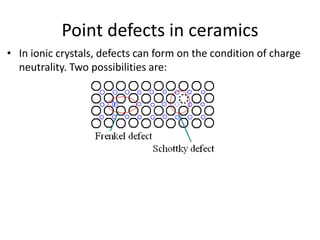
• In ionic crystals, defects can form on the condition of charge
neutrality. Two possibilities are:
Point defects in ceramics
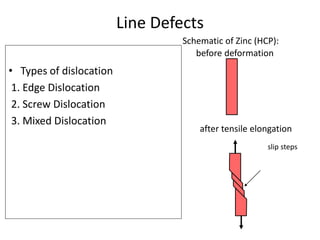
Line Defects
• Types of dislocation
1. Edge Dislocation
2. Screw Dislocation
3. Mixed Dislocation
Schematic of Zinc (HCP):
before deformation
after tensile elongation
slip steps
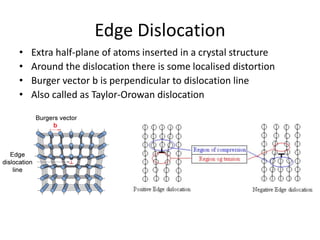
Edge Dislocation
• Extra half-plane of atoms inserted in a crystal structure
• Around the dislocation there is some localised distortion
• Burger vector b is perpendicular to dislocation line
• Also called as Taylor-Orowan dislocation
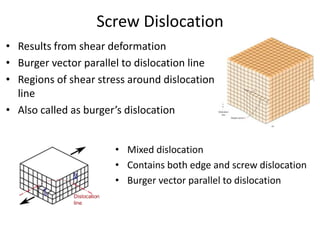
Screw Dislocation
• Results from shear deformation
• Burger vector parallel to dislocation line
• Regions of shear stress around dislocation
line
• Also called as burger’s dislocation
• Mixed dislocation
• Contains both edge and screw dislocation
• Burger vector parallel to dislocation
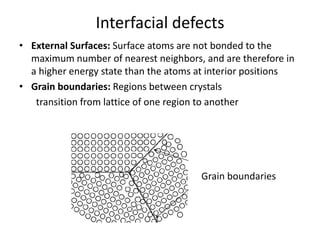
Interfacial defects
• External Surfaces: Surface atoms are not bonded to the
maximum number of nearest neighbors, and are therefore in
a higher energy state than the atoms at interior positions
• Grain boundaries: Regions between crystals
transition from lattice of one region to another
Grain boundaries
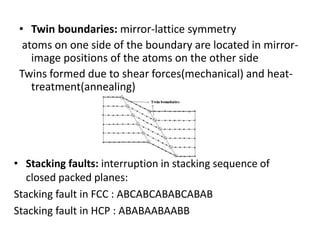
• Twin boundaries: mirror-lattice symmetry
atoms on one side of the boundary are located in mirror-
image positions of the atoms on the other side
Twins formed due to shear forces(mechanical) and heat-
treatment(annealing)
• Stacking faults: interruption in stacking sequence of
closed packed planes:
Stacking fault in FCC : ABCABCABABCABAB
Stacking fault in HCP : ABABAABAABB

Defects in materials

  • 1.
    (Established under thePresidency University Act, 2013 of the Karnataka Act 41 of 2013)
  • 2.
    Introduction of defects •Based on the geometry crystalline imperfections are classified: Point defects, Line defects, Interfacial defects and bulk or volume defects
  • 3.
    Point defects inmetals • Point defects are of zero dimensional i.e. atomic disorder is restricted to point-like regions.
  • 4.
    • In ioniccrystals, defects can form on the condition of charge neutrality. Two possibilities are: Point defects in ceramics
  • 5.
    Line Defects • Typesof dislocation 1. Edge Dislocation 2. Screw Dislocation 3. Mixed Dislocation Schematic of Zinc (HCP): before deformation after tensile elongation slip steps
  • 6.
    Edge Dislocation • Extrahalf-plane of atoms inserted in a crystal structure • Around the dislocation there is some localised distortion • Burger vector b is perpendicular to dislocation line • Also called as Taylor-Orowan dislocation
  • 7.
    Screw Dislocation • Resultsfrom shear deformation • Burger vector parallel to dislocation line • Regions of shear stress around dislocation line • Also called as burger’s dislocation • Mixed dislocation • Contains both edge and screw dislocation • Burger vector parallel to dislocation
  • 8.
    Interfacial defects • ExternalSurfaces: Surface atoms are not bonded to the maximum number of nearest neighbors, and are therefore in a higher energy state than the atoms at interior positions • Grain boundaries: Regions between crystals transition from lattice of one region to another Grain boundaries
  • 9.
    • Twin boundaries:mirror-lattice symmetry atoms on one side of the boundary are located in mirror- image positions of the atoms on the other side Twins formed due to shear forces(mechanical) and heat- treatment(annealing) • Stacking faults: interruption in stacking sequence of closed packed planes: Stacking fault in FCC : ABCABCABABCABAB Stacking fault in HCP : ABABAABAABB