DeepLPF: Deep Local Parametric Filters for
Image Enhancement
Sean Moran1 , Pierre Marza1,2, Steven McDonagh1 , Sarah Parisot1,3, Gregory Slabaugh1
Huawei Noah’s Ark Lab1 INSA Lyon2 Mila Montréal3
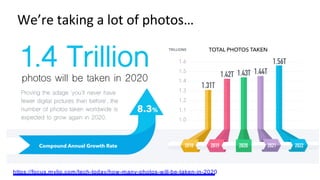
We’re taking a lot of photos…
https://focus.mylio.com/tech-today/how-many-photos-will-be-taken-in-2020
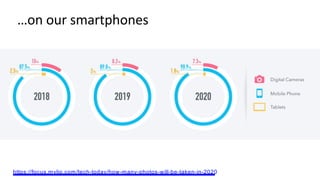
…on our smartphones
https://focus.mylio.com/tech-today/how-many-photos-will-be-taken-in-2020
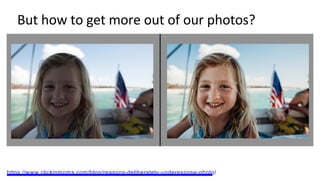
But how to get more out of our photos?
https://www.clickinmoms.com/blog/reasons-deliberately-underexpose-photo/
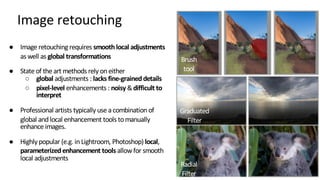
Image retouching
Brush
tool
Graduated
Filter
Radial
Filter
● Image retouching requires smoothlocal adjustments
as well as global transformations
● State of the art methods rely on either
○ global adjustments : lacks fine-graineddetails
○ pixel-level enhancements : noisy &difficult to
interpret
● Professional artists typically use a combination of
global and local enhancement tools tomanually
enhance images.
● Highly popular (e.g. in Lightroom, Photoshop) local,
parameterizedenhancement tools allowfor smooth
local adjustments
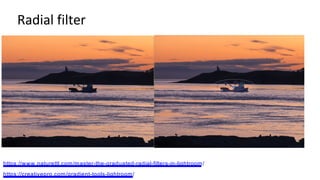
Radial filter
https://www.naturettl.com/master-the-graduated-radial-filters-in-lightroom/
https://creativepro.com/gradient-tools-lightroom/
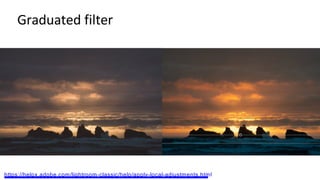
Graduated filter
https://helpx.adobe.com/lightroom-classic/help/apply-local-adjustments.html
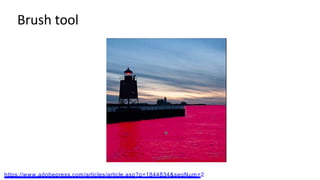
Brush tool
https://www.adobepress.com/articles/article.asp?p=1844834&seqNum=2
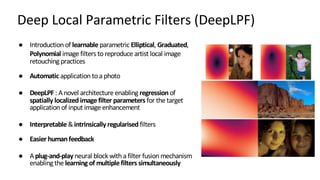
Deep Local Parametric Filters (DeepLPF)
● Introduction of learnable parametric Elliptical, Graduated,
Polynomial image filters toreproduce artist local image
retouching practices
● Automatic application toa photo
● DeepLPF : Anovel architecture enabling regressionof
spatially localizedimage filter parameters for the target
application of input image enhancement
● Interpretable &intrinsically regularised filters
● Easier humanfeedback
● Aplug-and-play neural block with a filter fusion mechanism
enabling the learning of multiplefilters simultaneously
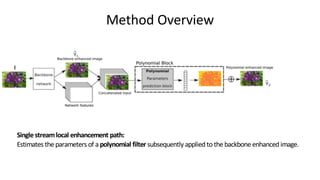
Method Overview
Global enhancement:
Standard backbone feature extractor (e.g. U-Net [1])
Single streamlocal enhancement path:
Estimates the parameters of a polynomial filter subsequently applied tothe backbone enhanced image.
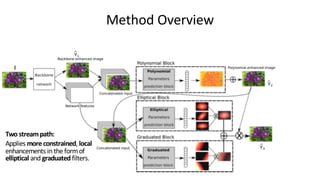
Method Overview
Two streampath:
Applies more constrained, local
enhancements in the formof
elliptical and graduatedfilters.
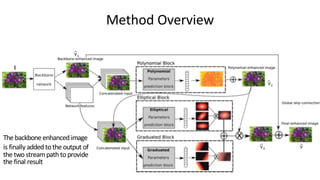
Method Overview
The backbone enhanced image
is finally addedtothe output of
the twostreampath toprovide
the final result
Method Overview
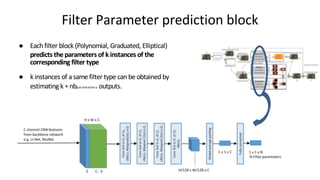
● Each filter block (Polynomial, Graduated, Elliptical)
predicts the parameters of k instances of the
corresponding filter type
● k instances of a same filter type can be obtained by
estimating k ∗ nbparam eters outputs.
Filter Parameter prediction block
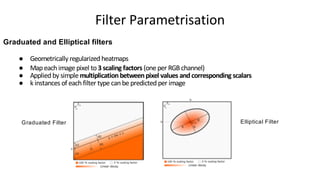
● Geometrically regularized heatmaps
● Map each image pixel to3 scaling factors (one per RGBchannel)
● Applied by simple multiplicationbetweenpixel values andcorresponding scalars
● k instances of each filter type can be predicted per image
Graduated and Elliptical filters
Graduated Filter Elliptical Filter
Filter Parametrisation
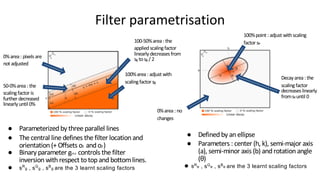
100%area: adjust with
scalingfactor sg
100-50%area: the
appliedscalingfactor
linearlydecreasesfrom
sg tosg / 2
50-0%area: the
scalingfactor is
further decreased
linearlyuntil 0%
0%area: pixelsare
not adjusted
0%area: no
changes
100%point : adjust withscaling
factor se
Decayarea: the
scalingfactor
decreaseslinearly
fromseuntil 0
● Parameterized by three parallel lines
● The central line defines the filter location and
orientation (+ Offsets o1 and o2)
● Binary parameter ginv controls the filter
inversionwithrespect totopandbottomlines.
● sR
g , sG
g , sB
g are the 3 learnt scaling factors
● Defined by an ellipse
● Parameters : center (h, k), semi-major axis
(a), semi-minor axis (b) and rotation angle
(θ)
● sRe , sGe , sBe are the 3 learnt scaling factors
Filter parametrisation
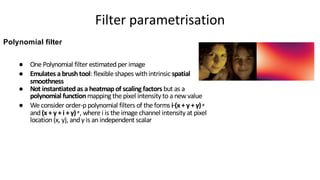
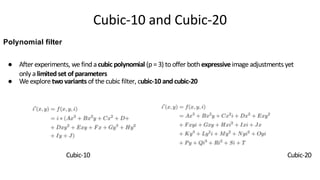
● One Polynomial filter estimated per image
● Emulates a brushtool: flexible shapes with intrinsic spatial
smoothness
● Not instantiatedas a heatmapof scaling factors but as a
polynomial functionmapping the pixel intensity toa newvalue
● We consider order-p polynomial filters of the forms i·(x + y + γ) p
and (x + y + i + γ) p
, where i is the image channel intensity at pixel
location(x, y), andγ is anindependent scalar
Polynomial filter
Filter parametrisation
Cubic-10 Cubic-20
● After experiments, we find acubic polynomial (p = 3) tooffer bothexpressiveimage adjustments yet
only a limitedset of parameters
● We explore two variants of the cubic filter, cubic-10 andcubic-20
Polynomial filter
Cubic-10 and Cubic-20
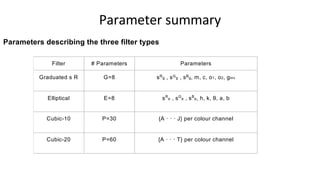
Parameters describing the three filter types
Filter # Parameters Parameters
Graduated s R G=8 sRg , sGg , sBg, m, c, o1, o2, ginv
Elliptical E=8 sR
e , sG
e , sB
e, h, k, θ, a, b
Cubic-10 P=30 {A · · · J} per colour channel
Cubic-20 P=60 {A · · · T} per colour channel
Parameter summary
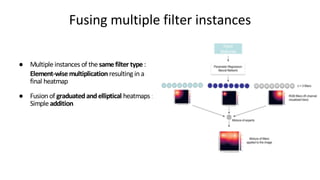
● Multiple instances of the same filter type:
Element-wise multiplicationresulting in a
final heatmap
● Fusion of graduatedandelliptical heatmaps :
Simple addition
Fusing multiple filter instances
Given Nimage pairs {(Yi , Yˆi)}i=1...N, where Yi is the reference image andYˆi is the predictedimage, we define
the DeepLPF training loss function as:
● Lab(·) : CIELab Lab channels of the input image
● L(·) : L channel of the image in CIELab colour space
● MS-SSIM: Multi-Scale Structural Similarity [26]
Loss Function
● Chrominance and luminance information split intotwoseparate loss terms
● Focus on both local (MS-SSIM) and global enhancement (L1) operations during training
● MIT-Adobe-5K dataset [2]:
○ 5000 images captured using various DSLRcameras.
○ Each captured image is subsequently (independently) retouched by five human artists.
○ The image retouching of Artist C is used todefine image enhancement ground truth.
○ MIT-Adobe-5K-DPE [3]: Subset used by DeepPhotoEnhancer (DPE) [3] with their dataset pre-
processing procedure.
○ MIT-Adobe-5K-UPE [4]: Pre-processing following the protocol of DeepUPE [4].
● See-in-the-dark (SID) [5]:
○ 5094 image pairs, captured by a Fuji camera
○ Inputs are short-exposure images in rawformat and the ground truth targets are long-exposure
RGBimages.
○ Both indoor and outdoor environments
Datasets
Experiments
● PSNR&SSIM: Standard metrics measuring the quality of the performed enhancement compared tothe
ground-truth image
● LPIPS [10] : Computes the distance between the features extracted fromthe enhanced image and
ground truth using a backbone neural network. High-level metric correlatedtohumanperception
● Number of neural weights involved: Accounts for the model efficiency
Evaluation metrics
Experiments
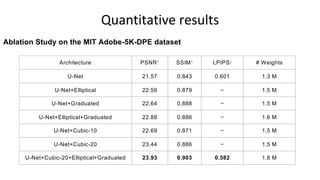
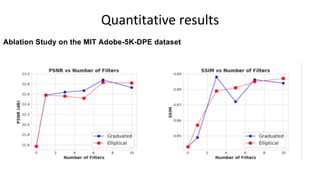
Ablation Study on the MIT Adobe-5K-DPE dataset
Quantitative results
Architecture PSNR↑ SSIM↑ LPIPS↓ # Weights
U-Net 21.57 0.843 0.601 1.3 M
U-Net+Elliptical 22.56 0.879 − 1.5 M
U-Net+Graduated 22.64 0.888 − 1.5 M
U-Net+Elliptical+Graduated 22.88 0.886 − 1.6 M
U-Net+Cubic-10 22.69 0.871 − 1.5 M
U-Net+Cubic-20 23.44 0.886 − 1.5 M
U-Net+Cubic-20+Elliptical+Graduated 23.93 0.903 0.582 1.8 M
Ablation Study on the MIT Adobe-5K-DPE dataset
Quantitative results
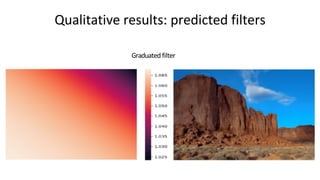
Graduated filter
Qualitative results: predicted filters
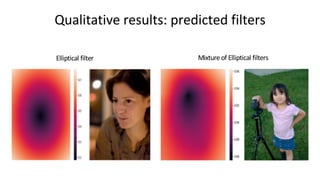
Mixture of Elliptical filtersElliptical filter
Qualitative results: predicted filters
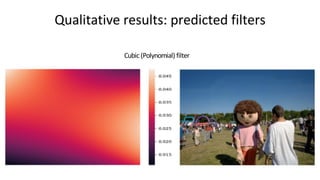
Cubic (Polynomial) filter
Qualitative results: predicted filters
Comparison to State of the Art
Quantitative results
Architecture PSNR↑ SSIM↑ LPIPS↓ # Weights
MIT-Adobe-5K-DPE dataset [3]
DeepLPF 23.93 0.903 0.582 1.8 M
DPE [3] 23.80 0.900 0.587 3.3 M
MIT-Adobe-5K-UPE dataset [4]
DeepLPF 24.48 0.887 0.103 800K
DPE [3] 22.15 0.850 – 3.3 M
DeepUPE [4] 23.04 0.893 0.158 1.0 M
SID dataset [5]
DeepLPF 26.82 0.702 0.564 2.0 M
U-Net [5] 26.61 0.680 0.586 7.8 M
DPE [3]
DeepLPF Ground Truth
Input
Qualitative Results - MIT Adobe-5K-DPE dataset
DPED(iphone7) [7] NPEA[8] FLLF [9]
Input DPE [3] DeepLPFGround Truth
CLHE [6]
Qualitative Results - MIT Adobe-5K-DPE dataset
Qualitative Results - MIT Adobe-5K-UPE dataset
DeepUPE [4]
DeepLPF Ground Truth
Input
SID(U-Net) [5]
Qualitative results – SID dataset
DeepLPF Ground Truth
Input
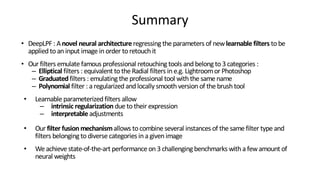
Summary
• DeepLPF : Anovel neural architectureregressing the parameters of newlearnablefilters tobe
applied toan input image in order toretouch it
• Our filters emulate famous professional retouching tools and belong to3 categories :
– Elliptical filters : equivalent tothe Radial filters in e.g. Lightroomor Photoshop
– Graduatedfilters : emulating the professional tool with the same name
– Polynomial filter : a regularized and locally smooth version of the brush tool
• Learnable parameterized filters allow
– intrinsic regularization due totheir expression
– interpretable adjustments
• Our filter fusionmechanismallows tocombine several instances of the same filter type and
filters belonging todiverse categories in a given image
• We achieve state-of-the-art performance on 3 challenging benchmarks with a fewamount of
neural weights
References
[1] O. Ronneberger, P. Fischer, and T. Brox. U-net: Convolutional networks for biomedical image
segmentation. In Medical Image Computing and Computer-Assisted Intervention (MICCAI), volume 9351 of
LNCS, pages 234–241. Springer, 2015. (available on arXiv:1505.04597 [cs.CV]). 6, 8
[2] Vladimir Bychkovsky, Sylvain Paris, Eric Chan, and Fredo ´ Durand. Learning photographic global tonal
adjustment with a database of input/output image pairs. In CVPR, pages 97– 104. IEEE, 2011. 1, 2
[3] Yu-Sheng Chen, Yu-Ching Wang, Man-Hsin Kao, and YungYu Chuang. Deep photo enhancer: Unpaired
learning for image enhancement from photographs with GANs. In Proceedings of the IEEE Conference on
Computer Vision and Pattern Recognition, pages 6306–6314, 2018. 2, 4, 6, 7, 8
[4] Ruixing Wang, Qing Zhang, Chi-Wing Fu, Xiaoyong Shen, Wei-Shi Zheng, and Jiaya Jia. Underexposed
photo enhancement using deep illumination estimation. In Proceedings of the IEEE Conference on Computer
Vision and Pattern Recognition, pages 6849–6857, 2019. 2, 6, 7, 8
[5] Chen Chen, Qifeng Chen, Jia Xu, and Vladlen Koltun. Learning to see in the dark. In Proceedings of the
IEEE Conference on Computer Vision and Pattern Recognition, pages 3291–3300, 2018. 2, 6, 7, 8
References
[6] S. Wang, W. Cho, J. Jang, M. Abidi, and J. Paik. Contrast-dependent saturation adjustment for outdoor
image enhancement. Journal of the Optical Society of America A, 2017. 12, 17, 18
[7] Andrey Ignatov, Nikolay Kobyshev, Radu Timofte, Kenneth Vanhoey, and Luc Van Gool. Dslr-quality
photos on mobile devices with deep convolutional networks. In Proceedings of the IEEE International
Conference on Computer Vision, pages 3277–3285, 2017. 2, 3, 7
[8] Y. Gao, H. Hu, and B. Li, and Q. Guo. Naturalness Preserved Non-Uniform Illumination Estimation for
Image Enhancement Based on Retinex. IEEE Transactions on Multimedia, 2017. 12, 17, 18
[9] M. Aubry, S. Paris, S. Hasinoff, J. Kautz, and F. Durand. Fast Local Laplacian Filters: Theory and
Applications. ACM Trans. Graph., 2014. 2, 12, 17, 18
[10] Richard Zhang, Phillip Isola, Alexei A Efros, Eli Shechtman, and Oliver Wang. The unreasonable
effectiveness of deep features as a perceptual metric. In CVPR, 2018. 6

Deep Local Parametric Filters for Image Enhancement

  • 1.
    DeepLPF: Deep LocalParametric Filters for Image Enhancement Sean Moran1 , Pierre Marza1,2, Steven McDonagh1 , Sarah Parisot1,3, Gregory Slabaugh1 Huawei Noah’s Ark Lab1 INSA Lyon2 Mila Montréal3
  • 2.
    We’re taking alot of photos… https://focus.mylio.com/tech-today/how-many-photos-will-be-taken-in-2020
  • 3.
  • 4.
    But how toget more out of our photos? https://www.clickinmoms.com/blog/reasons-deliberately-underexpose-photo/
  • 5.
    Image retouching Brush tool Graduated Filter Radial Filter ● Imageretouching requires smoothlocal adjustments as well as global transformations ● State of the art methods rely on either ○ global adjustments : lacks fine-graineddetails ○ pixel-level enhancements : noisy &difficult to interpret ● Professional artists typically use a combination of global and local enhancement tools tomanually enhance images. ● Highly popular (e.g. in Lightroom, Photoshop) local, parameterizedenhancement tools allowfor smooth local adjustments
  • 6.
  • 7.
  • 8.
  • 9.
    Deep Local ParametricFilters (DeepLPF) ● Introduction of learnable parametric Elliptical, Graduated, Polynomial image filters toreproduce artist local image retouching practices ● Automatic application toa photo ● DeepLPF : Anovel architecture enabling regressionof spatially localizedimage filter parameters for the target application of input image enhancement ● Interpretable &intrinsically regularised filters ● Easier humanfeedback ● Aplug-and-play neural block with a filter fusion mechanism enabling the learning of multiplefilters simultaneously
  • 10.
    Method Overview Global enhancement: Standardbackbone feature extractor (e.g. U-Net [1])
  • 11.
    Single streamlocal enhancementpath: Estimates the parameters of a polynomial filter subsequently applied tothe backbone enhanced image. Method Overview
  • 12.
    Two streampath: Applies moreconstrained, local enhancements in the formof elliptical and graduatedfilters. Method Overview
  • 13.
    The backbone enhancedimage is finally addedtothe output of the twostreampath toprovide the final result Method Overview
  • 14.
    ● Each filterblock (Polynomial, Graduated, Elliptical) predicts the parameters of k instances of the corresponding filter type ● k instances of a same filter type can be obtained by estimating k ∗ nbparam eters outputs. Filter Parameter prediction block
  • 15.
    ● Geometrically regularizedheatmaps ● Map each image pixel to3 scaling factors (one per RGBchannel) ● Applied by simple multiplicationbetweenpixel values andcorresponding scalars ● k instances of each filter type can be predicted per image Graduated and Elliptical filters Graduated Filter Elliptical Filter Filter Parametrisation
  • 16.
    100%area: adjust with scalingfactorsg 100-50%area: the appliedscalingfactor linearlydecreasesfrom sg tosg / 2 50-0%area: the scalingfactor is further decreased linearlyuntil 0% 0%area: pixelsare not adjusted 0%area: no changes 100%point : adjust withscaling factor se Decayarea: the scalingfactor decreaseslinearly fromseuntil 0 ● Parameterized by three parallel lines ● The central line defines the filter location and orientation (+ Offsets o1 and o2) ● Binary parameter ginv controls the filter inversionwithrespect totopandbottomlines. ● sR g , sG g , sB g are the 3 learnt scaling factors ● Defined by an ellipse ● Parameters : center (h, k), semi-major axis (a), semi-minor axis (b) and rotation angle (θ) ● sRe , sGe , sBe are the 3 learnt scaling factors Filter parametrisation
  • 17.
    ● One Polynomialfilter estimated per image ● Emulates a brushtool: flexible shapes with intrinsic spatial smoothness ● Not instantiatedas a heatmapof scaling factors but as a polynomial functionmapping the pixel intensity toa newvalue ● We consider order-p polynomial filters of the forms i·(x + y + γ) p and (x + y + i + γ) p , where i is the image channel intensity at pixel location(x, y), andγ is anindependent scalar Polynomial filter Filter parametrisation
  • 18.
    Cubic-10 Cubic-20 ● Afterexperiments, we find acubic polynomial (p = 3) tooffer bothexpressiveimage adjustments yet only a limitedset of parameters ● We explore two variants of the cubic filter, cubic-10 andcubic-20 Polynomial filter Cubic-10 and Cubic-20
  • 19.
    Parameters describing thethree filter types Filter # Parameters Parameters Graduated s R G=8 sRg , sGg , sBg, m, c, o1, o2, ginv Elliptical E=8 sR e , sG e , sB e, h, k, θ, a, b Cubic-10 P=30 {A · · · J} per colour channel Cubic-20 P=60 {A · · · T} per colour channel Parameter summary
  • 20.
    ● Multiple instancesof the same filter type: Element-wise multiplicationresulting in a final heatmap ● Fusion of graduatedandelliptical heatmaps : Simple addition Fusing multiple filter instances
  • 21.
    Given Nimage pairs{(Yi , Yˆi)}i=1...N, where Yi is the reference image andYˆi is the predictedimage, we define the DeepLPF training loss function as: ● Lab(·) : CIELab Lab channels of the input image ● L(·) : L channel of the image in CIELab colour space ● MS-SSIM: Multi-Scale Structural Similarity [26] Loss Function ● Chrominance and luminance information split intotwoseparate loss terms ● Focus on both local (MS-SSIM) and global enhancement (L1) operations during training
  • 22.
    ● MIT-Adobe-5K dataset[2]: ○ 5000 images captured using various DSLRcameras. ○ Each captured image is subsequently (independently) retouched by five human artists. ○ The image retouching of Artist C is used todefine image enhancement ground truth. ○ MIT-Adobe-5K-DPE [3]: Subset used by DeepPhotoEnhancer (DPE) [3] with their dataset pre- processing procedure. ○ MIT-Adobe-5K-UPE [4]: Pre-processing following the protocol of DeepUPE [4]. ● See-in-the-dark (SID) [5]: ○ 5094 image pairs, captured by a Fuji camera ○ Inputs are short-exposure images in rawformat and the ground truth targets are long-exposure RGBimages. ○ Both indoor and outdoor environments Datasets Experiments
  • 23.
    ● PSNR&SSIM: Standardmetrics measuring the quality of the performed enhancement compared tothe ground-truth image ● LPIPS [10] : Computes the distance between the features extracted fromthe enhanced image and ground truth using a backbone neural network. High-level metric correlatedtohumanperception ● Number of neural weights involved: Accounts for the model efficiency Evaluation metrics Experiments
  • 24.
    Ablation Study onthe MIT Adobe-5K-DPE dataset Quantitative results Architecture PSNR↑ SSIM↑ LPIPS↓ # Weights U-Net 21.57 0.843 0.601 1.3 M U-Net+Elliptical 22.56 0.879 − 1.5 M U-Net+Graduated 22.64 0.888 − 1.5 M U-Net+Elliptical+Graduated 22.88 0.886 − 1.6 M U-Net+Cubic-10 22.69 0.871 − 1.5 M U-Net+Cubic-20 23.44 0.886 − 1.5 M U-Net+Cubic-20+Elliptical+Graduated 23.93 0.903 0.582 1.8 M
  • 25.
    Ablation Study onthe MIT Adobe-5K-DPE dataset Quantitative results
  • 26.
  • 27.
    Mixture of EllipticalfiltersElliptical filter Qualitative results: predicted filters
  • 28.
    Cubic (Polynomial) filter Qualitativeresults: predicted filters
  • 29.
    Comparison to Stateof the Art Quantitative results Architecture PSNR↑ SSIM↑ LPIPS↓ # Weights MIT-Adobe-5K-DPE dataset [3] DeepLPF 23.93 0.903 0.582 1.8 M DPE [3] 23.80 0.900 0.587 3.3 M MIT-Adobe-5K-UPE dataset [4] DeepLPF 24.48 0.887 0.103 800K DPE [3] 22.15 0.850 – 3.3 M DeepUPE [4] 23.04 0.893 0.158 1.0 M SID dataset [5] DeepLPF 26.82 0.702 0.564 2.0 M U-Net [5] 26.61 0.680 0.586 7.8 M
  • 30.
    DPE [3] DeepLPF GroundTruth Input Qualitative Results - MIT Adobe-5K-DPE dataset
  • 31.
    DPED(iphone7) [7] NPEA[8]FLLF [9] Input DPE [3] DeepLPFGround Truth CLHE [6] Qualitative Results - MIT Adobe-5K-DPE dataset
  • 32.
    Qualitative Results -MIT Adobe-5K-UPE dataset DeepUPE [4] DeepLPF Ground Truth Input
  • 33.
    SID(U-Net) [5] Qualitative results– SID dataset DeepLPF Ground Truth Input
  • 34.
    Summary • DeepLPF :Anovel neural architectureregressing the parameters of newlearnablefilters tobe applied toan input image in order toretouch it • Our filters emulate famous professional retouching tools and belong to3 categories : – Elliptical filters : equivalent tothe Radial filters in e.g. Lightroomor Photoshop – Graduatedfilters : emulating the professional tool with the same name – Polynomial filter : a regularized and locally smooth version of the brush tool • Learnable parameterized filters allow – intrinsic regularization due totheir expression – interpretable adjustments • Our filter fusionmechanismallows tocombine several instances of the same filter type and filters belonging todiverse categories in a given image • We achieve state-of-the-art performance on 3 challenging benchmarks with a fewamount of neural weights
  • 35.
    References [1] O. Ronneberger,P. Fischer, and T. Brox. U-net: Convolutional networks for biomedical image segmentation. In Medical Image Computing and Computer-Assisted Intervention (MICCAI), volume 9351 of LNCS, pages 234–241. Springer, 2015. (available on arXiv:1505.04597 [cs.CV]). 6, 8 [2] Vladimir Bychkovsky, Sylvain Paris, Eric Chan, and Fredo ´ Durand. Learning photographic global tonal adjustment with a database of input/output image pairs. In CVPR, pages 97– 104. IEEE, 2011. 1, 2 [3] Yu-Sheng Chen, Yu-Ching Wang, Man-Hsin Kao, and YungYu Chuang. Deep photo enhancer: Unpaired learning for image enhancement from photographs with GANs. In Proceedings of the IEEE Conference on Computer Vision and Pattern Recognition, pages 6306–6314, 2018. 2, 4, 6, 7, 8 [4] Ruixing Wang, Qing Zhang, Chi-Wing Fu, Xiaoyong Shen, Wei-Shi Zheng, and Jiaya Jia. Underexposed photo enhancement using deep illumination estimation. In Proceedings of the IEEE Conference on Computer Vision and Pattern Recognition, pages 6849–6857, 2019. 2, 6, 7, 8 [5] Chen Chen, Qifeng Chen, Jia Xu, and Vladlen Koltun. Learning to see in the dark. In Proceedings of the IEEE Conference on Computer Vision and Pattern Recognition, pages 3291–3300, 2018. 2, 6, 7, 8
  • 36.
    References [6] S. Wang,W. Cho, J. Jang, M. Abidi, and J. Paik. Contrast-dependent saturation adjustment for outdoor image enhancement. Journal of the Optical Society of America A, 2017. 12, 17, 18 [7] Andrey Ignatov, Nikolay Kobyshev, Radu Timofte, Kenneth Vanhoey, and Luc Van Gool. Dslr-quality photos on mobile devices with deep convolutional networks. In Proceedings of the IEEE International Conference on Computer Vision, pages 3277–3285, 2017. 2, 3, 7 [8] Y. Gao, H. Hu, and B. Li, and Q. Guo. Naturalness Preserved Non-Uniform Illumination Estimation for Image Enhancement Based on Retinex. IEEE Transactions on Multimedia, 2017. 12, 17, 18 [9] M. Aubry, S. Paris, S. Hasinoff, J. Kautz, and F. Durand. Fast Local Laplacian Filters: Theory and Applications. ACM Trans. Graph., 2014. 2, 12, 17, 18 [10] Richard Zhang, Phillip Isola, Alexei A Efros, Eli Shechtman, and Oliver Wang. The unreasonable effectiveness of deep features as a perceptual metric. In CVPR, 2018. 6