© SuperDataScienceDeep Learning A-Z
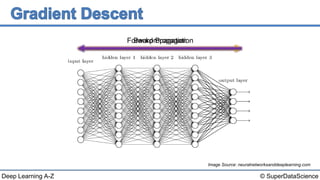
Image Source: neuralnetworksanddeeplearning.com
Forward PropagationBackpropagation
© SuperDataScienceDeep Learning A-Z
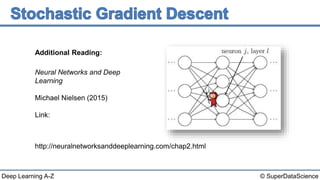
Neural Networks and Deep
Learning
Michael Nielsen (2015)
Link:
http://neuralnetworksanddeeplearning.com/chap2.html
Additional Reading:
© SuperDataScienceDeep Learning A-Z
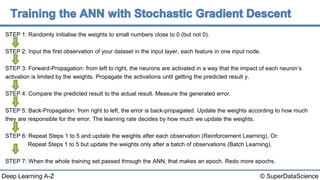
STEP 1: Randomly initialise the weights to small numbers close to 0 (but not 0).
STEP 2: Input the first observation of your dataset in the input layer, each feature in one input node.
STEP 3: Forward-Propagation: from left to right, the neurons are activated in a way that the impact of each neuron’s
activation is limited by the weights. Propagate the activations until getting the predicted result y.
STEP 4: Compare the predicted result to the actual result. Measure the generated error.
STEP 5: Back-Propagation: from right to left, the error is back-propagated. Update the weights according to how much
they are responsible for the error. The learning rate decides by how much we update the weights.
STEP 6: Repeat Steps 1 to 5 and update the weights after each observation (Reinforcement Learning). Or:
Repeat Steps 1 to 5 but update the weights only after a batch of observations (Batch Learning).
STEP 7: When the whole training set passed through the ANN, that makes an epoch. Redo more epochs.

Deep Learning A-Z™: Artificial Neural Networks (ANN) - Backpropagation

  • 1.
  • 2.
    © SuperDataScienceDeep LearningA-Z Image Source: neuralnetworksanddeeplearning.com Forward PropagationBackpropagation
  • 3.
    © SuperDataScienceDeep LearningA-Z Neural Networks and Deep Learning Michael Nielsen (2015) Link: http://neuralnetworksanddeeplearning.com/chap2.html Additional Reading:
  • 4.
    © SuperDataScienceDeep LearningA-Z STEP 1: Randomly initialise the weights to small numbers close to 0 (but not 0). STEP 2: Input the first observation of your dataset in the input layer, each feature in one input node. STEP 3: Forward-Propagation: from left to right, the neurons are activated in a way that the impact of each neuron’s activation is limited by the weights. Propagate the activations until getting the predicted result y. STEP 4: Compare the predicted result to the actual result. Measure the generated error. STEP 5: Back-Propagation: from right to left, the error is back-propagated. Update the weights according to how much they are responsible for the error. The learning rate decides by how much we update the weights. STEP 6: Repeat Steps 1 to 5 and update the weights after each observation (Reinforcement Learning). Or: Repeat Steps 1 to 5 but update the weights only after a batch of observations (Batch Learning). STEP 7: When the whole training set passed through the ANN, that makes an epoch. Redo more epochs.