© SuperDataScienceDeep Learning A-Z
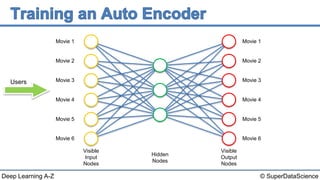
Movie 1
Movie 2
Movie 3
Movie 4
Movie 5
Movie 6
Movie 1
Movie 2
Movie 3
Movie 4
Movie 5
Movie 6
Visible
Input
Nodes
Hidden
Nodes
Visible
Output
Nodes
Users
© SuperDataScienceDeep Learning A-Z
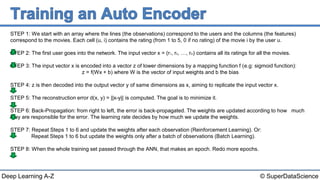
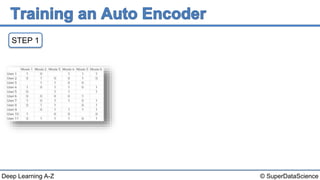
STEP 1: We start with an array where the lines (the observations) correspond to the users and the columns (the features)
correspond to the movies. Each cell (u, i) contains the rating (from 1 to 5, 0 if no rating) of the movie i by the user u.
STEP 2: The first user goes into the network. The input vector x = (r1, r2, …, rm) contains all its ratings for all the movies.
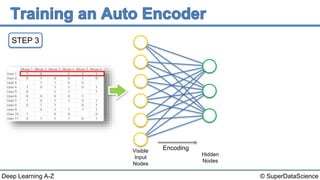
STEP 3: The input vector x is encoded into a vector z of lower dimensions by a mapping function f (e.g: sigmoid function):
z = f(Wx + b) where W is the vector of input weights and b the bias
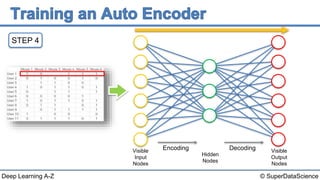
STEP 4: z is then decoded into the output vector y of same dimensions as x, aiming to replicate the input vector x.
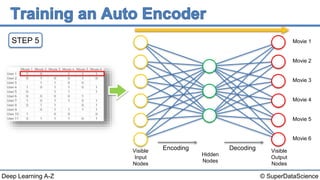
STEP 5: The reconstruction error d(x, y) = ||x-y|| is computed. The goal is to minimize it.
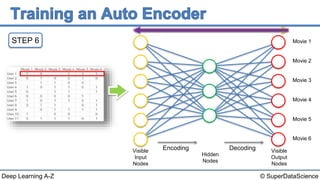
STEP 6: Back-Propagation: from right to left, the error is back-propagated. The weights are updated according to how much
they are responsible for the error. The learning rate decides by how much we update the weights.
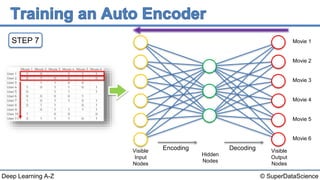
STEP 7: Repeat Steps 1 to 6 and update the weights after each observation (Reinforcement Learning). Or:
Repeat Steps 1 to 6 but update the weights only after a batch of observations (Batch Learning).
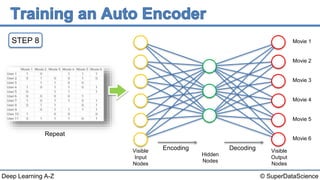
STEP 8: When the whole training set passed through the ANN, that makes an epoch. Redo more epochs.
© SuperDataScienceDeep Learning A-Z
STEP 1
© SuperDataScienceDeep Learning A-Z
STEP 2
Visible
Input
Nodes
© SuperDataScienceDeep Learning A-Z
STEP 3
Hidden
Nodes
Visible
Input
Nodes
Encoding
© SuperDataScienceDeep Learning A-Z
STEP 4
Hidden
Nodes
Visible
Output
Nodes
Visible
Input
Nodes
Encoding Decoding
© SuperDataScienceDeep Learning A-Z
STEP 5 Movie 1
Movie 2
Movie 3
Movie 4
Movie 5
Movie 6
Hidden
Nodes
Visible
Output
Nodes
Visible
Input
Nodes
Encoding Decoding
© SuperDataScienceDeep Learning A-Z
STEP 6 Movie 1
Movie 2
Movie 3
Movie 4
Movie 5
Movie 6
Hidden
Nodes
Visible
Output
Nodes
Visible
Input
Nodes
Encoding Decoding
© SuperDataScienceDeep Learning A-Z
STEP 7 Movie 1
Movie 2
Movie 3
Movie 4
Movie 5
Movie 6
Hidden
Nodes
Visible
Output
Nodes
Visible
Input
Nodes
Encoding Decoding
© SuperDataScienceDeep Learning A-Z
STEP 8 Movie 1
Movie 2
Movie 3
Movie 4
Movie 5
Movie 6
Hidden
Nodes
Visible
Output
Nodes
Visible
Input
Nodes
Encoding Decoding
Repeat
© SuperDataScienceDeep Learning A-Z
Building Autoencoders in Keras
By Francois Chollet (2016)
Link:
https://blog.keras.io/building-autoencoders-in-keras.html
Additional Reading:

Deep Learning A-Z™: AutoEncoders - Training an AutoEncoder

  • 1.
  • 2.
    © SuperDataScienceDeep LearningA-Z Movie 1 Movie 2 Movie 3 Movie 4 Movie 5 Movie 6 Movie 1 Movie 2 Movie 3 Movie 4 Movie 5 Movie 6 Visible Input Nodes Hidden Nodes Visible Output Nodes Users
  • 3.
    © SuperDataScienceDeep LearningA-Z STEP 1: We start with an array where the lines (the observations) correspond to the users and the columns (the features) correspond to the movies. Each cell (u, i) contains the rating (from 1 to 5, 0 if no rating) of the movie i by the user u. STEP 2: The first user goes into the network. The input vector x = (r1, r2, …, rm) contains all its ratings for all the movies. STEP 3: The input vector x is encoded into a vector z of lower dimensions by a mapping function f (e.g: sigmoid function): z = f(Wx + b) where W is the vector of input weights and b the bias STEP 4: z is then decoded into the output vector y of same dimensions as x, aiming to replicate the input vector x. STEP 5: The reconstruction error d(x, y) = ||x-y|| is computed. The goal is to minimize it. STEP 6: Back-Propagation: from right to left, the error is back-propagated. The weights are updated according to how much they are responsible for the error. The learning rate decides by how much we update the weights. STEP 7: Repeat Steps 1 to 6 and update the weights after each observation (Reinforcement Learning). Or: Repeat Steps 1 to 6 but update the weights only after a batch of observations (Batch Learning). STEP 8: When the whole training set passed through the ANN, that makes an epoch. Redo more epochs.
  • 4.
  • 5.
    © SuperDataScienceDeep LearningA-Z STEP 2 Visible Input Nodes
  • 6.
    © SuperDataScienceDeep LearningA-Z STEP 3 Hidden Nodes Visible Input Nodes Encoding
  • 7.
    © SuperDataScienceDeep LearningA-Z STEP 4 Hidden Nodes Visible Output Nodes Visible Input Nodes Encoding Decoding
  • 8.
    © SuperDataScienceDeep LearningA-Z STEP 5 Movie 1 Movie 2 Movie 3 Movie 4 Movie 5 Movie 6 Hidden Nodes Visible Output Nodes Visible Input Nodes Encoding Decoding
  • 9.
    © SuperDataScienceDeep LearningA-Z STEP 6 Movie 1 Movie 2 Movie 3 Movie 4 Movie 5 Movie 6 Hidden Nodes Visible Output Nodes Visible Input Nodes Encoding Decoding
  • 10.
    © SuperDataScienceDeep LearningA-Z STEP 7 Movie 1 Movie 2 Movie 3 Movie 4 Movie 5 Movie 6 Hidden Nodes Visible Output Nodes Visible Input Nodes Encoding Decoding
  • 11.
    © SuperDataScienceDeep LearningA-Z STEP 8 Movie 1 Movie 2 Movie 3 Movie 4 Movie 5 Movie 6 Hidden Nodes Visible Output Nodes Visible Input Nodes Encoding Decoding Repeat
  • 12.
    © SuperDataScienceDeep LearningA-Z Building Autoencoders in Keras By Francois Chollet (2016) Link: https://blog.keras.io/building-autoencoders-in-keras.html Additional Reading: