FINANCING THE POST-2015
DEVELOPMENT FRAMEWORK
UNITED NATIONS PANEL ON FINANCING FOR
SUSTAINABLE DEVELOPMENT
Geneva – 9 July 2013
The World Bank
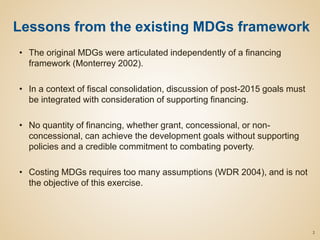
• The original MDGs were articulated independently of a financing
framework (Monterrey 2002).
• In a context of fiscal consolidation, discussion of post-2015 goals must
be integrated with consideration of supporting financing.
• No quantity of financing, whether grant, concessional, or non-
concessional, can achieve the development goals without supporting
policies and a credible commitment to combating poverty.
• Costing MDGs requires too many assumptions (WDR 2004), and is not
the objective of this exercise.
2
Lessons from the existing MDGs framework
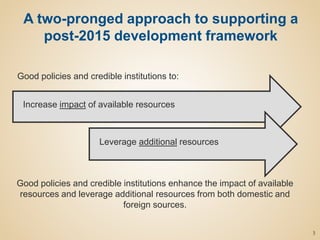
Increase impact of available resources
Leverage additional resources
3
A two-pronged approach to supporting a
post-2015 development framework
Good policies and credible institutions enhance the impact of available
resources and leverage additional resources from both domestic and
foreign sources.
Good policies and credible institutions to:
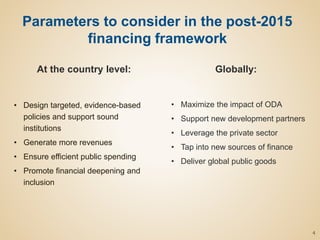
Parameters to consider in the post-2015
financing framework
At the country level:
• Design targeted, evidence-based
policies and support sound
institutions
• Generate more revenues
• Ensure efficient public spending
• Promote financial deepening and
inclusion
Globally:
• Maximize the impact of ODA
• Support new development partners
• Leverage the private sector
• Tap into new sources of finance
• Deliver global public goods
4
5
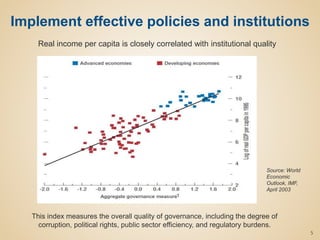
Implement effective policies and institutions
Real income per capita is closely correlated with institutional quality
Source: World
Economic
Outlook, IMF,
April 2003
This index measures the overall quality of governance, including the degree of
corruption, political rights, public sector efficiency, and regulatory burdens.
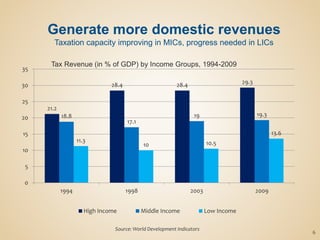
21.2
28.4 28.4 29.3
18.8
17.1
19 19.3
11.3
10 10.5
13.6
0
5
10
15
20
25
30
35
1994 1998 2003 2009
High Income Middle Income Low Income
6
Generate more domestic revenues
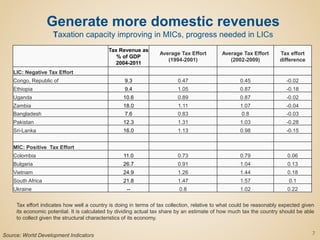
Taxation capacity improving in MICs, progress needed in LICs
Tax Revenue (in % of GDP) by Income Groups, 1994-2009
Source: World Development Indicators
Tax Revenue as
% of GDP
2004-2011
Average Tax Effort
(1994-2001)
Average Tax Effort
(2002-2009)
Tax effort
difference
LIC: Negative Tax Effort
Congo, Republic of 9.3 0.47 0.45 -0.02
Ethiopia 9.4 1.05 0.87 -0.18
Uganda 10.6 0.89 0.87 -0.02
Zambia 18.0 1.11 1.07 -0.04
Bangladesh 7.6 0.83 0.8 -0.03
Pakistan 12.3 1.31 1.03 -0.28
Sri-Lanka 16.0 1.13 0.98 -0.15
MIC: Positive Tax Effort
Colombia 11.0 0.73 0.79 0.06
Bulgaria 26.7 0.91 1.04 0.13
Vietnam 24.9 1.26 1.44 0.18
South Africa 21.8 1.47 1.57 0.1
Ukraine -- 0.8 1.02 0.22
7
Generate more domestic revenues
Taxation capacity improving in MICs, progress needed in LICs
Source: World Development Indicators
Tax effort indicates how well a country is doing in terms of tax collection, relative to what could be reasonably expected given
its economic potential. It is calculated by dividing actual tax share by an estimate of how much tax the country should be able
to collect given the structural characteristics of its economy.
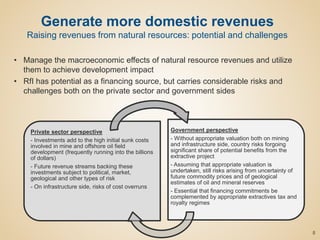
• Manage the macroeconomic effects of natural resource revenues and utilize
them to achieve development impact
• RfI has potential as a financing source, but carries considerable risks and
challenges both on the private sector and government sides
8
Generate more domestic revenues
Raising revenues from natural resources: potential and challenges
Private sector perspective
- Investments add to the high initial sunk costs
involved in mine and offshore oil field
development (frequently running into the billions
of dollars)
- Future revenue streams backing these
investments subject to political, market,
geological and other types of risk
- On infrastructure side, risks of cost overruns
Government perspective
- Without appropriate valuation both on mining
and infrastructure side, country risks forgoing
significant share of potential benefits from the
extractive project
- Assuming that appropriate valuation is
undertaken, still risks arising from uncertainty of
future commodity prices and of geological
estimates of oil and mineral reserves
- Essential that financing commitments be
complemented by appropriate extractives tax and
royalty regimes
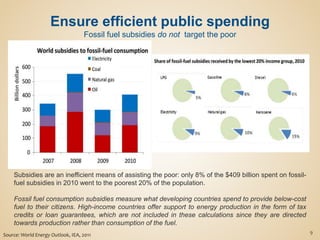
Ensure efficient public spending
Fossil fuel subsidies do not target the poor
9
Source: World Energy Outlook, IEA, 2011
Subsidies are an inefficient means of assisting the poor: only 8% of the $409 billion spent on fossil-
fuel subsidies in 2010 went to the poorest 20% of the population.
Fossil fuel consumption subsidies measure what developing countries spend to provide below-cost
fuel to their citizens. High-income countries offer support to energy production in the form of tax
credits or loan guarantees, which are not included in these calculations since they are directed
towards production rather than consumption of the fuel.
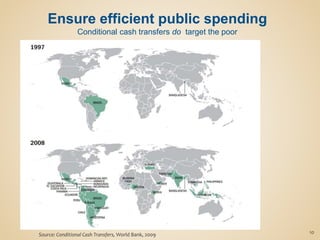
10
Ensure efficient public spending
Conditional cash transfers do target the poor
Source: Conditional Cash Transfers, World Bank, 2009 10
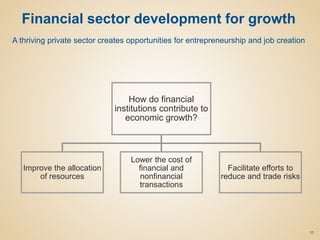
How do financial
institutions contribute to
economic growth?
Improve the allocation
of resources
Lower the cost of
financial and
nonfinancial
transactions
Facilitate efforts to
reduce and trade risks
11
Financial sector development for growth
A thriving private sector creates opportunities for entrepreneurship and job creation
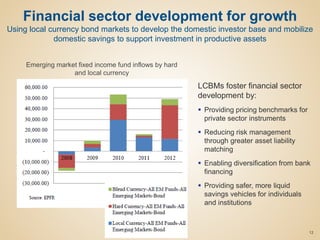
12
Financial sector development for growth
Using local currency bond markets to develop the domestic investor base and mobilize
domestic savings to support investment in productive assets
Emerging market fixed income fund inflows by hard
and local currency
LCBMs foster financial sector
development by:
 Providing pricing benchmarks for
private sector instruments
 Reducing risk management
through greater asset liability
matching
 Enabling diversification from bank
financing
 Providing safer, more liquid
savings vehicles for individuals
and institutions
Financial Inclusion
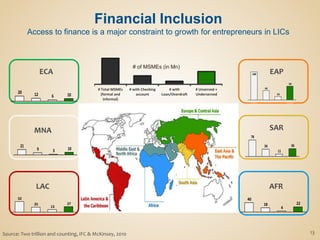
Access to finance is a major constraint to growth for entrepreneurs in LICs
21
9 3 10
#Total MSMEs (formal
andinformal)
#with Checking account #with Loan/Overdraft #Unserved+
Underserved
52
25
13
27
# Total MSMEs (formal
and informal)
# with Checking account # with Loan/Overdraft # Unserved +
Underserved
20 12 6 10
#Total MSMEs (formal
andinformal)
#with Checking account #with Loan/Overdraft #Unserved+
Underserved
188
62
23
92
# Total MSMEs (formal
and informal)
# with Checking account # with Loan/Overdraft # Unserved +
Underserved
78
34
11
36
#Total MSMEs (formal
andinformal)
#with Checking account #with Loan/Overdraft #Unserved+
Underserved
40
18
4
22
# Total MSMEs (formal
andinformal)
# with Checking account # with Loan/Overdraft # Unserved+
Underserved
LAC
MNA
ECA EAP
SAR
AFR
# of MSMEs (in Mn)
# Total MSMEs
(formal and
informal)
# with Checking
account
# with
Loan/Overdraft
# Unserved +
Underserved
Source: Two trillion and counting, IFC & McKinsey, 2010 13
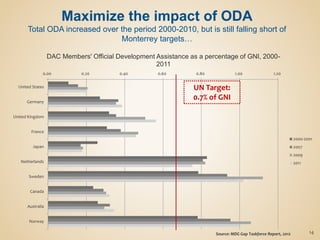
Source: MDG Gap Taskforce Report, 2012
0.00 0.20 0.40 0.60 0.80 1.00 1.20
United States
Germany
United Kingdom
France
Japan
Netherlands
Sweden
Canada
Australia
Norway
DAC Members' Official Development Assistance as a percentage of GNI, 2000-
2011
2000-2001
2007
2009
2011
UN Target:
0.7% of GNI
14
Maximize the impact of ODA
Total ODA increased over the period 2000-2010, but is still falling short of
Monterrey targets…
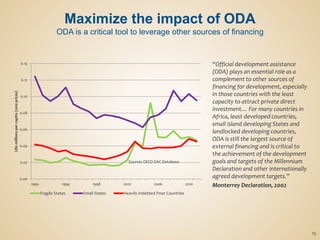
“Official development assistance
(ODA) plays an essential role as a
complement to other sources of
financing for development, especially
in those countries with the least
capacity to attract private direct
investment… For many countries in
Africa, least developed countries,
small island developing States and
landlocked developing countries,
ODA is still the largest source of
external financing and is critical to
the achievement of the development
goals and targets of the Millennium
Declaration and other internationally
agreed development targets.”
Monterrey Declaration, 2002
15
Maximize the impact of ODA
ODA is a critical tool to leverage other sources of financing
Source: OECD DAC Database
0.00
0.02
0.04
0.06
0.08
0.10
0.12
0.14
1990 1994 1998 2002 2006 2010
US$millionspercapita(2010prices)
Fragile States Small States Heavily Indebted Poor Countries
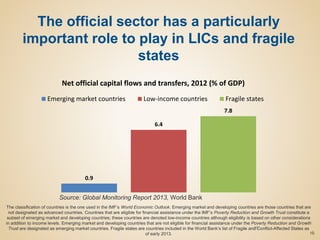
0.9
6.4
7.8
Net official capital flows and transfers, 2012 (% of GDP)
Emerging market countries Low-income countries Fragile states
16
The official sector has a particularly
important role to play in LICs and fragile
states
Source: Global Monitoring Report 2013, World Bank
The classification of countries is the one used in the IMF‘s World Economic Outlook. Emerging market and developing countries are those countries that are
not designated as advanced countries. Countries that are eligible for financial assistance under the IMF‘s Poverty Reduction and Growth Trust constitute a
subset of emerging market and developing countries; these countries are denoted low-income countries although eligibility is based on other considerations
in addition to income levels. Emerging market and developing countries that are not eligible for financial assistance under the Poverty Reduction and Growth
Trust are designated as emerging market countries. Fragile states are countries included in the World Bank‘s list of Fragile and Conflict-Affected States as
of early 2013. 16
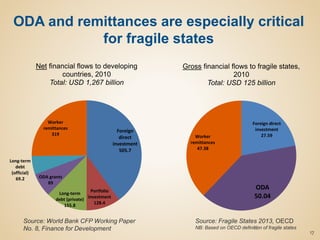
ODA and remittances are especially critical
for fragile states
Foreign
direct
investment
505.7
Portfolio
investment
128.4
Long-term
debt (private)
155.8
ODA grants
89
Long-term
debt
(official)
69.2
Worker
remittances
319
Net financial flows to developing
countries, 2010
Total: USD 1,267 billion
Foreign direct
investment
27.59
ODA
50.04
Worker
remittances
47.38
Gross financial flows to fragile states,
2010
Total: USD 125 billion
17
Source: World Bank CFP Working Paper
No. 8, Finance for Development
Source: Fragile States 2013, OECD
NB: Based on OECD definition of fragile states
17
18
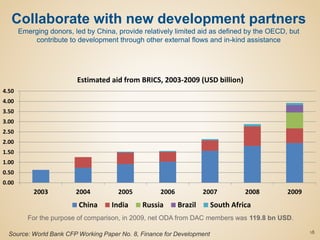
Collaborate with new development partners
Emerging donors, led by China, provide relatively limited aid as defined by the OECD, but
contribute to development through other external flows and in-kind assistance
Source: World Bank CFP Working Paper No. 8, Finance for Development
For the purpose of comparison, in 2009, net ODA from DAC members was 119.8 bn USD.
0.00
0.50
1.00
1.50
2.00
2.50
3.00
3.50
4.00
4.50
2003 2004 2005 2006 2007 2008 2009
Estimated aid from BRICS, 2003-2009 (USD billion)
China India Russia Brazil South Africa
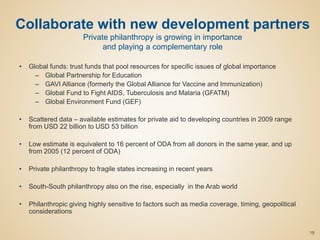
• Global funds: trust funds that pool resources for specific issues of global importance
– Global Partnership for Education
– GAVI Alliance (formerly the Global Alliance for Vaccine and Immunization)
– Global Fund to Fight AIDS, Tuberculosis and Malaria (GFATM)
– Global Environment Fund (GEF)
• Scattered data – available estimates for private aid to developing countries in 2009 range
from USD 22 billion to USD 53 billion
• Low estimate is equivalent to 16 percent of ODA from all donors in the same year, and up
from 2005 (12 percent of ODA)
• Private philanthropy to fragile states increasing in recent years
• South-South philanthropy also on the rise, especially in the Arab world
• Philanthropic giving highly sensitive to factors such as media coverage, timing, geopolitical
considerations
19
Collaborate with new development partners
Private philanthropy is growing in importance
and playing a complementary role
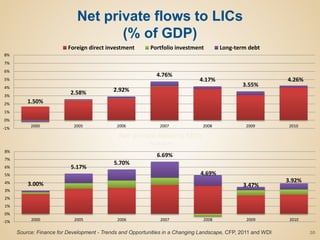
1.50%
2.58% 2.92%
4.76%
4.17%
3.55%
4.26%
-1%
0%
1%
2%
3%
4%
5%
6%
7%
8%
2000 2005 2006 2007 2008 2009 2010
Foreign direct investment Portfolio investment Long-term debt
20
3.00%
5.17%
5.70%
6.69%
4.69%
3.47%
3.92%
-1%
0%
1%
2%
3%
4%
5%
6%
7%
8%
2000 2005 2006 2007 2008 2009 2010
Net private flows to MICs
(% of GDP)
Net private flows to LICs
(% of GDP)
Source: Finance for Development - Trends and Opportunities in a Changing Landscape, CFP, 2011 and WDI
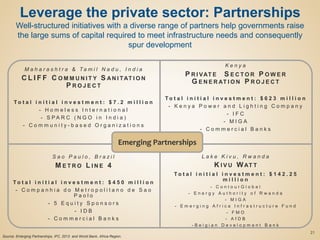
Leverage the private sector: Partnerships
Well-structured initiatives with a diverse range of partners help governments raise
the large sums of capital required to meet infrastructure needs and consequently
spur development
21
M a h a r a s h t r a & T a m i l N a d u , I n d i a
C L I F F C O M M U N I T Y S AN I TAT I O N
P R O J E C T
T o t a l i n i t i a l i n v e s t m e n t : $ 7 . 2 m i l l i o n
- H o m e l e s s I n t e r n a t i o n a l
- S P A R C ( N G O i n I n d i a )
- C o m m u n i t y - b a s e d O r g a n i z a t i o n s
K e n y a
P R I VAT E S E C T O R P O W E R
G E N E R AT I O N P R O J E C T
T o t a l i n i t i a l i n v e s t m e n t : $ 6 2 3 m i l l i o n
- K e n y a P o w e r a n d L i g h t i n g C o m p a n y
- I F C
- M I G A
- C o m m e r c i a l B a n k s
S a o P a u l o , B r a z i l
M E T R O L I N E 4
T o t a l i n i t i a l i n v e s t m e n t : $ 4 5 0 m i l l i o n
- C o m p a n h i a d o M e t r o p o l i t a n o d e S a o
P a o l o
- 5 E q u i t y S p o n s o r s
- I D B
- C o m m e r c i a l B a n k s
L a k e K i v u , R w a n d a
K I V U WAT T
T o t a l i n i t i a l i n v e s t m e n t : $ 1 4 2 . 2 5
m i l l i o n
- C o n t o u r G l o b a l
- E n e r g y A u t h o r i t y o f R w a n d a
- M I G A
- E m e r g i n g A f r i c a I n f r a s t r u c t u r e F u n d
- F M O
- A f D B
- B e l g i a n D e v e l o p m e n t B a n k
Source: Emerging Partnerships, IFC, 2013 and World Bank, Africa Region.
Emerging Partnerships
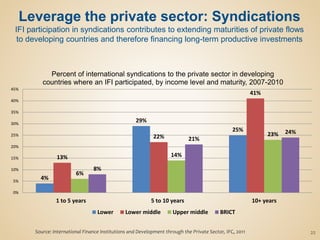
4%
29%
25%
13%
22%
41%
6%
14%
23%
8%
21%
24%
0%
5%
10%
15%
20%
25%
30%
35%
40%
45%
1 to 5 years 5 to 10 years 10+ years
Percent of international syndications to the private sector in developing
countries where an IFI participated, by income level and maturity, 2007-2010
Lower Lower middle Upper middle BRICT
22
Leverage the private sector: Syndications
IFI participation in syndications contributes to extending maturities of private flows
to developing countries and therefore financing long-term productive investments
Source: International Finance Institutions and Development through the Private Sector, IFC, 2011
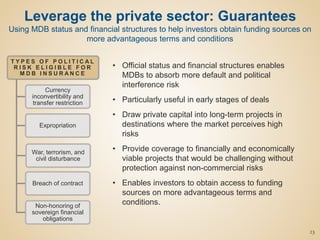
• Official status and financial structures enables
MDBs to absorb more default and political
interference risk
• Particularly useful in early stages of deals
• Draw private capital into long-term projects in
destinations where the market perceives high
risks
• Provide coverage to financially and economically
viable projects that would be challenging without
protection against non-commercial risks
• Enables investors to obtain access to funding
sources on more advantageous terms and
conditions.
Leverage the private sector: Guarantees
Using MDB status and financial structures to help investors obtain funding sources on
more advantageous terms and conditions
23
T Y P E S O F P O L I T I C A L
R I S K E L I G I B L E F O R
M D B I N S U R A N C E
Currency
inconvertibility and
transfer restriction
Expropriation
War, terrorism, and
civil disturbance
Breach of contract
Non-honoring of
sovereign financial
obligations
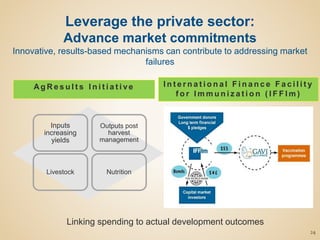
Leverage the private sector:
Advance market commitments
Innovative, results-based mechanisms can contribute to addressing market
failures
Ag R e s u l t s I n i t i a t i ve
Inputs
increasing
yields
Outputs post
harvest
management
Livestock Nutrition
I n t e r n a t i o n a l F i n a n c e F a c i l i t y
f o r I m m u n i z a t i o n ( I F F I m )
24
Linking spending to actual development outcomes
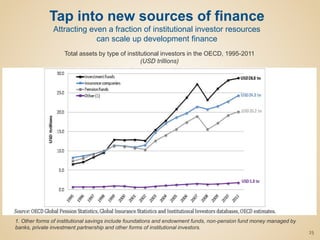
Tap into new sources of finance
Attracting even a fraction of institutional investor resources
can scale up development finance
25
Total assets by type of institutional investors in the OECD, 1995-2011
(USD trillions)
1. Other forms of institutional savings include foundations and endowment funds, non-pension fund money managed by
banks, private investment partnership and other forms of institutional investors.
26
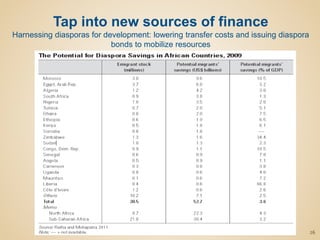
Tap into new sources of finance
Harnessing diasporas for development: lowering transfer costs and issuing diaspora
bonds to mobilize resources
• Global public goods lie at the intersection of national development
priorities and global interests
• The under-provision of GPGs disproportionately affects the poor
• GPGs are at the center of the post-2015 agenda:
– International financial architecture
– Trade/market access
– Peace and security
– Climate change
– Communicable diseases
– Knowledge for development
– Statistical capacity-building
27
Support Global Public Goods
28
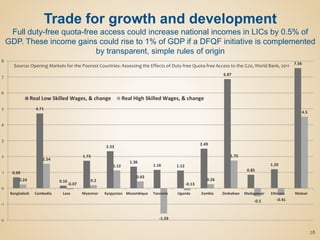
Trade for growth and development
Full duty-free quota-free access could increase national incomes in LICs by 0.5% of
GDP. These income gains could rise to 1% of GDP if a DFQF initiative is complemented
by transparent, simple rules of origin
0.69
4.71
0.16
1.73
2.33
1.36
1.16 1.12
2.49
6.87
0.85
1.20
7.56
0.24
1.54
-0.07
0.2
1.12
0.43
-1.59
-0.13
0.26
1.75
-0.5 -0.41
4.5
-2
-1
0
1
2
3
4
5
6
7
8
Bangladesh Cambodia Laos Myanmar Kyrgyzstan Mozambique Tanzania Uganda Zambia Zimbabwe Madagascar Ethiopia Malawi
Real Low Skilled Wages, & change Real High Skilled Wages, & change
Source: Opening Markets for the Poorest Countries: Assessing the Effects of Duty-free Quota-free Access to the G20, World Bank, 2011
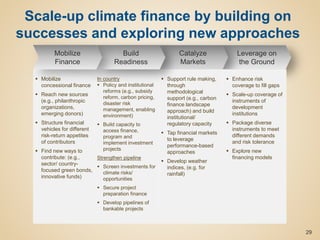
Leverage on
the Ground
Catalyze
Markets
 Mobilize
concessional finance
 Reach new sources
(e.g., philanthropic
organizations,
emerging donors)
 Structure financial
vehicles for different
risk-return appetites
of contributors
 Find new ways to
contribute: (e.g.,
sector/ country-
focused green bonds,
innovative funds)
29
Scale-up climate finance by building on
successes and exploring new approaches
Build
Readiness
 Support rule making,
through
methodological
support (e.g., carbon
finance landscape
approach) and build
institutional/
regulatory capacity
 Tap financial markets
to leverage
performance-based
approaches
 Develop weather
indices, (e.g. for
rainfall)
In country
 Policy and institutional
reforms (e.g., subsidy
reform, carbon pricing,
disaster risk
management, enabling
environment)
 Build capacity to
access finance,
program and
implement investment
projects
Strengthen pipeline
 Screen investments for
climate risks/
opportunities
 Secure project
preparation finance
 Develop pipelines of
bankable projects
 Enhance risk
coverage to fill gaps
 Scale-up coverage of
instruments of
development
institutions
 Package diverse
instruments to meet
different demands
and risk tolerance
 Explore new
financing models
Mobilize
Finance
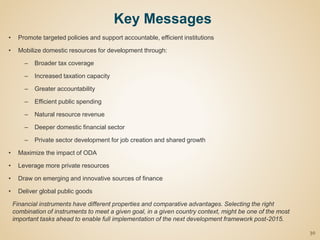
• Promote targeted policies and support accountable, efficient institutions
• Mobilize domestic resources for development through:
– Broader tax coverage
– Increased taxation capacity
– Greater accountability
– Efficient public spending
– Natural resource revenue
– Deeper domestic financial sector
– Private sector development for job creation and shared growth
• Maximize the impact of ODA
• Leverage more private resources
• Draw on emerging and innovative sources of finance
• Deliver global public goods
Financial instruments have different properties and comparative advantages. Selecting the right
combination of instruments to meet a given goal, in a given country context, might be one of the most
important tasks ahead to enable full implementation of the next development framework post-2015.
30
Key Messages
Thank you for
your attention
31
Marilou Uy
Senior Adviser
The World Bank
muy@worldbank.org

Financing the Post-2015 Development Framework

  • 1.
    FINANCING THE POST-2015 DEVELOPMENTFRAMEWORK UNITED NATIONS PANEL ON FINANCING FOR SUSTAINABLE DEVELOPMENT Geneva – 9 July 2013 The World Bank
  • 2.
    • The originalMDGs were articulated independently of a financing framework (Monterrey 2002). • In a context of fiscal consolidation, discussion of post-2015 goals must be integrated with consideration of supporting financing. • No quantity of financing, whether grant, concessional, or non- concessional, can achieve the development goals without supporting policies and a credible commitment to combating poverty. • Costing MDGs requires too many assumptions (WDR 2004), and is not the objective of this exercise. 2 Lessons from the existing MDGs framework
  • 3.
    Increase impact ofavailable resources Leverage additional resources 3 A two-pronged approach to supporting a post-2015 development framework Good policies and credible institutions enhance the impact of available resources and leverage additional resources from both domestic and foreign sources. Good policies and credible institutions to:
  • 4.
    Parameters to considerin the post-2015 financing framework At the country level: • Design targeted, evidence-based policies and support sound institutions • Generate more revenues • Ensure efficient public spending • Promote financial deepening and inclusion Globally: • Maximize the impact of ODA • Support new development partners • Leverage the private sector • Tap into new sources of finance • Deliver global public goods 4
  • 5.
    5 Implement effective policiesand institutions Real income per capita is closely correlated with institutional quality Source: World Economic Outlook, IMF, April 2003 This index measures the overall quality of governance, including the degree of corruption, political rights, public sector efficiency, and regulatory burdens.
  • 6.
    21.2 28.4 28.4 29.3 18.8 17.1 1919.3 11.3 10 10.5 13.6 0 5 10 15 20 25 30 35 1994 1998 2003 2009 High Income Middle Income Low Income 6 Generate more domestic revenues Taxation capacity improving in MICs, progress needed in LICs Tax Revenue (in % of GDP) by Income Groups, 1994-2009 Source: World Development Indicators
  • 7.
    Tax Revenue as %of GDP 2004-2011 Average Tax Effort (1994-2001) Average Tax Effort (2002-2009) Tax effort difference LIC: Negative Tax Effort Congo, Republic of 9.3 0.47 0.45 -0.02 Ethiopia 9.4 1.05 0.87 -0.18 Uganda 10.6 0.89 0.87 -0.02 Zambia 18.0 1.11 1.07 -0.04 Bangladesh 7.6 0.83 0.8 -0.03 Pakistan 12.3 1.31 1.03 -0.28 Sri-Lanka 16.0 1.13 0.98 -0.15 MIC: Positive Tax Effort Colombia 11.0 0.73 0.79 0.06 Bulgaria 26.7 0.91 1.04 0.13 Vietnam 24.9 1.26 1.44 0.18 South Africa 21.8 1.47 1.57 0.1 Ukraine -- 0.8 1.02 0.22 7 Generate more domestic revenues Taxation capacity improving in MICs, progress needed in LICs Source: World Development Indicators Tax effort indicates how well a country is doing in terms of tax collection, relative to what could be reasonably expected given its economic potential. It is calculated by dividing actual tax share by an estimate of how much tax the country should be able to collect given the structural characteristics of its economy.
  • 8.
    • Manage themacroeconomic effects of natural resource revenues and utilize them to achieve development impact • RfI has potential as a financing source, but carries considerable risks and challenges both on the private sector and government sides 8 Generate more domestic revenues Raising revenues from natural resources: potential and challenges Private sector perspective - Investments add to the high initial sunk costs involved in mine and offshore oil field development (frequently running into the billions of dollars) - Future revenue streams backing these investments subject to political, market, geological and other types of risk - On infrastructure side, risks of cost overruns Government perspective - Without appropriate valuation both on mining and infrastructure side, country risks forgoing significant share of potential benefits from the extractive project - Assuming that appropriate valuation is undertaken, still risks arising from uncertainty of future commodity prices and of geological estimates of oil and mineral reserves - Essential that financing commitments be complemented by appropriate extractives tax and royalty regimes
  • 9.
    Ensure efficient publicspending Fossil fuel subsidies do not target the poor 9 Source: World Energy Outlook, IEA, 2011 Subsidies are an inefficient means of assisting the poor: only 8% of the $409 billion spent on fossil- fuel subsidies in 2010 went to the poorest 20% of the population. Fossil fuel consumption subsidies measure what developing countries spend to provide below-cost fuel to their citizens. High-income countries offer support to energy production in the form of tax credits or loan guarantees, which are not included in these calculations since they are directed towards production rather than consumption of the fuel.
  • 10.
    10 Ensure efficient publicspending Conditional cash transfers do target the poor Source: Conditional Cash Transfers, World Bank, 2009 10
  • 11.
    How do financial institutionscontribute to economic growth? Improve the allocation of resources Lower the cost of financial and nonfinancial transactions Facilitate efforts to reduce and trade risks 11 Financial sector development for growth A thriving private sector creates opportunities for entrepreneurship and job creation
  • 12.
    12 Financial sector developmentfor growth Using local currency bond markets to develop the domestic investor base and mobilize domestic savings to support investment in productive assets Emerging market fixed income fund inflows by hard and local currency LCBMs foster financial sector development by:  Providing pricing benchmarks for private sector instruments  Reducing risk management through greater asset liability matching  Enabling diversification from bank financing  Providing safer, more liquid savings vehicles for individuals and institutions
  • 13.
    Financial Inclusion Access tofinance is a major constraint to growth for entrepreneurs in LICs 21 9 3 10 #Total MSMEs (formal andinformal) #with Checking account #with Loan/Overdraft #Unserved+ Underserved 52 25 13 27 # Total MSMEs (formal and informal) # with Checking account # with Loan/Overdraft # Unserved + Underserved 20 12 6 10 #Total MSMEs (formal andinformal) #with Checking account #with Loan/Overdraft #Unserved+ Underserved 188 62 23 92 # Total MSMEs (formal and informal) # with Checking account # with Loan/Overdraft # Unserved + Underserved 78 34 11 36 #Total MSMEs (formal andinformal) #with Checking account #with Loan/Overdraft #Unserved+ Underserved 40 18 4 22 # Total MSMEs (formal andinformal) # with Checking account # with Loan/Overdraft # Unserved+ Underserved LAC MNA ECA EAP SAR AFR # of MSMEs (in Mn) # Total MSMEs (formal and informal) # with Checking account # with Loan/Overdraft # Unserved + Underserved Source: Two trillion and counting, IFC & McKinsey, 2010 13
  • 14.
    Source: MDG GapTaskforce Report, 2012 0.00 0.20 0.40 0.60 0.80 1.00 1.20 United States Germany United Kingdom France Japan Netherlands Sweden Canada Australia Norway DAC Members' Official Development Assistance as a percentage of GNI, 2000- 2011 2000-2001 2007 2009 2011 UN Target: 0.7% of GNI 14 Maximize the impact of ODA Total ODA increased over the period 2000-2010, but is still falling short of Monterrey targets…
  • 15.
    “Official development assistance (ODA)plays an essential role as a complement to other sources of financing for development, especially in those countries with the least capacity to attract private direct investment… For many countries in Africa, least developed countries, small island developing States and landlocked developing countries, ODA is still the largest source of external financing and is critical to the achievement of the development goals and targets of the Millennium Declaration and other internationally agreed development targets.” Monterrey Declaration, 2002 15 Maximize the impact of ODA ODA is a critical tool to leverage other sources of financing Source: OECD DAC Database 0.00 0.02 0.04 0.06 0.08 0.10 0.12 0.14 1990 1994 1998 2002 2006 2010 US$millionspercapita(2010prices) Fragile States Small States Heavily Indebted Poor Countries
  • 16.
    0.9 6.4 7.8 Net official capitalflows and transfers, 2012 (% of GDP) Emerging market countries Low-income countries Fragile states 16 The official sector has a particularly important role to play in LICs and fragile states Source: Global Monitoring Report 2013, World Bank The classification of countries is the one used in the IMF‘s World Economic Outlook. Emerging market and developing countries are those countries that are not designated as advanced countries. Countries that are eligible for financial assistance under the IMF‘s Poverty Reduction and Growth Trust constitute a subset of emerging market and developing countries; these countries are denoted low-income countries although eligibility is based on other considerations in addition to income levels. Emerging market and developing countries that are not eligible for financial assistance under the Poverty Reduction and Growth Trust are designated as emerging market countries. Fragile states are countries included in the World Bank‘s list of Fragile and Conflict-Affected States as of early 2013. 16
  • 17.
    ODA and remittancesare especially critical for fragile states Foreign direct investment 505.7 Portfolio investment 128.4 Long-term debt (private) 155.8 ODA grants 89 Long-term debt (official) 69.2 Worker remittances 319 Net financial flows to developing countries, 2010 Total: USD 1,267 billion Foreign direct investment 27.59 ODA 50.04 Worker remittances 47.38 Gross financial flows to fragile states, 2010 Total: USD 125 billion 17 Source: World Bank CFP Working Paper No. 8, Finance for Development Source: Fragile States 2013, OECD NB: Based on OECD definition of fragile states 17
  • 18.
    18 Collaborate with newdevelopment partners Emerging donors, led by China, provide relatively limited aid as defined by the OECD, but contribute to development through other external flows and in-kind assistance Source: World Bank CFP Working Paper No. 8, Finance for Development For the purpose of comparison, in 2009, net ODA from DAC members was 119.8 bn USD. 0.00 0.50 1.00 1.50 2.00 2.50 3.00 3.50 4.00 4.50 2003 2004 2005 2006 2007 2008 2009 Estimated aid from BRICS, 2003-2009 (USD billion) China India Russia Brazil South Africa
  • 19.
    • Global funds:trust funds that pool resources for specific issues of global importance – Global Partnership for Education – GAVI Alliance (formerly the Global Alliance for Vaccine and Immunization) – Global Fund to Fight AIDS, Tuberculosis and Malaria (GFATM) – Global Environment Fund (GEF) • Scattered data – available estimates for private aid to developing countries in 2009 range from USD 22 billion to USD 53 billion • Low estimate is equivalent to 16 percent of ODA from all donors in the same year, and up from 2005 (12 percent of ODA) • Private philanthropy to fragile states increasing in recent years • South-South philanthropy also on the rise, especially in the Arab world • Philanthropic giving highly sensitive to factors such as media coverage, timing, geopolitical considerations 19 Collaborate with new development partners Private philanthropy is growing in importance and playing a complementary role
  • 20.
    1.50% 2.58% 2.92% 4.76% 4.17% 3.55% 4.26% -1% 0% 1% 2% 3% 4% 5% 6% 7% 8% 2000 20052006 2007 2008 2009 2010 Foreign direct investment Portfolio investment Long-term debt 20 3.00% 5.17% 5.70% 6.69% 4.69% 3.47% 3.92% -1% 0% 1% 2% 3% 4% 5% 6% 7% 8% 2000 2005 2006 2007 2008 2009 2010 Net private flows to MICs (% of GDP) Net private flows to LICs (% of GDP) Source: Finance for Development - Trends and Opportunities in a Changing Landscape, CFP, 2011 and WDI
  • 21.
    Leverage the privatesector: Partnerships Well-structured initiatives with a diverse range of partners help governments raise the large sums of capital required to meet infrastructure needs and consequently spur development 21 M a h a r a s h t r a & T a m i l N a d u , I n d i a C L I F F C O M M U N I T Y S AN I TAT I O N P R O J E C T T o t a l i n i t i a l i n v e s t m e n t : $ 7 . 2 m i l l i o n - H o m e l e s s I n t e r n a t i o n a l - S P A R C ( N G O i n I n d i a ) - C o m m u n i t y - b a s e d O r g a n i z a t i o n s K e n y a P R I VAT E S E C T O R P O W E R G E N E R AT I O N P R O J E C T T o t a l i n i t i a l i n v e s t m e n t : $ 6 2 3 m i l l i o n - K e n y a P o w e r a n d L i g h t i n g C o m p a n y - I F C - M I G A - C o m m e r c i a l B a n k s S a o P a u l o , B r a z i l M E T R O L I N E 4 T o t a l i n i t i a l i n v e s t m e n t : $ 4 5 0 m i l l i o n - C o m p a n h i a d o M e t r o p o l i t a n o d e S a o P a o l o - 5 E q u i t y S p o n s o r s - I D B - C o m m e r c i a l B a n k s L a k e K i v u , R w a n d a K I V U WAT T T o t a l i n i t i a l i n v e s t m e n t : $ 1 4 2 . 2 5 m i l l i o n - C o n t o u r G l o b a l - E n e r g y A u t h o r i t y o f R w a n d a - M I G A - E m e r g i n g A f r i c a I n f r a s t r u c t u r e F u n d - F M O - A f D B - B e l g i a n D e v e l o p m e n t B a n k Source: Emerging Partnerships, IFC, 2013 and World Bank, Africa Region. Emerging Partnerships
  • 22.
    4% 29% 25% 13% 22% 41% 6% 14% 23% 8% 21% 24% 0% 5% 10% 15% 20% 25% 30% 35% 40% 45% 1 to 5years 5 to 10 years 10+ years Percent of international syndications to the private sector in developing countries where an IFI participated, by income level and maturity, 2007-2010 Lower Lower middle Upper middle BRICT 22 Leverage the private sector: Syndications IFI participation in syndications contributes to extending maturities of private flows to developing countries and therefore financing long-term productive investments Source: International Finance Institutions and Development through the Private Sector, IFC, 2011
  • 23.
    • Official statusand financial structures enables MDBs to absorb more default and political interference risk • Particularly useful in early stages of deals • Draw private capital into long-term projects in destinations where the market perceives high risks • Provide coverage to financially and economically viable projects that would be challenging without protection against non-commercial risks • Enables investors to obtain access to funding sources on more advantageous terms and conditions. Leverage the private sector: Guarantees Using MDB status and financial structures to help investors obtain funding sources on more advantageous terms and conditions 23 T Y P E S O F P O L I T I C A L R I S K E L I G I B L E F O R M D B I N S U R A N C E Currency inconvertibility and transfer restriction Expropriation War, terrorism, and civil disturbance Breach of contract Non-honoring of sovereign financial obligations
  • 24.
    Leverage the privatesector: Advance market commitments Innovative, results-based mechanisms can contribute to addressing market failures Ag R e s u l t s I n i t i a t i ve Inputs increasing yields Outputs post harvest management Livestock Nutrition I n t e r n a t i o n a l F i n a n c e F a c i l i t y f o r I m m u n i z a t i o n ( I F F I m ) 24 Linking spending to actual development outcomes
  • 25.
    Tap into newsources of finance Attracting even a fraction of institutional investor resources can scale up development finance 25 Total assets by type of institutional investors in the OECD, 1995-2011 (USD trillions) 1. Other forms of institutional savings include foundations and endowment funds, non-pension fund money managed by banks, private investment partnership and other forms of institutional investors.
  • 26.
    26 Tap into newsources of finance Harnessing diasporas for development: lowering transfer costs and issuing diaspora bonds to mobilize resources
  • 27.
    • Global publicgoods lie at the intersection of national development priorities and global interests • The under-provision of GPGs disproportionately affects the poor • GPGs are at the center of the post-2015 agenda: – International financial architecture – Trade/market access – Peace and security – Climate change – Communicable diseases – Knowledge for development – Statistical capacity-building 27 Support Global Public Goods
  • 28.
    28 Trade for growthand development Full duty-free quota-free access could increase national incomes in LICs by 0.5% of GDP. These income gains could rise to 1% of GDP if a DFQF initiative is complemented by transparent, simple rules of origin 0.69 4.71 0.16 1.73 2.33 1.36 1.16 1.12 2.49 6.87 0.85 1.20 7.56 0.24 1.54 -0.07 0.2 1.12 0.43 -1.59 -0.13 0.26 1.75 -0.5 -0.41 4.5 -2 -1 0 1 2 3 4 5 6 7 8 Bangladesh Cambodia Laos Myanmar Kyrgyzstan Mozambique Tanzania Uganda Zambia Zimbabwe Madagascar Ethiopia Malawi Real Low Skilled Wages, & change Real High Skilled Wages, & change Source: Opening Markets for the Poorest Countries: Assessing the Effects of Duty-free Quota-free Access to the G20, World Bank, 2011
  • 29.
    Leverage on the Ground Catalyze Markets Mobilize concessional finance  Reach new sources (e.g., philanthropic organizations, emerging donors)  Structure financial vehicles for different risk-return appetites of contributors  Find new ways to contribute: (e.g., sector/ country- focused green bonds, innovative funds) 29 Scale-up climate finance by building on successes and exploring new approaches Build Readiness  Support rule making, through methodological support (e.g., carbon finance landscape approach) and build institutional/ regulatory capacity  Tap financial markets to leverage performance-based approaches  Develop weather indices, (e.g. for rainfall) In country  Policy and institutional reforms (e.g., subsidy reform, carbon pricing, disaster risk management, enabling environment)  Build capacity to access finance, program and implement investment projects Strengthen pipeline  Screen investments for climate risks/ opportunities  Secure project preparation finance  Develop pipelines of bankable projects  Enhance risk coverage to fill gaps  Scale-up coverage of instruments of development institutions  Package diverse instruments to meet different demands and risk tolerance  Explore new financing models Mobilize Finance
  • 30.
    • Promote targetedpolicies and support accountable, efficient institutions • Mobilize domestic resources for development through: – Broader tax coverage – Increased taxation capacity – Greater accountability – Efficient public spending – Natural resource revenue – Deeper domestic financial sector – Private sector development for job creation and shared growth • Maximize the impact of ODA • Leverage more private resources • Draw on emerging and innovative sources of finance • Deliver global public goods Financial instruments have different properties and comparative advantages. Selecting the right combination of instruments to meet a given goal, in a given country context, might be one of the most important tasks ahead to enable full implementation of the next development framework post-2015. 30 Key Messages
  • 31.
    Thank you for yourattention 31 Marilou Uy Senior Adviser The World Bank muy@worldbank.org