A2 Macro – October 2012


Unit 4 Macro: Aid and Development
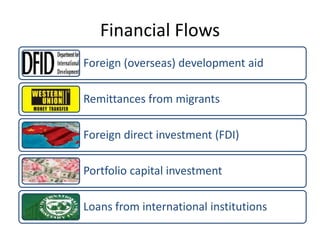
Financial Flows
Foreign (overseas) development aid

Remittances from migrants

Foreign direct investment (FDI)

Portfolio capital investment

Loans from international institutions
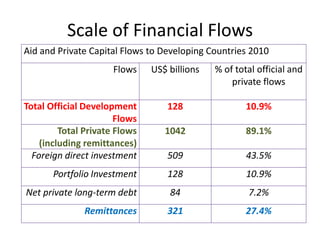
Scale of Financial Flows
Aid and Private Capital Flows to Developing Countries 2010
                      Flows    US$ billions   % of total official and
                                                  private flows

Total Official Development         128                10.9%
                       Flows
         Total Private Flows      1042                89.1%
    (including remittances)
  Foreign direct investment        509                43.5%
       Portfolio Investment        128                10.9%
Net private long-term debt         84                 7.2%
               Remittances         321                27.4%
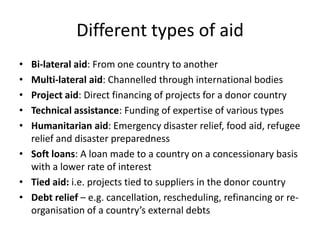
Different types of aid
• Bi-lateral aid: From one country to another
• Multi-lateral aid: Channelled through international bodies
• Project aid: Direct financing of projects for a donor country
• Technical assistance: Funding of expertise of various types
• Humanitarian aid: Emergency disaster relief, food aid, refugee
  relief and disaster preparedness
• Soft loans: A loan made to a country on a concessionary basis
  with a lower rate of interest
• Tied aid: i.e. projects tied to suppliers in the donor country
• Debt relief – e.g. cancellation, rescheduling, refinancing or re-
  organisation of a country’s external debts
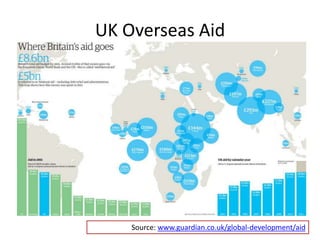
UK Overseas Aid


    Source: www.guardian.co.uk/global-development/aid
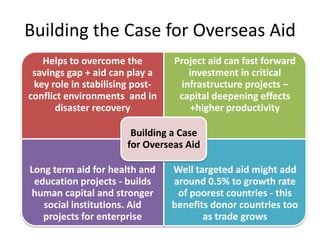
Building the Case for Overseas Aid
   Helps to overcome the         Project aid can fast forward
 savings gap + aid can play a        investment in critical
 key role in stabilising post-     infrastructure projects –
conflict environments and in      capital deepening effects
      disaster recovery              +higher productivity

                        Building a Case
                       for Overseas Aid

Long term aid for health and     Well targeted aid might add
 education projects - builds     around 0.5% to growth rate
human capital and stronger        of poorest countries - this
   social institutions. Aid      benefits donor countries too
   projects for enterprise              as trade grows
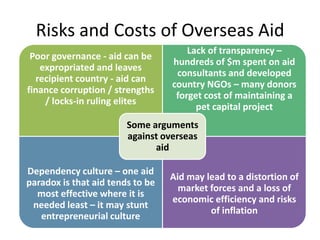
Risks and Costs of Overseas Aid
                                      Lack of transparency –
 Poor governance - aid can be
                                  hundreds of $m spent on aid
   expropriated and leaves
                                   consultants and developed
  recipient country - aid can
                                  country NGOs – many donors
finance corruption / strengths
                                   forget cost of maintaining a
    / locks-in ruling elites
                                        pet capital project
                        Some arguments
                        against overseas
                              aid

Dependency culture – one aid
                                  Aid may lead to a distortion of
paradox is that aid tends to be
                                    market forces and a loss of
  most effective where it is
                                  economic efficiency and risks
 needed least – it may stunt
                                           of inflation
   entrepreneurial culture
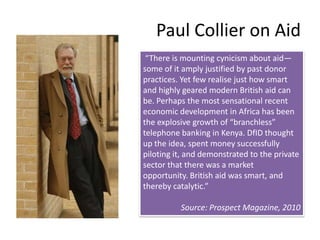
Paul Collier on Aid
 “There is mounting cynicism about aid—
some of it amply justified by past donor
practices. Yet few realise just how smart
and highly geared modern British aid can
be. Perhaps the most sensational recent
economic development in Africa has been
the explosive growth of “branchless”
telephone banking in Kenya. DfID thought
up the idea, spent money successfully
piloting it, and demonstrated to the private
sector that there was a market
opportunity. British aid was smart, and
thereby catalytic.”

          Source: Prospect Magazine, 2010
Dierk Herzer and Oliver Morrissey
• More often than not aid damages developing countries
• An increase in the aid-to-GDP ratio is associated with a long-run
   decrease in GDP in almost two-thirds of the countries
• 3 key barriers to aid effectiveness
1. Religious tensions, which are common in the poorest countries,
    and a big role for the military in politics
2. Large government, which is often a sign of a large military
    presence and a corrupt government.
3. Low level of law and order. ‘Law and order’ captures the quality
    of institutions, which many economists argue are essential to
    economic development.
Better law and order suggests that countries are more open to trade
    and have better protection of property rights. This gives people
    the ability and incentives to invest aid money productively in the
    economy.
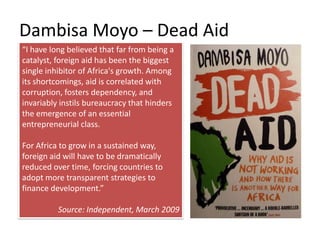
Dambisa Moyo – Dead Aid
“I have long believed that far from being a
catalyst, foreign aid has been the biggest
single inhibitor of Africa's growth. Among
its shortcomings, aid is correlated with
corruption, fosters dependency, and
invariably instils bureaucracy that hinders
the emergence of an essential
entrepreneurial class.

For Africa to grow in a sustained way,
foreign aid will have to be dramatically
reduced over time, forcing countries to
adopt more transparent strategies to
finance development.”

          Source: Independent, March 2009
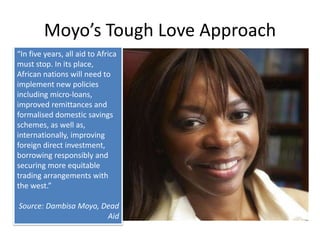
Moyo’s Tough Love Approach
“In five years, all aid to Africa
must stop. In its place,
African nations will need to
implement new policies
including micro-loans,
improved remittances and
formalised domestic savings
schemes, as well as,
internationally, improving
foreign direct investment,
borrowing responsibly and
securing more equitable
trading arrangements with
the west.”

Source: Dambisa Moyo, Dead
                       Aid
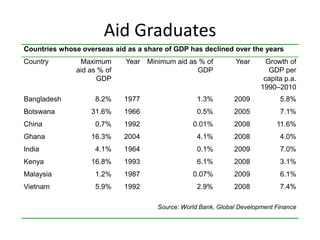
Aid Graduates
Countries whose overseas aid as a share of GDP has declined over the years
Country        Maximum       Year   Minimum aid as % of        Year       Growth of
              aid as % of                         GDP                      GDP per
                    GDP                                                  capita p.a.
                                                                        1990–2010
Bangladesh          8.2%    1977                   1.3%        2009           5.8%
Botswana           31.6%    1966                   0.5%        2005           7.1%
China               0.7%    1992                 0.01%         2008          11.6%
Ghana              16.3%    2004                   4.1%        2008           4.0%
India               4.1%    1964                   0.1%        2009           7.0%
Kenya              16.8%    1993                   6.1%        2008           3.1%
Malaysia            1.2%    1987                 0.07%         2009           6.1%
Vietnam             5.9%    1992                   2.9%        2008           7.4%

                                      Source: World Bank, Global Development Finance
Michael Clemens, Steven Radelet, Rikhil
    Bhavani and Samuel Bazzi (EJ, 2012)
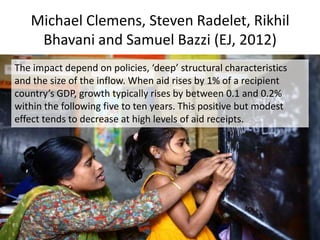
The impact depend on policies, ‘deep’ structural characteristics
and the size of the inflow. When aid rises by 1% of a recipient
country’s GDP, growth typically rises by between 0.1 and 0.2%
within the following five to ten years. This positive but modest
effect tends to decrease at high levels of aid receipts.
Duflo and Banerjee – Poor Economics
• Duflo and Banerjee - Poverty Action Lab
                                                 “Precisely because
• Have pioneered use of randomised
  controlled trials to find out what works       [the poor] have so
  in development                                little, we often find
• Test efficacy of projects / interventions     them putting much
  within a population – 2 or more groups        careful thought into
  (inc control)
• Many “top-down” aid projects afflicted         their choices: They
  by                                                  have to be
    – Ideology (prejudices, beliefs)                sophisticated
    – Ignorance (info gaps about local           economists just to
      conditions)
    – Inertia (failure to change when project          survive.”
      does not work)
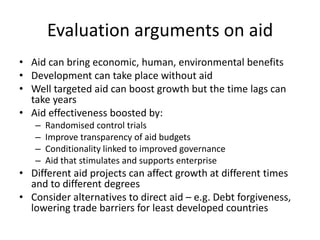
Evaluation arguments on aid
• Aid can bring economic, human, environmental benefits
• Development can take place without aid
• Well targeted aid can boost growth but the time lags can
  take years
• Aid effectiveness boosted by:
   –   Randomised control trials
   –   Improve transparency of aid budgets
   –   Conditionality linked to improved governance
   –   Aid that stimulates and supports enterprise
• Different aid projects can affect growth at different times
  and to different degrees
• Consider alternatives to direct aid – e.g. Debt forgiveness,
  lowering trade barriers for least developed countries
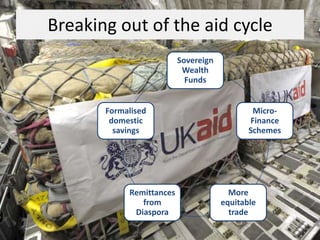
Breaking out of the aid cycle
                          Sovereign
                           Wealth
                            Funds


       Formalised                             Micro-
        domestic                             Finance
         savings                             Schemes


            Remittances                 More
               from                   equitable
             Diaspora                   trade
Tutor2u
Keep up-to-date with economics,
     resources, quizzes and
 worksheets for your economics
            course.

Aid and Economic Development

  • 1.
    A2 Macro –October 2012 Unit 4 Macro: Aid and Development
  • 2.
    Financial Flows Foreign (overseas)development aid Remittances from migrants Foreign direct investment (FDI) Portfolio capital investment Loans from international institutions
  • 3.
    Scale of FinancialFlows Aid and Private Capital Flows to Developing Countries 2010 Flows US$ billions % of total official and private flows Total Official Development 128 10.9% Flows Total Private Flows 1042 89.1% (including remittances) Foreign direct investment 509 43.5% Portfolio Investment 128 10.9% Net private long-term debt 84 7.2% Remittances 321 27.4%
  • 4.
    Different types ofaid • Bi-lateral aid: From one country to another • Multi-lateral aid: Channelled through international bodies • Project aid: Direct financing of projects for a donor country • Technical assistance: Funding of expertise of various types • Humanitarian aid: Emergency disaster relief, food aid, refugee relief and disaster preparedness • Soft loans: A loan made to a country on a concessionary basis with a lower rate of interest • Tied aid: i.e. projects tied to suppliers in the donor country • Debt relief – e.g. cancellation, rescheduling, refinancing or re- organisation of a country’s external debts
  • 5.
    UK Overseas Aid Source: www.guardian.co.uk/global-development/aid
  • 6.
    Building the Casefor Overseas Aid Helps to overcome the Project aid can fast forward savings gap + aid can play a investment in critical key role in stabilising post- infrastructure projects – conflict environments and in capital deepening effects disaster recovery +higher productivity Building a Case for Overseas Aid Long term aid for health and Well targeted aid might add education projects - builds around 0.5% to growth rate human capital and stronger of poorest countries - this social institutions. Aid benefits donor countries too projects for enterprise as trade grows
  • 7.
    Risks and Costsof Overseas Aid Lack of transparency – Poor governance - aid can be hundreds of $m spent on aid expropriated and leaves consultants and developed recipient country - aid can country NGOs – many donors finance corruption / strengths forget cost of maintaining a / locks-in ruling elites pet capital project Some arguments against overseas aid Dependency culture – one aid Aid may lead to a distortion of paradox is that aid tends to be market forces and a loss of most effective where it is economic efficiency and risks needed least – it may stunt of inflation entrepreneurial culture
  • 8.
    Paul Collier onAid “There is mounting cynicism about aid— some of it amply justified by past donor practices. Yet few realise just how smart and highly geared modern British aid can be. Perhaps the most sensational recent economic development in Africa has been the explosive growth of “branchless” telephone banking in Kenya. DfID thought up the idea, spent money successfully piloting it, and demonstrated to the private sector that there was a market opportunity. British aid was smart, and thereby catalytic.” Source: Prospect Magazine, 2010
  • 9.
    Dierk Herzer andOliver Morrissey • More often than not aid damages developing countries • An increase in the aid-to-GDP ratio is associated with a long-run decrease in GDP in almost two-thirds of the countries • 3 key barriers to aid effectiveness 1. Religious tensions, which are common in the poorest countries, and a big role for the military in politics 2. Large government, which is often a sign of a large military presence and a corrupt government. 3. Low level of law and order. ‘Law and order’ captures the quality of institutions, which many economists argue are essential to economic development. Better law and order suggests that countries are more open to trade and have better protection of property rights. This gives people the ability and incentives to invest aid money productively in the economy.
  • 10.
    Dambisa Moyo –Dead Aid “I have long believed that far from being a catalyst, foreign aid has been the biggest single inhibitor of Africa's growth. Among its shortcomings, aid is correlated with corruption, fosters dependency, and invariably instils bureaucracy that hinders the emergence of an essential entrepreneurial class. For Africa to grow in a sustained way, foreign aid will have to be dramatically reduced over time, forcing countries to adopt more transparent strategies to finance development.” Source: Independent, March 2009
  • 11.
    Moyo’s Tough LoveApproach “In five years, all aid to Africa must stop. In its place, African nations will need to implement new policies including micro-loans, improved remittances and formalised domestic savings schemes, as well as, internationally, improving foreign direct investment, borrowing responsibly and securing more equitable trading arrangements with the west.” Source: Dambisa Moyo, Dead Aid
  • 12.
    Aid Graduates Countries whoseoverseas aid as a share of GDP has declined over the years Country Maximum Year Minimum aid as % of Year Growth of aid as % of GDP GDP per GDP capita p.a. 1990–2010 Bangladesh 8.2% 1977 1.3% 2009 5.8% Botswana 31.6% 1966 0.5% 2005 7.1% China 0.7% 1992 0.01% 2008 11.6% Ghana 16.3% 2004 4.1% 2008 4.0% India 4.1% 1964 0.1% 2009 7.0% Kenya 16.8% 1993 6.1% 2008 3.1% Malaysia 1.2% 1987 0.07% 2009 6.1% Vietnam 5.9% 1992 2.9% 2008 7.4% Source: World Bank, Global Development Finance
  • 13.
    Michael Clemens, StevenRadelet, Rikhil Bhavani and Samuel Bazzi (EJ, 2012) The impact depend on policies, ‘deep’ structural characteristics and the size of the inflow. When aid rises by 1% of a recipient country’s GDP, growth typically rises by between 0.1 and 0.2% within the following five to ten years. This positive but modest effect tends to decrease at high levels of aid receipts.
  • 14.
    Duflo and Banerjee– Poor Economics • Duflo and Banerjee - Poverty Action Lab “Precisely because • Have pioneered use of randomised controlled trials to find out what works [the poor] have so in development little, we often find • Test efficacy of projects / interventions them putting much within a population – 2 or more groups careful thought into (inc control) • Many “top-down” aid projects afflicted their choices: They by have to be – Ideology (prejudices, beliefs) sophisticated – Ignorance (info gaps about local economists just to conditions) – Inertia (failure to change when project survive.” does not work)
  • 15.
    Evaluation arguments onaid • Aid can bring economic, human, environmental benefits • Development can take place without aid • Well targeted aid can boost growth but the time lags can take years • Aid effectiveness boosted by: – Randomised control trials – Improve transparency of aid budgets – Conditionality linked to improved governance – Aid that stimulates and supports enterprise • Different aid projects can affect growth at different times and to different degrees • Consider alternatives to direct aid – e.g. Debt forgiveness, lowering trade barriers for least developed countries
  • 16.
    Breaking out ofthe aid cycle Sovereign Wealth Funds Formalised Micro- domestic Finance savings Schemes Remittances More from equitable Diaspora trade
  • 17.
    Tutor2u Keep up-to-date witheconomics, resources, quizzes and worksheets for your economics course.