2
Combinational Circuit Design
CONTENTS
Module-2
 Binary adder and subtractor
 Ripple carry adders/subtractors and fast adders
 Binary decoders, encoders
 Multiplexers and de-multiplexers
 Logic functions using decoders and multiplexers
 Code converters
 Magnitude comparator
3
Number Systems
CONTENTS
Lecture-3
 Decoder
 Designing Higher order decoder for lower order decoder
 Boolean function Implementation using Decoder
4
BOOKS
Textbooks
1. M.Morris Mano, Michael D Ciletti, Digital Design, 5th edition, Pearson Publishers, 2013.
2. R.P. Jain, “Modern Digital Electronics”, 4th edition, TMH.
References
1. M.Morris Mano, Charles R. Kime, Tom Martin, Logic and Computer Design Fundamentals, 4th edition,
Pearson Publishers.
2. C. H. Roth and L. L. Kinney, Fundamentals of Logic Design, 5th edition, Cengage Publishers.
Combinational Circuit Design
5
Combinational Circuit Design
6
DECODER
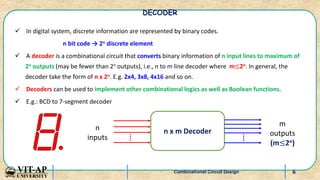
 In digital system, discrete information are represented by binary codes.
n bit code → 2n discrete element
 A decoder is a combinational circuit that converts binary information of n input lines to maximum of
2n outputs (may be fewer than 2n outputs), i.e., n to m line decoder where m≤2n. In general, the
decoder take the form of n x 2n. E.g. 2x4, 3x8, 4x16 and so on.
 Decoders can be used to implement other combinational logics as well as Boolean functions.
 E.g.: BCD to 7-segment decoder
Combinational Circuit Design
n x m Decoder
n
inputs
m
outputs
(m≤2n)
7
DECODER
2x4 Decoder
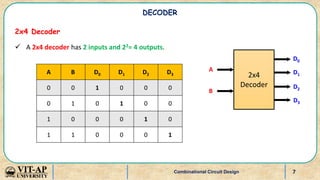
 A 2x4 decoder has 2 inputs and 22= 4 outputs.
Combinational Circuit Design
2x4
Decoder
A
B
D0
D1
D2
D3
A B D0 D1 D2 D3
0 0 1 0 0 0
0 1 0 1 0 0
1 0 0 0 1 0
1 1 0 0 0 1
8
9
DECODER
2x4 Decoder
Combinational Circuit Design
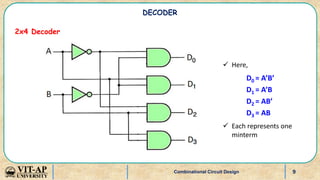
 Here,
D0 = A’B’
D1 = A’B
D2 = AB’
D3 = AB
 Each represents one
minterm
10
11
DECODER
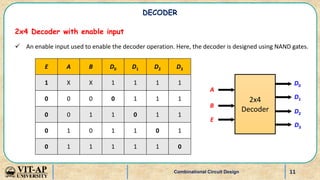
2x4 Decoder with enable input
 An enable input used to enable the decoder operation. Here, the decoder is designed using NAND gates.
Combinational Circuit Design
E A B D0 D1 D2 D3
1 X X 1 1 1 1
0 0 0 0 1 1 1
0 0 1 1 0 1 1
0 1 0 1 1 0 1
0 1 1 1 1 1 0
2x4
Decoder
A
B
D0
D1
D2
D3
E
12
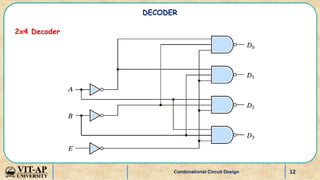
DECODER
2x4 Decoder
Combinational Circuit Design
13
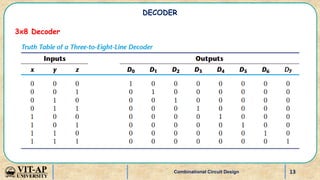
DECODER
3x8 Decoder
Combinational Circuit Design
14
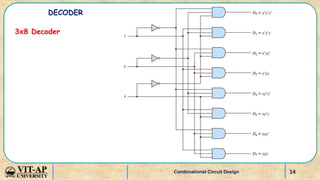
DECODER
3x8 Decoder
Combinational Circuit Design
15
Combinational Circuit Design
DECODER
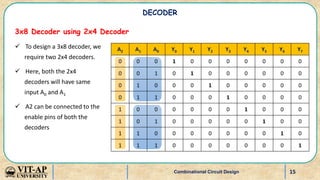
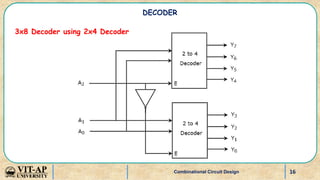
3x8 Decoder using 2x4 Decoder
 To design a 3x8 decoder, we
require two 2x4 decoders.
 Here, both the 2x4
decoders will have same
input A0 and A1
 A2 can be connected to the
enable pins of both the
decoders
A2 A1 A0 Y0 Y1 Y2 Y3 Y4 Y5 Y6 Y7
0 0 0 1 0 0 0 0 0 0 0
0 0 1 0 1 0 0 0 0 0 0
0 1 0 0 0 1 0 0 0 0 0
0 1 1 0 0 0 1 0 0 0 0
1 0 0 0 0 0 0 1 0 0 0
1 0 1 0 0 0 0 0 1 0 0
1 1 0 0 0 0 0 0 0 1 0
1 1 1 0 0 0 0 0 0 0 1
16
Combinational Circuit Design
DECODER
3x8 Decoder using 2x4 Decoder
17
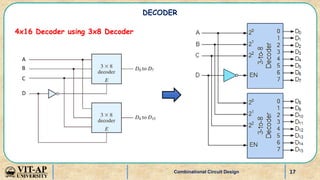
4x16 Decoder using 3x8 Decoder
Combinational Circuit Design
A
B
C
D
DECODER
18
Question: Design a 4x16 decoder using appropriate number of
(i) 3x8 Decoders
(ii) 2x4 Decoders
Combinational Circuit Design
DECODER: PRACTICE PROBLEM
19
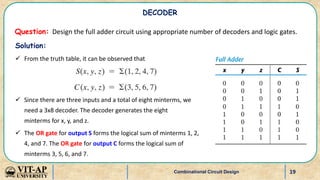
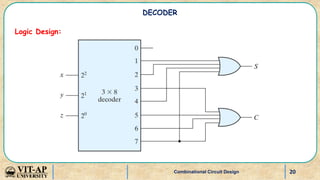
Question: Design the full adder circuit using appropriate number of decoders and logic gates.
Combinational Circuit Design
DECODER
Solution:
 From the truth table, it can be observed that
 Since there are three inputs and a total of eight minterms, we
need a 3x8 decoder. The decoder generates the eight
minterms for x, y, and z.
 The OR gate for output S forms the logical sum of minterms 1, 2,
4, and 7. The OR gate for output C forms the logical sum of
minterms 3, 5, 6, and 7.
20
Logic Design:
Combinational Circuit Design
DECODER
21
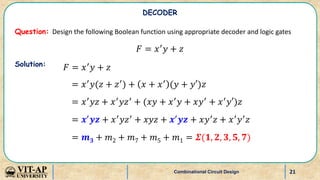
Question: Design the following Boolean function using appropriate decoder and logic gates
𝐹 = 𝑥′𝑦 + 𝑧
Combinational Circuit Design
DECODER
Solution:
𝐹 = 𝑥′𝑦 + 𝑧
= 𝑥′
𝑦(𝑧 + 𝑧′
) + 𝑥 + 𝑥′
(𝑦 + 𝑦′)𝑧
= 𝑥′
𝑦𝑧 + 𝑥′
𝑦𝑧′
+ (𝑥𝑦 + 𝑥′
𝑦 + 𝑥𝑦′
+ 𝑥′
𝑦′)𝑧
= 𝒙′𝒚𝒛 + 𝑥′𝑦𝑧′ + 𝑥𝑦𝑧 + 𝒙′𝒚𝒛 + 𝑥𝑦′𝑧 + 𝑥′𝑦′𝑧
= 𝒎𝟑 + 𝑚2 + 𝑚7 + 𝑚5 + 𝑚1 = 𝜮(𝟏, 𝟐, 𝟑, 𝟓, 𝟕)
22
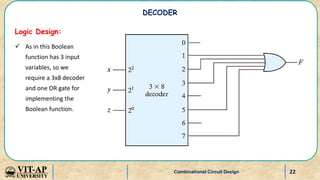
Logic Design:
 As in this Boolean
function has 3 input
variables, so we
require a 3x8 decoder
and one OR gate for
implementing the
Boolean function.
Combinational Circuit Design
DECODER
23
Please follow the instructions of the government and stay safe
Combinational Circuit Design

Decoders.pptx

  • 2.
    2 Combinational Circuit Design CONTENTS Module-2 Binary adder and subtractor  Ripple carry adders/subtractors and fast adders  Binary decoders, encoders  Multiplexers and de-multiplexers  Logic functions using decoders and multiplexers  Code converters  Magnitude comparator
  • 3.
    3 Number Systems CONTENTS Lecture-3  Decoder Designing Higher order decoder for lower order decoder  Boolean function Implementation using Decoder
  • 4.
    4 BOOKS Textbooks 1. M.Morris Mano,Michael D Ciletti, Digital Design, 5th edition, Pearson Publishers, 2013. 2. R.P. Jain, “Modern Digital Electronics”, 4th edition, TMH. References 1. M.Morris Mano, Charles R. Kime, Tom Martin, Logic and Computer Design Fundamentals, 4th edition, Pearson Publishers. 2. C. H. Roth and L. L. Kinney, Fundamentals of Logic Design, 5th edition, Cengage Publishers. Combinational Circuit Design
  • 5.
  • 6.
    6 DECODER  In digitalsystem, discrete information are represented by binary codes. n bit code → 2n discrete element  A decoder is a combinational circuit that converts binary information of n input lines to maximum of 2n outputs (may be fewer than 2n outputs), i.e., n to m line decoder where m≤2n. In general, the decoder take the form of n x 2n. E.g. 2x4, 3x8, 4x16 and so on.  Decoders can be used to implement other combinational logics as well as Boolean functions.  E.g.: BCD to 7-segment decoder Combinational Circuit Design n x m Decoder n inputs m outputs (m≤2n)
  • 7.
    7 DECODER 2x4 Decoder  A2x4 decoder has 2 inputs and 22= 4 outputs. Combinational Circuit Design 2x4 Decoder A B D0 D1 D2 D3 A B D0 D1 D2 D3 0 0 1 0 0 0 0 1 0 1 0 0 1 0 0 0 1 0 1 1 0 0 0 1
  • 8.
  • 9.
    9 DECODER 2x4 Decoder Combinational CircuitDesign  Here, D0 = A’B’ D1 = A’B D2 = AB’ D3 = AB  Each represents one minterm
  • 10.
  • 11.
    11 DECODER 2x4 Decoder withenable input  An enable input used to enable the decoder operation. Here, the decoder is designed using NAND gates. Combinational Circuit Design E A B D0 D1 D2 D3 1 X X 1 1 1 1 0 0 0 0 1 1 1 0 0 1 1 0 1 1 0 1 0 1 1 0 1 0 1 1 1 1 1 0 2x4 Decoder A B D0 D1 D2 D3 E
  • 12.
  • 13.
  • 14.
  • 15.
    15 Combinational Circuit Design DECODER 3x8Decoder using 2x4 Decoder  To design a 3x8 decoder, we require two 2x4 decoders.  Here, both the 2x4 decoders will have same input A0 and A1  A2 can be connected to the enable pins of both the decoders A2 A1 A0 Y0 Y1 Y2 Y3 Y4 Y5 Y6 Y7 0 0 0 1 0 0 0 0 0 0 0 0 0 1 0 1 0 0 0 0 0 0 0 1 0 0 0 1 0 0 0 0 0 0 1 1 0 0 0 1 0 0 0 0 1 0 0 0 0 0 0 1 0 0 0 1 0 1 0 0 0 0 0 1 0 0 1 1 0 0 0 0 0 0 0 1 0 1 1 1 0 0 0 0 0 0 0 1
  • 16.
  • 17.
    17 4x16 Decoder using3x8 Decoder Combinational Circuit Design A B C D DECODER
  • 18.
    18 Question: Design a4x16 decoder using appropriate number of (i) 3x8 Decoders (ii) 2x4 Decoders Combinational Circuit Design DECODER: PRACTICE PROBLEM
  • 19.
    19 Question: Design thefull adder circuit using appropriate number of decoders and logic gates. Combinational Circuit Design DECODER Solution:  From the truth table, it can be observed that  Since there are three inputs and a total of eight minterms, we need a 3x8 decoder. The decoder generates the eight minterms for x, y, and z.  The OR gate for output S forms the logical sum of minterms 1, 2, 4, and 7. The OR gate for output C forms the logical sum of minterms 3, 5, 6, and 7.
  • 20.
  • 21.
    21 Question: Design thefollowing Boolean function using appropriate decoder and logic gates 𝐹 = 𝑥′𝑦 + 𝑧 Combinational Circuit Design DECODER Solution: 𝐹 = 𝑥′𝑦 + 𝑧 = 𝑥′ 𝑦(𝑧 + 𝑧′ ) + 𝑥 + 𝑥′ (𝑦 + 𝑦′)𝑧 = 𝑥′ 𝑦𝑧 + 𝑥′ 𝑦𝑧′ + (𝑥𝑦 + 𝑥′ 𝑦 + 𝑥𝑦′ + 𝑥′ 𝑦′)𝑧 = 𝒙′𝒚𝒛 + 𝑥′𝑦𝑧′ + 𝑥𝑦𝑧 + 𝒙′𝒚𝒛 + 𝑥𝑦′𝑧 + 𝑥′𝑦′𝑧 = 𝒎𝟑 + 𝑚2 + 𝑚7 + 𝑚5 + 𝑚1 = 𝜮(𝟏, 𝟐, 𝟑, 𝟓, 𝟕)
  • 22.
    22 Logic Design:  Asin this Boolean function has 3 input variables, so we require a 3x8 decoder and one OR gate for implementing the Boolean function. Combinational Circuit Design DECODER
  • 23.
    23 Please follow theinstructions of the government and stay safe Combinational Circuit Design