International Research Journal of Engineering and Technology (IRJET) e-ISSN: 2395-0056
Volume: 09 Issue: 07 | July 2022 www.irjet.net p-ISSN: 2395-0072
© 2022, IRJET | Impact Factor value: 7.529 | ISO 9001:2008 Certified Journal | Page 1130
Decentralized Social Network
Gnanesh K S 1, Varsha Shastri2, Priya Ramesh Naik3, Suman R M4, Sathish B Basapur5, Shilpa
Biradar6
*1,2,3,4 Bachelor of Engineering, Information Science Student, Dr. Ambedkar Institute Of Technology.
*5Asst.Professor, Department of ISE, Dr. Ambedkar Institute Of Technology, Bangalore
*6Asst.Professor, Department of ISE, Dr. Ambedkar Institute Of Technology, Bangalore
---------------------------------------------------------------------***---------------------------------------------------------------------
Abstract - The current approach of social networks is
based on extreme responsibility in the hands of a single
platform. Conflicts are inevitable when there is
disagreement between users, creators, advertisers or
governments within the platform. In the current scenario of
online social networks, users and creators do not have
much-needed privacy and security. Decentralization helps to
change this status.People need a reliable, predictable and
free platform.This trust can move from a closed corporate
policy established by a company to open blockchain
protocols. Because of its predictable state, it can provide the
necessary security and stability for the creators to function
on the platform. Decentralization is the future.
Decentralized social networks operate on independently
managed servers rather than a centralized server owned by
a company. Blockchain technology allows data inputs to be
stored on servers anywhere in the world.It promotes
transparency as everyone on a network can see the data in
near real-time. Users can sign up on their social media and
see how the network works and what other users can say.
Rather than having a company monitor the content, the
founder of a federated social network can set the terms of
acceptable behavior for the site.
Keywords: Decentralized applications, Blockchain ,
Web 3.0 , Solidity, Hardhat , Metamask , InterPlanetary
File System , Smart Contract.
1. INTRODUCTION
Decentralized social media, also known as blockchain-
based social media, refers to social media platforms
powered by distributed ledger technologies (DLT) such as
blockchain or directed acyclic graph. Therefore, activities
on these platforms are irrevocably logged in a
decentralized log that cannot be controlled or monitored
by any central authority.
Because these social media platforms are decentralized,
they are not under a central authority that owns all the
data. Rather, data is stored decentrally across all nodes in
the network.
Traditional social platforms not only control what users
post, but also what they see. Therefore, they present users
with attention-grabbing advertising content that
entertains them rather than informs them.Users of
decentralized social networks are free to interact as they
please without censorship, since developers usually only
provide guidance rules and leave the rest to a distributed
group of users.
Decentralized social media platforms prevent the
unauthorized sale of user data, which is one of the bones
of contention of centralized social media. In addition,
blockchain technology increases user privacy and data
security through end-to-end encryption.
2. METHODOLOGY
The smart contract of this application manages all
transactions of the DApp . The user must first register
once with their wallet/account address and this user
address is stored in a mapping in the smart contract. Each
account in the app is linked to a single account address to
avoid creating multiple accounts from the same address.
This smart contract will be implemented in the Ethereum
virtual machine and the user interface will interact with
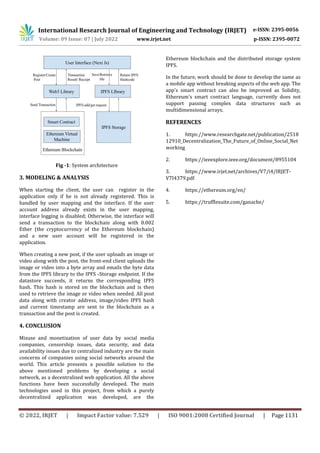
the users. Thus, the whole system forms a three-tier
architecture, where the UI is responsible for user
interaction, while the web3 and IPFS libraries are
responsible for API calls from the UI, the client
interface to the blockchain, and the IPFS storage,
respectively are. .At the very top is the frontend UI, which
is responsible for getting user input for log data,
publishing data and messages, and forwarding them to the
web3 library and the IPFS library. The web3 library then
connects to the underlying Ethereum blockchain system
for function calls, contract implementation, and fund
transfers. The IPFS library is called when the user creates
a post with an image or video. Images and videos are
stored in IPFS data storage and an IPFS hash is returned
and stored as log data on the blockchain.The whole system
consists of three main components, namely the Ethereum
backend blockchain, the IPFS storage and the frontend
web UI.
International Research Journal of Engineering and Technology (IRJET) e-ISSN: 2395-0056
Volume: 09 Issue: 07 | July 2022 www.irjet.net p-ISSN: 2395-0072
© 2022, IRJET | Impact Factor value: 7.529 | ISO 9001:2008 Certified Journal | Page 1131
Fig -1: System architecture
3. MODELING & ANALYSIS
When starting the client, the user can register in the
application only if he is not already registered. This is
handled by user mapping and the interface. If the user
account address already exists in the user mapping,
interface logging is disabled; Otherwise, the interface will
send a transaction to the blockchain along with 0.002
Ether (the cryptocurrency of the Ethereum blockchain)
and a new user account will be registered in the
application.
When creating a new post, if the user uploads an image or
video along with the post, the front-end client uploads the
image or video into a byte array and emails the byte data
from the IPFS library to the IPFS -Storage endpoint. If the
datastore succeeds, it returns the corresponding IPFS
hash. This hash is stored on the blockchain and is then
used to retrieve the image or video when needed. All post
data along with creator address, image/video IPFS hash
and current timestamp are sent to the blockchain as a
transaction and the post is created.
4. CONCLUSION
Misuse and monetization of user data by social media
companies, censorship issues, data security, and data
availability issues due to centralized industry are the main
concerns of companies using social networks around the
world. This article presents a possible solution to the
above mentioned problems by developing a social
network, as a decentralized web application. All the above
functions have been successfully developed. The main
technologies used in this project, from which a purely
decentralized application was developed, are the
Ethereum blockchain and the distributed storage system
IPFS.
In the future, work should be done to develop the same as
a mobile app without breaking aspects of the web app. The
app's smart contract can also be improved as Solidity,
Ethereum's smart contract language, currently does not
support passing complex data structures such as
multidimensional arrays.
REFERENCES
1. https://www.researchgate.net/publication/2518
12910_Decentralization_The_Future_of_Online_Social_Net
working
2. https://ieeexplore.ieee.org/document/8955104
3. https://www.irjet.net/archives/V7/i4/IRJET-
V7I4379.pdf
4. https://ethereum.org/en/
5. https://trufflesuite.com/ganache/

Decentralized Social Network

  • 1.
    International Research Journalof Engineering and Technology (IRJET) e-ISSN: 2395-0056 Volume: 09 Issue: 07 | July 2022 www.irjet.net p-ISSN: 2395-0072 © 2022, IRJET | Impact Factor value: 7.529 | ISO 9001:2008 Certified Journal | Page 1130 Decentralized Social Network Gnanesh K S 1, Varsha Shastri2, Priya Ramesh Naik3, Suman R M4, Sathish B Basapur5, Shilpa Biradar6 *1,2,3,4 Bachelor of Engineering, Information Science Student, Dr. Ambedkar Institute Of Technology. *5Asst.Professor, Department of ISE, Dr. Ambedkar Institute Of Technology, Bangalore *6Asst.Professor, Department of ISE, Dr. Ambedkar Institute Of Technology, Bangalore ---------------------------------------------------------------------***--------------------------------------------------------------------- Abstract - The current approach of social networks is based on extreme responsibility in the hands of a single platform. Conflicts are inevitable when there is disagreement between users, creators, advertisers or governments within the platform. In the current scenario of online social networks, users and creators do not have much-needed privacy and security. Decentralization helps to change this status.People need a reliable, predictable and free platform.This trust can move from a closed corporate policy established by a company to open blockchain protocols. Because of its predictable state, it can provide the necessary security and stability for the creators to function on the platform. Decentralization is the future. Decentralized social networks operate on independently managed servers rather than a centralized server owned by a company. Blockchain technology allows data inputs to be stored on servers anywhere in the world.It promotes transparency as everyone on a network can see the data in near real-time. Users can sign up on their social media and see how the network works and what other users can say. Rather than having a company monitor the content, the founder of a federated social network can set the terms of acceptable behavior for the site. Keywords: Decentralized applications, Blockchain , Web 3.0 , Solidity, Hardhat , Metamask , InterPlanetary File System , Smart Contract. 1. INTRODUCTION Decentralized social media, also known as blockchain- based social media, refers to social media platforms powered by distributed ledger technologies (DLT) such as blockchain or directed acyclic graph. Therefore, activities on these platforms are irrevocably logged in a decentralized log that cannot be controlled or monitored by any central authority. Because these social media platforms are decentralized, they are not under a central authority that owns all the data. Rather, data is stored decentrally across all nodes in the network. Traditional social platforms not only control what users post, but also what they see. Therefore, they present users with attention-grabbing advertising content that entertains them rather than informs them.Users of decentralized social networks are free to interact as they please without censorship, since developers usually only provide guidance rules and leave the rest to a distributed group of users. Decentralized social media platforms prevent the unauthorized sale of user data, which is one of the bones of contention of centralized social media. In addition, blockchain technology increases user privacy and data security through end-to-end encryption. 2. METHODOLOGY The smart contract of this application manages all transactions of the DApp . The user must first register once with their wallet/account address and this user address is stored in a mapping in the smart contract. Each account in the app is linked to a single account address to avoid creating multiple accounts from the same address. This smart contract will be implemented in the Ethereum virtual machine and the user interface will interact with the users. Thus, the whole system forms a three-tier architecture, where the UI is responsible for user interaction, while the web3 and IPFS libraries are responsible for API calls from the UI, the client interface to the blockchain, and the IPFS storage, respectively are. .At the very top is the frontend UI, which is responsible for getting user input for log data, publishing data and messages, and forwarding them to the web3 library and the IPFS library. The web3 library then connects to the underlying Ethereum blockchain system for function calls, contract implementation, and fund transfers. The IPFS library is called when the user creates a post with an image or video. Images and videos are stored in IPFS data storage and an IPFS hash is returned and stored as log data on the blockchain.The whole system consists of three main components, namely the Ethereum backend blockchain, the IPFS storage and the frontend web UI.
  • 2.
    International Research Journalof Engineering and Technology (IRJET) e-ISSN: 2395-0056 Volume: 09 Issue: 07 | July 2022 www.irjet.net p-ISSN: 2395-0072 © 2022, IRJET | Impact Factor value: 7.529 | ISO 9001:2008 Certified Journal | Page 1131 Fig -1: System architecture 3. MODELING & ANALYSIS When starting the client, the user can register in the application only if he is not already registered. This is handled by user mapping and the interface. If the user account address already exists in the user mapping, interface logging is disabled; Otherwise, the interface will send a transaction to the blockchain along with 0.002 Ether (the cryptocurrency of the Ethereum blockchain) and a new user account will be registered in the application. When creating a new post, if the user uploads an image or video along with the post, the front-end client uploads the image or video into a byte array and emails the byte data from the IPFS library to the IPFS -Storage endpoint. If the datastore succeeds, it returns the corresponding IPFS hash. This hash is stored on the blockchain and is then used to retrieve the image or video when needed. All post data along with creator address, image/video IPFS hash and current timestamp are sent to the blockchain as a transaction and the post is created. 4. CONCLUSION Misuse and monetization of user data by social media companies, censorship issues, data security, and data availability issues due to centralized industry are the main concerns of companies using social networks around the world. This article presents a possible solution to the above mentioned problems by developing a social network, as a decentralized web application. All the above functions have been successfully developed. The main technologies used in this project, from which a purely decentralized application was developed, are the Ethereum blockchain and the distributed storage system IPFS. In the future, work should be done to develop the same as a mobile app without breaking aspects of the web app. The app's smart contract can also be improved as Solidity, Ethereum's smart contract language, currently does not support passing complex data structures such as multidimensional arrays. REFERENCES 1. https://www.researchgate.net/publication/2518 12910_Decentralization_The_Future_of_Online_Social_Net working 2. https://ieeexplore.ieee.org/document/8955104 3. https://www.irjet.net/archives/V7/i4/IRJET- V7I4379.pdf 4. https://ethereum.org/en/ 5. https://trufflesuite.com/ganache/