Crowd-Sourced Mapping for Open Government
Prepared for
MIT Libraries Informatics Program Brown Bag Talk
December 2013

Crowd-Sourced Mapping for
Open Government
Dr. Micah Altman
<escience@mit.edu>
Director of Research, MIT Libraries
DISCLAIMER
These opinions are my own, they are not the opinions
of MIT, Brookings, any of the project funders, nor (with
the exception of co-authored previously published
work) my collaborators
Secondary disclaimer:

“It’s tough to make predictions, especially about the
future!”
-- Attributed to Woody Allen, Yogi Berra, Niels Bohr, Vint Cerf, Winston
Churchill, Confucius, Disreali [sic], Freeman Dyson, Cecil B. Demille, Albert
Einstein, Enrico Fermi, Edgar R. Fiedler, Bob Fourer, Sam Goldwyn, Allan
Lamport, Groucho Marx, Dan Quayle, George Bernard Shaw, Casey Stengel, Will
Rogers, M. Taub, Mark Twain, Kerr L. White, etc.

Crowd-Sourced Mapping for Open Government
Collaborators & Co-Conspirators
• Michael P. McDonald, George Mason
University
• Research Support
Thanks to the the Sloan Foundation, the Joyce
Foundation, the Judy Ford Watson Center for
Public Policy, Amazon Corporation

Crowd-Sourced Mapping for Open Government
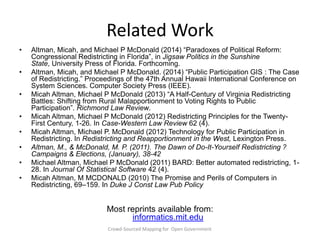
Related Work
•

•
•
•

•
•
•
•

Altman, Micah, and Michael P McDonald (2014) ―Paradoxes of Political Reform:
Congressional Redistricting in Florida‖, in Jigsaw Politics in the Sunshine
State, University Press of Florida. Forthcoming.
Altman, Micah, and Michael P McDonald. (2014) ―Public Participation GIS : The Case
of Redistricting.‖ Proceedings of the 47th Annual Hawaii International Conference on
System Sciences. Computer Society Press (IEEE).
Micah Altman, Michael P McDonald (2013) ―A Half-Century of Virginia Redistricting
Battles: Shifting from Rural Malapportionment to Voting Rights to Public
Participation‖. Richmond Law Review.
Micah Altman, Michael P McDonald (2012) Redistricting Principles for the TwentyFirst Century, 1-26. In Case-Western Law Review 62 (4).
Micah Altman, Michael P. McDonald (2012) Technology for Public Participation in
Redistricting. In Redistricting and Reapportionment in the West, Lexington Press.
Altman, M., & McDonald, M. P. (2011). The Dawn of Do-It-Yourself Redistricting ?
Campaigns & Elections, (January), 38-42
Michael Altman, Michael P McDonald (2011) BARD: Better automated redistricting, 128. In Journal Of Statistical Software 42 (4).
Micah Altman, M MCDONALD (2010) The Promise and Perils of Computers in
Redistricting, 69–159. In Duke J Const Law Pub Policy

Most reprints available from:
informatics.mit.edu
Crowd-Sourced Mapping for Open Government
This Talk
• Political Boundary Mapping
& Open Government
• Building a Platform for Crowd-Sourced
Political Boundary Mapping
• Are Publicly Created Maps Different?
• Future R&D

Crowd-Sourced Mapping for Open Government
Political Boundary
Mapping
Crowd-Sourced Mapping for Open Government
Definitions?
Electoral Boundary Delimitation. The
aim of electoral boundary delimitation
is to assign people to equipopulous
geographical districts from which they
will elect representatives, in order to
reflect communities of interest and to
improve representation.
Gerrymandering. Gerrymandering is a
form of political boundary delimitation,
or redistricting, in which the boundaries
are selected to produce an outcome
that is improperly favorable to some
group. The name “gerrymander” was
first used by the Boston Gazette in 1812
to describe the shape of Massachusetts
Governor Elbridge Ger- ry’s redistricting
plan, in which one district was said to
have resembled a salamander.

Crowd-Sourced Mapping for Open Government
Maybe Use a Computer?
only
had
manpower and
―In ―Until recentlyof thispolitical partiesequalthepopulation. Nowthe tools to redrawthis
summary, keeping districtstechnology and educationpolitically play
eliminationdescribe a — feedandanybody can last
ofingerrymandering the
―The rapid advancesway to do reapportionment simple into the computer
―There is only one in computer to
during would
boundaries while Article is …
―The purpose
two decadesrequire thewhich canasdraw contiguousan analysis firm Caliper
all the to least as aitkibitzer. Forsimple toreapportion aof districts of equal
game, computer relatively as little $3,500 the legislature or other
feasibleat make program registration.‖
seem factors except politicalestablishmentgeographicautomatic
population Reagan havesame time to and census data you need to redistricting
- Ronald [and] at the the software further whatever secondary goalsnovel
Corp. will let you [Goff 1973]
body of people who represent geo- graphical districts. …The try out the
and impersonaldesigned to implement carrying outothers have put
“Let a computer do it”
State has.”proposed is procedure for the value judgments of
geometries on a PC screen. Harvard researcher Micah Altman and a
program
- -Washington Post,in that
Justice Brennan, appears to districts. at all difficult
together a program Karcher v. Daggett [Nagel
those responsible for reapportionment‖–(1983) 1965]
redistricting. It2003 draws compactbe notHis software is free. to
( And many, many blogs)
devise rules for doing this which a census, a commission in each
Democratic redistricting could work like this. After will produce
state entertains proposals from the political parties and any do-gooder group or
results not markedly inferior to those which would
individual willing to compete. The commission picks the most compact
be solution, according to some simple criterion. (Say, add up the miles of boundary
arrived at by a genuinely disinterested
lines, giving any segments that track 1961]
a 50% discount, and go for
commission.‖ -- [Vickrey municipal bordersinspire some gifted amateurs
the shortest total.) The mathematical challenge might
to weigh in.” – William Baldwin, Forbes 2008
Two Challenges
It’s hard.
(Optimal delimitation
with simple criteria is
NP-hard [Altman 1997])

Neutral criteria, aren’t.

(Parker 1990)

1 r é
r! ù
r
n
S( n,r) = å ê( -1) ( r - i)
ú=
r! i=0 ë
( r - i)!i!û

Crowd-Sourced Mapping for Open Government
Trends in computing use for
boundary delimitation?

2000
1990
1980
• First
production use

1960-70
• Research
systems, de
mos

• Common use
of GIS for
congressional
boundaries
• GIS = Decision
Support
• Professional
Only
• Bespoke
systems

Crowd-Sourced Mapping for Open Government

• Web –
disseminate
government
information
• Ubiquitous
GIS on
desktop

Source:
Altman, MacDonald, McDonald
2005
What’s next?

2020

2010
• Web/GIS “2.0”
• Transparency
• Public Engagement

• ???
• AI tools for
computer-aided
boundary
• Public Government
Collaboration?
• Social collaboration?
• “CAD” tools?

Crowd-Sourced Mapping for Open Government
Building a Platform

Crowd-Sourced Mapping for Open Government
Public Mapping Project Goals
• Identify principles for transparency and public
participation in redistricting
• Enable the public to draw maps of the
communities and redistricting plans for their
states
– Facilitate public input to process
– Inform the public debate
– Provide maps for courts where litigation occurs
Crowd-Sourced Mapping for Open Government
Principles for Transparency
 All redistricting plans should include sufficient
information such that the public can
verify, reproduce, and evaluate a plan


Proposed redistricting plans should be publicly available in non-proprietary formats.

 Public redistricting services should provide the public with the ability to make available all
published redistricting plans and community boundaries in non-proprietary formats.



Public redistricting services must provide documentation of any organizations providing significant contributions to their
operation.
All demographic, electoral and geographic data necessary to create legal redistricting plans and define community
boundaries should be publicly available, under a license allowing reuse of these data for non-commercial purposes.

 The criteria used to evaluate plans and districts
should be documented.





Software used to automatically create or improve redistricting plans should be either open-source or provide
documentation sufficient for the public to replicate the results using independent software.
Software used to generate reports that analyze redistricting plans should be accompanied by documentation of
data, methods, and procedures sufficient for the reports to be verified by the public.
Software necessary to replicate the creation or analysis of redistricting plans and community boundaries produced by the
service must be publicly available.
Supporting a Public Mapping
Workflow -- Initial Features
• Create
– Create districts and plans

• Evaluate
– Visualize
– Summarize
• Population balance
• Geographic compactness
• Completeness and contiguity

– Report in depth

• Share
– Import & export plans
– Publish a plan

Crowd-Sourced Mapping for Open Government
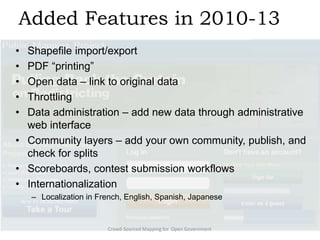
Added Features in 2010-13
•
•
•
•
•

Shapefile import/export
PDF ―printing‖
Open data – link to original data
Throttling
Data administration – add new data through administrative
web interface
• Community layers – add your own community, publish, and
check for splits
• Scoreboards, contest submission workflows
• Internationalization
– Localization in French, English, Spanish, Japanese

Crowd-Sourced Mapping for Open Government
Builds on Best-of-Class
Open Source Software

Crowd-Sourced Mapping for Open Government
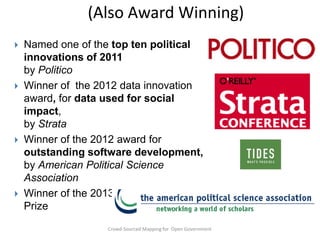
(Also Award Winning)








Named one of the top ten political
innovations of 2011
by Politico
Winner of the 2012 data innovation
award, for data used for social
impact,
by Strata
Winner of the 2012 award for
outstanding software development,
by American Political Science
Association
Winner of the 2013 Tides Pizzigati
Prize
Crowd-Sourced Mapping for Open Government
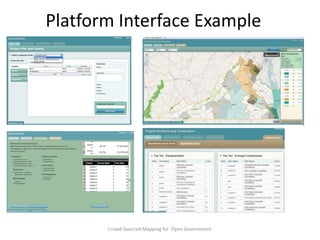
Platform Interface Example

Crowd-Sourced Mapping for Open Government
Sign in – Or just View

Open Data

Open Access

Prepared for 2011 CGA Conference at Harvard University

Open Source

21
Choose Your Legislature

Prepared for 2011 CGA Conference at Harvard University

22
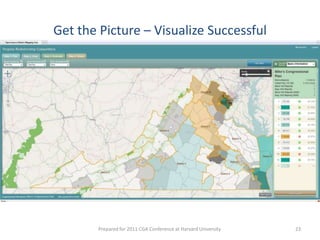
Get the Picture – Visualize Successful

Prepared for 2011 CGA Conference at Harvard University

23
Drill Down – Get The Facts

Prepared for 2011 CGA Conference at Harvard University

24
Make A Plan

Prepared for 2011 CGA Conference at Harvard University

25
Get the Details

Prepared for 2011 CGA Conference at Harvard University

26
Run The Numbers

Prepared for 2011 CGA Conference at Harvard University

27
Is it legal? How Well Are You Doing?
Who’s Doing Better?

Prepared for 2011 CGA Conference at Harvard University

28
Spread the Word
 Share

your plans with others in the
system
 Publish links
 Have a contest

Prepared for 2011 CGA Conference at Harvard University

29
Intervention Part 1 - Platform

Crowd-Sourced Mapping for Open Government
Are Public Maps
Different?
Crowd-Sourced Mapping for Open Government
Our Solution:
Increase Public Participation
Draw the Lines?
Evaluate maps?
Watch the
News
Interest

Get the data
Information
Seeking

Debate &
Commentary

Propose
Alternatives

Consultative
Government

Crowd-Sourced Mapping for Open Government
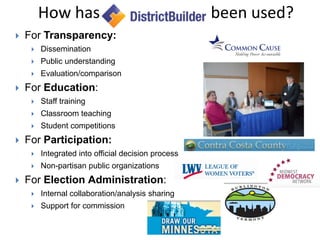
How has DistrictBuilder been used?


For Transparency:



Public understanding





Dissemination
Evaluation/comparison

For Education:



Classroom teaching





Staff training
Student competitions

For Participation:





Integrated into official decision process
Non-partisan public organizations

For Election Administration:


Internal collaboration/analysis sharing



Support for commission
Crowd-Sourced Mapping for Open Government
Where has DistrictBuilder been used?
 Used

in 10 states
 More than 1000
legal plans
created by the
public
 Thousands of
public participants
 Millions of
viewers
Crowd-Sourced Mapping for Open Government
Intervention - Redistricting Competitions




Arizona, Michigan, Minnesota, Ohio, New
York, Virginia, City of Philadelphia
Inspire participation
Transform the redistricting story

Crowd-Sourced Mapping for Open Government
Virginia Redistricting Competition
• Participants
– Eligible: Any student from Virginia College/University

• Incentives
– Potential media attention
– Honorarium: $200
– Prizes: $500-$2000

• Criteria
– Legally required redistricting criteria: equal
population, contiguity, voting rights, completeness
– Good government criteria: communities of interest, county & city
boundaries, competitiveness, partisan balance
– Explanatory narrative

• Timeline
– Nov 2010 (recruitment) -March 2011 (awards)
Crowd-Sourced Mapping for Open Government
Plan Evaluation Criteria
Majority-Minority
Representation

Number of districts in which minority population > 50% of the
district

Population Equality percentage deviation from ideal district population
County Integrity

Number of times counties & independent cities are split by
districts

Compactness

Normalized ratio of (perimeter of district)/(area of district)^2

Partisan Balance

Number of Republican leaning districts minus
Number of Democratic-leaning districts

Competitiveness

Number of districts with normal Democratic vote share in [45%55%]

Crowd-Sourced Mapping for Open Government
Data
Domain: Virginia Redistricting Proposals
- All redistricting plans submitted by members of the
public
- All redistricting plans proposed by legislature
- All plans proposed by redistricting commission
Exclusions:
- Proposals that did not meet minimum legal criteria
- Plans developed internally by legislature, but never
proposed publicly
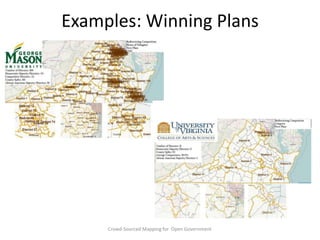
Crowd-Sourced Mapping for Open Government
Examples: Winning Plans

!

!

Crowd-Sourced Mapping for Open Government
Results: VA Congress

Crowd-Sourced Mapping for Open Government
Results: VA Senate

Crowd-Sourced Mapping for Open Government
Results: VA House

Crowd-Sourced Mapping for Open Government
Results from Virginia
• Students can create legal districting plans.
• The “best” plan, as ranked by each individual
criterion, was a student plan.
• Student plans
– demonstrated a wider range of possibilities than other
entities.
– covered a larger set of possible tradeoffs among each
criterion.
– were generally better on pairs of criteria.

• Student plans were more competitive and had more
partisan balance than any of the adopted plans.
Crowd-Sourced Mapping for Open Government
Preview of Florida
• Yes, Virginia, the
public can draw
districts
• Revealed
preferences of the
legislature –
stick it to the
Democrats
Crowd-Sourced Mapping for Open Government
Observations
• There is likely a tension, particularly among state
legislative districts, among greater population
equality, compactness, and respect for local
political boundaries.
• Political reform goals may be more reliably
implemented by including them explicitly in
redistricting criteria, not subsuming them in
other administrative criteria.
• Effective redistricting reform will include a role
for the on-line public participation in line-drawing
and evaluation.
Crowd-Sourced Mapping for Open Government
Lessons for Future Engagement
•

What works
–
–
–

•

Technology barriers
–
–

•

Technology is an enabler … many more plans created by public than in previous decades
Engagement of good-government groups, or other advocates is also critical to public participation
Permeability of government authorities (legislature, courts) to public input needed to have significant effect
Tools for collaborative construction
Tools for web-based visualization and analytics

Government resistance through data availability
–
–

Not providing election results merged with census geography
Redistricting authorities may purposefully restrict the scope of the information they make available.
•

–
–

•

For example, a number of states chose to make available boundaries and information related to the approved plan only.

Non-machine readable formats
No API or automatable way to retrieve plans/data

Forms of government impermeability
–
–
–

Authorities blatantly resist public input by providing no recognized channel for it; or
Create a nominal channel, but leaving it devoid of funding or process;or
Procedurally accept input, but substantively ignore it

Crowd-Sourced Mapping for Open Government
Future R&D

Crowd-Sourced Mapping for Open Government
Future Research
• Analyze results from other states
– over a dozen states had public processes

•
•
•
•

Randomized interventions
Evaluate effect on participants
Computer-aided automated redistricting
Characterizing plans
– semantic fingerprints for maps
• General methods and tools for eliciting geospatially based
preferences and opinions
– Combine: What’s your community?; What’s your opinion?;
What’s your location
– Integrate: Data collection & management and distribution
– Sustain: Reintegrate editing workflows into core open-source
GIStools
Crowd-Sourced Mapping for Open Government
Additional References
•

•

Altman, Micah. "Is automation the answer: the computational complexity of
automated redistricting." Rutgers Computer and Law Technology Journal 23
(1997).Altman, Micah, Karin MacDonald, and Michael McDonald. "From
Crayons to Computers The Evolution of Computer Use in Redistricting."
Social Science Computer Review 23.3 (2005): 334-346.
Parker, Frank R. Black votes count: Political empowerment in Mississippi
after 1965. UNC Press, 1990.

Crowd-Sourced Mapping for Open
Government
Questions?
E-mail:
Web:

escience@mit.edu
informatics.mit.edu

Crowd-Sourced Mapping for Open
Government

Crowd-Sourced Mapping for Open Government

  • 1.
  • 2.
    Prepared for MIT LibrariesInformatics Program Brown Bag Talk December 2013 Crowd-Sourced Mapping for Open Government Dr. Micah Altman <escience@mit.edu> Director of Research, MIT Libraries
  • 3.
    DISCLAIMER These opinions aremy own, they are not the opinions of MIT, Brookings, any of the project funders, nor (with the exception of co-authored previously published work) my collaborators Secondary disclaimer: “It’s tough to make predictions, especially about the future!” -- Attributed to Woody Allen, Yogi Berra, Niels Bohr, Vint Cerf, Winston Churchill, Confucius, Disreali [sic], Freeman Dyson, Cecil B. Demille, Albert Einstein, Enrico Fermi, Edgar R. Fiedler, Bob Fourer, Sam Goldwyn, Allan Lamport, Groucho Marx, Dan Quayle, George Bernard Shaw, Casey Stengel, Will Rogers, M. Taub, Mark Twain, Kerr L. White, etc. Crowd-Sourced Mapping for Open Government
  • 4.
    Collaborators & Co-Conspirators •Michael P. McDonald, George Mason University • Research Support Thanks to the the Sloan Foundation, the Joyce Foundation, the Judy Ford Watson Center for Public Policy, Amazon Corporation Crowd-Sourced Mapping for Open Government
  • 5.
    Related Work • • • • • • • • Altman, Micah,and Michael P McDonald (2014) ―Paradoxes of Political Reform: Congressional Redistricting in Florida‖, in Jigsaw Politics in the Sunshine State, University Press of Florida. Forthcoming. Altman, Micah, and Michael P McDonald. (2014) ―Public Participation GIS : The Case of Redistricting.‖ Proceedings of the 47th Annual Hawaii International Conference on System Sciences. Computer Society Press (IEEE). Micah Altman, Michael P McDonald (2013) ―A Half-Century of Virginia Redistricting Battles: Shifting from Rural Malapportionment to Voting Rights to Public Participation‖. Richmond Law Review. Micah Altman, Michael P McDonald (2012) Redistricting Principles for the TwentyFirst Century, 1-26. In Case-Western Law Review 62 (4). Micah Altman, Michael P. McDonald (2012) Technology for Public Participation in Redistricting. In Redistricting and Reapportionment in the West, Lexington Press. Altman, M., & McDonald, M. P. (2011). The Dawn of Do-It-Yourself Redistricting ? Campaigns & Elections, (January), 38-42 Michael Altman, Michael P McDonald (2011) BARD: Better automated redistricting, 128. In Journal Of Statistical Software 42 (4). Micah Altman, M MCDONALD (2010) The Promise and Perils of Computers in Redistricting, 69–159. In Duke J Const Law Pub Policy Most reprints available from: informatics.mit.edu Crowd-Sourced Mapping for Open Government
  • 6.
    This Talk • PoliticalBoundary Mapping & Open Government • Building a Platform for Crowd-Sourced Political Boundary Mapping • Are Publicly Created Maps Different? • Future R&D Crowd-Sourced Mapping for Open Government
  • 7.
  • 8.
    Definitions? Electoral Boundary Delimitation.The aim of electoral boundary delimitation is to assign people to equipopulous geographical districts from which they will elect representatives, in order to reflect communities of interest and to improve representation. Gerrymandering. Gerrymandering is a form of political boundary delimitation, or redistricting, in which the boundaries are selected to produce an outcome that is improperly favorable to some group. The name “gerrymander” was first used by the Boston Gazette in 1812 to describe the shape of Massachusetts Governor Elbridge Ger- ry’s redistricting plan, in which one district was said to have resembled a salamander. Crowd-Sourced Mapping for Open Government
  • 9.
    Maybe Use aComputer? only had manpower and ―In ―Until recentlyof thispolitical partiesequalthepopulation. Nowthe tools to redrawthis summary, keeping districtstechnology and educationpolitically play eliminationdescribe a — feedandanybody can last ofingerrymandering the ―The rapid advancesway to do reapportionment simple into the computer ―There is only one in computer to during would boundaries while Article is … ―The purpose two decadesrequire thewhich canasdraw contiguousan analysis firm Caliper all the to least as aitkibitzer. Forsimple toreapportion aof districts of equal game, computer relatively as little $3,500 the legislature or other feasibleat make program registration.‖ seem factors except politicalestablishmentgeographicautomatic population Reagan havesame time to and census data you need to redistricting - Ronald [and] at the the software further whatever secondary goalsnovel Corp. will let you [Goff 1973] body of people who represent geo- graphical districts. …The try out the and impersonaldesigned to implement carrying outothers have put “Let a computer do it” State has.”proposed is procedure for the value judgments of geometries on a PC screen. Harvard researcher Micah Altman and a program - -Washington Post,in that Justice Brennan, appears to districts. at all difficult together a program Karcher v. Daggett [Nagel those responsible for reapportionment‖–(1983) 1965] redistricting. It2003 draws compactbe notHis software is free. to ( And many, many blogs) devise rules for doing this which a census, a commission in each Democratic redistricting could work like this. After will produce state entertains proposals from the political parties and any do-gooder group or results not markedly inferior to those which would individual willing to compete. The commission picks the most compact be solution, according to some simple criterion. (Say, add up the miles of boundary arrived at by a genuinely disinterested lines, giving any segments that track 1961] a 50% discount, and go for commission.‖ -- [Vickrey municipal bordersinspire some gifted amateurs the shortest total.) The mathematical challenge might to weigh in.” – William Baldwin, Forbes 2008
  • 10.
    Two Challenges It’s hard. (Optimaldelimitation with simple criteria is NP-hard [Altman 1997]) Neutral criteria, aren’t. (Parker 1990) 1 r é r! ù r n S( n,r) = å ê( -1) ( r - i) ú= r! i=0 ë ( r - i)!i!û Crowd-Sourced Mapping for Open Government
  • 11.
    Trends in computinguse for boundary delimitation? 2000 1990 1980 • First production use 1960-70 • Research systems, de mos • Common use of GIS for congressional boundaries • GIS = Decision Support • Professional Only • Bespoke systems Crowd-Sourced Mapping for Open Government • Web – disseminate government information • Ubiquitous GIS on desktop Source: Altman, MacDonald, McDonald 2005
  • 12.
    What’s next? 2020 2010 • Web/GIS“2.0” • Transparency • Public Engagement • ??? • AI tools for computer-aided boundary • Public Government Collaboration? • Social collaboration? • “CAD” tools? Crowd-Sourced Mapping for Open Government
  • 13.
    Building a Platform Crowd-SourcedMapping for Open Government
  • 14.
    Public Mapping ProjectGoals • Identify principles for transparency and public participation in redistricting • Enable the public to draw maps of the communities and redistricting plans for their states – Facilitate public input to process – Inform the public debate – Provide maps for courts where litigation occurs Crowd-Sourced Mapping for Open Government
  • 15.
    Principles for Transparency All redistricting plans should include sufficient information such that the public can verify, reproduce, and evaluate a plan  Proposed redistricting plans should be publicly available in non-proprietary formats.  Public redistricting services should provide the public with the ability to make available all published redistricting plans and community boundaries in non-proprietary formats.   Public redistricting services must provide documentation of any organizations providing significant contributions to their operation. All demographic, electoral and geographic data necessary to create legal redistricting plans and define community boundaries should be publicly available, under a license allowing reuse of these data for non-commercial purposes.  The criteria used to evaluate plans and districts should be documented.    Software used to automatically create or improve redistricting plans should be either open-source or provide documentation sufficient for the public to replicate the results using independent software. Software used to generate reports that analyze redistricting plans should be accompanied by documentation of data, methods, and procedures sufficient for the reports to be verified by the public. Software necessary to replicate the creation or analysis of redistricting plans and community boundaries produced by the service must be publicly available.
  • 16.
    Supporting a PublicMapping Workflow -- Initial Features • Create – Create districts and plans • Evaluate – Visualize – Summarize • Population balance • Geographic compactness • Completeness and contiguity – Report in depth • Share – Import & export plans – Publish a plan Crowd-Sourced Mapping for Open Government
  • 17.
    Added Features in2010-13 • • • • • Shapefile import/export PDF ―printing‖ Open data – link to original data Throttling Data administration – add new data through administrative web interface • Community layers – add your own community, publish, and check for splits • Scoreboards, contest submission workflows • Internationalization – Localization in French, English, Spanish, Japanese Crowd-Sourced Mapping for Open Government
  • 18.
    Builds on Best-of-Class OpenSource Software Crowd-Sourced Mapping for Open Government
  • 19.
    (Also Award Winning)     Namedone of the top ten political innovations of 2011 by Politico Winner of the 2012 data innovation award, for data used for social impact, by Strata Winner of the 2012 award for outstanding software development, by American Political Science Association Winner of the 2013 Tides Pizzigati Prize Crowd-Sourced Mapping for Open Government
  • 20.
    Platform Interface Example Crowd-SourcedMapping for Open Government
  • 21.
    Sign in –Or just View Open Data Open Access Prepared for 2011 CGA Conference at Harvard University Open Source 21
  • 22.
    Choose Your Legislature Preparedfor 2011 CGA Conference at Harvard University 22
  • 23.
    Get the Picture– Visualize Successful Prepared for 2011 CGA Conference at Harvard University 23
  • 24.
    Drill Down –Get The Facts Prepared for 2011 CGA Conference at Harvard University 24
  • 25.
    Make A Plan Preparedfor 2011 CGA Conference at Harvard University 25
  • 26.
    Get the Details Preparedfor 2011 CGA Conference at Harvard University 26
  • 27.
    Run The Numbers Preparedfor 2011 CGA Conference at Harvard University 27
  • 28.
    Is it legal?How Well Are You Doing? Who’s Doing Better? Prepared for 2011 CGA Conference at Harvard University 28
  • 29.
    Spread the Word Share your plans with others in the system  Publish links  Have a contest Prepared for 2011 CGA Conference at Harvard University 29
  • 30.
    Intervention Part 1- Platform Crowd-Sourced Mapping for Open Government
  • 31.
    Are Public Maps Different? Crowd-SourcedMapping for Open Government
  • 32.
    Our Solution: Increase PublicParticipation Draw the Lines? Evaluate maps? Watch the News Interest Get the data Information Seeking Debate & Commentary Propose Alternatives Consultative Government Crowd-Sourced Mapping for Open Government
  • 33.
    How has DistrictBuilderbeen used?  For Transparency:   Public understanding   Dissemination Evaluation/comparison For Education:   Classroom teaching   Staff training Student competitions For Participation:    Integrated into official decision process Non-partisan public organizations For Election Administration:  Internal collaboration/analysis sharing  Support for commission Crowd-Sourced Mapping for Open Government
  • 34.
    Where has DistrictBuilderbeen used?  Used in 10 states  More than 1000 legal plans created by the public  Thousands of public participants  Millions of viewers Crowd-Sourced Mapping for Open Government
  • 35.
    Intervention - RedistrictingCompetitions    Arizona, Michigan, Minnesota, Ohio, New York, Virginia, City of Philadelphia Inspire participation Transform the redistricting story Crowd-Sourced Mapping for Open Government
  • 36.
    Virginia Redistricting Competition •Participants – Eligible: Any student from Virginia College/University • Incentives – Potential media attention – Honorarium: $200 – Prizes: $500-$2000 • Criteria – Legally required redistricting criteria: equal population, contiguity, voting rights, completeness – Good government criteria: communities of interest, county & city boundaries, competitiveness, partisan balance – Explanatory narrative • Timeline – Nov 2010 (recruitment) -March 2011 (awards) Crowd-Sourced Mapping for Open Government
  • 37.
    Plan Evaluation Criteria Majority-Minority Representation Numberof districts in which minority population > 50% of the district Population Equality percentage deviation from ideal district population County Integrity Number of times counties & independent cities are split by districts Compactness Normalized ratio of (perimeter of district)/(area of district)^2 Partisan Balance Number of Republican leaning districts minus Number of Democratic-leaning districts Competitiveness Number of districts with normal Democratic vote share in [45%55%] Crowd-Sourced Mapping for Open Government
  • 38.
    Data Domain: Virginia RedistrictingProposals - All redistricting plans submitted by members of the public - All redistricting plans proposed by legislature - All plans proposed by redistricting commission Exclusions: - Proposals that did not meet minimum legal criteria - Plans developed internally by legislature, but never proposed publicly Crowd-Sourced Mapping for Open Government
  • 39.
    Examples: Winning Plans ! ! Crowd-SourcedMapping for Open Government
  • 40.
    Results: VA Congress Crowd-SourcedMapping for Open Government
  • 41.
    Results: VA Senate Crowd-SourcedMapping for Open Government
  • 42.
    Results: VA House Crowd-SourcedMapping for Open Government
  • 43.
    Results from Virginia •Students can create legal districting plans. • The “best” plan, as ranked by each individual criterion, was a student plan. • Student plans – demonstrated a wider range of possibilities than other entities. – covered a larger set of possible tradeoffs among each criterion. – were generally better on pairs of criteria. • Student plans were more competitive and had more partisan balance than any of the adopted plans. Crowd-Sourced Mapping for Open Government
  • 44.
    Preview of Florida •Yes, Virginia, the public can draw districts • Revealed preferences of the legislature – stick it to the Democrats Crowd-Sourced Mapping for Open Government
  • 45.
    Observations • There islikely a tension, particularly among state legislative districts, among greater population equality, compactness, and respect for local political boundaries. • Political reform goals may be more reliably implemented by including them explicitly in redistricting criteria, not subsuming them in other administrative criteria. • Effective redistricting reform will include a role for the on-line public participation in line-drawing and evaluation. Crowd-Sourced Mapping for Open Government
  • 46.
    Lessons for FutureEngagement • What works – – – • Technology barriers – – • Technology is an enabler … many more plans created by public than in previous decades Engagement of good-government groups, or other advocates is also critical to public participation Permeability of government authorities (legislature, courts) to public input needed to have significant effect Tools for collaborative construction Tools for web-based visualization and analytics Government resistance through data availability – – Not providing election results merged with census geography Redistricting authorities may purposefully restrict the scope of the information they make available. • – – • For example, a number of states chose to make available boundaries and information related to the approved plan only. Non-machine readable formats No API or automatable way to retrieve plans/data Forms of government impermeability – – – Authorities blatantly resist public input by providing no recognized channel for it; or Create a nominal channel, but leaving it devoid of funding or process;or Procedurally accept input, but substantively ignore it Crowd-Sourced Mapping for Open Government
  • 47.
  • 48.
    Future Research • Analyzeresults from other states – over a dozen states had public processes • • • • Randomized interventions Evaluate effect on participants Computer-aided automated redistricting Characterizing plans – semantic fingerprints for maps • General methods and tools for eliciting geospatially based preferences and opinions – Combine: What’s your community?; What’s your opinion?; What’s your location – Integrate: Data collection & management and distribution – Sustain: Reintegrate editing workflows into core open-source GIStools Crowd-Sourced Mapping for Open Government
  • 49.
    Additional References • • Altman, Micah."Is automation the answer: the computational complexity of automated redistricting." Rutgers Computer and Law Technology Journal 23 (1997).Altman, Micah, Karin MacDonald, and Michael McDonald. "From Crayons to Computers The Evolution of Computer Use in Redistricting." Social Science Computer Review 23.3 (2005): 334-346. Parker, Frank R. Black votes count: Political empowerment in Mississippi after 1965. UNC Press, 1990. Crowd-Sourced Mapping for Open Government
  • 50.

Editor's Notes

  • #2 This work. “The Public Mapping Project”, by Micah Altman (http://redistricting.info) is licensed under the Creative Commons Attribution-Share Alike 3.0 United States License. To view a copy of this license, visit http://creativecommons.org/licenses/by-sa/3.0/us/ or send a letter to Creative Commons, 171 Second Street, Suite 300, San Francisco, California, 94105, USA.
  • #3 This work. by Micah Altman (http://micahaltman.com) is licensed under the Creative Commons Attribution-Share Alike 3.0 United States License. To view a copy of this license, visit http://creativecommons.org/licenses/by-sa/3.0/us/ or send a letter to Creative Commons, 171 Second Street, Suite 300, San Francisco, California, 94105, USA.
  • #4 The structure and design of digital storage systems is a cornerstone of digital preservation. To better understand ongoing storage practices of organizations committed to digital preservation, the National Digital Stewardship Alliance conducted a survey of member organizations. This talk discusses findings from this survey, common gaps, and trends in this area.(I also have a little fun highlighting the hidden assumptions underlying Amazon Glacier&apos;s reliability claims. For more on that see this earlier post: http://drmaltman.wordpress.com/2012/11/15/amazons-creeping-glacier-and-digital-preservation )
  • #8 5 Minutes
  • #14 5 Minutes
  • #32 5 Minutes
  • #48 5 Minutes