Crowdsourcing Planning?

     Robert Goodspeed
     PhD Student
     MIT Department of Urban Studies and Planning
     Delivered as a lighting talk at the Virginia Tech Social Media for
     Planning Conference, April 19, 2011:
     http://www.cpe.vt.edu/socialplan/
Other
                                          Presentation
                                                                            Website
                      Facebook/Twi
                      tter


        Published
           Article
                                                   To What
                                                                                      Community
                                                    End?                              Forum
                                                                                      Meetings


       Citizen Task
       Force


N = 73
Survey Universe: City email list
                                                                            Online Survey
Convenience Sample
                                   Open House
                                                         Meeting-In-a-Box
Three view of “regular” participation:
?
?
Six Forms of
Crowdsourcing

What can we learn
from them?
The New Outsourcing?


Jeff Howe, “The Rise of Crowdsourcing,” Wired Magazine
http://www.wired.com/wired/archive/14.06/crowds.html
#1 Distributed data collection


“Volunteered geographic information”
Emergency response, vacant property tracking, invasive species, etc.
#2 Soliciting design solutions


Brabham, D. 2009. Crowdsourcing the Public Participation Process for Planning
Participation. Planning Theory 8: 3, 242-262.
#3 Collective intelligence


Mark Elliott PhD Dissertation: “Stigmergic Collaboration: A theoretical framework for
mass collaboration”
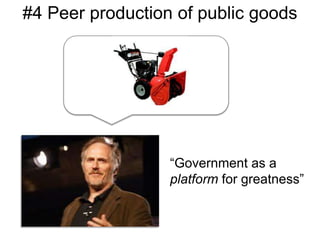
#4 Peer production of public goods


                  “Government as a
                  platform for greatness”
These have naïve conception of
government and power.

At their worst, they are a libertarian
pipe dream.

Let’s get institutional.
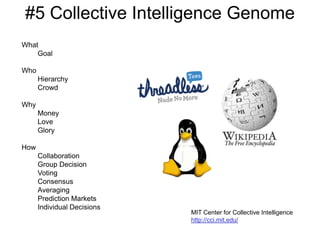
#5 Collective Intelligence Genome
What
    Goal

Who
      Hierarchy
      Crowd

Why
      Money
      Love
      Glory

How
      Collaboration
      Group Decision
      Voting
      Consensus
      Averaging
      Prediction Markets
      Individual Decisions
                             MIT Center for Collective Intelligence
                             http://cci.mit.edu/
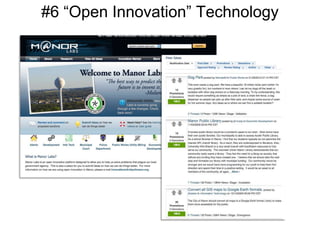
#6 “Open Innovation” Technology
New models from disparate fields
     present fruitful ideas.


                          Problem identification

                          Data collection

                                  Ideas

                         Volunteers

                             Input for plans
Only by including new technologies
as a variable can we be open to
new social, political, and
institutional arrangements that
previously weren’t possible.
Thank You

Robert Goodspeed
PhD Student
MIT Department of Urban Studies and Planning
http://web.mit.edu/rgoodspe/www/
rgoodspe@mit.edu

Crowdsourcing Planning?

  • 1.
    Crowdsourcing Planning? Robert Goodspeed PhD Student MIT Department of Urban Studies and Planning Delivered as a lighting talk at the Virginia Tech Social Media for Planning Conference, April 19, 2011: http://www.cpe.vt.edu/socialplan/
  • 3.
    Other Presentation Website Facebook/Twi tter Published Article To What Community End? Forum Meetings Citizen Task Force N = 73 Survey Universe: City email list Online Survey Convenience Sample Open House Meeting-In-a-Box
  • 4.
    Three view of“regular” participation:
  • 6.
  • 7.
  • 8.
    Six Forms of Crowdsourcing Whatcan we learn from them?
  • 9.
    The New Outsourcing? JeffHowe, “The Rise of Crowdsourcing,” Wired Magazine http://www.wired.com/wired/archive/14.06/crowds.html
  • 10.
    #1 Distributed datacollection “Volunteered geographic information” Emergency response, vacant property tracking, invasive species, etc.
  • 11.
    #2 Soliciting designsolutions Brabham, D. 2009. Crowdsourcing the Public Participation Process for Planning Participation. Planning Theory 8: 3, 242-262.
  • 12.
    #3 Collective intelligence MarkElliott PhD Dissertation: “Stigmergic Collaboration: A theoretical framework for mass collaboration”
  • 13.
    #4 Peer productionof public goods “Government as a platform for greatness”
  • 14.
    These have naïveconception of government and power. At their worst, they are a libertarian pipe dream. Let’s get institutional.
  • 15.
    #5 Collective IntelligenceGenome What Goal Who Hierarchy Crowd Why Money Love Glory How Collaboration Group Decision Voting Consensus Averaging Prediction Markets Individual Decisions MIT Center for Collective Intelligence http://cci.mit.edu/
  • 16.
  • 17.
    New models fromdisparate fields present fruitful ideas. Problem identification Data collection Ideas Volunteers Input for plans
  • 18.
    Only by includingnew technologies as a variable can we be open to new social, political, and institutional arrangements that previously weren’t possible.
  • 19.
    Thank You Robert Goodspeed PhDStudent MIT Department of Urban Studies and Planning http://web.mit.edu/rgoodspe/www/ rgoodspe@mit.edu

Editor's Notes

  • #3 Last fall I completed a research paper on social media in planning about a comprehensive planning process in Austin, Texas. As you see here I evaluated their offline and online approaches, including facebook, twitter, blogging, and others.
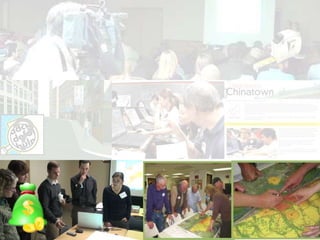
  • #4 One of the most interesting outcomes was this diagram. It illustrates the pattern of participation for a survey of highly active participants. The bars represent the pairwise commonalities between the two only. The colors are just for fun. Basically, out of all of these activities most people went to the website. This seems to suggest the hypothesis they were then told about other opportunities, however the reverse causality is also interesting. Attended a public meeting and then went to a website. However, the key question I kept coming back to was what the purpose of all this participation was? Were we happy with the system that was emerging, or should we question what we wanted as well?
  • #5 This is the central question: what models work and how might we be inspired by other experiments?That are flexible, effective, and get resultsWe can do a host of things previously difficult. Easily aggregate and rate ideas and preferences, collect data, mine contents of digital networks for views, and much more. But I’m getting a little ahead of myself.
  • #6 Attendees to public meetings are not representative. Most seriously, the process silences new ideas, says “no,” and deadens community vitality.The question we ask ourselves with disappointing results: is this the best we can do?Others focus on deliberative or educational experiences divorced from a plan or policy contextOften limited to creating a vision. Is that all we want? Then get out of our way, let us write regulation and run the approval process?An unsatisfying scope for planning. Yet without an affirmative model for deeper engagement, it’s where we are.
  • #7 Attendees to public meetings are not representative. Most seriously, the process silences new ideas, says “no,” and deadens community vitality.The question we ask ourselves with disappointing results: is this the best we can do?Others focus on deliberative or educational experiences divorced from a plan or policy contextOften limited to creating a vision. Is that all we want? Then get out of our way, let us write regulation and run the approval process?An unsatisfying scope for planning. Yet without an affirmative model for deeper engagement, it’s where we are.
  • #8 Attendees to public meetings are not representative. Most seriously, the process silences new ideas, says “no,” and deadens community vitality.The question we ask ourselves with disappointing results: is this the best we can do?Others focus on deliberative or educational experiences divorced from a plan or policy contextOften limited to creating a vision. Is that all we want? Then get out of our way, let us write regulation and run the approval process?An unsatisfying scope for planning. Yet without an affirmative model for deeper engagement, it’s where we are.
  • #9 Internet-enabled collaboration and communication arising new social practices.
  • #10 “ … crowdsourcing represents the act of a company or institution taking a function once performed by employees and outsourcing it to an undefined (and generally large) network of people in the form of an open call. This can take the form of peer-production (when the job is performed collaboratively), but is also often undertaken by sole individuals. The crucial prerequisite is the use of the open call format and the large network of potential laborers.”-- Jeff Howe
  • #17 GovSpigit enables government agencies to launch internal and/or external campaigns to collect new ideas from employees and/or citizens. Ideas advance through a structured process, customized for each agency, designed to make them actionable.
  • #18 It’s our job to build these new frameworks for problem identification and solutions.What do we want? How do we get it? What is the role of social media?