"Today's Data Grow Tomorrow's Citizens"
What? Research data management, citizenship and democracy?
Keynote, CASRAI Reconnect 16
Toronto, Ontario, October 24, 2016, 13:30-14:15
Dr. Tracey P. Lauriault - orcid.org/0000-0003-1847-2738
Critical Media and Big Data
Media Studies and Communication
School of Journalism and Communication
Carleton University
Tracey.Lauriault@Carleton.ca
http://del.icio.us/tlauriau
Do we live in a data based
technological society?
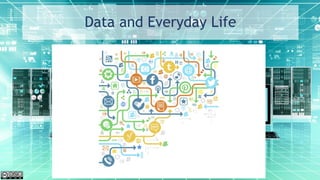
Data and Everyday Life
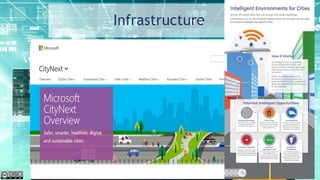
Infrastructure
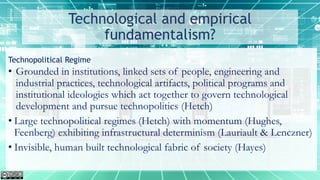
Technological and empirical
fundamentalism?
Technopolitical Regime
• Grounded in institutions, linked sets of people, engineering and
industrial practices, technological artifacts, political programs and
institutional ideologies which act together to govern technological
development and pursue technopolitics (Hetch)
• Large technopolitical regimes (Hetch) with momentum (Hughes,
Feenberg) exhibiting infrastructural determinism (Lauriault & Lenczner)
• Invisible, human built technological fabric of society (Hayes)
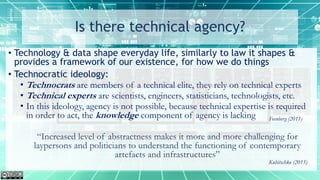
Is there technical agency?
• Technology & data shape everyday life, similarly to law it shapes &
provides a framework of our existence, for how we do things
• Technocratic ideology:
• Technocrats are members of a technical elite, they rely on technical experts
• Technical experts are scientists, engineers, statisticians, technologists, etc.
• In this ideology, agency is not possible, because technical expertise is required
in order to act, the knowledge component of agency is lacking
“Increased level of abstractness makes it more and more challenging for
laypersons and politicians to understand the functioning of contemporary
artefacts and infrastructures”
Feenberg (2011)
Kubitschko (2015)
Are Data Political?
Data power
Cover Popular Science
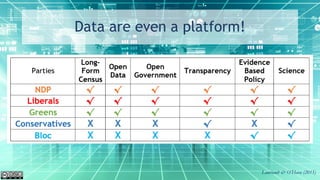
Data are even a platform!
Lauriault & O’Hara (2015)
What about research data?
Are they political?
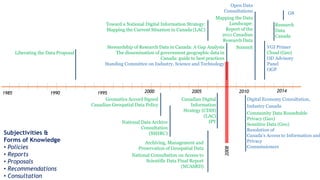
20101990 1995 2000 2005
National Data Archive
Consultation
(SSHRC)
Stewardship of Research Data in Canada: A Gap Analysis
The dissemination of government geographic data in
Canada: guide to best practices
Standing Committee on Industry, Science and Technology
Toward a National Digital Information Strategy:
Mapping the Current Situation in Canada (LAC)
Canadian Digital
Information
Strategy (CDIS)
(LAC)
IPY
1985 2014
Open Data
Consultations
Mapping the Data
Landscape:
Report of the
2011 Canadian
Research Data
Summit
Digital Economy Consultation,
Industry Canada
Community Data Roundtable
Privacy (Geo)
Sensitive Data (Geo)
Resolution of
Canada’s Access to Information and
Privacy
Commissioners
Geomatics Accord Signed
Canadian Geospatial Data Policy
Liberating the Data Proposal
VGI Primer
Cloud (Geo)
OD Advisory
Panel
OGP
G8
Subjectivities &
Forms of Knowledge
• Policies
• Reports
• Proposals
• Recommendations
• Consultation
Research
Data
Canada
Archiving, Management and
Preservation of Geospatial Data
National Consultation on Access to
Scientific Data Final Report
(NCASRD)
2008
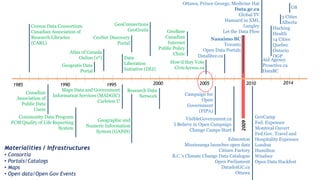
20101990 1995 2000 20051985 2014
Data
Liberation
Initiative (DLI)
Geogratis Data
Portal
GeoBase
Canadian
Internet
Public Policy
Clinic
Maps Data and Government
Information Services (MADGIC)
Carleton U
GeoConnections
GeoGratis
Census Data Consortium
Canadian Association of
Research Libraries
(CARL)
Atlas of Canada
Online (1st)
CeoNet Discovery
Portal
Research Data
Network
How'd they Vote
CivicAccess.ca
Campaign for
Open
Government
(FIPA)
Canadian
Association of
Public Data
Users
Datalibre.ca
VisibleGovernment.ca
I Believe in Open Campaign
Change Camps Start
Nanaimo BC
Toronto
Open Data Portals
Edmonton
Mississauga launches open data
Citizen Factory
B.C.'s Climate Change Data Catalogue
Open Parliament
DatadotGC.ca
Ottawa
Ottawa, Prince George, Medicine Hat
Data.gc.ca
Global TV
Hansard in XML
Langley
Let the Data Flow
GovCamp
Fed. Expenses
Montreal Ouvert
Fed.Gov. Travel and
Hospitality Expenses
London
Hamilton
Windsor
Open Data Hackfest
Aid Agency
Proactive.ca
DataBC
Hacking
Health
14 Cities
Quebec
Ontario
OGP
3 Cities
Alberta
G8
Community Data Program
FCM Quality of Life Reporting
System
Geographic and
Numeric Information
System (GANIS)
Materialities / Infrastructures
• Consortia
• Portals/Catalogs
• Maps
• Open data/Open Gov Events
2009
Can we critically re-conceptualize
data?
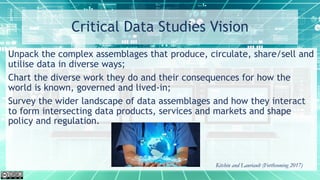
Critical Data Studies Vision
Unpack the complex assemblages that produce, circulate, share/sell and
utilise data in diverse ways;
Chart the diverse work they do and their consequences for how the
world is known, governed and lived-in;
Survey the wider landscape of data assemblages and how they interact
to form intersecting data products, services and markets and shape
policy and regulation.
Kitchin and Lauriault (Forthcoming 2017)
Data – big or small (& infrastructures)
Are more than a unique arrangement of objective and politically neutral
facts
&
they do not exist independently of ideas, techniques, technologies, systems,
people and contexts regardless of them being presented in that way.
Lauriault (2012)
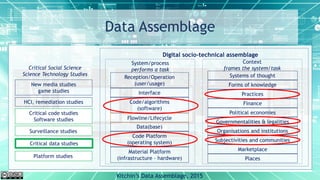
Data Assemblage
Kitchin’s Data Assemblage, 2015
Material Platform
(infrastructure – hardware)
Code Platform
(operating system)
Code/algorithms
(software)
Data(base)
Interface
Reception/Operation
(user/usage)
Systems of thought
Forms of knowledge
Finance
Political economies
Governmentalities & legalities
Organisations and institutions
Subjectivities and communities
Marketplace
System/process
performs a task
Context
frames the system/task
Digital socio-technical assemblage
HCI, remediation studies
Critical code studies
Software studies
Critical data studies
New media studies
game studies
Critical Social Science
Science Technology Studies
Platform studies Places
Practices
Flowline/Lifecycle
Surveillance studies
Doing data citizenship?
Agency and Citizenship in a
Technological Society
“Citizenship implies agency, but what is agency and how is agency
possible in a technologically [data based] advanced society where so
much of life is organized around technological [data driven] systems
commanded by experts?”
Feenberg (2011)
Technological Citizenship
• Agency = Capacity to act
• Capacity to act implies 3 conditions:
1. Knowledge
2. Power
3. Appropriate occasion to act
Ex. Politics – Citizen agency is the legitimate right and power to
influence political events
• Need to close the expert-public gap
• Strengthen the ability of citizens to gain understanding of complex issues that co-determine
socio-technical outcomes
Feenberg (2011)
Expert Culture
• Technology is complicated
• Expert public gap
• Experts are called upon to play a role in helping citizens to fulfill their role in democratic
constellations by strengthening citizen’s abilities to deliberate and debate public issues
• Democracy and expertise
• What an expert is, is conditioned by social realties
• Forms and modes shift with political landscape
• Expertise
• High level of knowledge, skills and experience
Kubitschko (2015)
CASRAI
You are technical experts building a [the] research data management
infrastructure
You are creating a technological framework
…in the infrastructural trenches - standards, code, metadata,
agreements, processes, procedures, regulation…
You are a social-technological network
…tackling the technocrats…
You are engaged in databased technological politics - for a long time
And there is a high degree of abstractness in what you do
Technological Citizenship
• Are you doing this to make a Research Data Management Infrastructure?
…better system, robust standards, solid agreements, persistent UIDs?
• Or is it more about
• you being the technological experts, working to store, manage, disseminate and preserve data
so that we have the requisite artifacts to increase our data and technological literacy in order
to build upon collective/collected knowledge?
• good technological and data based governance to enable knowledge production?
If that is you, then I hope you will mobilize your expert knowledge, your specialized
data and technological power and act in such a way that we may have a literate and
numerate democratic technological society.
Data and technological literacy, I believe, is indispensable in
the current democratic system, and that requires having
access to data, data infrastructures - knowledge and
technology - and dedicated skilled people and resources to
sustainably care for them.
I consider research data management to be our duty.
References
• Barney, Darin. (2004) Network Technology, Chapter 2 in The Network Society, Cambridge: Polity Press. pp.34-68.
• Barney, Darin (2005) The Problem of Education in Technological Society, International Journal of Technology, Knowledge
and Society, Vol. 1
• Feenberg, Andrew, (2011), Agency and Citizenship in a Technological Society. Lecture presented to the Course on Digital
Citizenship in a Technological Society, IT University of Copenhagen, pp. 1-13, http://www.sfu.ca/~andrewf/copen5-1.pdf
• Kitchin, Rob (2014) The Data Revolution, Sage.
• Kitchin,Rob and Tracey P. Lauriault, Forthcoming, Toward a Critical Data Studies: Charting and Unpacking Data
Assemblages and their Work, in J. Eckert,, A. Shears & J. Thatcher, Geoweb and Big Data, University of Nebraska
Press , Pre-Print http://papers.ssrn.com/sol3/papers.cfm?abstract_id=2474112
• Kubitschko, Sebastian, (2015), Hackers’ media practices: Demonstrating and articulating expertise as interlocking
arrangements, Convergence: The International Journal of Research into New Media Technologies 2015, Vol. 21(3) 388–402.
DOI: 10.1177/1354856515579847
• Lauriault, Tracey P. (2012), Data, Infrastructures and Geographical Imaginations. Ph.D. Thesis, Carleton University,
Ottawa, http://curve.carleton.ca/theses/27431
• Lauriault, Tracey P. and O'Hara, Kathryn, Working Paper: 2015 Canadian Election Platforms: Long-Form Census, Open
Data, Open Government, Transparency and Evidence Based Policy and Science (October 28, 2015). Available at
SSRN: https://ssrn.com/abstract=2682638 or http://dx.doi.org/10.2139/ssrn.2682638
Abstract
In a technological society such as Canada, it is suggested that a specialized kind of expert
citizenship is needed (Andrew Feenberg). In the era of big data, others suggest that there is a need
to learn how to read algorithms and to study its high priests and alchemists (Genevieve Bell).
While, doing citizenship requires a political ethics of technology to thwart technological and
quantitative fundamentalism (Darin Barney). Finally, in the midst of a data revolution we need to
critically re-conceptualize data (Rob Kitchin). Quite simply, in today's Canada doing citizenship
requires data literacy, technical, philosophical and political. Access to print media - books,
government documents, academic journals - in libraries and archives enabled a literate society, the
prerequisite of a democratic system. I argue that good governance in knowledge producing
institutions, is to have technological experts, both data creators and preservers, working to store,
manage, disseminate and preserve data so that we have the requisite artifacts to increase our
literacy and build upon collected knowledge. Data literacy I suggest, is indispensable in the
current democratic system, and that requires having access to data, data infrastructures -
knowledge and technology - and dedicated skilled people and resources to sustainably care for
them. I consider research data management to be our duty.
Dr Tracey P. Lauriault, School of Journalism and Communication Carleton University
Bio
• Dr. Tracey P. Lauriault is an Assistant Professor of Critical Media and Big Data in the School of Journalism and
Communication, at Carleton University in Ottawa, Canada. She is also a research Associate with the European Research
Council (ERC) funded Programmable City Project, directed by Professor Rob Kitchin in Ireland and with The Geomatics
and Cartographic Research Centre in Canada directed Professor D. R. Fraser Taylor.
• Her research domain is critical data studies and she is actively engaged in public policy research as it pertains to data with
civil society and government. Her ongoing research with the Programmable City Project entails three case studies investigating
How digital data materially and discursively are supported and processed about cities and their citizens? At the Geomatics
and Cartographic Research Centre (GCRC), she is involved in the archiving and preservation of geospatial data; legal and
policy issues associated with data. As a consultant she has developed indicators of absolute and the risk of homelessness for
the Federation of Canadian Municipalities Quality of Life Reporting System and has coordinated the Canadian Council
on Social Development Community Data Program.
• As a citizen, she is engaged in the promotion of evidence-informed decision-making as part of democratic deliberation and
actively advances those issues within civil society organizations, academic institutions and government. This includes activities
related to open data and open government in Canada, the Republic of Ireland and internationally. She is also the recipient
of the Canadian Open Data Leadership award.

Today's Data Grow Tomorrow's Citizens

  • 1.
    "Today's Data GrowTomorrow's Citizens" What? Research data management, citizenship and democracy? Keynote, CASRAI Reconnect 16 Toronto, Ontario, October 24, 2016, 13:30-14:15 Dr. Tracey P. Lauriault - orcid.org/0000-0003-1847-2738 Critical Media and Big Data Media Studies and Communication School of Journalism and Communication Carleton University Tracey.Lauriault@Carleton.ca http://del.icio.us/tlauriau
  • 2.
    Do we livein a data based technological society?
  • 3.
  • 4.
  • 5.
    Technological and empirical fundamentalism? TechnopoliticalRegime • Grounded in institutions, linked sets of people, engineering and industrial practices, technological artifacts, political programs and institutional ideologies which act together to govern technological development and pursue technopolitics (Hetch) • Large technopolitical regimes (Hetch) with momentum (Hughes, Feenberg) exhibiting infrastructural determinism (Lauriault & Lenczner) • Invisible, human built technological fabric of society (Hayes)
  • 6.
    Is there technicalagency? • Technology & data shape everyday life, similarly to law it shapes & provides a framework of our existence, for how we do things • Technocratic ideology: • Technocrats are members of a technical elite, they rely on technical experts • Technical experts are scientists, engineers, statisticians, technologists, etc. • In this ideology, agency is not possible, because technical expertise is required in order to act, the knowledge component of agency is lacking “Increased level of abstractness makes it more and more challenging for laypersons and politicians to understand the functioning of contemporary artefacts and infrastructures” Feenberg (2011) Kubitschko (2015)
  • 7.
  • 8.
  • 9.
    Data are evena platform! Lauriault & O’Hara (2015)
  • 10.
    What about researchdata? Are they political?
  • 11.
    20101990 1995 20002005 National Data Archive Consultation (SSHRC) Stewardship of Research Data in Canada: A Gap Analysis The dissemination of government geographic data in Canada: guide to best practices Standing Committee on Industry, Science and Technology Toward a National Digital Information Strategy: Mapping the Current Situation in Canada (LAC) Canadian Digital Information Strategy (CDIS) (LAC) IPY 1985 2014 Open Data Consultations Mapping the Data Landscape: Report of the 2011 Canadian Research Data Summit Digital Economy Consultation, Industry Canada Community Data Roundtable Privacy (Geo) Sensitive Data (Geo) Resolution of Canada’s Access to Information and Privacy Commissioners Geomatics Accord Signed Canadian Geospatial Data Policy Liberating the Data Proposal VGI Primer Cloud (Geo) OD Advisory Panel OGP G8 Subjectivities & Forms of Knowledge • Policies • Reports • Proposals • Recommendations • Consultation Research Data Canada Archiving, Management and Preservation of Geospatial Data National Consultation on Access to Scientific Data Final Report (NCASRD) 2008
  • 12.
    20101990 1995 200020051985 2014 Data Liberation Initiative (DLI) Geogratis Data Portal GeoBase Canadian Internet Public Policy Clinic Maps Data and Government Information Services (MADGIC) Carleton U GeoConnections GeoGratis Census Data Consortium Canadian Association of Research Libraries (CARL) Atlas of Canada Online (1st) CeoNet Discovery Portal Research Data Network How'd they Vote CivicAccess.ca Campaign for Open Government (FIPA) Canadian Association of Public Data Users Datalibre.ca VisibleGovernment.ca I Believe in Open Campaign Change Camps Start Nanaimo BC Toronto Open Data Portals Edmonton Mississauga launches open data Citizen Factory B.C.'s Climate Change Data Catalogue Open Parliament DatadotGC.ca Ottawa Ottawa, Prince George, Medicine Hat Data.gc.ca Global TV Hansard in XML Langley Let the Data Flow GovCamp Fed. Expenses Montreal Ouvert Fed.Gov. Travel and Hospitality Expenses London Hamilton Windsor Open Data Hackfest Aid Agency Proactive.ca DataBC Hacking Health 14 Cities Quebec Ontario OGP 3 Cities Alberta G8 Community Data Program FCM Quality of Life Reporting System Geographic and Numeric Information System (GANIS) Materialities / Infrastructures • Consortia • Portals/Catalogs • Maps • Open data/Open Gov Events 2009
  • 13.
    Can we criticallyre-conceptualize data?
  • 14.
    Critical Data StudiesVision Unpack the complex assemblages that produce, circulate, share/sell and utilise data in diverse ways; Chart the diverse work they do and their consequences for how the world is known, governed and lived-in; Survey the wider landscape of data assemblages and how they interact to form intersecting data products, services and markets and shape policy and regulation. Kitchin and Lauriault (Forthcoming 2017)
  • 15.
    Data – bigor small (& infrastructures) Are more than a unique arrangement of objective and politically neutral facts & they do not exist independently of ideas, techniques, technologies, systems, people and contexts regardless of them being presented in that way. Lauriault (2012)
  • 16.
    Data Assemblage Kitchin’s DataAssemblage, 2015 Material Platform (infrastructure – hardware) Code Platform (operating system) Code/algorithms (software) Data(base) Interface Reception/Operation (user/usage) Systems of thought Forms of knowledge Finance Political economies Governmentalities & legalities Organisations and institutions Subjectivities and communities Marketplace System/process performs a task Context frames the system/task Digital socio-technical assemblage HCI, remediation studies Critical code studies Software studies Critical data studies New media studies game studies Critical Social Science Science Technology Studies Platform studies Places Practices Flowline/Lifecycle Surveillance studies
  • 17.
  • 18.
    Agency and Citizenshipin a Technological Society “Citizenship implies agency, but what is agency and how is agency possible in a technologically [data based] advanced society where so much of life is organized around technological [data driven] systems commanded by experts?” Feenberg (2011)
  • 19.
    Technological Citizenship • Agency= Capacity to act • Capacity to act implies 3 conditions: 1. Knowledge 2. Power 3. Appropriate occasion to act Ex. Politics – Citizen agency is the legitimate right and power to influence political events • Need to close the expert-public gap • Strengthen the ability of citizens to gain understanding of complex issues that co-determine socio-technical outcomes Feenberg (2011)
  • 20.
    Expert Culture • Technologyis complicated • Expert public gap • Experts are called upon to play a role in helping citizens to fulfill their role in democratic constellations by strengthening citizen’s abilities to deliberate and debate public issues • Democracy and expertise • What an expert is, is conditioned by social realties • Forms and modes shift with political landscape • Expertise • High level of knowledge, skills and experience Kubitschko (2015)
  • 21.
    CASRAI You are technicalexperts building a [the] research data management infrastructure You are creating a technological framework …in the infrastructural trenches - standards, code, metadata, agreements, processes, procedures, regulation… You are a social-technological network …tackling the technocrats… You are engaged in databased technological politics - for a long time And there is a high degree of abstractness in what you do
  • 22.
    Technological Citizenship • Areyou doing this to make a Research Data Management Infrastructure? …better system, robust standards, solid agreements, persistent UIDs? • Or is it more about • you being the technological experts, working to store, manage, disseminate and preserve data so that we have the requisite artifacts to increase our data and technological literacy in order to build upon collective/collected knowledge? • good technological and data based governance to enable knowledge production? If that is you, then I hope you will mobilize your expert knowledge, your specialized data and technological power and act in such a way that we may have a literate and numerate democratic technological society.
  • 23.
    Data and technologicalliteracy, I believe, is indispensable in the current democratic system, and that requires having access to data, data infrastructures - knowledge and technology - and dedicated skilled people and resources to sustainably care for them. I consider research data management to be our duty.
  • 24.
    References • Barney, Darin.(2004) Network Technology, Chapter 2 in The Network Society, Cambridge: Polity Press. pp.34-68. • Barney, Darin (2005) The Problem of Education in Technological Society, International Journal of Technology, Knowledge and Society, Vol. 1 • Feenberg, Andrew, (2011), Agency and Citizenship in a Technological Society. Lecture presented to the Course on Digital Citizenship in a Technological Society, IT University of Copenhagen, pp. 1-13, http://www.sfu.ca/~andrewf/copen5-1.pdf • Kitchin, Rob (2014) The Data Revolution, Sage. • Kitchin,Rob and Tracey P. Lauriault, Forthcoming, Toward a Critical Data Studies: Charting and Unpacking Data Assemblages and their Work, in J. Eckert,, A. Shears & J. Thatcher, Geoweb and Big Data, University of Nebraska Press , Pre-Print http://papers.ssrn.com/sol3/papers.cfm?abstract_id=2474112 • Kubitschko, Sebastian, (2015), Hackers’ media practices: Demonstrating and articulating expertise as interlocking arrangements, Convergence: The International Journal of Research into New Media Technologies 2015, Vol. 21(3) 388–402. DOI: 10.1177/1354856515579847 • Lauriault, Tracey P. (2012), Data, Infrastructures and Geographical Imaginations. Ph.D. Thesis, Carleton University, Ottawa, http://curve.carleton.ca/theses/27431 • Lauriault, Tracey P. and O'Hara, Kathryn, Working Paper: 2015 Canadian Election Platforms: Long-Form Census, Open Data, Open Government, Transparency and Evidence Based Policy and Science (October 28, 2015). Available at SSRN: https://ssrn.com/abstract=2682638 or http://dx.doi.org/10.2139/ssrn.2682638
  • 25.
    Abstract In a technologicalsociety such as Canada, it is suggested that a specialized kind of expert citizenship is needed (Andrew Feenberg). In the era of big data, others suggest that there is a need to learn how to read algorithms and to study its high priests and alchemists (Genevieve Bell). While, doing citizenship requires a political ethics of technology to thwart technological and quantitative fundamentalism (Darin Barney). Finally, in the midst of a data revolution we need to critically re-conceptualize data (Rob Kitchin). Quite simply, in today's Canada doing citizenship requires data literacy, technical, philosophical and political. Access to print media - books, government documents, academic journals - in libraries and archives enabled a literate society, the prerequisite of a democratic system. I argue that good governance in knowledge producing institutions, is to have technological experts, both data creators and preservers, working to store, manage, disseminate and preserve data so that we have the requisite artifacts to increase our literacy and build upon collected knowledge. Data literacy I suggest, is indispensable in the current democratic system, and that requires having access to data, data infrastructures - knowledge and technology - and dedicated skilled people and resources to sustainably care for them. I consider research data management to be our duty. Dr Tracey P. Lauriault, School of Journalism and Communication Carleton University
  • 26.
    Bio • Dr. TraceyP. Lauriault is an Assistant Professor of Critical Media and Big Data in the School of Journalism and Communication, at Carleton University in Ottawa, Canada. She is also a research Associate with the European Research Council (ERC) funded Programmable City Project, directed by Professor Rob Kitchin in Ireland and with The Geomatics and Cartographic Research Centre in Canada directed Professor D. R. Fraser Taylor. • Her research domain is critical data studies and she is actively engaged in public policy research as it pertains to data with civil society and government. Her ongoing research with the Programmable City Project entails three case studies investigating How digital data materially and discursively are supported and processed about cities and their citizens? At the Geomatics and Cartographic Research Centre (GCRC), she is involved in the archiving and preservation of geospatial data; legal and policy issues associated with data. As a consultant she has developed indicators of absolute and the risk of homelessness for the Federation of Canadian Municipalities Quality of Life Reporting System and has coordinated the Canadian Council on Social Development Community Data Program. • As a citizen, she is engaged in the promotion of evidence-informed decision-making as part of democratic deliberation and actively advances those issues within civil society organizations, academic institutions and government. This includes activities related to open data and open government in Canada, the Republic of Ireland and internationally. She is also the recipient of the Canadian Open Data Leadership award.