What’s happening in the world of big data and the social sciences
David De Roure, University of Oxford @dder
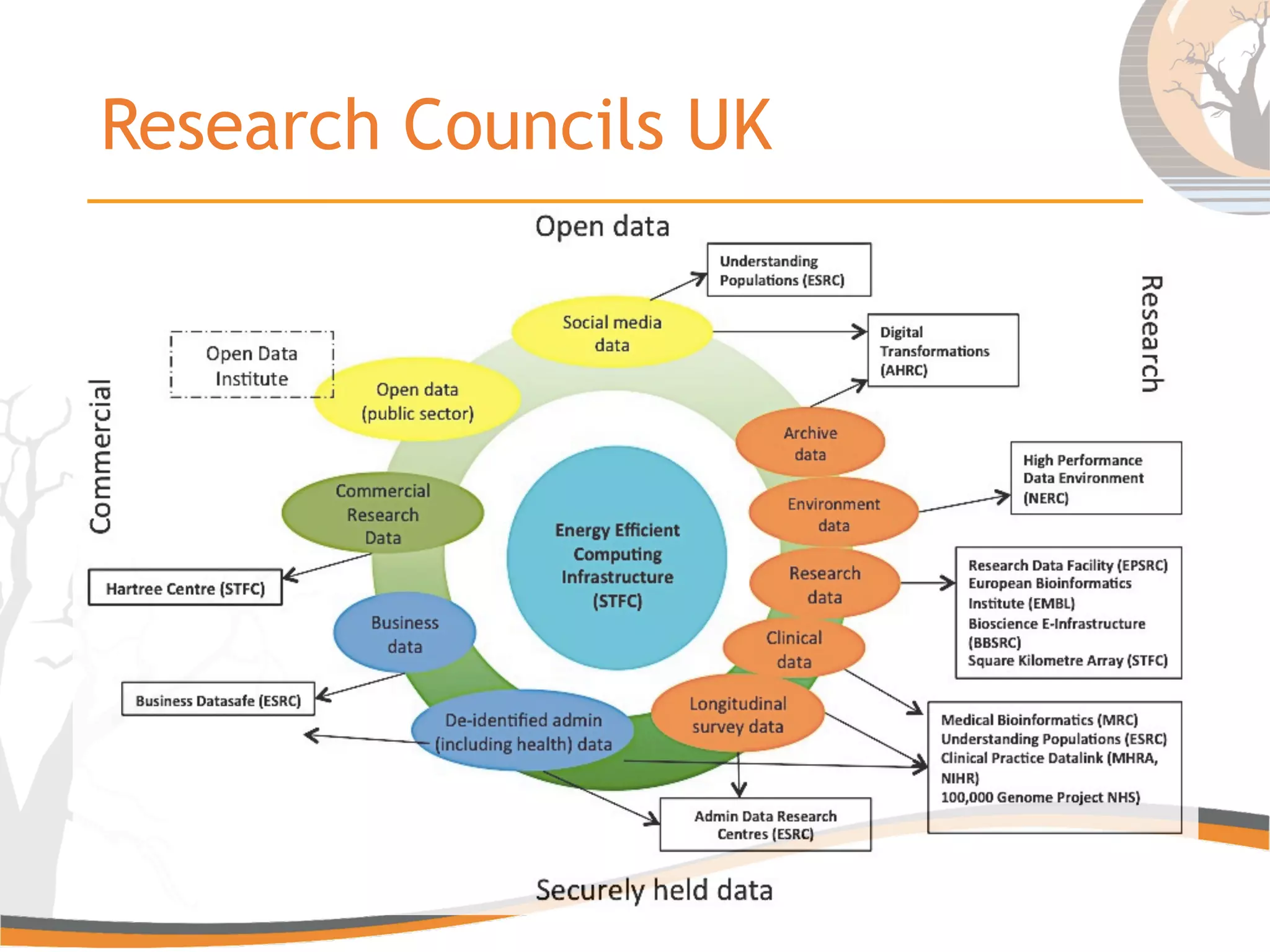
Research Councils UK
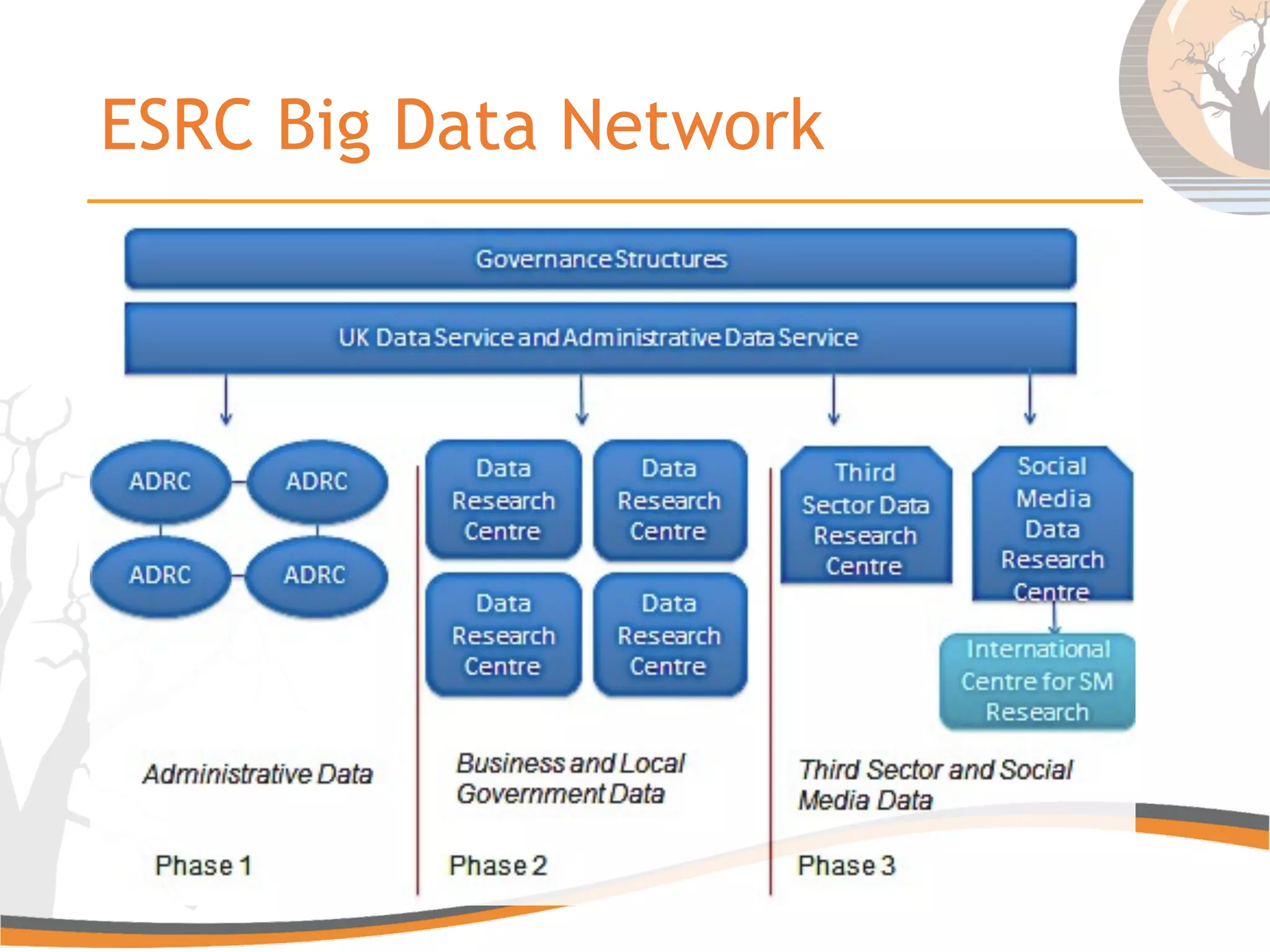
ESRC Big Data Network
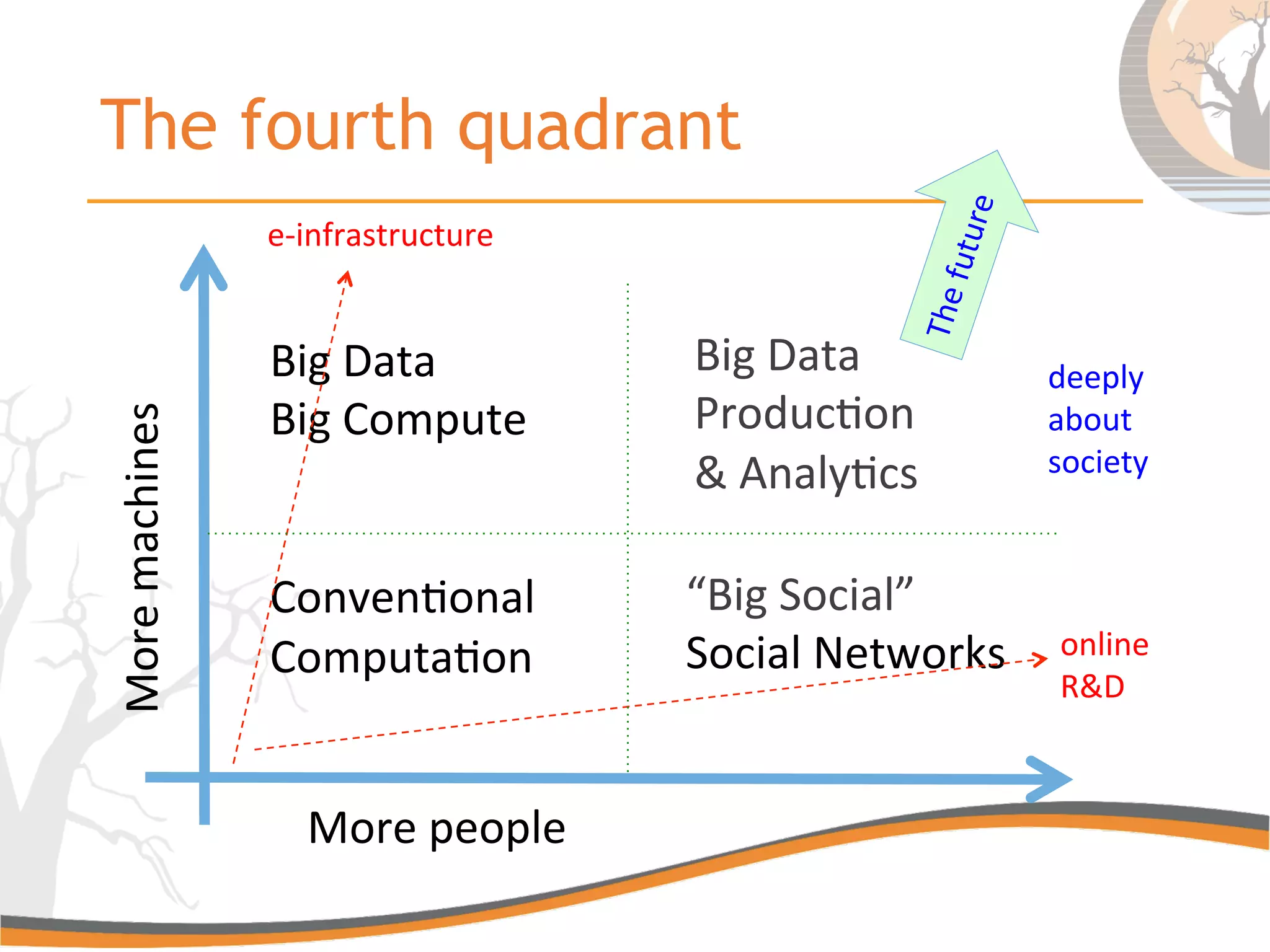
The fourth quadrant
More	
  people	
  
More	
  machines	
  
Big	
  Data	
  
Big	
  Compute	


Conven6onal	
  	
  
Computa6on	


“Big	
  Social”	
  
Social	
  Networks	
  
e-­‐infrastructure	
  
online	
  
R&D	
  
Big	
  Data	
  
Produc6on	
  
&	
  Analy6cs	
  
deeply	
  
about	
  
society	
  
The	
  future	
  
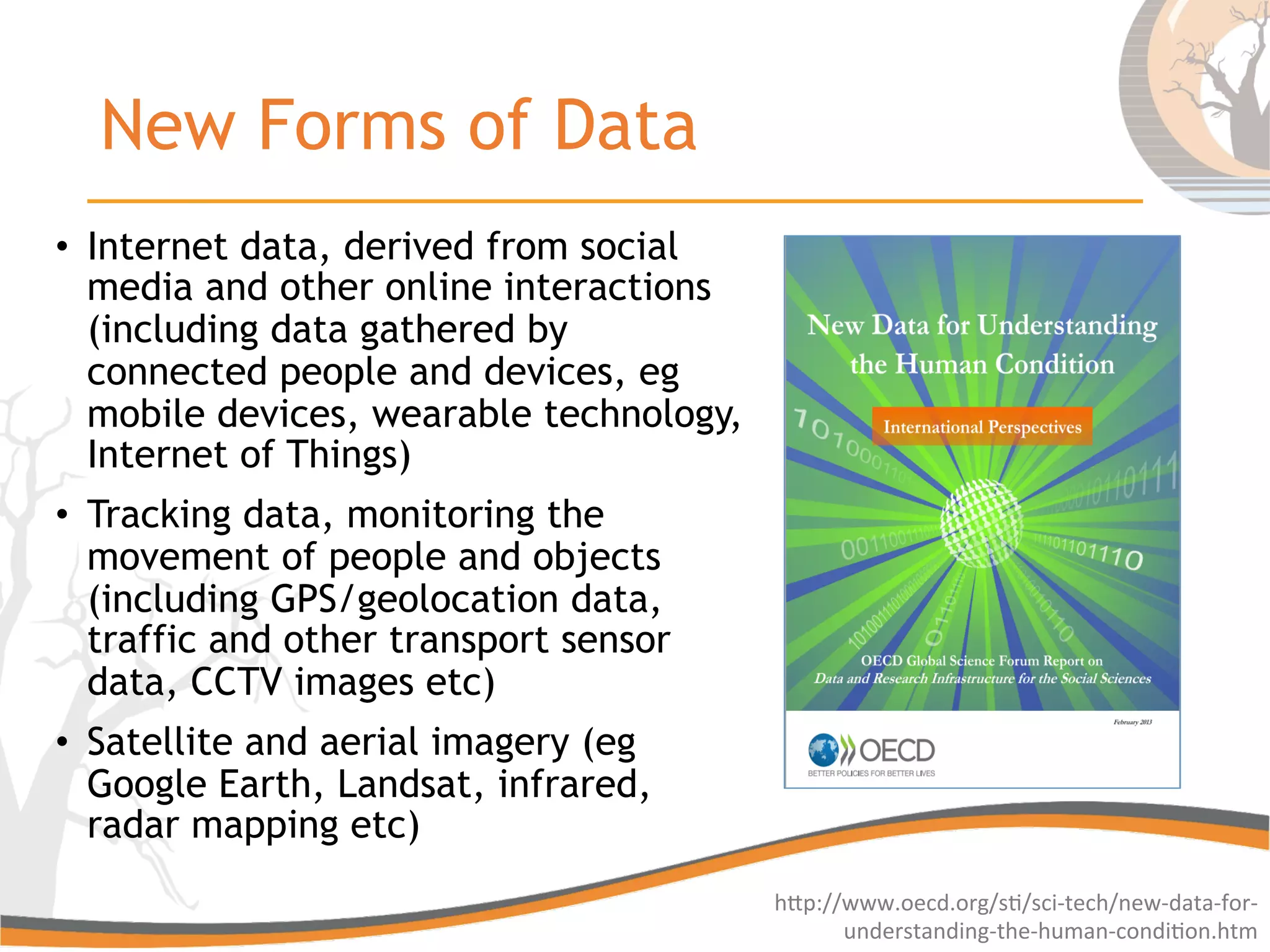
New Forms of Data
•  Internet data, derived from social
media and other online interactions
(including data gathered by
connected people and devices, eg
mobile devices, wearable technology,
Internet of Things)
•  Tracking data, monitoring the
movement of people and objects
(including GPS/geolocation data,
traffic and other transport sensor
data, CCTV images etc)
•  Satellite and aerial imagery (eg
Google Earth, Landsat, infrared,
radar mapping etc)
hGp://www.oecd.org/s6/sci-­‐tech/new-­‐data-­‐for-­‐
understanding-­‐the-­‐human-­‐condi6on.htm	
  
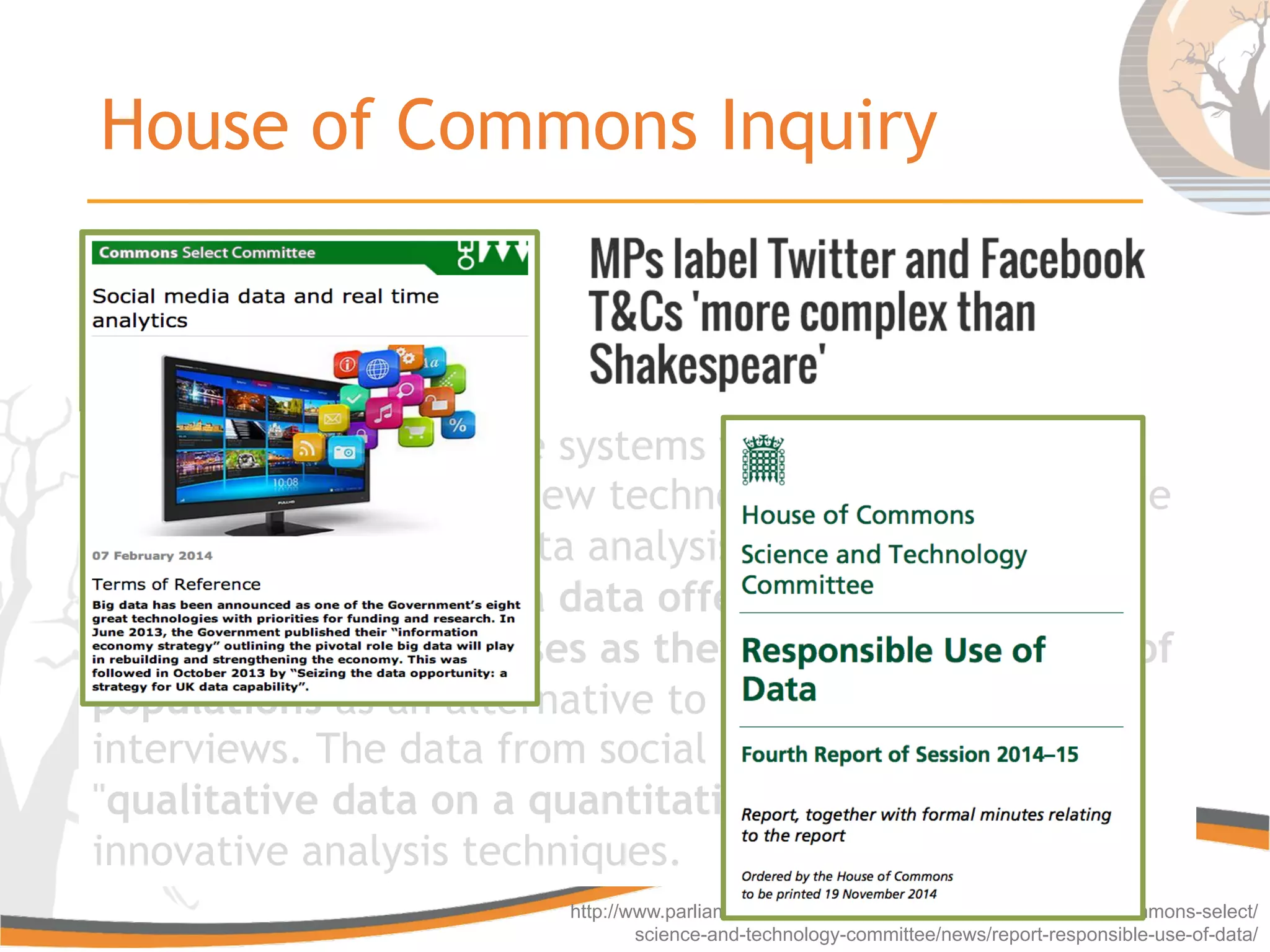
House of Commons Inquiry
http://www.parliament.uk/business/committees/committees-a-z/commons-select/
science-and-technology-committee/news/report-responsible-use-of-data/
Traditional data storage systems were not designed for
real-time analysis but new technologies can now provide
live information and data analysis can accomplished in
real-time. Social media data offers the possibility of
studying social processes as they unfold at the level of
populations as an alternative to traditional surveys or
interviews. The data from social media is described as
"qualitative data on a quantitative scale" and requires
innovative analysis techniques.
Traditional data storage systems were not designed for
real-time analysis but new technologies can now provide
live information and data analysis can accomplished in
real-time. Social media data offers the possibility of
studying social processes as they unfold at the level of
populations as an alternative to traditional surveys or
interviews. The data from social media is described as
"qualitative data on a quantitative scale" and requires
innovative analysis techniques.
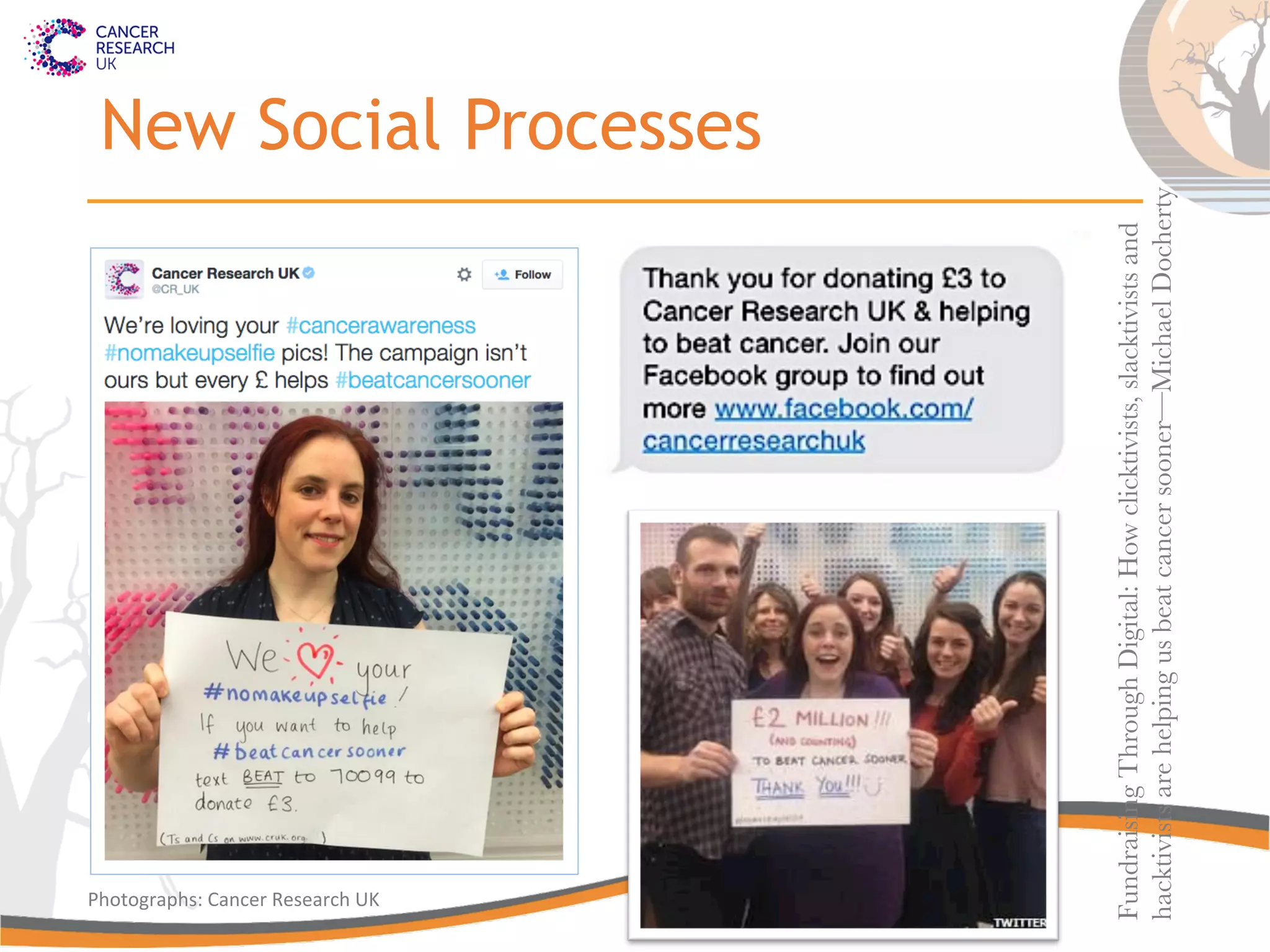
New Social Processes
FundraisingThroughDigital:Howclicktivists,slacktivistsand
hacktivistsarehelpingusbeatcancersooner—MichaelDocherty
Photographs:	
  Cancer	
  Research	
  UK	
  
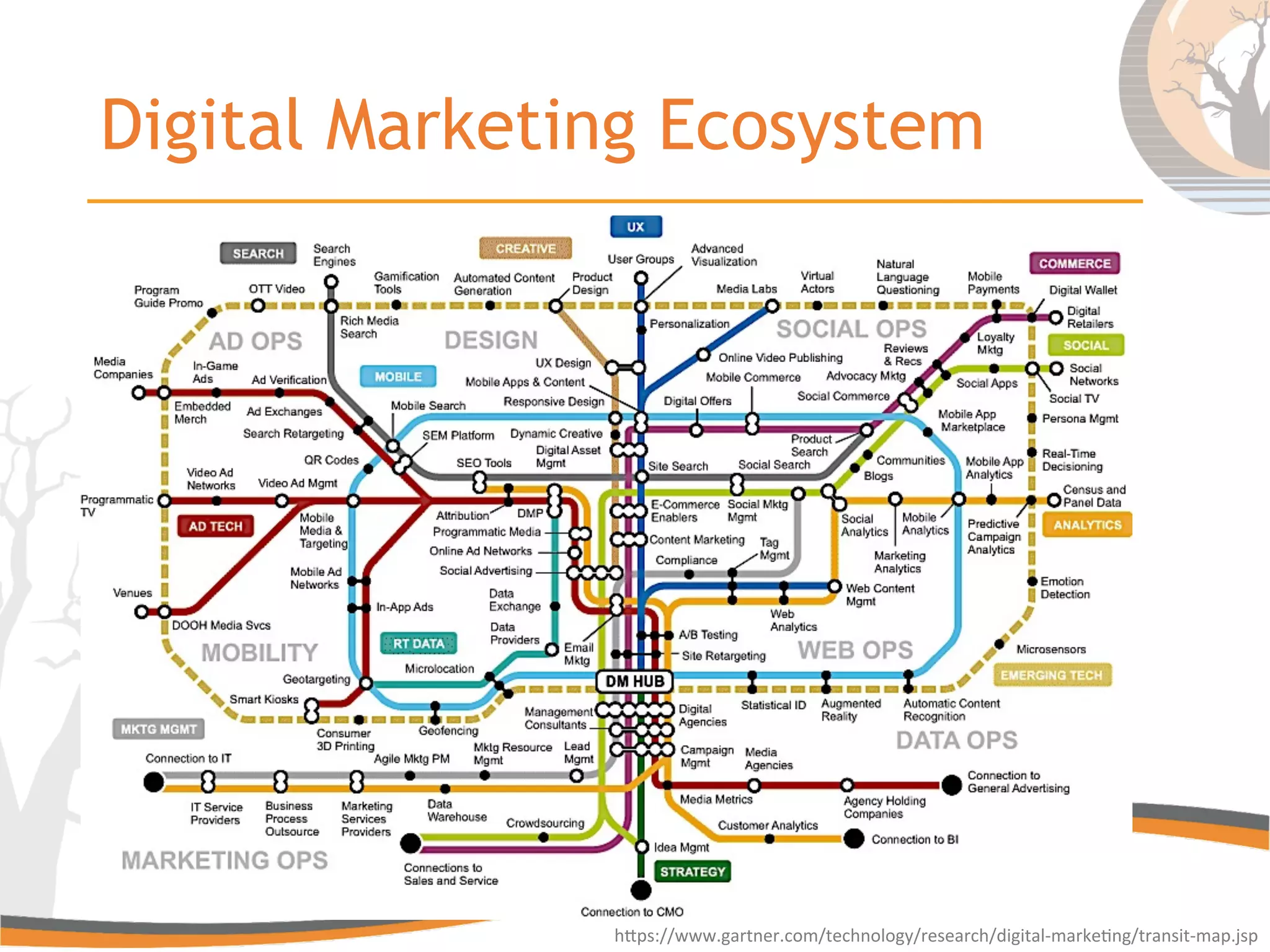
Digital Marketing Ecosystem
hGps://www.gartner.com/technology/research/digital-­‐marke6ng/transit-­‐map.jsp	
  
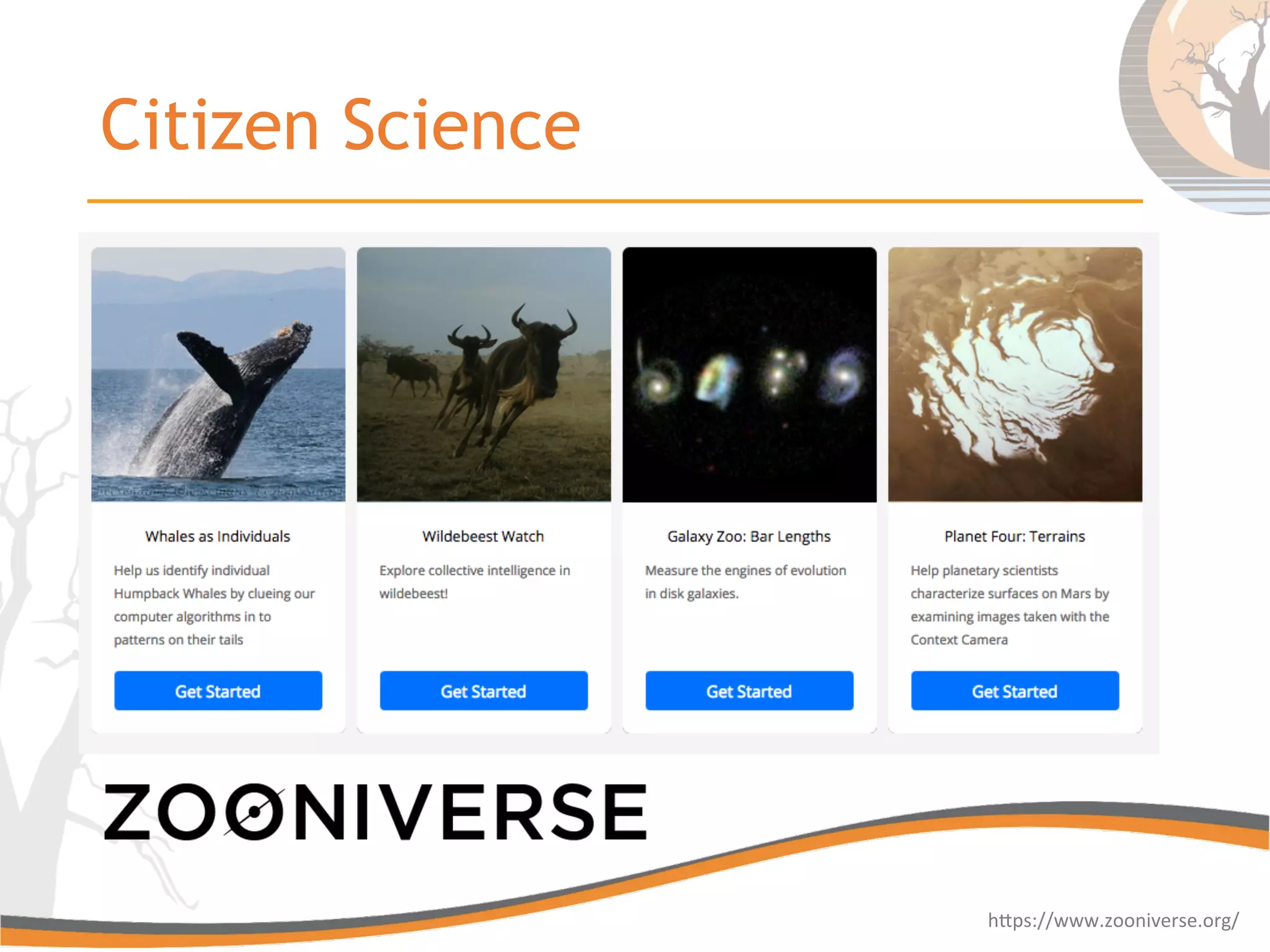
Citizen Science
hGps://www.zooniverse.org/	
  
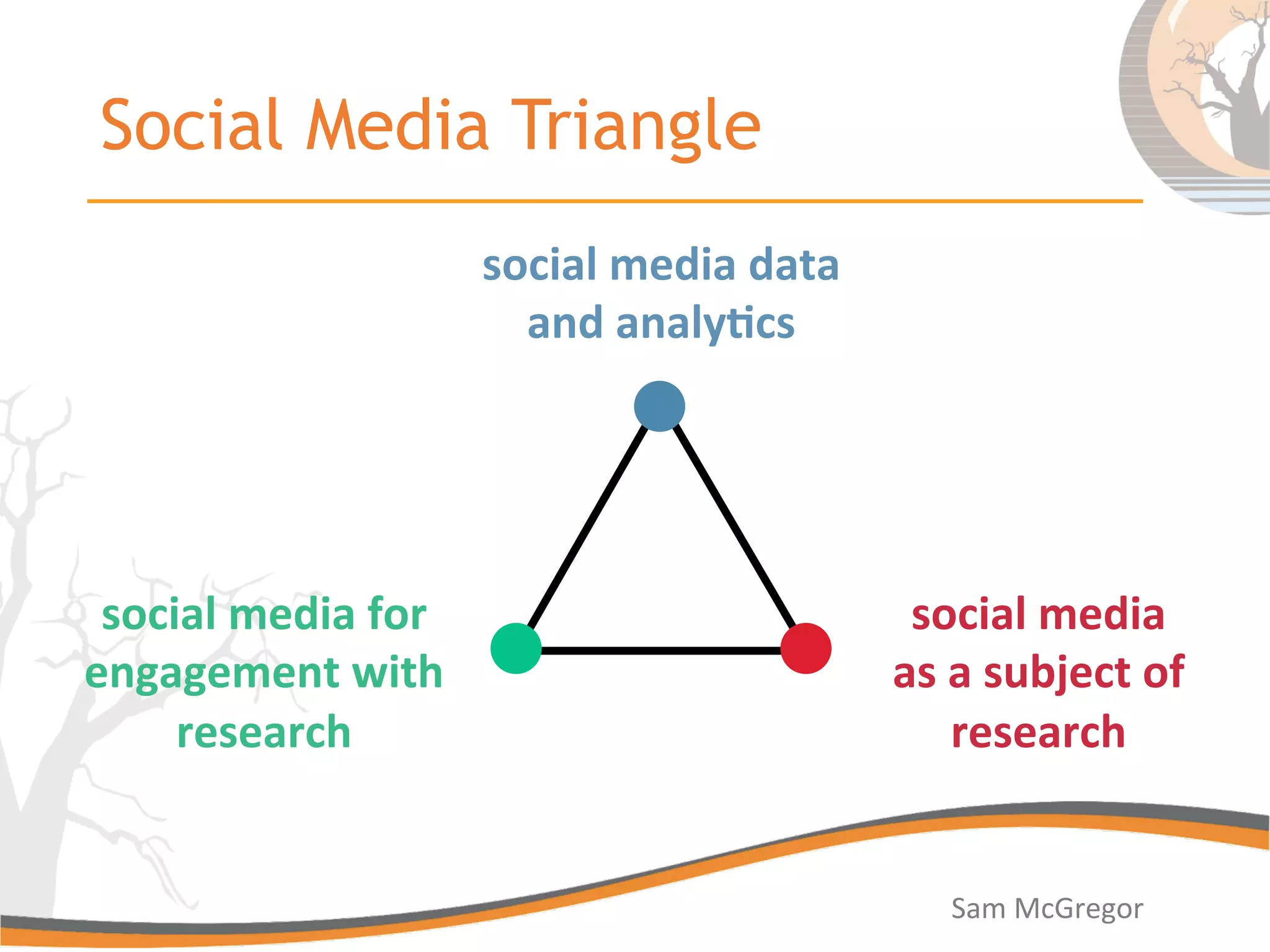
Social Media Triangle
social	
  media	
  data	
  
and	
  analy.cs	
  
social	
  media	
  for	
  
engagement	
  with	
  
research	
  
social	
  media	
  	
  
as	
  a	
  subject	
  of	
  
research	
  
Sam	
  McGregor	
  
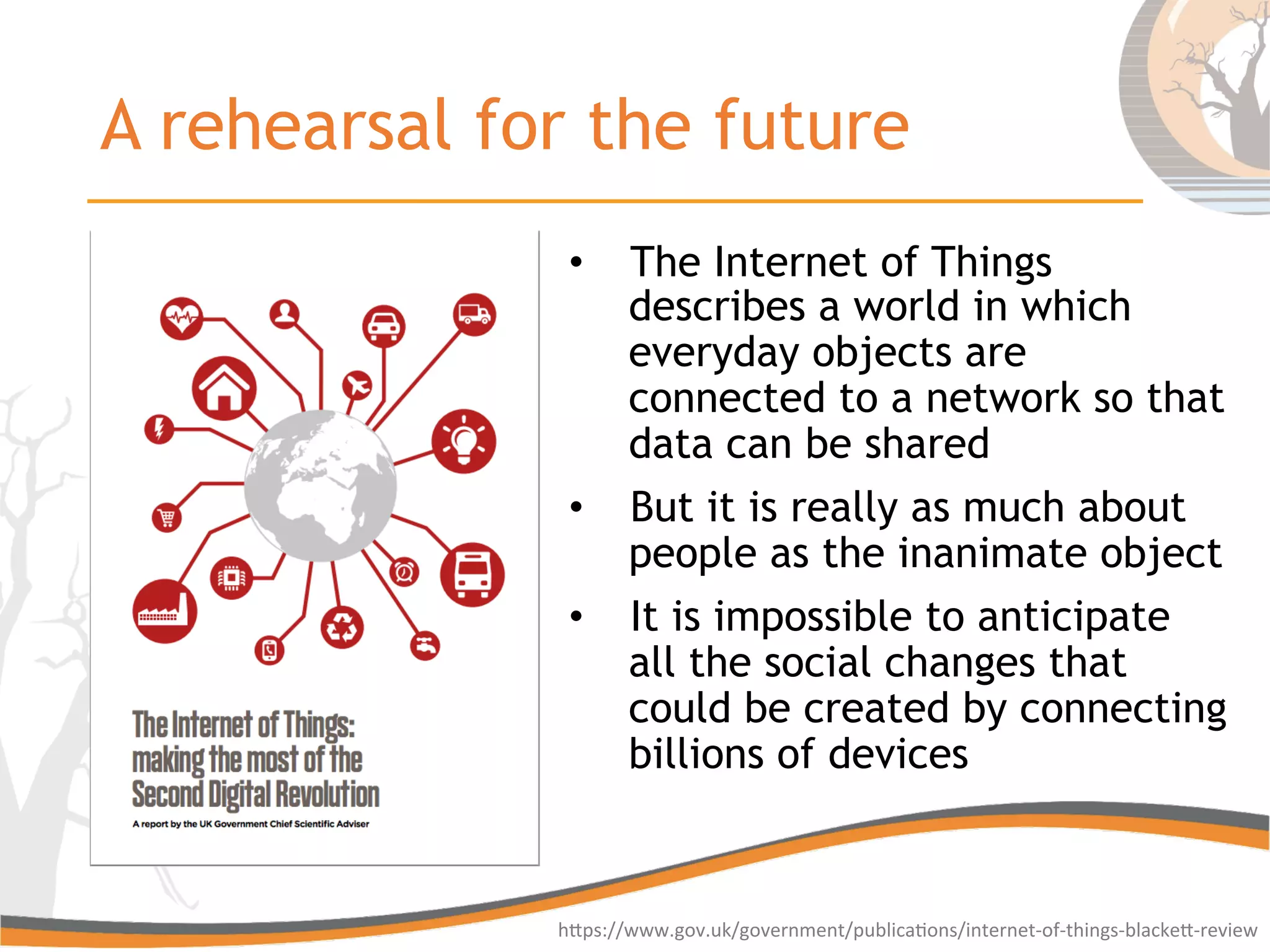
A rehearsal for the future
•  The Internet of Things
describes a world in which
everyday objects are
connected to a network so that
data can be shared
•  But it is really as much about
people as the inanimate object
•  It is impossible to anticipate
all the social changes that
could be created by connecting
billions of devices
hGps://www.gov.uk/government/publica6ons/internet-­‐of-­‐things-­‐blackeG-­‐review	
  
New Forms of Data CDT
New UK Centres for Doctoral Training in New Forms
of Data and in Biosocial Research
Much of the value of ‘new forms of data’ lie in the
potential for them to be analysed in near real-time,
which presents opportunities for revealing phenomena
as they unfold, enabling timely response with
immediate influence.
Such analysis brings distinct new computational
requirements, requires new skills, and makes new
demands on the ease of use and capability of the
national e-Infrastructure.
hGp://www.esrc.ac.uk/funding-­‐and-­‐guidance/postgraduates/dtc/dtc-­‐
policy/commissioning-­‐of-­‐centres-­‐for-­‐doctoral-­‐training.aspx	
  
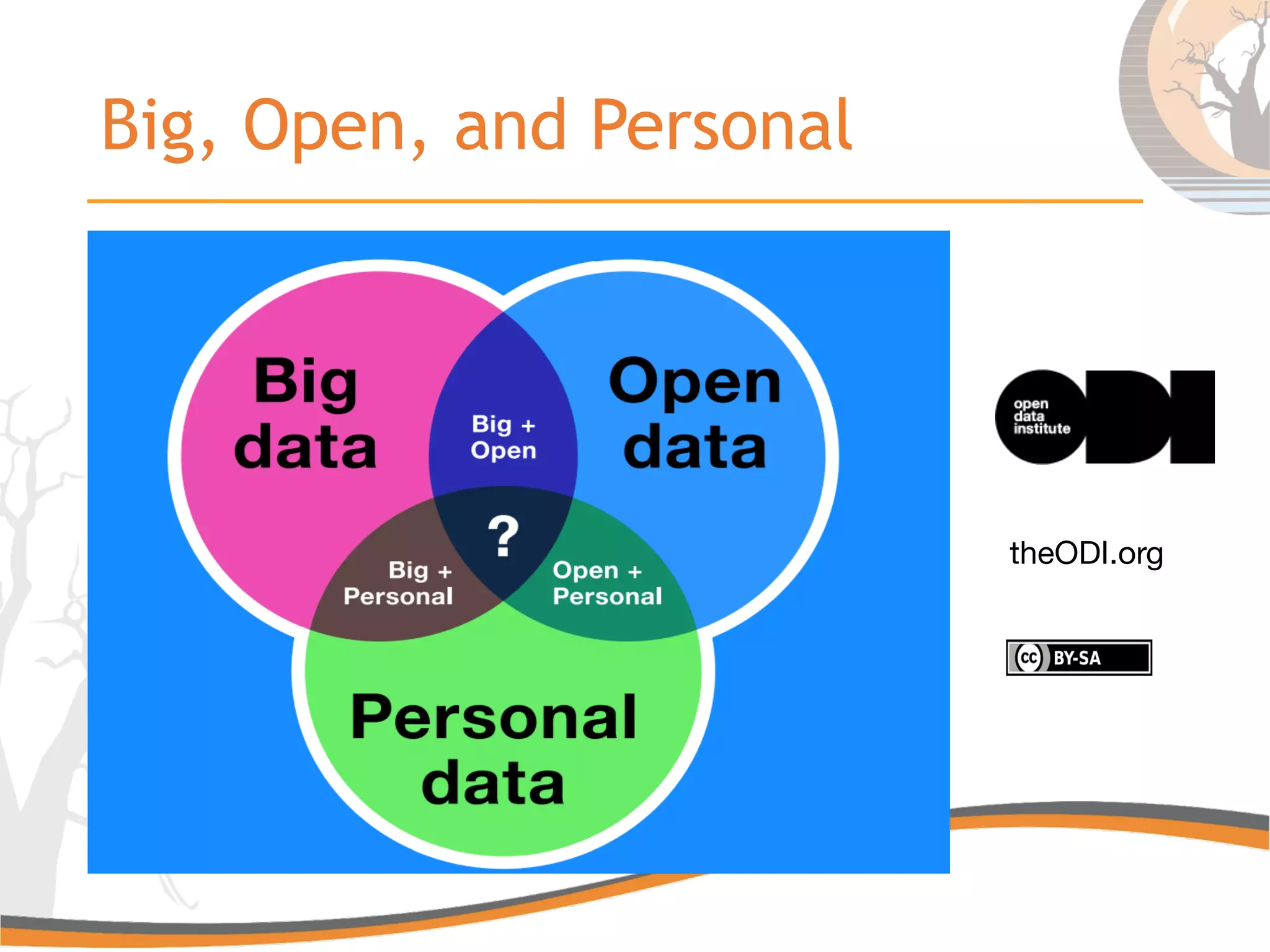
Big, Open, and Personal
theODI.org
Social Machines
Real life is and must be full of all kinds of social
constraint – the very processes from which society
arises. Computers can help if we use them to create
abstract social machines on the Web: processes in
which the people do the creative work and the machine
does the administration... The stage is set for an
evolutionary growth of new social engines. The ability
to create new forms of social process would be given to
the world at large, and development would be rapid.
Berners-Lee, Weaving the Web,
1999 (pp. 172–175)
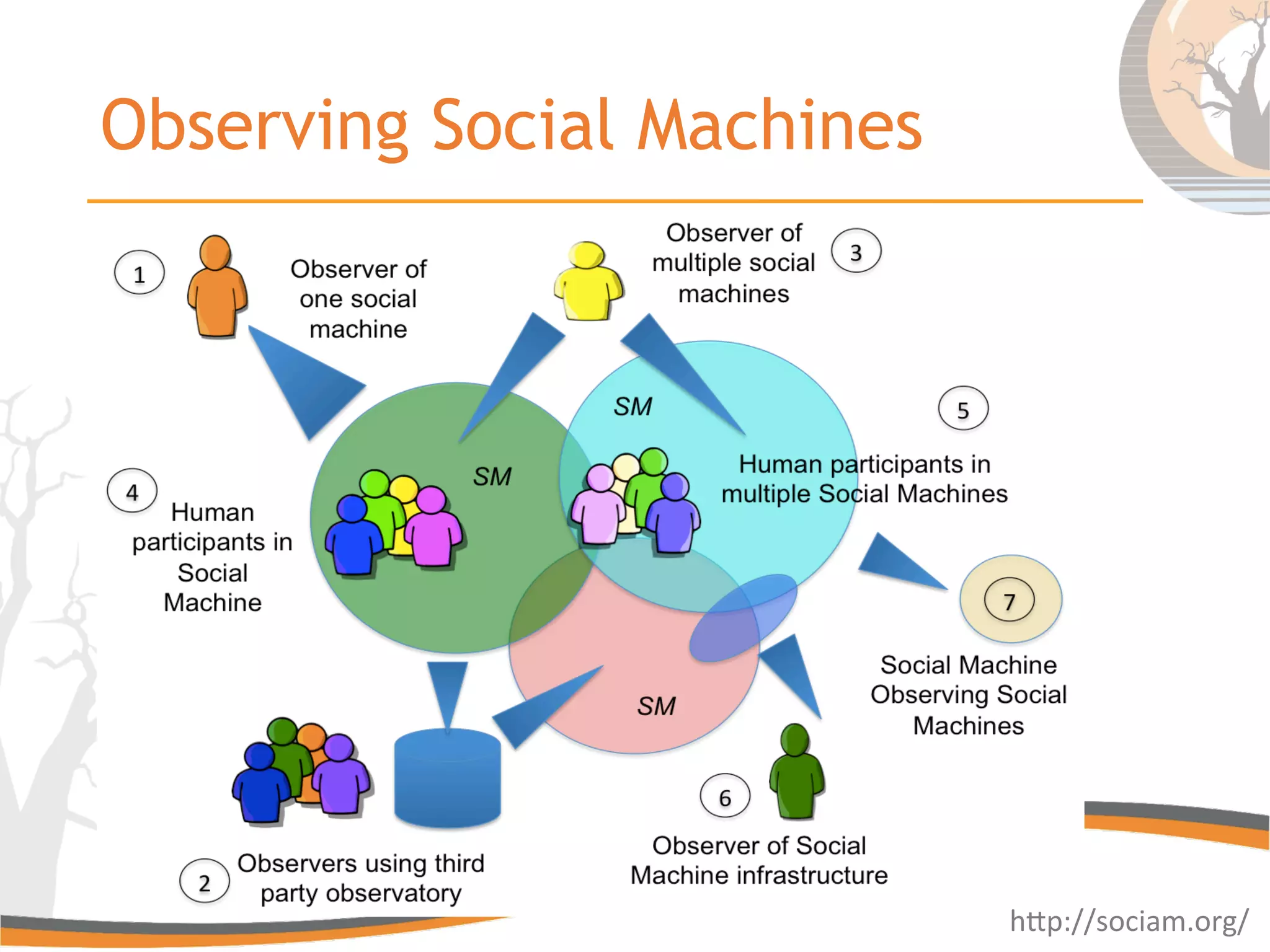
Observing Social Machines
hGp://sociam.org/	
  
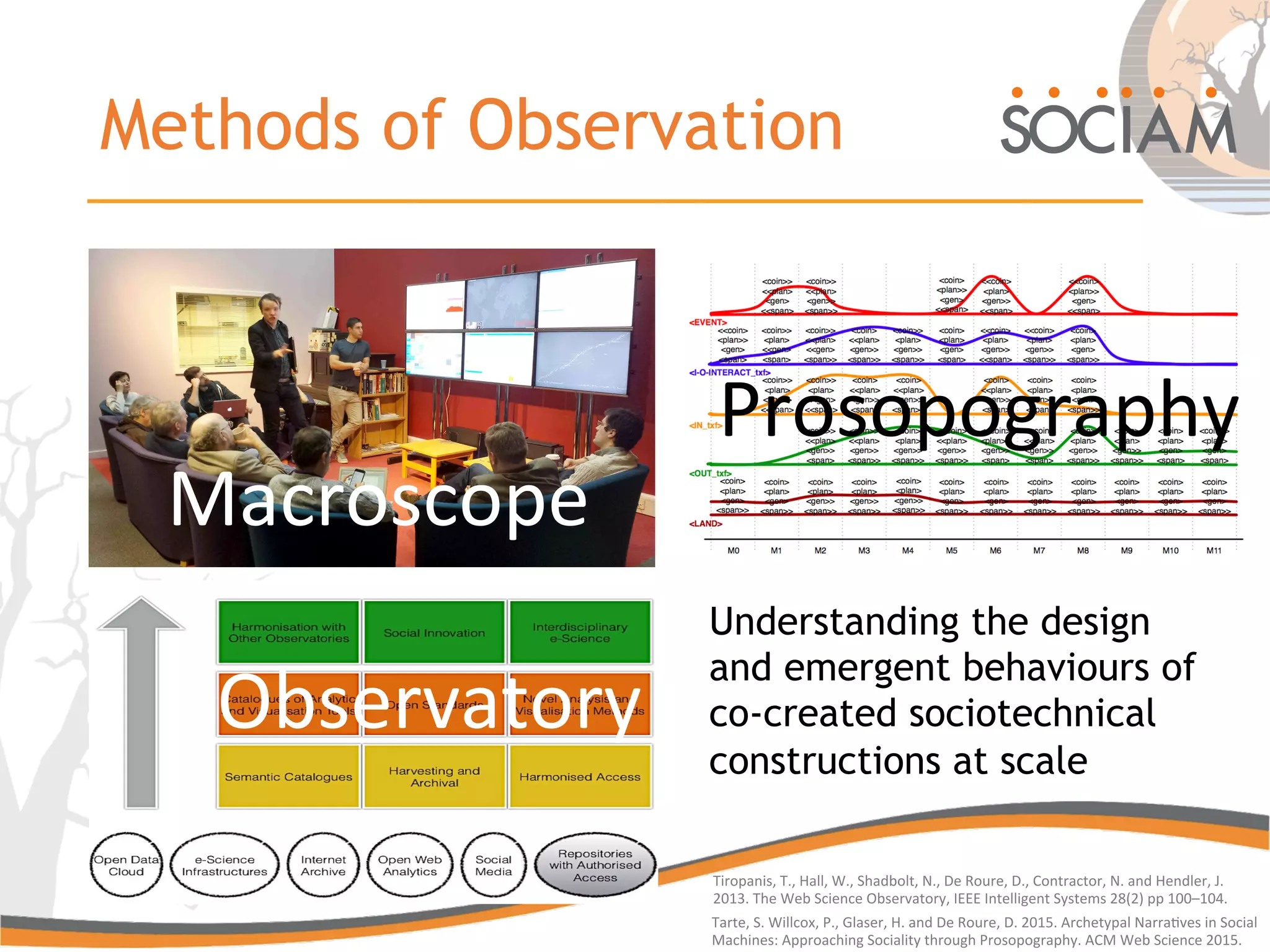
Methods of Observation
Tarte,	
  S.	
  Willcox,	
  P.,	
  Glaser,	
  H.	
  and	
  De	
  Roure,	
  D.	
  2015.	
  Archetypal	
  Narra6ves	
  in	
  Social	
  
Machines:	
  Approaching	
  Sociality	
  through	
  Prosopography.	
  ACM	
  Web	
  Science	
  2015.	
  
Tiropanis,	
  T.,	
  Hall,	
  W.,	
  Shadbolt,	
  N.,	
  De	
  Roure,	
  D.,	
  Contractor,	
  N.	
  and	
  Hendler,	
  J.	
  
2013.	
  The	
  Web	
  Science	
  Observatory,	
  IEEE	
  Intelligent	
  Systems	
  28(2)	
  pp	
  100–104.	
  	
  
Understanding the design
and emergent behaviours of
co-created sociotechnical
constructions at scale
Macroscope	
  
Observatory	
  
Prosopography	
  
Summary
New forms of data enable us to:
•  Observe social processes in new ways
•  Study new social processes, e.g. social media
•  Design new social processes, e.g. for citizen
engagement at scale
There are considerations of ethics and responsible
innovation in each
This is all a rehearsal for living in the Internet of
Things
Thank You
Thanks to Fiona Armstrong, Peter Elias, Wendy Hall,
Chris Lintott, Sam McGregor, Nigel Shadbolt, Ségolène
Tarte, Ramine Tinati, Thanassis Tiropanis, Max Van
Cleek, and Pip Willcox
Contact david.deroure@oerc.ox.ac.uk

Big Data Challenges for the Social Sciences

  • 1.
    What’s happening inthe world of big data and the social sciences David De Roure, University of Oxford @dder
  • 2.
  • 3.
  • 4.
    The fourth quadrant More  people   More  machines   Big  Data   Big  Compute       Conven6onal     Computa6on               “Big  Social”   Social  Networks   e-­‐infrastructure   online   R&D   Big  Data   Produc6on   &  Analy6cs   deeply   about   society   The  future  
  • 5.
    New Forms ofData •  Internet data, derived from social media and other online interactions (including data gathered by connected people and devices, eg mobile devices, wearable technology, Internet of Things) •  Tracking data, monitoring the movement of people and objects (including GPS/geolocation data, traffic and other transport sensor data, CCTV images etc) •  Satellite and aerial imagery (eg Google Earth, Landsat, infrared, radar mapping etc) hGp://www.oecd.org/s6/sci-­‐tech/new-­‐data-­‐for-­‐ understanding-­‐the-­‐human-­‐condi6on.htm  
  • 6.
    House of CommonsInquiry http://www.parliament.uk/business/committees/committees-a-z/commons-select/ science-and-technology-committee/news/report-responsible-use-of-data/ Traditional data storage systems were not designed for real-time analysis but new technologies can now provide live information and data analysis can accomplished in real-time. Social media data offers the possibility of studying social processes as they unfold at the level of populations as an alternative to traditional surveys or interviews. The data from social media is described as "qualitative data on a quantitative scale" and requires innovative analysis techniques. Traditional data storage systems were not designed for real-time analysis but new technologies can now provide live information and data analysis can accomplished in real-time. Social media data offers the possibility of studying social processes as they unfold at the level of populations as an alternative to traditional surveys or interviews. The data from social media is described as "qualitative data on a quantitative scale" and requires innovative analysis techniques.
  • 7.
  • 8.
  • 9.
  • 10.
    Social Media Triangle social  media  data   and  analy.cs   social  media  for   engagement  with   research   social  media     as  a  subject  of   research   Sam  McGregor  
  • 11.
    A rehearsal forthe future •  The Internet of Things describes a world in which everyday objects are connected to a network so that data can be shared •  But it is really as much about people as the inanimate object •  It is impossible to anticipate all the social changes that could be created by connecting billions of devices hGps://www.gov.uk/government/publica6ons/internet-­‐of-­‐things-­‐blackeG-­‐review  
  • 12.
    New Forms ofData CDT New UK Centres for Doctoral Training in New Forms of Data and in Biosocial Research Much of the value of ‘new forms of data’ lie in the potential for them to be analysed in near real-time, which presents opportunities for revealing phenomena as they unfold, enabling timely response with immediate influence. Such analysis brings distinct new computational requirements, requires new skills, and makes new demands on the ease of use and capability of the national e-Infrastructure. hGp://www.esrc.ac.uk/funding-­‐and-­‐guidance/postgraduates/dtc/dtc-­‐ policy/commissioning-­‐of-­‐centres-­‐for-­‐doctoral-­‐training.aspx  
  • 13.
    Big, Open, andPersonal theODI.org
  • 14.
    Social Machines Real lifeis and must be full of all kinds of social constraint – the very processes from which society arises. Computers can help if we use them to create abstract social machines on the Web: processes in which the people do the creative work and the machine does the administration... The stage is set for an evolutionary growth of new social engines. The ability to create new forms of social process would be given to the world at large, and development would be rapid. Berners-Lee, Weaving the Web, 1999 (pp. 172–175)
  • 15.
  • 16.
    Methods of Observation Tarte,  S.  Willcox,  P.,  Glaser,  H.  and  De  Roure,  D.  2015.  Archetypal  Narra6ves  in  Social   Machines:  Approaching  Sociality  through  Prosopography.  ACM  Web  Science  2015.   Tiropanis,  T.,  Hall,  W.,  Shadbolt,  N.,  De  Roure,  D.,  Contractor,  N.  and  Hendler,  J.   2013.  The  Web  Science  Observatory,  IEEE  Intelligent  Systems  28(2)  pp  100–104.     Understanding the design and emergent behaviours of co-created sociotechnical constructions at scale Macroscope   Observatory   Prosopography  
  • 17.
    Summary New forms ofdata enable us to: •  Observe social processes in new ways •  Study new social processes, e.g. social media •  Design new social processes, e.g. for citizen engagement at scale There are considerations of ethics and responsible innovation in each This is all a rehearsal for living in the Internet of Things
  • 18.
    Thank You Thanks toFiona Armstrong, Peter Elias, Wendy Hall, Chris Lintott, Sam McGregor, Nigel Shadbolt, Ségolène Tarte, Ramine Tinati, Thanassis Tiropanis, Max Van Cleek, and Pip Willcox Contact david.deroure@oerc.ox.ac.uk