Dr Tracey P. Lauriault
Communication and Media Studies
School of Journalism and
Communication
Tracey.Lauriault@carleton.ca
@TraceyLauriault
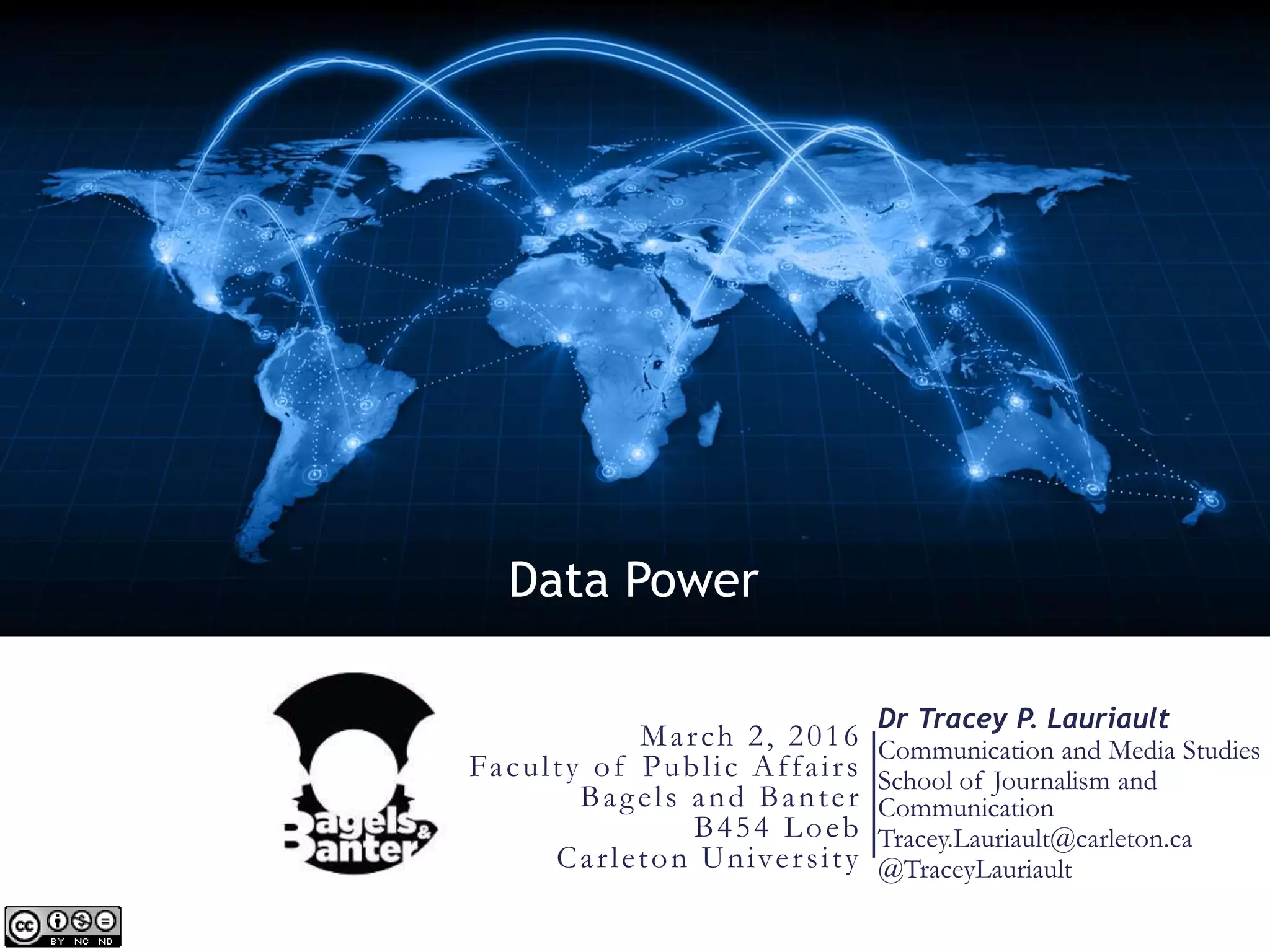
Data Power
March 2, 2016
Faculty of Public Affairs
Bagels and Banter
B454 Loeb
Carleton University
, 24 APRIL 2015
Data Power
Dr Tracey P. Lauriault, Communication and Media Studies, Carleton University
TOC
1. Data and Every Day Life
2. Data Power
3. Critical Questions
Dr Tracey P. Lauriault, Communication and Media Studies, Carleton University
DATA AND EVERYDAY LIFE
Dr Tracey P. Lauriault, Communication and Media Studies, Carleton University
Are more than the unique arrangement of objective and
politically neutral facts
&
they do not exist independently of ideas, techniques,
technologies, systems, people and contexts regardless of
them being presented in that way
DATA – BIG OR SMALL
Tracey P. Lauriault, 2012, Data, Infrastructures and Geographical
Imaginations. Ph.D. Thesis, Carleton University, Ottawa,
http://curve.carleton.ca/theses/27431
Dr Tracey P. Lauriault, Communication and Media Studies, Carleton University
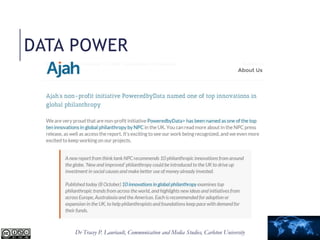
DATA POWER
Cover Popular Science
Dr Tracey P. Lauriault, Communication and Media Studies, Carleton University
RESEARCH & DEVELOPMENT
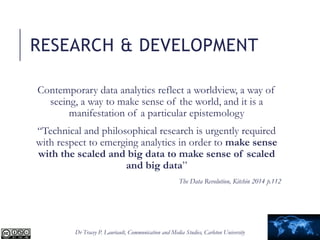
Contemporary data analytics reflect a worldview, a way of
seeing, a way to make sense of the world, and it is a
manifestation of a particular epistemology
“Technical and philosophical research is urgently required
with respect to emerging analytics in order to make sense
with the scaled and big data to make sense of scaled
and big data”
The Data Revolution, Kitchin 2014 p.112
Dr Tracey P. Lauriault, Communication and Media Studies, Carleton University
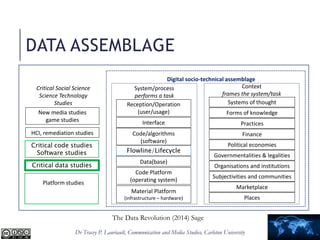
DATA ASSEMBLAGE
Material Platform
(infrastructure – hardware)
Code Platform
(operating system)
Code/algorithms
(software)
Data(base)
Interface
Reception/Operation
(user/usage)
Systems of thought
Forms of knowledge
Finance
Political economies
Governmentalities & legalities
Organisations and institutions
Subjectivities and communities
Marketplace
System/process
performs a task
Context
frames the system/task
Digital socio-technical assemblage
HCI, remediation studies
Critical code studies
Software studies
Critical data studies
New media studies
game studies
Critical Social Science
Science Technology
Studies
Platform studies
Places
Practices
Flowline/Lifecycle
The Data Revolution (2014) Sage
Dr Tracey P. Lauriault, Communication and Media Studies, Carleton University
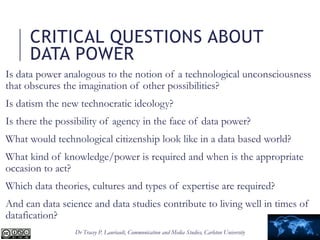
CRITICAL QUESTIONS ABOUT
DATA POWER
Is data power analogous to the notion of a technological unconsciousness
that obscures the imagination of other possibilities?
Is datism the new technocratic ideology?
Is there the possibility of agency in the face of data power?
What would technological citizenship look like in a data based world?
What kind of knowledge/power is required and when is the appropriate
occasion to act?
Which data theories, cultures and types of expertise are required?
And can data science and data studies contribute to living well in times of
datafication?
Dr Tracey P. Lauriault, Communication and Media Studies, Carleton University
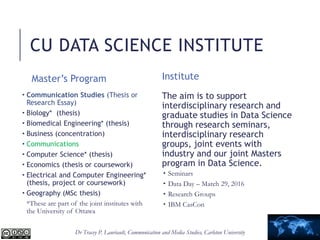
CU DATA SCIENCE INSTITUTE
Master’s Program
 Communication Studies (Thesis or
Research Essay)
 Biology* (thesis)
 Biomedical Engineering* (thesis)
 Business (concentration)
 Communications
 Computer Science* (thesis)
 Economics (thesis or coursework)
 Electrical and Computer Engineering*
(thesis, project or coursework)
 Geography (MSc thesis)
*These are part of the joint institutes with
the University of Ottawa
Institute
The aim is to support
interdisciplinary research and
graduate studies in Data Science
through research seminars,
interdisciplinary research
groups, joint events with
industry and our joint Masters
program in Data Science.
 Seminars
 Data Day – March 29, 2016
 Research Groups
 IBM CasCon

Data Power

  • 1.
    Dr Tracey P.Lauriault Communication and Media Studies School of Journalism and Communication Tracey.Lauriault@carleton.ca @TraceyLauriault Data Power March 2, 2016 Faculty of Public Affairs Bagels and Banter B454 Loeb Carleton University , 24 APRIL 2015 Data Power
  • 2.
    Dr Tracey P.Lauriault, Communication and Media Studies, Carleton University TOC 1. Data and Every Day Life 2. Data Power 3. Critical Questions
  • 3.
    Dr Tracey P.Lauriault, Communication and Media Studies, Carleton University DATA AND EVERYDAY LIFE
  • 4.
    Dr Tracey P.Lauriault, Communication and Media Studies, Carleton University Are more than the unique arrangement of objective and politically neutral facts & they do not exist independently of ideas, techniques, technologies, systems, people and contexts regardless of them being presented in that way DATA – BIG OR SMALL Tracey P. Lauriault, 2012, Data, Infrastructures and Geographical Imaginations. Ph.D. Thesis, Carleton University, Ottawa, http://curve.carleton.ca/theses/27431
  • 5.
    Dr Tracey P.Lauriault, Communication and Media Studies, Carleton University DATA POWER Cover Popular Science
  • 6.
    Dr Tracey P.Lauriault, Communication and Media Studies, Carleton University RESEARCH & DEVELOPMENT Contemporary data analytics reflect a worldview, a way of seeing, a way to make sense of the world, and it is a manifestation of a particular epistemology “Technical and philosophical research is urgently required with respect to emerging analytics in order to make sense with the scaled and big data to make sense of scaled and big data” The Data Revolution, Kitchin 2014 p.112
  • 7.
    Dr Tracey P.Lauriault, Communication and Media Studies, Carleton University DATA ASSEMBLAGE Material Platform (infrastructure – hardware) Code Platform (operating system) Code/algorithms (software) Data(base) Interface Reception/Operation (user/usage) Systems of thought Forms of knowledge Finance Political economies Governmentalities & legalities Organisations and institutions Subjectivities and communities Marketplace System/process performs a task Context frames the system/task Digital socio-technical assemblage HCI, remediation studies Critical code studies Software studies Critical data studies New media studies game studies Critical Social Science Science Technology Studies Platform studies Places Practices Flowline/Lifecycle The Data Revolution (2014) Sage
  • 8.
    Dr Tracey P.Lauriault, Communication and Media Studies, Carleton University CRITICAL QUESTIONS ABOUT DATA POWER Is data power analogous to the notion of a technological unconsciousness that obscures the imagination of other possibilities? Is datism the new technocratic ideology? Is there the possibility of agency in the face of data power? What would technological citizenship look like in a data based world? What kind of knowledge/power is required and when is the appropriate occasion to act? Which data theories, cultures and types of expertise are required? And can data science and data studies contribute to living well in times of datafication?
  • 9.
    Dr Tracey P.Lauriault, Communication and Media Studies, Carleton University CU DATA SCIENCE INSTITUTE Master’s Program  Communication Studies (Thesis or Research Essay)  Biology* (thesis)  Biomedical Engineering* (thesis)  Business (concentration)  Communications  Computer Science* (thesis)  Economics (thesis or coursework)  Electrical and Computer Engineering* (thesis, project or coursework)  Geography (MSc thesis) *These are part of the joint institutes with the University of Ottawa Institute The aim is to support interdisciplinary research and graduate studies in Data Science through research seminars, interdisciplinary research groups, joint events with industry and our joint Masters program in Data Science.  Seminars  Data Day – March 29, 2016  Research Groups  IBM CasCon

Editor's Notes

  • #6 Data power is ubiquitous, intangible and normalized. Data infrastructures, are invisible, systemic, and the substrate of society. Predictive policing Credit Score Image sources in order: Data is power: http://www.popsci.com/technology/article/2011-10/data-power Hitachi: http://www.channelworld.in/media-releases/hitachi-data-systems-unveils-advancements-in-predictive-policing Minority Report: http://lettherebemovies.com/2014/08/30/review-elliott-minority-report/ Person of Interest: http://personofinterest.wikia.com/wiki/Samaritan http://www.predpol.com/ Predictive Policing Manchester: https://www.ironsidegroup.com/2015/10/06/ironside-case-study-manchester-pds-predictive-policing-success/ Ferguson Paramilitary Police: http://www.salon.com/2014/08/18/more_fergusons_are_coming_why_para_military_hysteria_is_dooming_america/ Credit Score: http://illinoisbankruptcyattorney.cc/what-is-a-good-credit-score/ Credit Score email: https://blog.creditkarma.com/wp-content/October-infographic-copy.png Credit Score Dating: http://creditscoredating.com/ Student Loans Ontario: https://osap.gov.on.ca/OSAPPortal/en/PlanYourEducation/ChooseaCareerSchoolProgram/PRDR012287.html Data for Good: https://realimpactanalytics.com/en/data-for-good Philanthropy: http://ajah.ca/
  • #8 Co-functioning heterogeneous elements of a large complex socio-technological system – these elements are loosely coupled.
  • #10 Carleton’s new collaborative master’s in this area is geared toward graduate students and high-tech professionals who are interested in understanding how to analyze and use ‘big data’ sets collected by governments, industry, NGOs etc. Next year it will include Communication Studies and the shared course will be Critical Data Studies will be the anchor course DATA 5000 [0.5] DATA SCIENCE SEMINAR Cloud based distributed systems, statistics, machine learning, use of complex ecosystems of tools and platforms, and communication skills to explain advanced analytics. Students choose a project in Big Data management and/or analysis, deliver a paper and give a class presentation on their findings. 0.5 credit in COMM 5XXX [0.5] Critical Data Studies COMM 5101 [1.0] FOUNDATIONS OF COMMUNICATION STUDIES COMM 5605 [0.5] APPROACHES TO COMMUNICATION RESEARCH COMM 5908 [1.0] RESEARCH ESSAY on a Data Science Issue or Topic Students will earn their degree in one of six academic disciplines at Carleton with a specialization in Data Science or a concentration in Business Analytics for the MBA. Participants will pursue a thesis, coursework-only or project option that is directly related to Data Science, as per their original degree. Business students are also required to complete an internship. Depending on availability, students in other fields may also gain real-world experience through internships.