Redistricting
– A US Perspective
Micah Altman
Director of Research
MIT Libraries
Prepared for
International Seminar on Electoral
Districting
National Electoral Institute
Mexico City, Mexico
May 2018
Disclaimers
These opinions are our own, they are not the opinions of our
institutions, of any of the project funders, nor (with the exception of
co-authored previously published work) my collaborators.
Secondary disclaimer:
“It’s tough to make predictions, especially about the future!”
-- Attributed to Woody Allen, Yogi Berra, Niels Bohr, Vint Cerf, Winston Churchill, Confucius, Disreali [sic], Freeman Dyson, Cecil
B. Demille, Albert Einstein, Enrico Fermi, Edgar R. Fiedler, Bob Fourer, Sam Goldwyn, Allan Lamport, Groucho Marx, Dan Quayle,
George Bernard Shaw, Casey Stengel, Will Rogers, M. Taub, Mark Twain, Kerr L. White, etc.
2
Collaborators, Co-conspirators, and Supporters
Michael P. McDonald, Eric Magar, Allejandro Trelles
We thank the Sloan Foundation for research support.
3
4
This Talk
Process
Problems
Consequences
Process
5
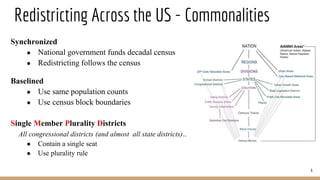
Redistricting Across the US - Commonalities
6
Synchronized
● National government funds decadal census
● Redistricting follows the census
Baselined
● Use same population counts
● Use census block boundaries
Single Member Plurality Districts
All congressional districts (and almost all state districts)…
● Contain a single seat
● Use plurality rule
Common Redistricting Criteria
7
Population Constraints
● Seats for each state are proportional
to population
(however, each state elect two
Senators at-large)
● Within states, each district must have
equal population
● Population is measured with Census
total population
● Only minimal deviations are allowed
at national level
Permissible Goals
● Quality of representation
● Partisan advantage (but not too much)
● Incumbency protection (but not too
much)
Minority Representation Requirements
Majority-minority districts must be
created…
● When voting is polarized, and …
● Minority large enough to elect
candidate-of-choice and …
● …minority populations are compact
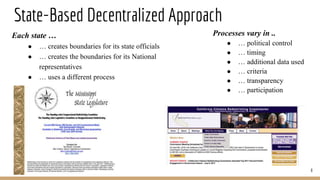
State-Based Decentralized Approach
8
Each state …
● … creates boundaries for its state officials
● … creates the boundaries for its National
representatives
● … uses a different process
Processes vary in ..
● … political control
● … timing
● … additional data used
● … criteria
● … transparency
● … participation
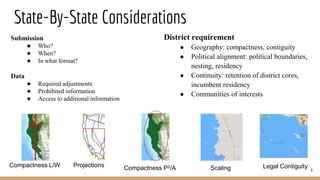
State-By-State Considerations
9
Compactness L/W Projections Compactness P2/A Scaling Legal Contiguity
Submission
● Who?
● When?
● In what format?
Data
● Required adjustments
● Prohibited information
● Access to additional information
District requirement
● Geography: compactness, contiguity
● Political alignment: political boundaries,
nesting, residency
● Continuity: retention of district cores,
incumbent residency
● Communities of interests
Challenges
10
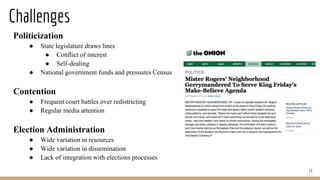
Challenges
11
Politicization
● State legislature draws lines
● Conflict of interest
● Self-dealing
● National government funds and pressures Census
Contention
● Frequent court battles over redistricting
● Regular media attention
Election Administration
● Wide variation in resources
● Wide variation in dissemination
● Lack of integration with elections processes
Consequences
12
Consequences
13
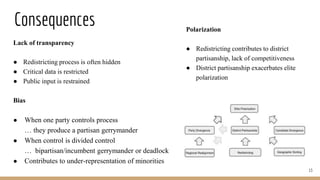
Lack of transparency
● Redistricting process is often hidden
● Critical data is restricted
● Public input is restrained
Bias
● When one party controls process
… they produce a partisan gerrymander
● When control is divided control
… bipartisan/incumbent gerrymander or deadlock
● Contributes to under-representation of minorities
Polarization
● Redistricting contributes to district
partisanship, lack of competitiveness
● District partisanship exacerbates elite
polarization
Reasons for Hope
14
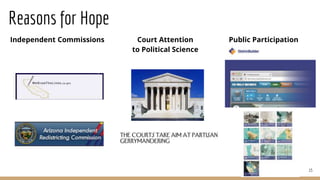
Reasons for Hope
15
Independent Commissions Court Attention
to Political Science
Public Participation
Backmatter
16
Selected Bibliography
17
Articles
● Altman, M. and McDonald, M., 2015. Redistricting and Polarization. American Gridlock, pp.45-67.
● Altman M, McDonald M. The promise and perils of computers in redistricting. Duke J. Const. L. & Pub. Pol'y. 2010;5:69.
● Levitt, Justin. "A citizen's guide to redistricting." (2008). <https://papers.ssrn.com/sol3/papers.cfm?abstract_id=1647221>
● Altman M, MacDonald K, McDonald M. From crayons to computers: The evolution of computer use in redistricting. Social
Science Computer Review. 2005 Aug;23(3):334-46.
Websites
● Ballotpedia: https://ballotpedia.org/
● All about redistricting: http://redistricting.lls.edu/
● United states Election Project: http://www.electproject.org/
18
informatics.mit.edu
Questions?
Appendices
19

Redistricting in the US -- An Overview

  • 1.
    Redistricting – A USPerspective Micah Altman Director of Research MIT Libraries Prepared for International Seminar on Electoral Districting National Electoral Institute Mexico City, Mexico May 2018
  • 2.
    Disclaimers These opinions areour own, they are not the opinions of our institutions, of any of the project funders, nor (with the exception of co-authored previously published work) my collaborators. Secondary disclaimer: “It’s tough to make predictions, especially about the future!” -- Attributed to Woody Allen, Yogi Berra, Niels Bohr, Vint Cerf, Winston Churchill, Confucius, Disreali [sic], Freeman Dyson, Cecil B. Demille, Albert Einstein, Enrico Fermi, Edgar R. Fiedler, Bob Fourer, Sam Goldwyn, Allan Lamport, Groucho Marx, Dan Quayle, George Bernard Shaw, Casey Stengel, Will Rogers, M. Taub, Mark Twain, Kerr L. White, etc. 2
  • 3.
    Collaborators, Co-conspirators, andSupporters Michael P. McDonald, Eric Magar, Allejandro Trelles We thank the Sloan Foundation for research support. 3
  • 4.
  • 5.
  • 6.
    Redistricting Across theUS - Commonalities 6 Synchronized ● National government funds decadal census ● Redistricting follows the census Baselined ● Use same population counts ● Use census block boundaries Single Member Plurality Districts All congressional districts (and almost all state districts)… ● Contain a single seat ● Use plurality rule
  • 7.
    Common Redistricting Criteria 7 PopulationConstraints ● Seats for each state are proportional to population (however, each state elect two Senators at-large) ● Within states, each district must have equal population ● Population is measured with Census total population ● Only minimal deviations are allowed at national level Permissible Goals ● Quality of representation ● Partisan advantage (but not too much) ● Incumbency protection (but not too much) Minority Representation Requirements Majority-minority districts must be created… ● When voting is polarized, and … ● Minority large enough to elect candidate-of-choice and … ● …minority populations are compact
  • 8.
    State-Based Decentralized Approach 8 Eachstate … ● … creates boundaries for its state officials ● … creates the boundaries for its National representatives ● … uses a different process Processes vary in .. ● … political control ● … timing ● … additional data used ● … criteria ● … transparency ● … participation
  • 9.
    State-By-State Considerations 9 Compactness L/WProjections Compactness P2/A Scaling Legal Contiguity Submission ● Who? ● When? ● In what format? Data ● Required adjustments ● Prohibited information ● Access to additional information District requirement ● Geography: compactness, contiguity ● Political alignment: political boundaries, nesting, residency ● Continuity: retention of district cores, incumbent residency ● Communities of interests
  • 10.
  • 11.
    Challenges 11 Politicization ● State legislaturedraws lines ● Conflict of interest ● Self-dealing ● National government funds and pressures Census Contention ● Frequent court battles over redistricting ● Regular media attention Election Administration ● Wide variation in resources ● Wide variation in dissemination ● Lack of integration with elections processes
  • 12.
  • 13.
    Consequences 13 Lack of transparency ●Redistricting process is often hidden ● Critical data is restricted ● Public input is restrained Bias ● When one party controls process … they produce a partisan gerrymander ● When control is divided control … bipartisan/incumbent gerrymander or deadlock ● Contributes to under-representation of minorities Polarization ● Redistricting contributes to district partisanship, lack of competitiveness ● District partisanship exacerbates elite polarization
  • 14.
  • 15.
    Reasons for Hope 15 IndependentCommissions Court Attention to Political Science Public Participation
  • 16.
  • 17.
    Selected Bibliography 17 Articles ● Altman,M. and McDonald, M., 2015. Redistricting and Polarization. American Gridlock, pp.45-67. ● Altman M, McDonald M. The promise and perils of computers in redistricting. Duke J. Const. L. & Pub. Pol'y. 2010;5:69. ● Levitt, Justin. "A citizen's guide to redistricting." (2008). <https://papers.ssrn.com/sol3/papers.cfm?abstract_id=1647221> ● Altman M, MacDonald K, McDonald M. From crayons to computers: The evolution of computer use in redistricting. Social Science Computer Review. 2005 Aug;23(3):334-46. Websites ● Ballotpedia: https://ballotpedia.org/ ● All about redistricting: http://redistricting.lls.edu/ ● United states Election Project: http://www.electproject.org/
  • 18.
  • 19.