Section 3: PRIVACY
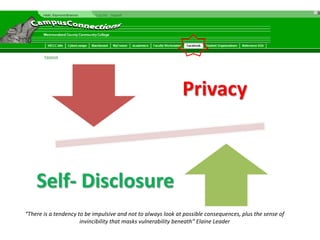
“ There is a tendency to be impulsive and not to always look at possible consequences, plus the sense of invincibility that masks vulnerability beneath” Elaine Leader
“ Educators must recognize that much of young people’s learning with information and communication technologies happens outside of school.”  Julian Sefton-Green ~  Informal Learning with Technology Outside School Digital Divide?  Does Age matter?
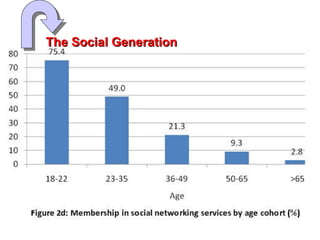
The Social Generation
Mini Generation Gaps “  People two, three or four years apart are having completely different experiences with technology.” College students scratch their heads at what their high school siblings are doing, and they scratch their heads at their younger siblings. It has sped up generational differences.” Lee Rainie, Director of the Pew Research Center’s Internet and American Life Project.
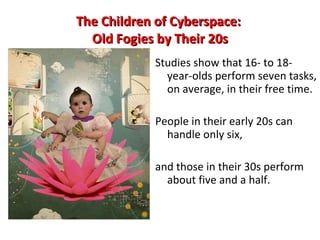
The Children of Cyberspace:  Old Fogies by Their 20s Studies show that 16- to 18-year-olds perform seven tasks, on average, in their free time. People in their early 20s can handle only six,  and those in their 30s perform about five and a half.
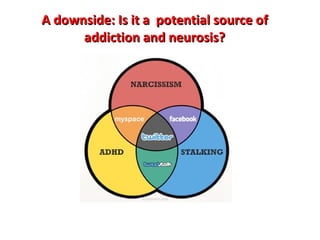
A downside: Is it a  potential source of addiction and neurosis?
Or worse: Student Suing School Over Sexting Scandal http://www.youtube.com/watch?v=uOz82gSa8mA
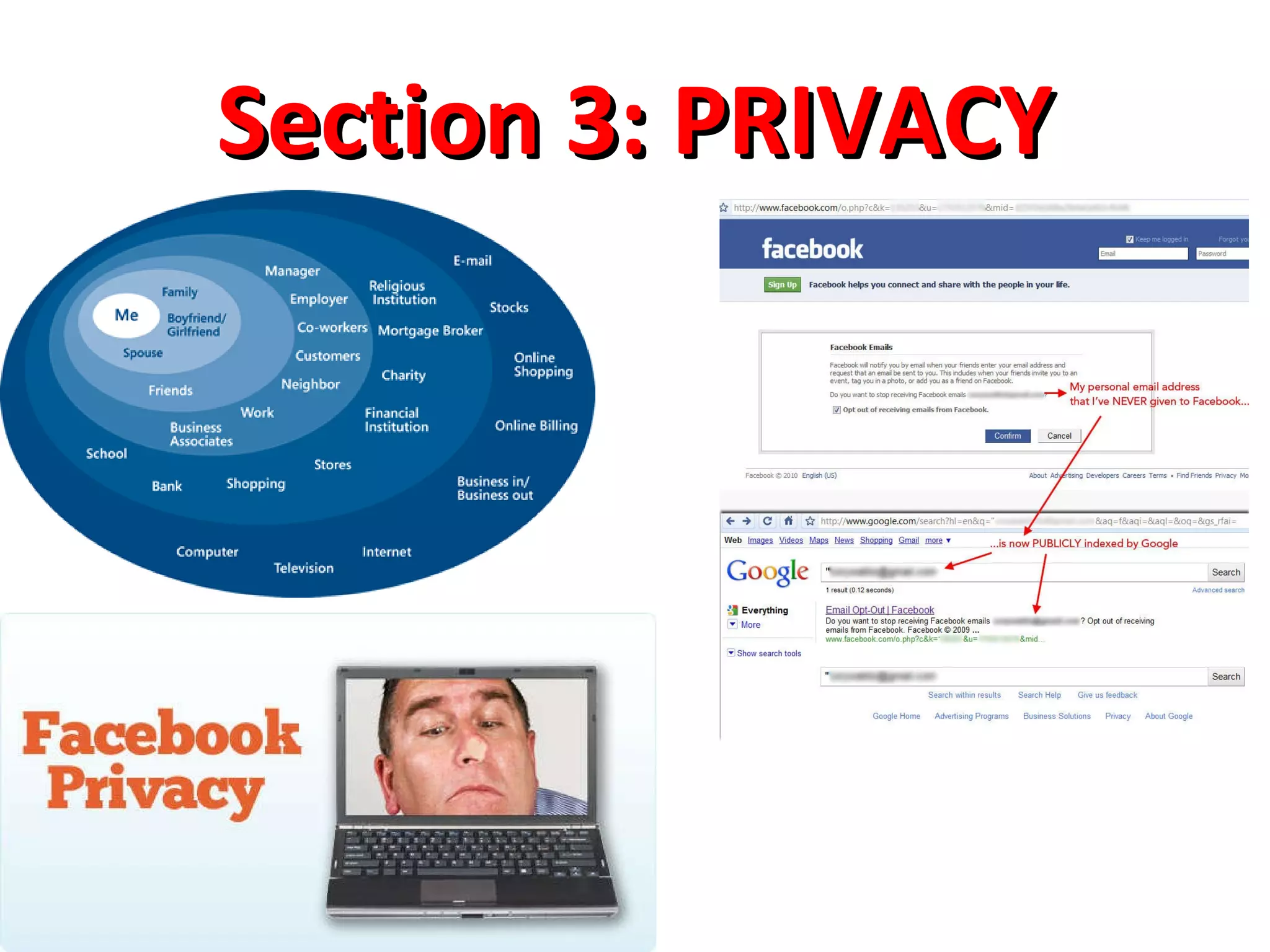
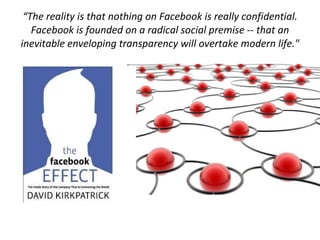
“ The reality is that nothing on Facebook is really confidential. Facebook is founded on a radical social premise -- that an inevitable enveloping transparency will overtake modern life."
The Machine is US/ing Us http://www.youtube.com/watch?v=6gmP4nk0EOE
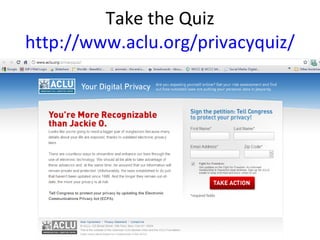
Take the Quiz http://www.aclu.org/privacyquiz/
The Importance of Critical Thinking Skills Youth as actively constructing their social and cultural worlds,  not as innocent victims or passive recipients  of media messages
The active and sociable nature of youth new media engagement argues for an ethnographic approach that  looks at not only the content of media but also the social practices and contexts in which media engagement is embedded.  2010 Poll by common sense Media 85% of parents say they're more concerned about online privacy than they were five years ago. • 91% of parents think that search engines and social networking sites should not be able to share kids' physical location. • 79% of teens think their friends share too much personal information online.
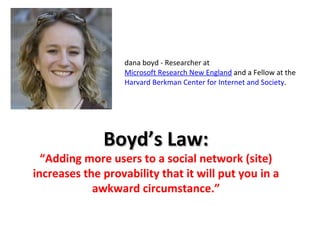
dana boyd - Researcher at  Microsoft Research New England  and a Fellow at the  Harvard Berkman Center for Internet and Society . Boyd’s Law: “ Adding more users to a social network (site) increases the provability that it will put you in a awkward circumstance.”
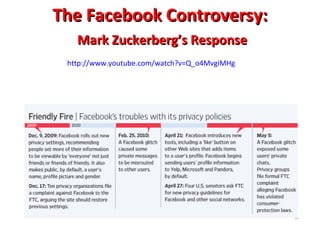
Facebook: The Entire Web Will Be   Social By   Liz Gannes   Apr. 21, 2010   Social plugins   are little widgets that bring Facebook to the rest of the web. They offer  “ instant personalization ”   Creates a  persistent relationship  with you around that content. Sites give Facebook semantic information around the thing you liked  —  for instance, the title, type, genre and city for a band you like on Pandora.   http://www.pandora.com/#/stations/create/
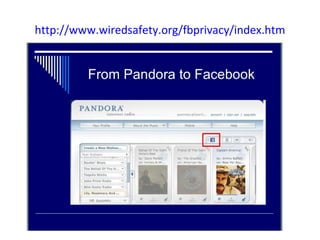
http://www.wiredsafety.org/fbprivacy/index.htm
Privacy Paradox An Oxymoron Young people will freely give up personal information to join social networks on the Internet.  Afterwards, they are surprised when their parents read their journals.  " There's a big difference between publicly available data and publicized data.” Dr.  Dana Boyd,  co-author a newly published book:  Hanging Out, Messing Around, and Geeking Out: Kids Living and Learning with New Media .
 
http://www.microsoft.com/privacy/dpd/default.aspx
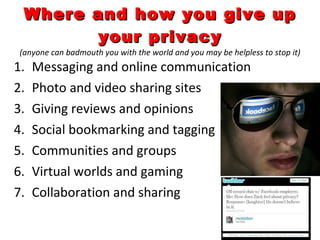
Where and how you give up your privacy (anyone can badmouth you with the world and you may be helpless to stop it) Messaging and online communication Photo and video sharing sites Giving reviews and opinions Social bookmarking and tagging Communities and groups Virtual worlds and gaming Collaboration and sharing
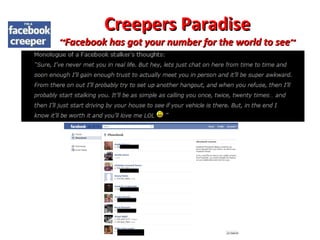
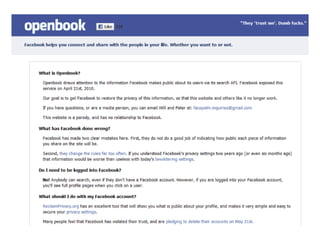
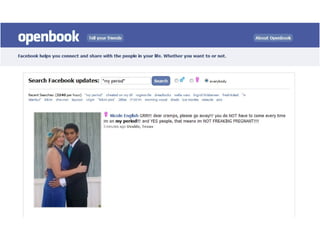
Creepers Paradise ~Facebook has got your number for the world to see~
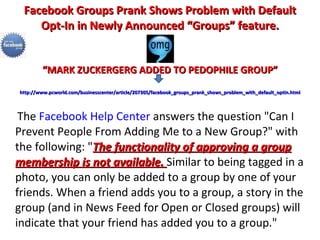
Facebook Groups Prank Shows Problem with Default Opt-In in Newly Announced “Groups” feature. “MARK ZUCKERGERG ADDED TO PEDOPHILE GROUP”   http://www.pcworld.com/businesscenter/article/207305/facebook_groups_prank_shows_problem_with_default_optin.html The  Facebook Help Center  answers the question "Can I Prevent People From Adding Me to a New Group?" with the following: " The functionality of approving a group membership is not available.  Similar to being tagged in a photo, you can only be added to a group by one of your friends. When a friend adds you to a group, a story in the group (and in News Feed for Open or Closed groups) will indicate that your friend has added you to a group."
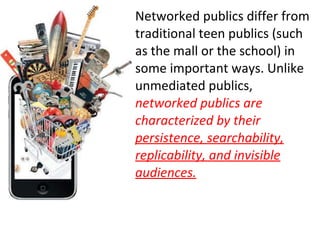
Networked publics differ from traditional teen publics (such as the mall or the school) in some important ways. Unlike unmediated publics,  networked publics are characterized by their  persistence, searchability, replicability, and invisible audiences.
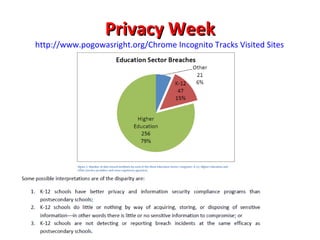
How Safe Are we Safe in our Schools? http://www.jcampana.com/JCampanaDocuments/EducationSectorDataBreachStudy.pdf This study was presented in part at the 2008 Association of School Business Officials International Annual Meeting, Denver, CO, November 2008. Education-related organizations account for nearly one-third, 31%, of all the data breach incidents reported in U.S ., although the Education Sector makes up 0.6% (at least) to 13% (at most) of all entities in the U.S. Education-related organizations reported more than 12.4 million student and consumer profiles have been compromised in 324 breach incidents, which account for more than  25% of all profiles  compromised through  “typical” information security breaches.
Privacy Week http://www.pogowasright.org/ Chrome Incognito Tracks Visited Sites Chrome Incognito Tracks Visited Sites
The Facebook Controversy:   Mark Zuckerberg’s Response http://www.youtube.com/watch?v=Q_o4MvgiMHg
 
 
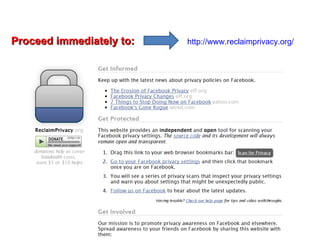
http://www.reclaimprivacy.org/ Proceed immediately to:
Not Google too !#@ http://www.youtube.com/watch?v=yBAAFd-1L4M&feature=related   Google has been Hoovering up data from open WiFi networks around the world --  some 600 gigs' worth, according to the AP  -- which is tantamount to wiretapping and may well violate federal and international laws. When Google sends its fleet of camera-equipped cars into the streets to snap pictures of your neighborhood for its Street View product,  these cars are also collecting something a little extra: The name and unique MAC address of every open WiFi network they encounter along the way.
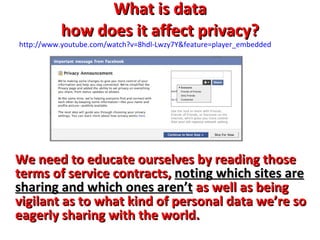
What is data how does it affect privacy? We need to educate ourselves by reading those terms of service contracts,  noting which sites are sharing and which ones aren’t  as well as being vigilant as to what kind of personal data we’re so eagerly sharing with the world.   http://www.youtube.com/watch?v=8hdl-Lwzy7Y&feature=player_embedded
From embarrassing photos to drunken texts,  Facebook users are notorious for sharing too much information.  Will subtle advertising via business check-ins be a step too far though? Source:  http://www.nbcchicago.com/news/tech/Facebook-on-Location-with-McDonalds-93255279.html#ixzz0nWsYglsj
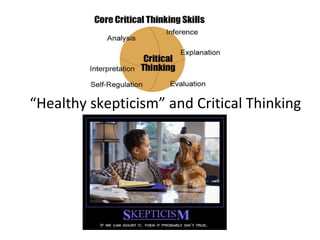
“ Healthy skepticism” and Critical Thinking
 

Hum 140: Social Media: Privacy

  • 1.
  • 2.
    “ There isa tendency to be impulsive and not to always look at possible consequences, plus the sense of invincibility that masks vulnerability beneath” Elaine Leader
  • 3.
    “ Educators mustrecognize that much of young people’s learning with information and communication technologies happens outside of school.” Julian Sefton-Green ~ Informal Learning with Technology Outside School Digital Divide? Does Age matter?
  • 4.
  • 5.
    Mini Generation Gaps“ People two, three or four years apart are having completely different experiences with technology.” College students scratch their heads at what their high school siblings are doing, and they scratch their heads at their younger siblings. It has sped up generational differences.” Lee Rainie, Director of the Pew Research Center’s Internet and American Life Project.
  • 6.
    The Children ofCyberspace: Old Fogies by Their 20s Studies show that 16- to 18-year-olds perform seven tasks, on average, in their free time. People in their early 20s can handle only six, and those in their 30s perform about five and a half.
  • 7.
    A downside: Isit a potential source of addiction and neurosis?
  • 8.
    Or worse: StudentSuing School Over Sexting Scandal http://www.youtube.com/watch?v=uOz82gSa8mA
  • 9.
    “ The realityis that nothing on Facebook is really confidential. Facebook is founded on a radical social premise -- that an inevitable enveloping transparency will overtake modern life."
  • 10.
    The Machine isUS/ing Us http://www.youtube.com/watch?v=6gmP4nk0EOE
  • 11.
    Take the Quizhttp://www.aclu.org/privacyquiz/
  • 12.
    The Importance ofCritical Thinking Skills Youth as actively constructing their social and cultural worlds, not as innocent victims or passive recipients of media messages
  • 13.
    The active andsociable nature of youth new media engagement argues for an ethnographic approach that looks at not only the content of media but also the social practices and contexts in which media engagement is embedded. 2010 Poll by common sense Media 85% of parents say they're more concerned about online privacy than they were five years ago. • 91% of parents think that search engines and social networking sites should not be able to share kids' physical location. • 79% of teens think their friends share too much personal information online.
  • 14.
    dana boyd -Researcher at  Microsoft Research New England  and a Fellow at the  Harvard Berkman Center for Internet and Society . Boyd’s Law: “ Adding more users to a social network (site) increases the provability that it will put you in a awkward circumstance.”
  • 15.
    Facebook: The EntireWeb Will Be   Social By   Liz Gannes   Apr. 21, 2010 Social plugins   are little widgets that bring Facebook to the rest of the web. They offer “ instant personalization ” Creates a persistent relationship with you around that content. Sites give Facebook semantic information around the thing you liked — for instance, the title, type, genre and city for a band you like on Pandora. http://www.pandora.com/#/stations/create/
  • 16.
  • 17.
    Privacy Paradox AnOxymoron Young people will freely give up personal information to join social networks on the Internet. Afterwards, they are surprised when their parents read their journals. " There's a big difference between publicly available data and publicized data.” Dr. Dana Boyd, co-author a newly published book:  Hanging Out, Messing Around, and Geeking Out: Kids Living and Learning with New Media .
  • 18.
  • 19.
  • 20.
    Where and howyou give up your privacy (anyone can badmouth you with the world and you may be helpless to stop it) Messaging and online communication Photo and video sharing sites Giving reviews and opinions Social bookmarking and tagging Communities and groups Virtual worlds and gaming Collaboration and sharing
  • 21.
    Creepers Paradise ~Facebookhas got your number for the world to see~
  • 22.
    Facebook Groups PrankShows Problem with Default Opt-In in Newly Announced “Groups” feature. “MARK ZUCKERGERG ADDED TO PEDOPHILE GROUP” http://www.pcworld.com/businesscenter/article/207305/facebook_groups_prank_shows_problem_with_default_optin.html The  Facebook Help Center  answers the question "Can I Prevent People From Adding Me to a New Group?" with the following: " The functionality of approving a group membership is not available. Similar to being tagged in a photo, you can only be added to a group by one of your friends. When a friend adds you to a group, a story in the group (and in News Feed for Open or Closed groups) will indicate that your friend has added you to a group."
  • 23.
    Networked publics differfrom traditional teen publics (such as the mall or the school) in some important ways. Unlike unmediated publics, networked publics are characterized by their persistence, searchability, replicability, and invisible audiences.
  • 24.
    How Safe Arewe Safe in our Schools? http://www.jcampana.com/JCampanaDocuments/EducationSectorDataBreachStudy.pdf This study was presented in part at the 2008 Association of School Business Officials International Annual Meeting, Denver, CO, November 2008. Education-related organizations account for nearly one-third, 31%, of all the data breach incidents reported in U.S ., although the Education Sector makes up 0.6% (at least) to 13% (at most) of all entities in the U.S. Education-related organizations reported more than 12.4 million student and consumer profiles have been compromised in 324 breach incidents, which account for more than 25% of all profiles compromised through “typical” information security breaches.
  • 25.
    Privacy Week http://www.pogowasright.org/Chrome Incognito Tracks Visited Sites Chrome Incognito Tracks Visited Sites
  • 26.
    The Facebook Controversy: Mark Zuckerberg’s Response http://www.youtube.com/watch?v=Q_o4MvgiMHg
  • 27.
  • 28.
  • 29.
  • 30.
    Not Google too!#@ http://www.youtube.com/watch?v=yBAAFd-1L4M&feature=related   Google has been Hoovering up data from open WiFi networks around the world --  some 600 gigs' worth, according to the AP  -- which is tantamount to wiretapping and may well violate federal and international laws. When Google sends its fleet of camera-equipped cars into the streets to snap pictures of your neighborhood for its Street View product, these cars are also collecting something a little extra: The name and unique MAC address of every open WiFi network they encounter along the way.
  • 31.
    What is datahow does it affect privacy? We need to educate ourselves by reading those terms of service contracts, noting which sites are sharing and which ones aren’t as well as being vigilant as to what kind of personal data we’re so eagerly sharing with the world. http://www.youtube.com/watch?v=8hdl-Lwzy7Y&feature=player_embedded
  • 32.
    From embarrassing photosto drunken texts, Facebook users are notorious for sharing too much information. Will subtle advertising via business check-ins be a step too far though? Source:  http://www.nbcchicago.com/news/tech/Facebook-on-Location-with-McDonalds-93255279.html#ixzz0nWsYglsj
  • 33.
    “ Healthy skepticism”and Critical Thinking
  • 34.

Editor's Notes

  • #6 According to a survey last year by Pew, teenagers are more likely to send instant messages than slightly older 20-somethings (68 percent versus 59 percent) and to play online games (78 percent versus 50 percent).
  • #7 People two, three or four years apart are having completely different experiences with technology,” said Lee Rainie, director of the Pew Research Center’s Internet and American LifeProject. “College students scratch their heads at what their high school siblings are doing, andthey scratch their heads at their younger siblings. It has sped up generational differences.”
  • #31 Here's something nobody -- including apparently most of the people at Google -- knew until last week. In addition to the SSID and MAC address, Google's WiFi antennas were also siphoning off unencrypted data as it passed through wireless routers and out onto the InterWebs. That could potentially include email, passwords, Facebook or Twitter status updates, Web sites visited -- really, anything not protected by an encrypted SSL (https:) connection.   in terms of the volume of information it possesses about ordinary citizens, it's pretty darned close. In some ways, Google knows more about you than Uncle Sam. And there are far fewer rules restricting what it's allowed to do with this information.